
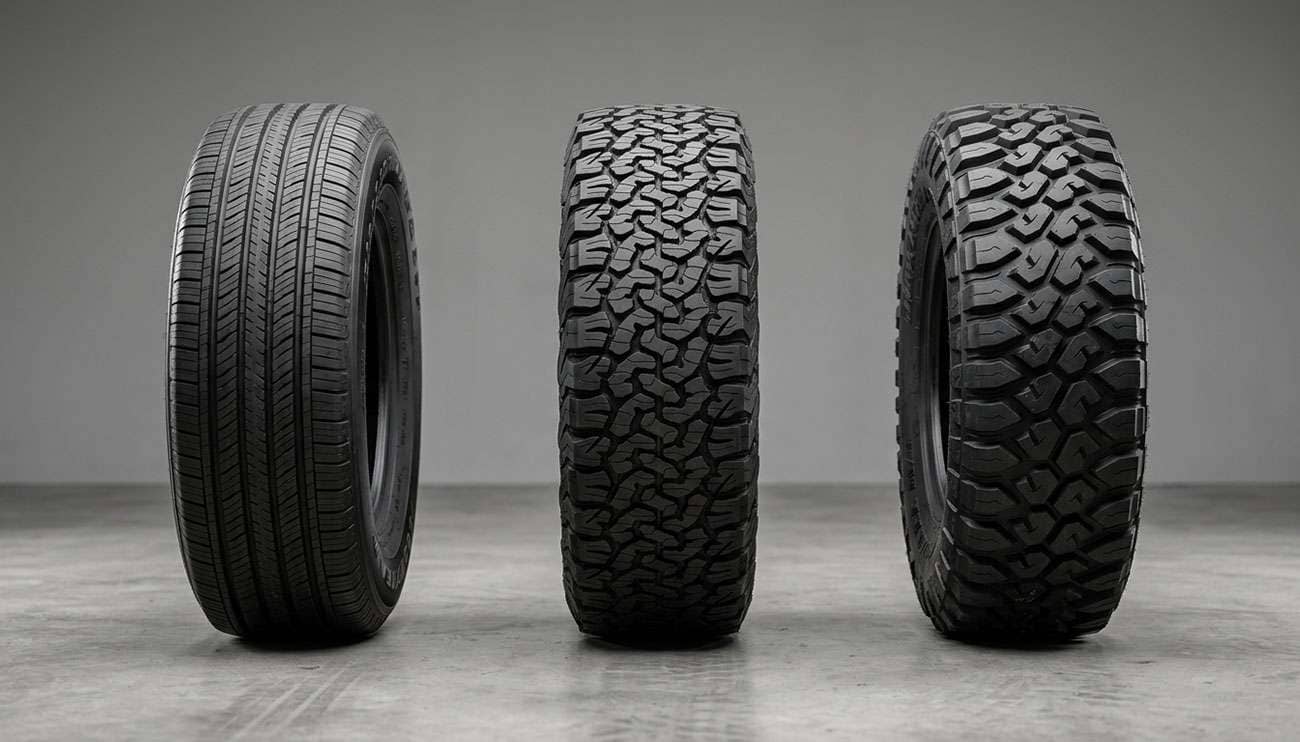
Here's a number I want you to think about: roughly 80% of trucks and SUVs on American roads never leave the pavement. Not once. The truck might look ready for the Rubicon Trail, but its biggest adventure is the gravel parking lot at the lake. I'm not judging — I'm just telling you the truth because it matters when you're about to spend $1,000 to $2,000 on a set of off-road tires.
The off-road tire market has three main categories: highway terrain (HT), all-terrain (AT), and mud-terrain (MT). Each one is engineered for a specific balance of on-road comfort and off-road capability. Picking the wrong category doesn't just waste money — it makes your truck louder, thirstier, and worse at the thing you actually do with it most. So let me walk you through all three, tell you what each one is genuinely good at, and help you make the honest choice.
Before we talk about tires, answer one question: what does your truck actually do during a normal week? Not what you wish it did. Not what you plan to do someday. What it does right now, Monday through Sunday.
If the answer is commuting, errands, towing, highway driving, and maybe the occasional dirt road to a campsite — you're an HT or light AT buyer. If you're hitting fire roads, forest service trails, unpaved ranch roads, and moderate off-road terrain on a regular basis — you're a solid AT buyer. If you're crawling over rocks, plowing through deep mud, or running trails where a tow strap is standard equipment — then and only then are you an MT buyer.
Most people are in the first category. And there's nothing wrong with that. Let me show you why the right tire for that use case is actually a great tire.
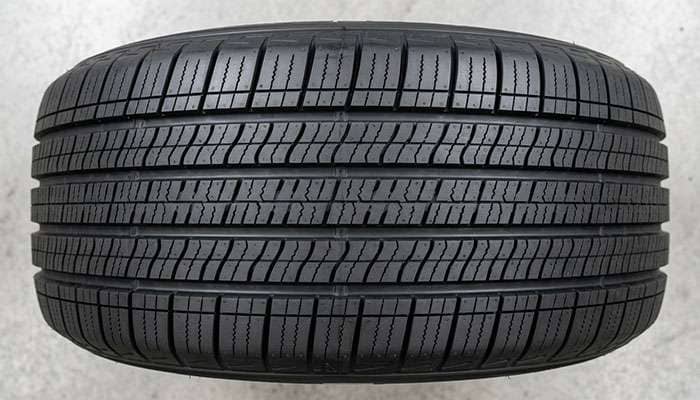
Highway terrain tires are what come on most new trucks and SUVs from the factory. They have tight, closed tread patterns with continuous ribs that maximize road contact. The result is a tire that's quiet on the highway, delivers excellent fuel economy, provides strong wet traction on paved roads, and lasts a long time — 60,000 to 80,000 miles on many models.
The knock on HT tires is that they're "boring." They don't have aggressive tread blocks. They don't look tough parked next to a Jeep on 35-inch mud tires. But what they do, they do better than any other category: they make your daily-driven truck comfortable, efficient, and predictable on the roads you actually drive.
The Falken Wildpeak H/T02 is our top pick in this category — it's quiet, handles well in rain, and carries a 70,000-mile treadwear warranty. The Cooper Discoverer SRX LE and Hankook Dynapro HPX are also excellent choices if you want a highway tire that doesn't completely give up when the pavement ends. Modern HT tires have gotten significantly better on light off-road surfaces like gravel, packed dirt, and wet grass compared to the highway tires of ten years ago.
Your truck is a daily driver. You tow a boat or trailer regularly. You want maximum highway comfort and fuel economy. Your off-road exposure is limited to gravel roads, unpaved parking areas, and the occasional campsite access road. You value tread life and low noise over rugged looks.
All-terrain tires are the compromise tire — and I mean that as a compliment. A good AT tire gives you 70-80% of a highway tire's road manners and 70-80% of a mud tire's off-road capability. For the vast majority of truck and SUV owners who actually leave the pavement sometimes — weekend trail rides, hunting land access roads, ski resort parking lots in winter, occasional beach driving — an AT tire is the single best investment you can make.
The tread pattern on an AT is the giveaway. You'll see wider spacing between tread blocks than an HT, with deeper grooves and more aggressive shoulder lugs that wrap around the sidewall. Those shoulder lugs are what give ATs their edge in loose surfaces — they bite into gravel, sand, and light mud when the tire drops into ruts or deforms over obstacles. The wider grooves evacuate mud and snow more effectively than an HT's tight rib pattern.
The trade-off is noise and tread life. An AT tire will be noticeably louder on the highway than an HT — some models more than others, but you'll always hear the difference. Tread life typically drops to the 40,000-60,000-mile range depending on the tire and how you drive. And fuel economy takes a small hit, usually 1-2 MPG, because of the more aggressive tread compound and heavier construction.
The BFGoodrich All-Terrain T/A KO3 just replaced the legendary KO2 and it's already the bestseller in this category — tougher sidewalls, better wet traction, and a 50,000-mile warranty. The Falken Wildpeak A/T4W is our pick for the quietest AT on the market while still delivering real off-road chops. The Toyo Open Country A/T III splits the difference with excellent wet performance and a ride quality that surprises people coming from highway tires. And the Nitto Terra Grappler G3 is a strong contender if you want a tire that leans slightly more toward on-road refinement while maintaining solid trail capability.
You drive on pavement 70-80% of the time but regularly encounter dirt roads, gravel, packed trails, or moderate off-road conditions. You want a tire that can handle snow and light mud without swapping to a dedicated winter tire. You're willing to accept a small increase in road noise and a modest reduction in fuel economy for genuine all-surface versatility. You want your truck to look like it actually goes places.
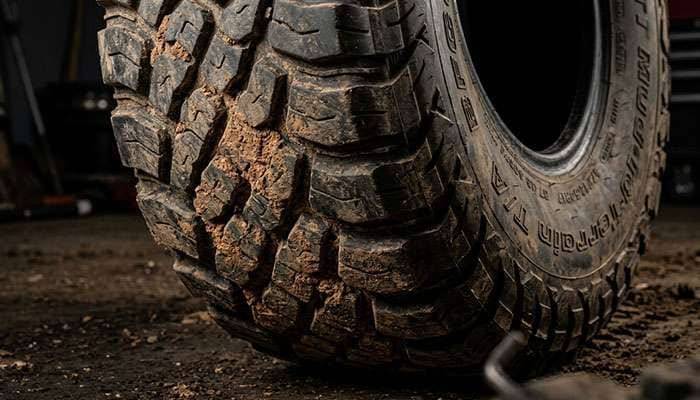
Mud-terrain tires are purpose-built weapons. The tread blocks are massive. The voids between them are deep and wide — sometimes an inch or more. The sidewall lugs are pronounced enough to function as additional traction surfaces when the tire is aired down over rocks. Everything about an MT tire is designed to claw through the worst terrain nature can throw at it: deep mud, loose rock, sand, and surfaces where a highway tire would spin helplessly.
But here's what the marketing photos don't tell you: mud-terrain tires are miserable on the highway. They're loud — not "slightly louder," genuinely loud. The aggressive tread pattern creates a constant hum that increases with speed. They wear faster — 25,000 to 40,000 miles is typical. They reduce fuel economy by 2-4 MPG compared to highway tires. They hydroplane more easily in heavy rain because the wide voids that evacuate mud also reduce the tire's contact patch on wet pavement. And they ride harder because of the stiffer sidewall construction needed for off-road durability.
None of that matters if you actually need them. A truck that's running technical trails, doing recovery work, or operating in genuine backcountry conditions needs an MT tire the same way a race car needs race tires. The capability difference over an AT in serious off-road conditions is enormous. But if you're putting MTs on a truck that spends 90% of its life on I-10, you're paying more for a worse daily driving experience.
The Nitto Trail Grappler M/T is the gold standard — incredible off-road traction with a tread pattern that's somewhat more civilized on-road than most MTs. The Mickey Thompson Baja Boss M/T is the aggressive choice — built for competition-grade off-roading with the deepest tread voids and most aggressive sidewall lugs in the category. The Falken Wildpeak M/T01 delivers serious off-road capability at a price point that undercuts the big names.
You run technical trails, deep mud, or rock crawling regularly — not occasionally, regularly. You're willing to accept significant highway noise, reduced tread life, and lower fuel economy as the cost of maximum off-road capability. You have a dedicated trail rig or a truck that genuinely splits time between serious off-road use and highway driving. You air down to 15-20 PSI on trails and need a sidewall that can take a beating.
There's a fourth category that's grown enormously in the last few years, and it deserves its own mention: rugged terrain (RT) tires. These sit exactly between AT and MT — more aggressive than an all-terrain, more civilized than a mud-terrain. They've become the fastest-growing segment in the truck tire market for good reason.
The Nitto Ridge Grappler is the tire that defined this category. It has an aggressive enough tread pattern to handle moderate mud, rocks, and sand, but the tread blocks are close enough together that highway noise stays manageable and tread life remains reasonable — 40,000-50,000 miles for most drivers. The Cooper Discoverer Rugged Trek is another strong option in this space.
If you're torn between AT and MT, rugged terrain is probably your answer. You get the look and most of the off-road capability of an MT without the daily-driving penalties.
Factor |
Highway Terrain (HT) |
All-Terrain (AT) |
Mud-Terrain (MT) |
|---|---|---|---|
Highway Comfort |
Excellent — quiet and smooth |
Good — slight road noise increase |
Poor — noticeably loud |
Fuel Economy Impact |
Best in class |
1-2 MPG reduction |
2-4 MPG reduction |
Tread Life |
60,000-80,000 miles |
40,000-60,000 miles |
25,000-40,000 miles |
Wet Pavement Traction |
Excellent |
Good |
Fair — wider voids reduce contact |
Gravel / Dirt Roads |
Adequate |
Excellent |
Excellent |
Mud Performance |
Poor |
Moderate |
Excellent — self-cleaning tread |
Rock Crawling |
Not recommended |
Light to moderate |
Excellent — reinforced sidewalls |
Snow Performance |
Fair — summer compound limits grip |
Good — many carry 3PMSF rating |
Fair — depends on model |
Aggressive Look |
No — smooth, conservative tread |
Moderate — visible tread blocks |
Maximum — deep lugs, bold sidewall |
Price Per Tire (avg) |
$130-$220 |
$170-$300 |
$220-$400+ |
Forget what looks cool in the parking lot. Ask yourself three questions:
How much of my driving is off-road? If it's under 10%, highway terrain is your best bet. If it's 10-30%, all-terrain is the sweet spot. If it's over 30% on genuinely challenging terrain, mud-terrain or rugged terrain earns its keep.
What's the worst surface I'll encounter? If the answer is gravel roads and grass, HT handles that fine. Packed dirt trails, moderate sand, light snow? AT covers it. Deep mud, rock shelves, river crossings? That's MT territory.
Do I care about highway noise and fuel economy? If yes — and most daily drivers should — every step up the aggression ladder costs you. An MT tire on a commuter truck is spending money to make your truck louder and thirstier for capability you may never use.
Still not sure? Browse our full all-terrain tire selection or call us at 888-926-2689. Tell us what you drive and how you use it — we'll match you to the right category and the right tire within ten minutes.
Yes, modern all-terrain tires are designed to be daily driven. Top models like the BFGoodrich KO3 and Falken Wildpeak A/T4W ride comfortably on the highway, handle well in rain, and carry treadwear warranties of 50,000+ miles. You'll notice slightly more road noise and a small fuel economy reduction compared to highway terrain tires, but for most drivers the difference is minimal. If you need a tire that handles both your commute and weekend adventures, all-terrain is the category that was built for exactly that scenario.
Significantly louder. Most mud-terrain tires add 5-10 decibels of interior cabin noise compared to a highway terrain tire at highway speeds. That's a noticeable and constant hum that many daily drivers find fatiguing on long trips. Some MT models are better than others — the Nitto Trail Grappler is one of the quieter options in the category — but no MT tire will match the silence of an HT or even a good AT. If highway noise bothers you, consider a rugged terrain tire as a compromise.
Many modern all-terrain tires carry the Three-Peak Mountain Snowflake (3PMSF) symbol, which means they've passed standardized snow traction testing. Tires like the BFGoodrich KO3, Falken Wildpeak A/T4W, and Toyo Open Country A/T III all have the 3PMSF rating and perform well in moderate snow conditions. They won't match a dedicated winter tire in deep snow or on ice, but for areas that see occasional winter weather, a 3PMSF-rated AT tire eliminates the need for seasonal tire swaps for many drivers.
Rugged terrain (RT) tires are a relatively new category that sits between all-terrain and mud-terrain. They have a more aggressive tread pattern than an AT — with larger, more widely spaced tread blocks and more prominent sidewall lugs — but maintain enough tread density to keep highway noise and wear rates closer to AT levels. The Nitto Ridge Grappler is the tire that popularized this category. RTs are ideal for truck owners who want an aggressive look and moderate off-road capability without the daily-driving penalties of a full mud-terrain tire.
Yes, but the degree depends on the tire category. Highway terrain tires have the lowest rolling resistance and best fuel economy. All-terrain tires typically reduce fuel economy by 1-2 MPG due to their more aggressive tread compound and slightly heavier construction. Mud-terrain tires can reduce fuel economy by 2-4 MPG because of their deep tread voids, stiffer compounds, and significantly heavier weight. Over a year of typical driving, the fuel cost difference between HT and MT can be $200-$500 depending on fuel prices and how much you drive.
You can, and many people do — mainly for the look and the added confidence in bad weather. A modern AT tire on a Jeep Grand Cherokee or Toyota 4Runner gives the vehicle a more capable, rugged appearance and provides noticeably better traction in snow, gravel, and wet grass compared to the factory highway tires. Just understand you're trading some highway refinement and tread life for capability you may not use. If aggressive looks and all-weather confidence are worth those trade-offs to you, it's a perfectly reasonable choice.



