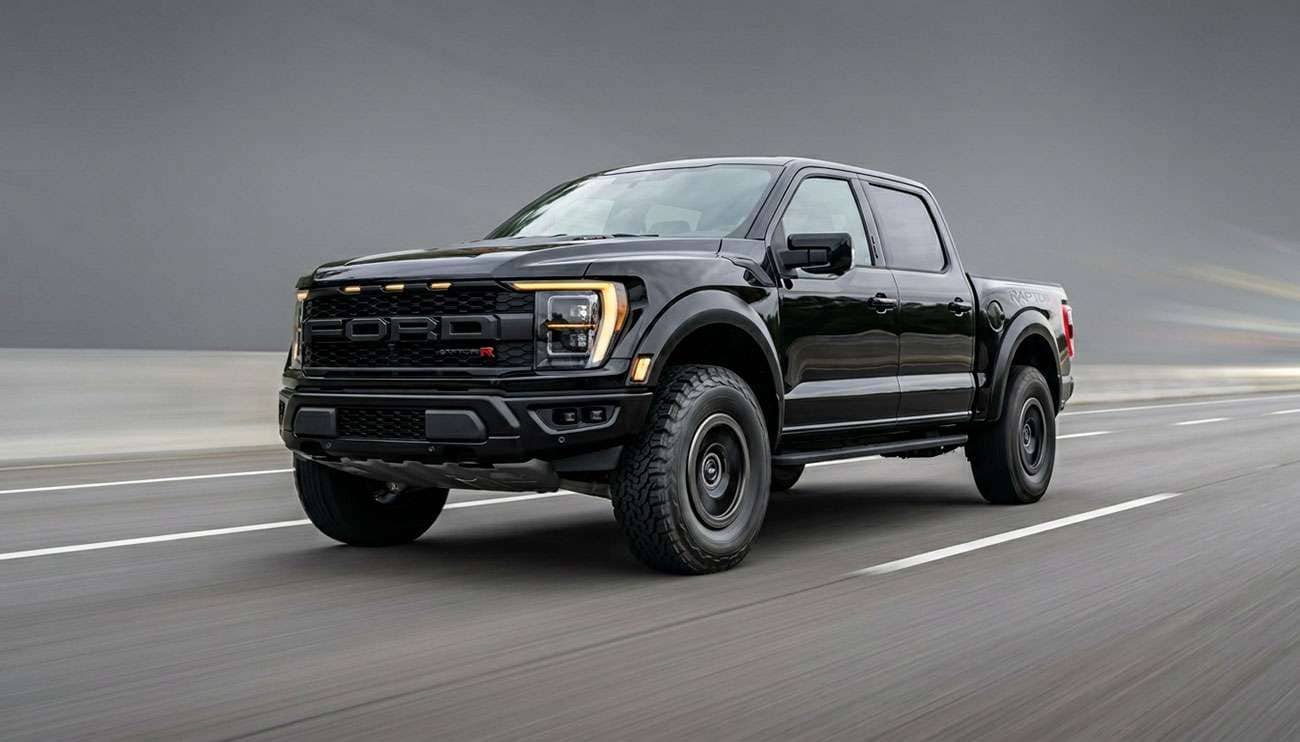
I get some version of this question every week: "I want off-road tires on my truck, but it's my daily driver — is that a problem?" The answer is yes, no, and it depends. That's not a cop-out. It's because "off-road tires" covers three very different categories, and each one has a completely different impact on your daily driving experience. Let me give you the honest, data-backed answer.
All-terrain tires? Absolutely — modern ATs are designed to be daily driven and do it well. Rugged-terrain tires? Yes, with minor trade-offs in noise and fuel economy. Mud-terrain tires? You can, but the penalties are significant enough that most daily drivers regret it within six months.
The longer answer requires looking at exactly what changes when you swap from the highway tires your truck came with to something more aggressive. The differences are measurable, and once you see the numbers, the right choice for your situation becomes obvious.
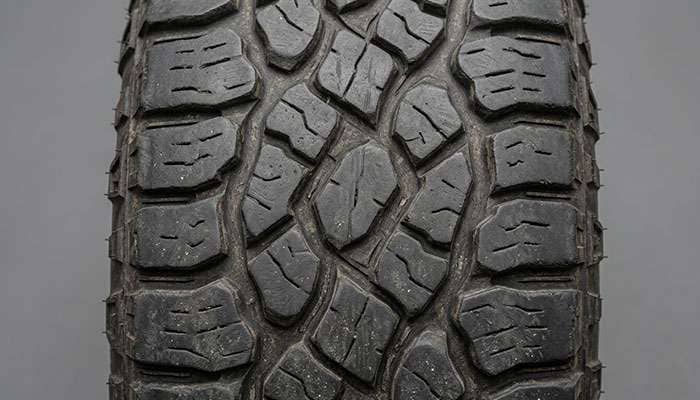
Pavement is an off-road tire's worst enemy. That sounds counterintuitive — pavement is smooth, predictable, and consistent. But that's exactly the problem. Off-road tires are engineered for irregular surfaces where the tread blocks need to flex, deform, and grip independently. On flat pavement, those same blocks scrub against a uniformly hard surface at highway speed, generating heat and wearing down faster than they would on dirt or gravel.
Here's what happens to each category when it lives on pavement full-time:
The softer rubber compounds that give off-road tires their grip on loose surfaces wear faster on asphalt. Mud-terrain tires daily-driven exclusively on pavement can wear out in as few as 20,000 miles — half their rated potential. All-terrain tires hold up significantly better, typically delivering 40,000-55,000 miles in daily highway use because their compounds are formulated for mixed-surface duty.
Off-road tread patterns create road noise. Period. The wider the voids between tread blocks, the louder the tire on pavement. All-terrain tires add 2-4 decibels of cabin noise compared to highway tires — noticeable but tolerable for most people. Mud-terrain tires add 6-10 decibels, which is the difference between a quiet conversation and a loud restaurant. That hum is there on every highway mile, every commute, every road trip. It gets old.
Heavier tires with more aggressive tread patterns create more rolling resistance. The engine burns more fuel to maintain the same speed. On a truck averaging 20 MPG on highway tires, you can expect 18-19 MPG on all-terrains and 16-18 MPG on mud-terrains. Over 15,000 miles of annual driving at $3.50 per gallon, that's roughly $130-$275 more per year on all-terrains and $290-$650 more on mud-terrains.
Here's how each off-road tire category performs across the metrics that matter most for daily driving:
Daily Driving Factor |
All-Terrain (AT) |
Rugged Terrain (RT) |
Mud-Terrain (MT) |
|---|---|---|---|
Road Noise |
Slight increase — 2-4 dB above HT |
Moderate increase — 4-6 dB above HT |
Significant — 6-10 dB above HT |
Ride Comfort |
Good — close to highway tire |
Slightly firm |
Noticeably harsh on rough pavement |
Wet Pavement Braking |
Good — comparable to HT |
Adequate |
Longer stopping distances |
Fuel Economy Impact |
–1 to –2 MPG |
–1.5 to –2.5 MPG |
–2 to –4 MPG |
Tread Life (daily pavement) |
40,000–55,000 miles |
35,000–45,000 miles |
20,000–35,000 miles |
Snow / Ice Performance |
Good — many carry 3PMSF rating |
Fair — varies by model |
Poor — voids pack with snow |
Daily Driver Rating |
Excellent — designed for this |
Good — acceptable trade-offs |
Poor — significant compromises |
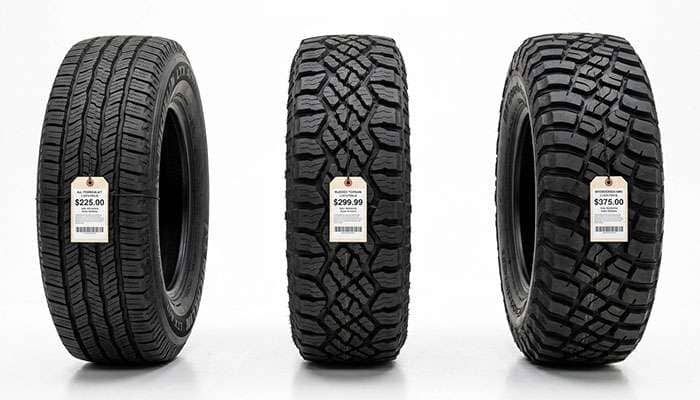
Here's the annual cost comparison for a truck owner driving 15,000 miles per year, based on average tire prices and real-world fuel economy data:
Highway Terrain baseline: Tires: $720 per set lasting 70,000 miles = $154/year in tire cost. Fuel: 20 MPG × 15,000 miles × $3.50/gal = $2,625/year. Total: $2,779/year.
All-Terrain: Tires: $1,000 per set lasting 50,000 miles = $300/year. Fuel: 18.5 MPG × 15,000 miles × $3.50/gal = $2,838/year. Total: $3,138/year. Extra cost vs HT: $359/year.
Mud-Terrain: Tires: $1,280 per set lasting 30,000 miles = $640/year. Fuel: 17 MPG × 15,000 miles × $3.50/gal = $3,088/year. Total: $3,728/year. Extra cost vs HT: $949/year.
All-terrain tires cost about a dollar a day more than highway tires. That's a very reasonable price for genuine all-surface capability and a tougher, more capable look. Mud-terrain tires cost nearly $1,000 more per year — real money that only makes sense if you're using the off-road capability they provide.
You own a truck or SUV that sees any combination of gravel roads, unpaved parking, camping access roads, seasonal snow, or occasional light trails. You want all-weather confidence without swapping to winter tires. You like the look and the added capability even if you don't use it every week. The small increase in noise and fuel cost is worth the peace of mind. This describes the majority of truck and SUV owners, which is why all-terrain tires are the fastest-growing tire category in the market.
Your truck spends 90%+ of its time on pavement. You drive in areas with frequent rain, snow, or ice — mud-terrain tires have poor wet and winter traction on paved surfaces. You care about interior cabin noise on highway commutes. You want to maximize tread life and fuel economy. You're on a budget and can't afford to replace tires twice as often. The only scenario where daily driving on MTs makes genuine sense is if your daily commute includes serious off-road terrain — unpaved ranch roads, construction sites, or regularly muddy access routes — and you can't justify owning a second set of wheels and tires.
If you genuinely need MT capability on the weekends but daily drive on pavement during the week, consider owning two sets of wheels and tires — highway or all-terrain tires on one set of wheels for daily use, mud-terrains on a second set for trail days. Swapping wheels takes 30 minutes in the driveway with a floor jack. The upfront cost is higher, but both sets last longer because each is being used in its intended environment, and your daily driving experience doesn't suffer. We build wheel and tire packages specifically for this setup.
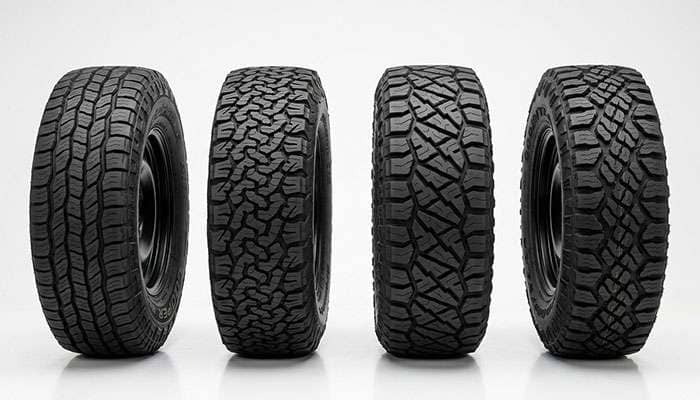
If you've decided to daily drive on off-road tires — and for most truck owners, that means all-terrain — here are the specific tires I recommend for the best daily driving experience:
The Falken Wildpeak A/T4W is the quietest all-terrain I've tested on the highway while still delivering real off-road capability. It carries the 3PMSF winter rating, has a 55,000-mile warranty, and the variable tread block sizing minimizes the harmonic drone that makes other ATs fatiguing on long drives.
The BFGoodrich All-Terrain T/A KO3 leans more aggressive than the Falken but is still a legitimate daily driver. The KO3 improved road noise significantly over the legendary KO2, bumped wet traction up a level, and carries a 50,000-mile warranty. If you want the most off-road capability you can get without crossing into rugged-terrain territory, this is the tire.
The Nitto Ridge Grappler is the best RT tire for mixed daily/trail use. It looks aggressive — closer to an MT visually — but the variable-pitch tread pattern keeps highway noise lower than you'd expect from a tire this aggressive. No treadwear warranty, but real-world reports consistently show 40,000+ miles on mixed-use trucks.
The Toyo Open Country A/T III delivers the smallest fuel economy penalty of any AT I've measured. The tread compound is optimized for low rolling resistance without sacrificing wet grip, and the 65,000-mile warranty is the longest in the AT category. If fuel cost matters — and on a truck driven 15,000+ miles a year it should — this tire pays for the difference.
Browse our full best all-terrain tire selection or call us at 888-926-2689 for a recommendation based on your specific truck and driving pattern.
Yes. Modern all-terrain tires are engineered, tested, and DOT-rated for highway use at full speed. Premium ATs like the BFGoodrich KO3 and Falken Wildpeak A/T4W deliver wet braking distances comparable to highway tires, carry speed ratings appropriate for highway speeds, and many include the Three-Peak Mountain Snowflake rating for winter traction. All-terrain tires are the most popular tire category for trucks and SUVs specifically because they handle highway driving well while adding off-road capability.
All-terrain tires add approximately 2-4 decibels of interior cabin noise compared to highway tires at 65 MPH. Most drivers describe this as a faint background hum that's noticeable when comparing directly but easy to live with. Mud-terrain tires add 6-10 decibels — a significant and constant noise increase that many drivers find fatiguing on commutes longer than 30 minutes. Rugged-terrain tires fall between the two, typically 4-6 decibels above highway tires. Tire model matters: variable-pitch tread designs like the Nitto Ridge Grappler are significantly quieter than uniform-pitch patterns.
Poorly, despite what the aggressive tread suggests. Mud-terrain tires have large, widely spaced tread blocks designed to scoop and eject mud. In snow, those same voids pack tightly with snow and ice, turning the tire into a nearly smooth cylinder with minimal grip. Most MTs also lack the siping (thin slits in the tread) that creates biting edges for ice traction. Very few mud-terrain tires carry the 3PMSF winter rating. For daily driving in areas with winter weather, an all-terrain tire with the 3PMSF designation is a dramatically safer choice.
Installing off-road tires in a size recommended by the tire manufacturer for your vehicle will not void your truck's warranty. However, if you install oversized tires that require a lift kit or suspension modification, and that modification causes a related component to fail, the dealer may deny a warranty claim under the Magnuson-Moss Warranty Act. The tire itself isn't the issue — it's whether the overall modification caused the specific failure. Running factory-size all-terrain or mud-terrain tires on a stock truck will not affect your warranty.
For the quietest daily commute with real off-road capability, the Falken Wildpeak A/T4W is our top recommendation. For maximum off-road capability in an AT package, the BFGoodrich KO3 leads the category. For best fuel economy and longest tread life, the Toyo Open Country A/T III is the winner with its 65,000-mile warranty. All three carry the 3PMSF winter rating and are excellent on wet pavement. The right choice depends on whether you prioritize comfort, capability, or cost of ownership.
Yes, and it's an increasingly popular approach. Many truck owners keep two sets of wheels — one with highway or all-terrain tires for daily driving and one with mud-terrain tires for trail weekends. Mounting complete wheel and tire sets means you can swap in 30 minutes with a floor jack and lug wrench, no tire shop visit needed. Both sets last longer because each is being used in its intended environment. Performance Plus Tire builds complete packages for exactly this purpose — call us at 888-926-2689 and we'll set up both sets matched to your truck.