
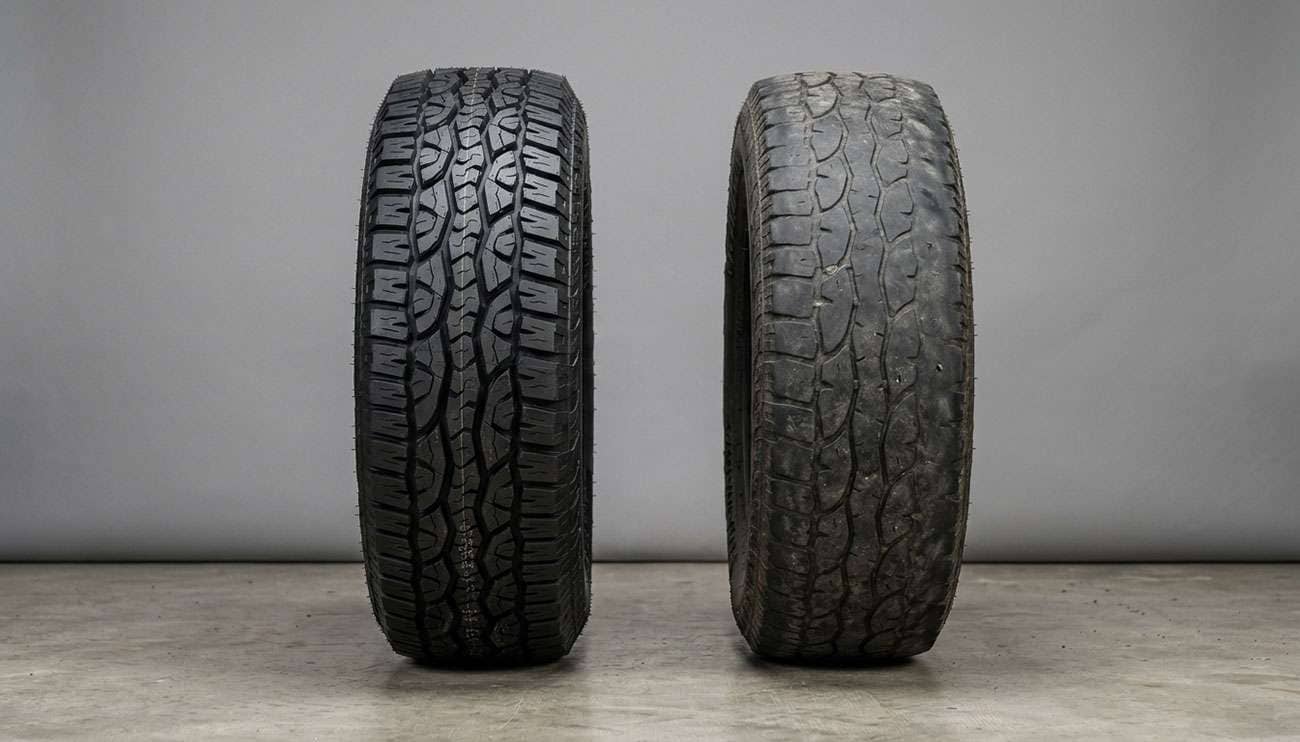
It's the question I hear at least once a day: "How long will these last?" A customer is looking at a set of aggressive all-terrain or mud-terrain tires, they see the price tag, and they want to know if that investment is going to hold up. The answer isn't as simple as a single number — but the data tells a clear story if you know where to look.
Yes, off-road tires wear faster than highway tires. That's not a flaw — it's physics. But how much faster depends on the tire category, the specific model, how you drive, and whether you're doing the basic maintenance that separates a 30,000-mile tire from a 60,000-mile tire. Let me give you the real numbers.
The short answer is that off-road tires wear 20-50% faster than highway terrain tires on pavement. A highway tire that lasts 70,000 miles will outlive an all-terrain that gets 50,000 and a mud-terrain that gets 30,000 under the same driving conditions.
The real answer is more nuanced. Not all off-road tires are created equal. A premium all-terrain like the BFGoodrich KO3 carries a 50,000-mile treadwear warranty and routinely exceeds it in real-world use. A budget mud-terrain with no warranty might be down to the wear bars at 20,000 miles. The category matters, but the specific tire matters more.
Here's what the data shows across the four main off-road tire categories. These numbers represent typical tread life on a mix of 80% highway and 20% off-road driving — which is how most truck owners actually use their tires:
Tire Category |
Typical Tread Life |
Warranty Range |
Starting Tread Depth |
UTQG Treadwear Rating |
|---|---|---|---|---|
Highway Terrain (HT) |
60,000–80,000 miles |
55,000–75,000 miles |
10/32"–11/32" |
600–800 |
All-Terrain (AT) |
40,000–60,000 miles |
40,000–55,000 miles |
12/32"–15/32" |
500–700 |
Rugged Terrain (RT) |
35,000–50,000 miles |
Varies — many have none |
15/32"–17/32" |
Varies widely |
Mud-Terrain (MT) |
25,000–40,000 miles |
Rare — most have none |
18/32"–22/32" |
300–500 (when rated) |
One detail that surprises people: mud-terrain tires start with significantly more tread depth than highway tires. An MT might begin life with 18-22/32" of tread compared to 10-11/32" on an HT. So even though the rubber wears faster per mile, there's more rubber to wear through. That partially offsets the faster wear rate — but not entirely, because the softer compound and aggressive pattern accelerate the rate at which that rubber disappears.
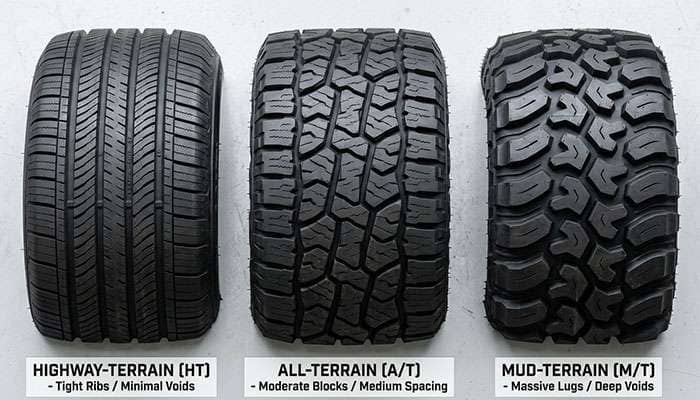
Three engineering factors explain the difference, and understanding them helps you make smarter buying decisions:
Off-road tires use softer rubber compounds than highway tires. Softer rubber conforms better to irregular surfaces — rocks, roots, packed dirt — which gives you grip where a hard compound would slip. But that same softness means the rubber wears away faster against pavement. It's a direct trade-off: more grip equals faster wear. There's no engineering trick that eliminates this relationship.
Highway tires have continuous ribs with small sipes — the contact patch is dense and evenly distributed. Off-road tires break that contact patch into individual tread blocks separated by wide voids. Each block carries more load per square inch than a continuous rib, which means each block wears faster. The more aggressive the pattern (MT > RT > AT > HT), the faster each individual block erodes. Mud-terrain tires have massive blocks with deep voids and very little contact area, which is why they wear fastest of all on pavement.
Off-road tires are heavier than highway tires in the same size — often 5-15 pounds per tire heavier. The reinforced sidewalls, deeper tread, and denser rubber all add mass. Heavier tires create more rolling resistance, which means the engine works harder to turn them. That additional force generates more heat at the contact patch, which accelerates compound wear. It's a cascading effect: more weight → more heat → faster wear.
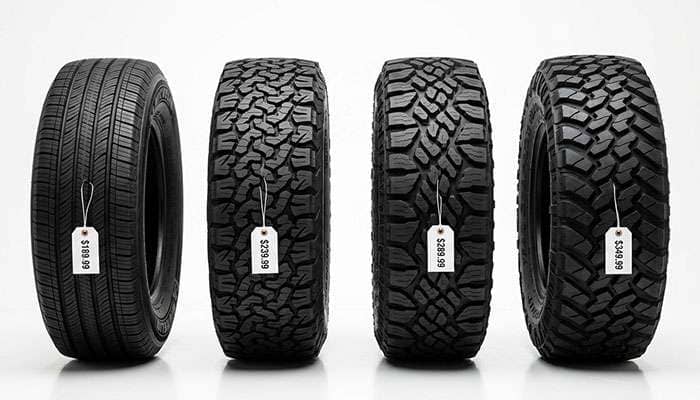
Here's a calculation that changes how a lot of our customers think about tire purchases. The sticker price only tells half the story — cost per mile tells the whole thing:
A set of four highway terrain tires at $180 each ($720 total) lasting 70,000 miles costs you 1.03 cents per mile. A set of four all-terrain tires at $250 each ($1,000 total) lasting 50,000 miles costs you 2.0 cents per mile. A set of four mud-terrain tires at $320 each ($1,280 total) lasting 30,000 miles costs you 4.27 cents per mile.
That means mud-terrain tires cost roughly four times as much per mile as highway tires. All-terrains cost about twice as much. Add the fuel economy penalty — 1-2 MPG for ATs, 2-4 MPG for MTs — and the total cost of ownership gap widens further. None of this means you shouldn't buy off-road tires. It means you should buy the right category for how you actually use your truck and understand the true cost before you commit.
The difference between getting 30,000 miles and 50,000 miles out of a set of all-terrain tires often comes down to five maintenance habits that cost almost nothing:
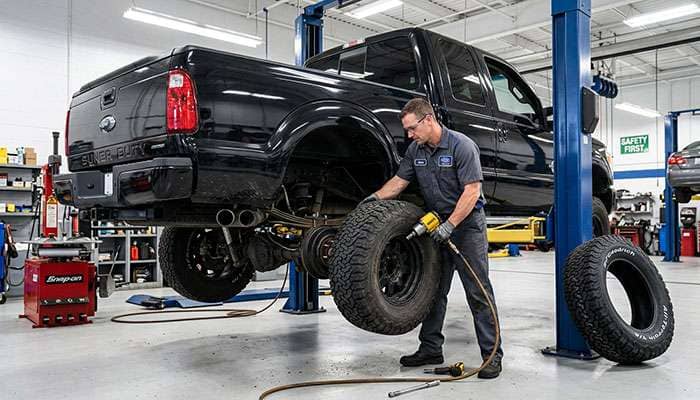
This is the single most impactful thing you can do. Off-road tires with aggressive tread patterns are especially sensitive to uneven wear because each tread block is carrying a disproportionate load. Front tires wear differently than rears due to steering forces. If you run a full-size spare, include it in a five-tire rotation pattern — this alone can add 20% to your total tread life.
Underinflation is the number one killer of off-road tire tread life. A tire running 5 PSI low wears the outer edges of the tread blocks faster than the center, creating uneven wear that shortens life dramatically. Check pressure cold (before driving) at least once a month and after any significant temperature change. If you air down for off-road use, always re-inflate to street pressure before driving on pavement.
Off-road driving is hard on alignment. Hitting rocks, ruts, and uneven terrain shifts toe, camber, and caster settings incrementally. A misaligned truck will chew through tires at an accelerated rate — I've seen mud-terrains lose half their tread life to a bad alignment that the owner never noticed. Check your wheel alignment at least annually, or immediately after any significant off-road impact.
Rocks lodged between tread blocks create pressure points that cause uneven wear and can eventually damage the tread. Mud packed into the voids reduces the tire's self-cleaning ability and adds unbalanced weight. After any serious off-road session, take five minutes to inspect each tire and remove packed debris. A flathead screwdriver works fine for rocks; a pressure washer handles packed mud.
Hard acceleration, hard braking, and aggressive cornering on pavement wear off-road tires faster than they wear highway tires. Those individual tread blocks flex more under lateral and longitudinal load than continuous ribs do, and that flex generates heat that eats compound. Drive your off-road tires smoothly on the highway and save the aggressive inputs for the trail.
The legal minimum tread depth is 2/32" in most states, but off-road tires lose their off-road capability well before they hit that number. Here's what I recommend:
For highway-only use, you can safely run down to 4/32" before wet traction degrades significantly. For mixed use (highway plus moderate off-road), replace at 6/32" — below this point, the tread voids are too shallow to effectively evacuate mud and provide trail traction. For serious off-road use, consider replacing at 8/32" if you need maximum mud and rock performance. At that depth, the tire's self-cleaning capability and sidewall lug engagement are significantly reduced.
Also watch for age regardless of tread depth. Rubber degrades from UV exposure, ozone, and heat over time. Any truck tire older than six years should be inspected carefully for cracking, even if the tread looks fine. Check the DOT date code on the sidewall — the last four digits tell you the week and year of manufacture.
Ready to find your next set? Browse our all-terrain tires, off-road tires, or call us at 888-926-2689 — we'll match you to the right tire for your truck and your driving style.
The BFGoodrich All-Terrain T/A KO3 carries a 50,000-mile treadwear warranty, which is among the longest in the all-terrain category. Real-world reports from drivers who rotate regularly and maintain proper inflation show many KO3 sets exceeding 55,000-60,000 miles on mixed highway and light off-road use. Heavy off-road use or underinflation will reduce that number, but for a tire with this level of off-road capability, the tread life is exceptional.
Most mud-terrain tires do not carry a treadwear warranty. This is because MT tires are classified as Light Truck (LT) tires with specialized off-road applications, and the extreme variability in how they're used makes it impractical for manufacturers to guarantee a specific mileage. Some all-terrain tires in LT ratings also lack treadwear warranties, though many premium AT models now offer them. If treadwear warranty is important to you, it's one more reason to consider an all-terrain or rugged-terrain tire over a mud-terrain.
UTQG treadwear ratings are only assigned to P-metric (passenger) tires — most LT-rated off-road tires are exempt and won't have a rating on the sidewall. When available, look for a treadwear rating of 500-700 for all-terrain tires, which indicates good longevity. Highway terrain tires typically rate 600-800. Mud-terrain tires with ratings usually fall in the 300-500 range. Keep in mind that UTQG ratings are comparative within a manufacturer's lineup and aren't standardized across brands, so use them as a rough guide rather than an absolute measure.
Airing down itself doesn't damage tread life — in fact, it can protect your tires off-road by allowing the tread to conform to irregular surfaces rather than fighting them, which reduces point-loading on individual tread blocks. The problem arises when drivers forget to re-inflate after returning to pavement. Driving on the highway at reduced pressure causes excessive heat buildup in the sidewalls and uneven tread wear across the contact patch. Always carry a portable air compressor and re-inflate to your recommended street pressure before hitting the highway.
Yes. Rugged-terrain tires like the Nitto Ridge Grappler typically deliver 35,000-50,000 miles of tread life — significantly better than most mud-terrain tires while providing more off-road capability than standard all-terrains. The tread blocks are closer together than an MT, which means more contact area on pavement and slower wear rates. If you want the aggressive look and moderate off-road capability of an MT without the 25,000-mile replacement cycle, rugged terrain is the category worth exploring.
Every 5,000-7,000 miles for most off-road tires. If you do significant off-road driving, lean toward the lower end of that range because trail driving creates uneven wear patterns more quickly than highway driving. If your vehicle has a matching full-size spare, use a five-tire rotation pattern — this distributes wear across five tires instead of four, effectively increasing total set life by up to 20%. Keep records of your rotations so you can track wear patterns and catch alignment issues early.



