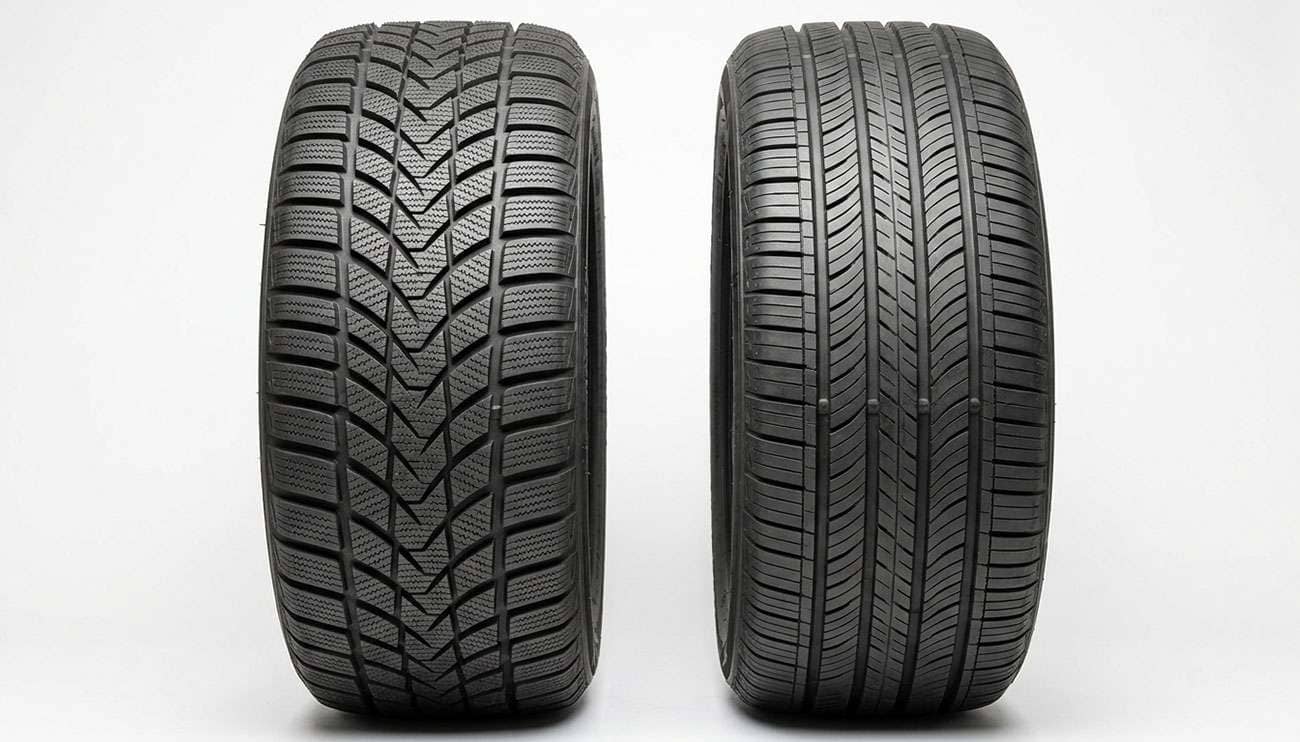
For stopping and turning, yes, every time. For pulling away from a stop and climbing an unplowed hill, AWD on all-season tires still has the edge. Most answers to this question end at "it depends" and never say what it depends on. It depends on which direction you need grip. AWD only adds grip in one direction, forward, and only while your foot is on the gas. Every car already brakes with all four wheels, so for stopping and steering, the rubber is the only thing that changes the number.
Every fall we get the same call from customers shopping winter sets: "I have all-wheel drive. Do I really need these?" It is a fair question, and the honest answer is a table, not a yes or no. Below is that table, the physics behind it, the test numbers, and the exact setup to buy for the roads you actually drive.
Find the job you are asking the car to do, then read across. The winner changes depending on whether you are going, stopping or turning.
What You Need the Car to Do |
AWD + All-Season Tires |
FWD + Winter Tires |
AWD + Winter Tires |
Why |
|---|---|---|---|---|
Pull away from a stop on flat, packed snow |
Good |
Good |
Best |
AWD splits drive torque across four tires; winter tread bites harder per tire |
Climb an unplowed hill from a stop |
Better |
Fair |
Best |
Pure forward traction is the one job AWD was built for |
Stop from highway speed on snow |
Poor |
Good |
Good |
All cars brake on four wheels; only the tire compound and tread change the stop |
Turn at an intersection on packed snow |
Poor |
Good |
Good |
Cornering grip is sideways grip, and AWD adds none |
Stop on glare ice near 32 degrees F |
Very poor |
Fair |
Fair |
Wet ice is the hardest surface there is; siping and soft compound are all you have |
Dry, cold pavement below 45 degrees F |
Fair |
Good |
Good |
All-season rubber stiffens in the cold even with no snow on the road |
Push through 6 inches or more of unplowed snow |
Better |
Fair |
Best |
Momentum through deep snow is a drive-torque problem; ground clearance matters too |
Count the rows. AWD on all-seasons wins two jobs, both of them about getting moving. Winter tires win every job that keeps you out of the car in front of you. That is the whole debate in one table, and it is why the right answer for most snow-belt drivers is not one or the other. It is both, or winter tires first.
All-wheel drive is a torque distribution system. It sends engine power to whichever axle or wheel can use it. That is a real advantage when you accelerate, because four tires each pushing a share of the load slip less than two tires pushing all of it.
Now take your foot off the gas. The drivetrain goes passive. When you press the brake pedal, every car on the road, front-drive, rear-drive or all-wheel drive, clamps all four wheels. Your antilock brakes then hold each tire right at the edge of its grip, and that edge is set by one thing: the friction between the tread rubber and the road. The AWD hardware is not in that equation.
Cornering works the same way. A turn on packed snow asks the tires for sideways grip, and the drivetrain has none to give. Stability control can brake individual wheels to keep the car pointed straight, but it can only use the grip the tires already have.
That is the mechanism most guides skip. AWD changes how the car accelerates. Tires change how it accelerates, brakes and turns.
There is one more problem, and it is the dangerous one. AWD makes a slippery road feel grippier than it is, because the car launches cleanly and you never feel the tires spin. A front-drive car on all-seasons warns you at every green light. An AWD car on all-seasons hides the warning until the brake pedal.
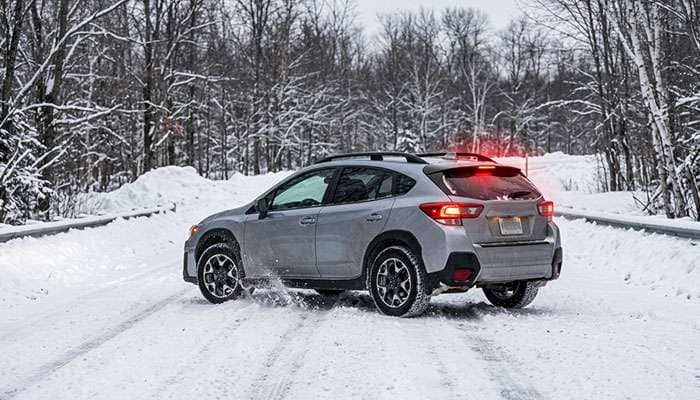
A winter tire does three things an all-season tire cannot, and each one adds grip in every direction at once.
All-season tread rubber is formulated to survive summer heat, so it stiffens as the temperature drops. The industry rule of thumb puts the switch-over point at about 45 degrees F. Below that, the rubber stops flowing into the fine texture of the road, and grip falls off even on dry pavement. Winter compounds are blended to stay pliable well below freezing, which is why a winter tire stops shorter on cold, clear pavement too.
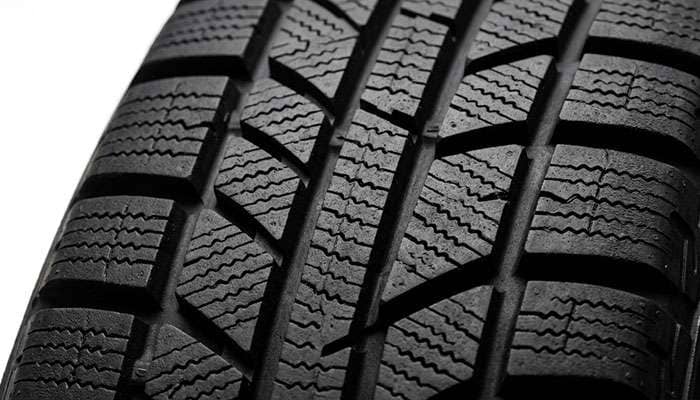
The dense zigzag slits across a winter tire's tread blocks are sipes. Each one opens slightly as the block rolls through the contact patch and gives the tire another edge to grab with. On ice, those edges are the difference between sliding and stopping. All-season tires have far fewer, and their stiffer rubber keeps them from opening in the cold.
New winter tires typically start with 10/32 to 12/32 inch of tread, usually a little deeper than an all-season in the same size, and the grooves are wider and more open. That depth and open space let the tire pack snow into its own tread. Snow grips snow better than rubber grips snow, so a tread full of packed snow actually helps you stop and turn.
Check what you already have. Your sidewall carries one of three marks, and they do not mean the same thing.
Sidewall Marking |
What It Means |
Tested for Snow? |
How It Compares in Winter |
|---|---|---|---|
M+S (or M/S, M&S) |
Tread pattern has enough open groove area to qualify |
No, it is a geometry rule |
Standard all-season; weakest of the three in snow and cold |
3PMSF on an all-weather or all-terrain tire |
Passed a snow acceleration test against a reference tire |
Yes, acceleration only |
Real step up from M+S; still behind a dedicated winter tire on ice and in braking |
3PMSF on a dedicated winter tire |
Winter compound, dense siping, deep tread |
Yes |
Best for snow, ice and cold pavement |
The three-peak mountain snowflake (3PMSF) standard was set in 1999 by the U.S. Tire Manufacturers Association and the Rubber Association of Canada. A tire earns the symbol by scoring a traction index of at least 110 against a standard reference tire in the ASTM F1805 test on medium-packed snow. That test measures acceleration, not braking or cornering, which is why a 3PMSF all-weather tire is a good compromise but not a full substitute for a winter tire. We break down the M+S side of this in M+S vs. winter tires, and the symbol itself in what the snowflake tire symbol means.
When Consumer Reports ran weeks of braking and handling tests in unplowed snow at its Connecticut track, it found that all-wheel drive did not help braking or certain cornering situations. An all-wheel-drive Honda CR-V on its original all-season tires needed almost 700 feet to stop from 60 mph on snow. Fitted with winter tires, the CR-V stopped in roughly 300 feet, and a front-drive Toyota Camry on winter tires stopped in about the same distance.
Setup |
Stop From 60 mph on Snow (approx.) |
What It Shows |
|---|---|---|
AWD crossover, all-season tires |
Almost 700 feet |
AWD adds nothing once you are on the brakes |
AWD crossover, winter tires |
About 300 feet |
Same vehicle, same drivetrain; the tires cut the stop by more than half |
FWD sedan, winter tires |
About 300 feet |
A front-drive car on winter tires stops like an AWD car on winter tires |
Read the top two rows together: same CR-V, same AWD system, and the stop changed by roughly 400 feet, more than a football field, entirely from the rubber. Read the bottom two together: once both vehicles had winter tires, the drivetrain stopped mattering for braking.
Consumer Reports also found that compact AWD crossovers on standard all-season tires took roughly three times their dry-pavement distance to stop from 60 mph on snow. All-season tires are not unsafe in snow. They are working far outside the temperature and surface range they were built for.
AWD is worth having in snow country. It makes steep driveways, unplowed side streets and slushy merges easier. But if your budget forces a choice between an AWD vehicle on all-seasons and a front-drive vehicle with winter tires, the front-drive car with winter tires is the safer winter car for most people. It stops shorter and turns better, and those are the jobs that prevent crashes.
Know what kind of AWD you are buying, too. Many crossover systems run in front-wheel drive most of the time and only send power rearward when the fronts slip. In Consumer Reports' snow handling runs, the CR-V mostly felt like a front-drive car.
The right setup depends on where you drive. Find your roads below.
Where You Drive |
What Goes Wrong First |
Best Setup |
Tire to Buy |
|---|---|---|---|
Flat, plowed city and suburban roads with regular freezes |
Stopping and turning at intersections on packed snow |
Winter tires on any drivetrain |
Studless winter tires |
Hills, mountain passes or unplowed rural roads |
Getting moving uphill, then stopping downhill |
AWD or 4WD with winter tires |
Studless winter tires, or studded where your state allows |
Frequent freezing rain and glare ice near 32 degrees F |
Braking on wet ice |
Winter tires; drivetrain is secondary |
Ice-focused studless or studded winter tires |
Occasional snow, most days above 45 degrees F |
Cold, wet pavement and the odd storm |
AWD or FWD with 3PMSF all-weather tires |
3PMSF all-weather tires year-round |
Mild climate with a few mountain trips a year |
Chain control on the pass |
AWD with 3PMSF all-weather tires plus chains in the car |
3PMSF all-weather tires |
Pickup or body-on-frame SUV in heavy snow |
Stopping a heavy vehicle on packed snow |
4WD with winter tires, or 3PMSF all-terrains for lighter duty |
LT or SUV winter tires, or 3PMSF all-terrain tires |
You need them if your winter includes regular snow-covered roads, ice, or weeks of temperatures below 45 degrees F. Your AWD will still help you get moving. It will not help you stop.
AWD on all-season tires is a defensible choice in four situations:
If none of those describe you, the AWD badge is not a substitute. Put winter tires on it, and you get the best of both: AWD's launch traction and winter rubber's braking and cornering. We dig into whether the cost pays off in whether winter tires are worth getting.
Four-wheel drive follows the same physics, with two differences that make tires matter even more.
First, a part-time 4WD system in 4-High locks the front and rear driveshafts together. That is excellent for pulling through deep snow and climbing. It does nothing for braking, and on packed snow and ice it can make the truck push wide in turns because the axles cannot turn at different speeds. Use 4-High for traction on slick roads and 2WD or 4-Auto on mixed pavement, per your owner's manual.
Second, trucks are heavy. A half-ton pickup carries far more momentum into a stop than a compact crossover, and that energy has to go somewhere through four contact patches. Stiff LT construction and highway tread on many trucks make the winter braking gap wider, not narrower.
Many truck owners split the difference with 3PMSF-rated all-terrain tires, which carry the same snowflake symbol as winter tires and handle light to moderate snow well. They still trail a dedicated winter tire on ice and in cold braking. Our breakdown of whether all-terrain tires are good in snow covers which ones carry the symbol and where they fall short.
This is the part nobody puts in front of you. Every comparison assumes fresh winter tires. A half-worn set is a different tire.
Winter tires start at roughly 10/32 to 12/32 inch of tread. Industry guidance puts the end of useful snow traction at about 5/32 to 6/32 inch. Below that, the grooves are too shallow to pack snow, the tread blocks are too short to flex and open their sipes, and the tire starts behaving more like an all-season on a cold day. Many winter tires have secondary wear bars molded into the grooves to mark that point.
Tread depth hurts all-season tires too. In Consumer Reports' testing, all-season tires shaved to about half their tread lost roughly 14 percent of their snow acceleration compared with full-tread versions of the same tires.
Winter Tire Tread Remaining |
Snow and Ice Performance |
Beats AWD on All-Seasons for Stopping? |
|---|---|---|
10/32 to 12/32 inch (new) |
Full snow packing and siping |
Yes, by a wide margin |
7/32 to 9/32 inch |
Still strong; compound does most of the work |
Yes |
5/32 to 6/32 inch |
Snow traction mostly gone; cold-pavement grip remains |
Narrowly on cold pavement; not reliably in snow |
Below 5/32 inch |
No longer a winter tire in any useful sense |
No; replace before the season |
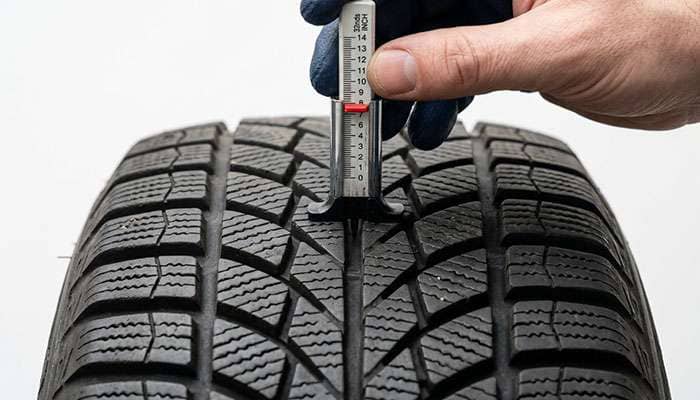
Measure before the first storm, not after. A tread depth gauge costs a few dollars and takes a minute per tire. Take readings in the center and both shoulders, and go by the lowest number.
Yes. Two winter tires and two all-seasons is the worst winter setup you can run, on any drivetrain.
Put winter tires on the front only, and the front grips while the rear slides, so the car wants to spin when you brake or turn. Put them on the rear only, and the front plows straight ahead when you steer. Either way, you have made the car less predictable than it was on four all-seasons.
AWD adds a second problem. Many AWD systems need all four tires within a tight range of overall diameter, because a mismatch makes the system think a wheel is slipping all the time. Mixing new winter tires with worn all-seasons can create exactly that mismatch and load up the center coupling or differential. Our guide to AWD tire requirements explains how much tread difference your system can tolerate and what happens if you replace only one tire on an AWD vehicle.
The clean way to do it is a dedicated set of four winter tires on their own wheels. You swap them in fall and spring, the tires never get remounted, and each set wears evenly on its own. A smaller wheel diameter often saves money and gives you more sidewall for potholes, as we cover in downsizing for a winter wheel and tire package.
Follow your owner's manual. Many AWD vehicles specify chains on the front axle only, some call for all four, and some low-profile tire and wheel combinations do not have the clearance for chains at all. Chains on the wrong axle, or chains that contact the suspension, can damage the vehicle.
Tread depth also decides how chain control treats you. California's R2 chain control, for example, lets 4WD and AWD vehicles with snow-tread tires on all four wheels skip chains, as long as chains are carried in the vehicle. Caltrans counts M+S-marked tires as snow-tread tires only when they have at least 6/32 inch of tread left, so an AWD crossover on half-worn all-seasons may not qualify. We cover each control level and what qualifies in California chain rules for 4WD and AWD.
The cost of skipping winter tires does not show up on a receipt. It shows up in distance, and distance turns into damage in a predictable order.
Compare that with what a winter set really costs. Winter tires only run in the cold months, so every mile they cover is a mile your all-season or summer tires do not. Over several seasons, you are mostly paying for a second set of wheels and the swaps, not for twice the tire wear. When you are ready to price it out, start with our winter and snow tires.
Fifteen minutes in the driveway tells you which row of the tables above you are in.
Winter tires are better than AWD at the two jobs that prevent winter crashes: stopping and turning. AWD is better at the one job that gets you up an unplowed hill: getting moving. The variable that settles it is the direction you need grip, and only tires add it in every direction.
In real winter, run AWD and winter tires together. If you must choose one, choose the tires. In a mild winter, a 3PMSF all-weather tire on AWD is a reasonable middle ground. Whatever you run, measure the tread before the first storm, because a half-worn winter tire gives back most of its advantage.
For stopping and turning, yes. AWD only adds traction when you accelerate, while winter tires add grip for accelerating, braking and cornering. In Consumer Reports' testing, an AWD crossover on all-season tires needed almost 700 feet to stop from 60 mph on snow, versus roughly 300 feet on winter tires. AWD on all-seasons still has the edge climbing unplowed hills and pushing through deep snow.
For braking and turning, yes. A front-drive car on winter tires stops and corners better on snow and ice than an AWD vehicle on all-season tires, while the AWD vehicle accelerates and climbs better. If you can only afford one upgrade, winter tires do more for safety. The best setup is AWD with winter tires.
If you drive on regular snow, ice or in temperatures below 45 degrees F for much of the winter, yes. AWD does not help you brake or turn. In mild climates with rare snow, AWD with 3PMSF all-weather tires is a reasonable compromise.
A new tire is taller than three worn ones, and many AWD systems read that diameter difference as constant wheel slip. That can overwork the center coupling or differential. Check your owner's manual for the allowed tread difference; if the others are too worn, replace all four or have the new tire shaved to match. For winter tires, always install a full set of four.
It depends on the vehicle, so follow your owner's manual. Many AWD vehicles call for chains on the front axle only, some on all four, and some cannot use chains at all because of tight clearance. In California's R2 chain control, AWD and 4WD vehicles can skip chains if all four tires are snow-tread tires, such as M+S-marked tires with at least 6/32 inch of tread, but they must still carry chains.