
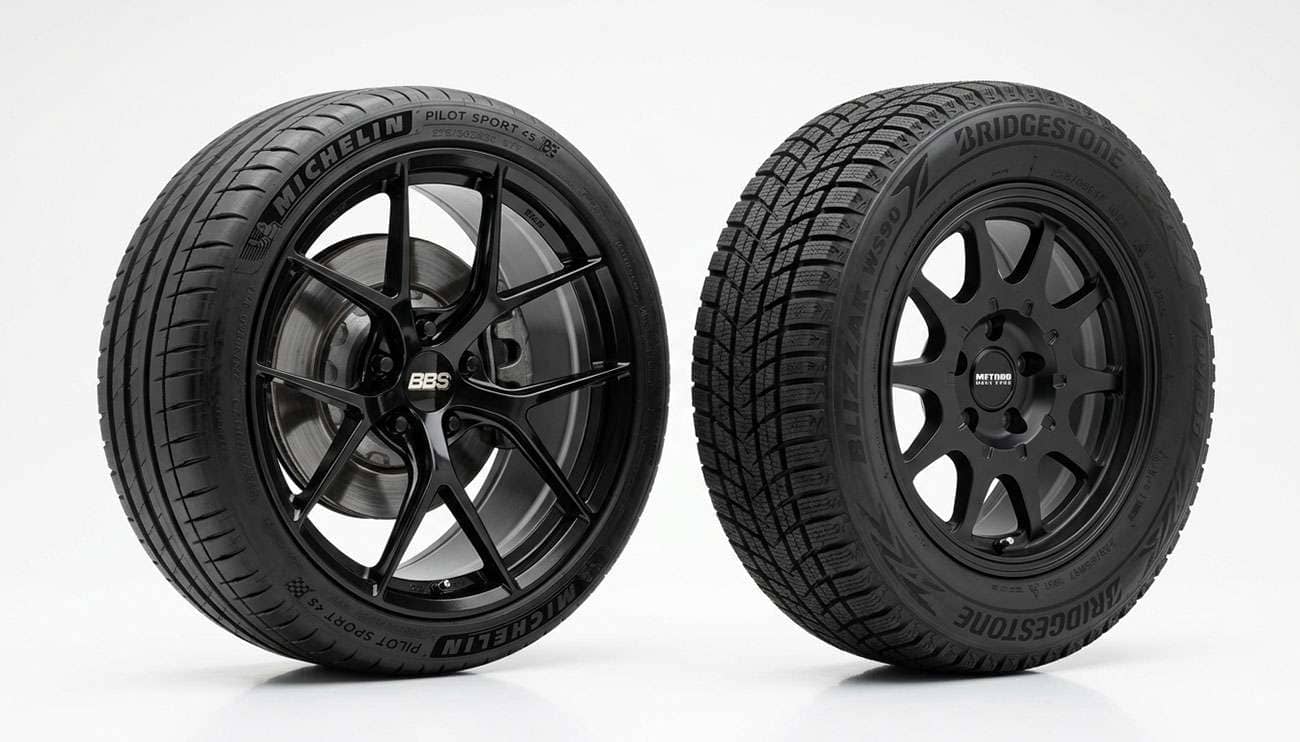
Usually yes, and two numbers decide it: what your brake caliper will clear, and the load index of the smaller tire. Every guide will tell you a narrower winter tire bites through snow better, costs less, and stores easier. All true. What they skip is that dropping an inch of wheel sometimes drops load capacity with it, and on a crossover that can be nearly 300 lb per corner. Downsizing is bounded at both ends. Find your bounds before you shop.
I have been selling wheels and tires since 1971, and I take calls every October from people in snow country who want a second set. The question is almost always the same, and so is the part they have not been told. They know the smaller tire is better in snow. Nobody has told them how far down they can go, or what it costs them in capacity when they get there.
Worth understanding the reason, because it tells you how far the benefit actually goes.
A wide tire floats. That is exactly what you want on dry pavement, where a big contact patch means grip. In deep snow and slush it works against you, because floating on top of the snow is not traction. You want the tire to cut down through it and find something solid. A narrower tire concentrates the same vehicle weight onto less rubber, which raises ground pressure and lets the tread knife down instead of skating across.
The taller sidewall that comes with a smaller wheel helps in a second way. Sidewall is suspension. Winter roads are full of frost heave, buried potholes, and curbs hidden under plow banks, and an inch of extra sidewall absorbs hits that a low-profile tire transmits straight to the rim. I have replaced a lot of bent 20-inch wheels in March. I have replaced very few bent 17s.
Then there is money and storage. Smaller tires cost less to begin with, and a set of 17s takes noticeably less corner in your garage than a set of 20s for eight months of the year. Those are real reasons, and they are the ones every article leads with.
Here is what the benefit curve actually looks like: most of the snow traction gain comes from the first inch down, because that is where you pick up the narrower section width and the meaningful sidewall. The second inch buys you a little more and starts costing you in other places. So the question is not "how small can I go," it is "how small should I go," and those have different answers.
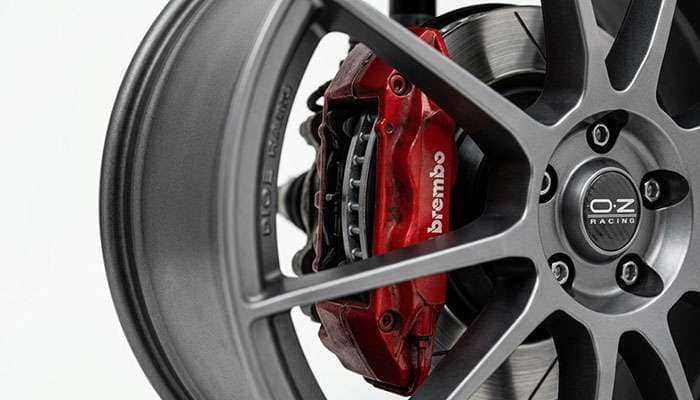
This is the floor, and it is not negotiable. Your brake caliper occupies a fixed amount of space inside the wheel. Go below the diameter that clears it and the wheel will not bolt on, or worse, it will bolt on and touch under load.
Two things set that floor. The obvious one is diameter, since a smaller wheel has less room inside the barrel. The one people miss is the wheel's inner spoke profile, which varies enormously between designs at the same nominal size. Two 17-inch wheels with identical diameter, width, offset, and bolt pattern can have completely different clearance behind the spokes, and one will fit your brakes while the other will not. We wrote up why two wheels with identical specs fit different brakes because it catches people constantly, and it catches them worse on a downsize, where the margin is already thin.
The quickest way to find your floor without measuring anything: look up the smallest wheel diameter your vehicle was ever factory-offered with, in any trim, for your model year. Base trims usually get the smallest wheels and the same brakes, so that number is a safe, manufacturer-validated floor. If your car came on 19s in the trim you bought but the base model rolled on 17s, a 17 clears your brakes.
If your car only ever came on one size, or you have upgraded brakes, you measure. You need the caliper's maximum radius from the hub center and its widest point, and you compare that against the wheel's published clearance profile. Most shops will do this for you before you buy. It is a ten-minute job and it beats a restocking fee.
One more thing on the way down. Selection thins out fast below 17 inches. In the modern fitment range, 16-inch is roughly a fifth the catalog depth of 17 or 18, because most vehicles stopped being built around it. If your brakes will clear a 17, you will have far more to choose from at 17 than at 16, and you give up almost nothing in snow performance. Do not downsize further than you need to just because you can.
Here is the one that does not come up until something goes wrong.
When you drop a wheel size, you do not just change the wheel. You change to a whole different tire size, and that new size has its own load index range that has nothing to do with what your old size offered. Most of the time the taller, narrower tire carries the same or more, because more air volume means more capacity. But not always, and the exceptions cluster in exactly the vehicles most likely to want a winter set.
Look at the real numbers. This is what the winter tire market actually offers in these sizes.
Your OE Size |
Winter Load Index Available |
Common Minus-One Size |
Winter Load Index Available There |
Worst Case vs OE |
|---|---|---|---|---|
235/45R18 (sedan) |
94 to 98 |
225/55R17 |
97 to 101 |
44 lb short. Low risk |
245/45R19 (sport sedan) |
98 to 102 |
235/55R18 |
100 to 104 |
110 lb short. Check before you buy |
255/50R20 (midsize SUV) |
109 only |
245/60R18 |
104 to 109 |
287 lb short. This is the trap |
225/55R18 going down two (compact SUV) |
98 to 102 |
215/65R16 |
98 to 102 |
221 lb short, and the diameter drops 2.7 percent |
275/45R20 (truck or large SUV) |
110 |
265/60R18 |
110 to 114 |
None. You gain capacity |
Read the third row again, because it is the one that gets people. On a common midsize SUV size, the winter market at OE diameter offers exactly one load index, 109, worth 2,271 lb per tire. Drop to the 18-inch equivalent and the range opens up at the bottom to 104, worth 1,984 lb. Buy the cheapest tire in that size and you have quietly removed 287 lb of capacity per corner, which is over 1,100 lb across the vehicle, on a truck-shaped thing that hauls people and gear in the worst conditions of the year.
And look at the last row. On a full-size truck, the same move gains you capacity. The direction is not consistent, which is exactly why you cannot follow a rule of thumb here. You have to look at your two sizes.
The fix is simple once you know to do it: write down your OE load index, and do not buy a winter tire below it. If the load index and load range distinction is fuzzy, our guide to load range vs load index sorts out how the two systems relate.
Three percent. That is the working tolerance the industry uses, and it is not arbitrary.
Your speedometer, odometer, ABS, traction control, and stability control all calculate road speed from how fast the wheels turn. They were calibrated around the overall diameter of the OE tire. Change that diameter and every one of those systems is working from a number that is slightly wrong. Inside about three percent, the error stays small enough that the systems behave normally. Past it, your speedometer reads noticeably off and your stability control starts making decisions on bad data, which is the last thing you want on ice.
The good news is that a proper minus-size is designed around this. When you drop an inch of wheel, you add sidewall to compensate, and a correctly chosen minus-one lands within a percent or two. In the table above, the sedan downsize runs 1.6 percent taller and the SUV downsize runs 1.6 percent shorter. Both are comfortably inside.
Where it bites is minus-two. That fourth row drops 2.7 percent, which is inside the tolerance but not by much, and it stacks with the capacity loss. That is the general shape of going down two sizes: each individual compromise is survivable and they add up. If you want to see how diameter changes translate into speedometer error, we walked through the math in our piece on how bigger tires affect your speedometer, and it works the same in the other direction.
One note specific to winter. Do not spec your package to sit right at the three percent line, because a winter tire is a tall-shouldered design and some of them measure slightly larger than their nominal size. Leave yourself margin.
Yes, on any vehicle where the system is required, which since the 2008 model year is essentially all of them.
People get surprised by this, and then they get annoyed by it, because it adds cost to a package that was supposed to save money. But a second set of wheels means a second set of sensors, unless you want to pay a shop to move four sensors back and forth twice a year, which costs more over three winters than just buying the sensors. Without them, the warning light stays on all season. In states with safety inspections that is a failure, and more to the point it means you have disabled the one system that tells you a tire is going soft during the months when you are least likely to notice by feel.
Budget for them up front, have them programmed to your vehicle when the package is built, and keep a note of which set is which. Our rundown of TPMS sensors for aftermarket wheels covers the programming side and the differences between sensor types.
Two special cases, and they go opposite directions.
Staggered setups. If your car runs wider wheels in the rear than the front, winter is the one time of year you may want to square it up, meaning the same size at all four corners. A staggered setup is built for dry grip and it makes the car want to push wide at the rear in snow, plus it means you cannot rotate. Squaring up for winter gives you balanced traction and lets you rotate through the season. Check first that the front and rear brakes both clear the size you pick, and that your car does not have a mechanical reason for the stagger.
Performance cars with big brakes. Sometimes the honest answer is that you cannot downsize at all. If the car came with 19s and the caliper fills the wheel, 19 is your floor. That is not a failure, it just changes the plan. You buy a narrower winter tire on the same diameter instead. Going from a 275-section summer tire to a 245-section winter tire at the same wheel size gets you most of the snow benefit without touching the wheel. You give up the sidewall cushion, so be more careful about potholes, but the traction gain is real.
The same logic applies if you would rather run winter tires on your existing wheels and skip the second set entirely. It works. You pay for mounting and balancing twice a year, you put more wear on your good wheels through salt season, and you have nowhere to go if you bend one. For anyone in a genuine snow state, the dedicated second set pays for itself inside three years and protects your summer wheels from the salt. If you want the cheapest possible version of that second set, the case for plain steel winter wheels has not changed in fifty years.
A downsize that is wrong in the ways above does not fail on day one. It works, and it costs you in order.
First, it rides worse than it should. An under-rated tire runs at higher deflection for the same load, which means it squirms under the car. On snow that feels like vagueness in the steering, and most people blame the winter tire compound for it.
Second, it runs hot on the highway. Winter compounds are soft by design, and a tire carrying closer to its ceiling generates more internal heat. Soft compound plus heat is how you turn a three-season winter tire into a two-season one. The wear does not show up in January. It shows up when you pull them out of the garage the following November and the tread is down a third.
Third, you lose braking margin in the exact conditions you bought them for. A tire near its capacity limit has less reserve for a panic stop on a loaded vehicle. That is the scenario you bought winter tires to handle.
Fourth, the casing takes the beating. Cold, salt, potholes under snow, and a tire working harder than specified are a rough combination for the sidewall. If you see a bulge, a cut, or a deformation after a winter, do not gamble on it, and read whether sidewall damage is safe to drive on before the next trip. Winter sidewall damage is common and it is the failure mode that strands people.
Fifth, you buy the set twice. A winter package that should have run five or six seasons runs three. The money you saved by taking the cheaper tire in the smaller size is gone, with interest.
Do it in this order. Each step narrows the next one.
If you would rather have someone put the whole thing together and ship it mounted and balanced, that is what our wheel and tire packages are for. Give us the vehicle and the year and we will confirm the clearance and the load index before anything ships.
Downsizing your wheels for winter is usually the right call. The narrower tire cuts into snow instead of floating on it, the taller sidewall saves your rims from the potholes the plow buried, and the whole package costs less and stores easier. None of that is in dispute.
What decides whether your downsize is a good one is two numbers nobody hands you. Your brake caliper sets the floor, and it is lower than most people think but not always low enough. And the load index of the smaller tire sets the ceiling on what the package can safely carry, which sometimes goes up when you downsize and sometimes goes down by almost 300 lb per corner. Find both numbers first. Then go shopping. Ten minutes of homework in October is the difference between a set that runs six winters and a set that runs three.
One inch is the sweet spot for most vehicles and two is the practical maximum. The hard limit is whatever your brake caliper clears, which you can find by looking up the smallest wheel your vehicle was factory-offered with in any trim. Past one inch down you start stacking overall diameter error, possible load index loss, and much thinner wheel selection, so go to two only if you have checked all three.
Yes, though the credit belongs mostly to the narrower tire that comes with them. A narrower tire concentrates vehicle weight onto less rubber, which raises ground pressure and lets the tread cut down through snow instead of floating on top of it. The taller sidewall is the second benefit, absorbing frost heave and hidden potholes that would bend a low-profile wheel.
Sometimes not, and that is a legitimate answer rather than a problem to solve. If the caliper fills the OE wheel, the OE diameter is your floor. You still get most of the winter benefit by running a narrower winter tire on the same wheel diameter, for example dropping from a 275-section summer tire to a 245-section winter tire. You lose the sidewall cushion but keep the traction gain.
Not if the package is specced correctly. A proper minus-size adds sidewall to replace the wheel diameter you removed, keeping overall diameter within about a percent or two of stock. The working industry tolerance is three percent, and inside that your speedometer, ABS, and stability control all behave normally. Going down two sizes is where you start approaching the edge of that window.
In a real snow state, yes, and it usually pays for itself within three years. Mounting and balancing twice a year adds up, repeated mounting is hard on tire beads, and running your good wheels through salt season costs you more in finish damage than the second set costs to buy. The package also means a swap takes an hour in your driveway instead of a shop appointment.
No. Load index is about the weight the tire carries, not the speed you carry it at, and your vehicle weighs the same in January as it does in July. Driving slower does not reduce what the tire supports. Speed rating is the specification that legitimately changes with winter tires, since many winter tires carry a lower speed rating than summer tires by design. Capacity is not negotiable the same way.



