
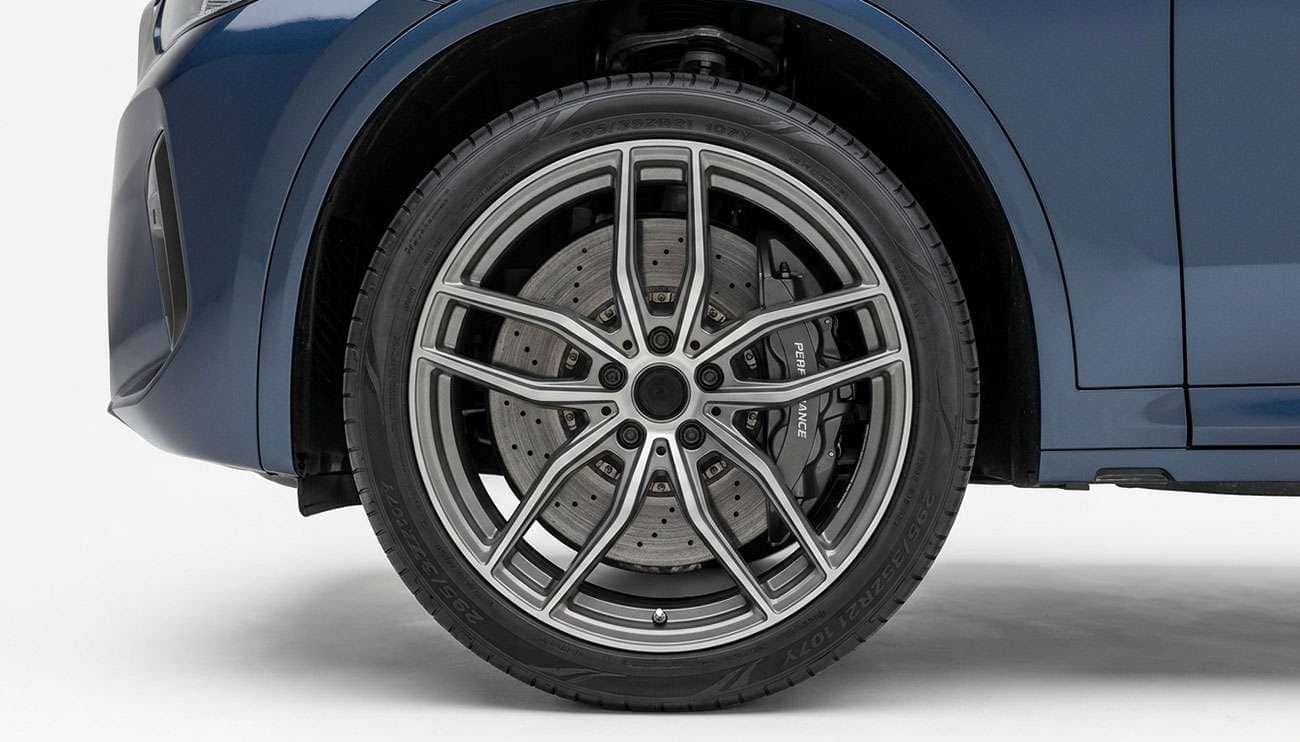
Yes. 21-inch rims are a real, factory-supported size and have been for roughly two decades. But that answer stops right where the useful part begins. Every 21-inch wheel on the road is a five-lug wheel built for a luxury sedan, a performance SUV, or an EV platform. What decides whether yours is easy to live with is not the 21. It is the two-digit number in front of it. Your aspect ratio, not your diameter, determines how many tire companies will sell you a replacement.
Most answers to this question stop at "yes, they exist" and hand you a photo gallery. Here is the part nobody puts in front of you: within the 21-inch diameter, replacement tire choice swings from more than twenty competing manufacturers down to one, depending entirely on the sidewall series stamped on your door placard. Two people can both own 21-inch wheels and have completely different ownership experiences.
Find the tire size on your driver door jamb placard. The middle number is your aspect ratio, expressed as a percentage of section width. That single number tells you more about your next tire purchase than the diameter does. Use the table below to find your case before you read anything else.
Sidewall Series on Your Placard |
Sidewall Height on a 275 Section |
Manufacturers Building That Size |
What Replacement Actually Looks Like |
|---|---|---|---|
25 series |
2.7 inches |
1 to 6 |
Special order territory. Several widths in this band come from two tire companies on the entire planet. |
30 series |
3.2 inches |
1 to 12 |
Workable at the common widths. Thins out sharply above 325 section width. |
35 series |
3.8 inches |
2 to 24 |
The deepest band at this diameter. Real choice and real price competition. |
40 series |
4.3 inches |
1 to 22 |
Strong. Most large SUV and sedan fitments live here and shop easily. |
45 series |
4.9 inches |
1 to 21 |
Strong at 265 through 285 section width. Falls off a cliff above and below that. |
50 to 55 series |
5.4 to 5.9 inches |
3 to 8 |
Thinnest band at 21 inches. Electric truck and full-size SUV owners feel this one hardest. |
Notice what that table does not say. It does not say 21-inch tires are hard to find. It says some of them are, and it tells you which. A driver running 245/35R21 has more than twenty manufacturers competing for the sale. A driver running 275/25R21 has one. Same diameter. Same wheel. Completely different position when a tire fails.
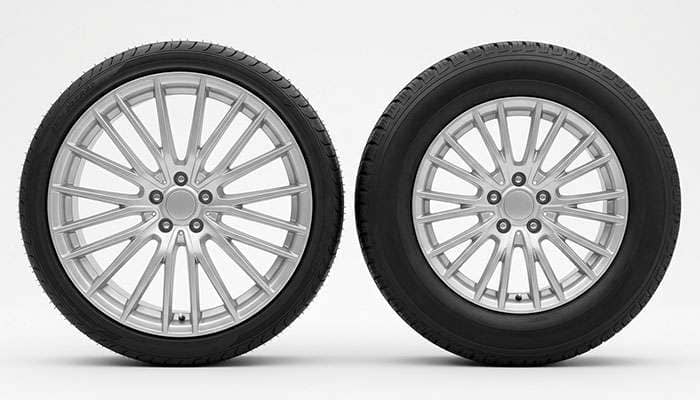
You will see 21-inch described online as a "bastard size." That is enthusiast shorthand for something more specific, and the specifics matter.
Across the four large diameters that dominate modern vehicles, 21-inch is genuinely the odd one out. Fewer than half the tire brands that build a 20-inch tire also build a 21. The number of distinct sizes offered in 21-inch runs to roughly a third of what exists in 20-inch. And 21-inch has fewer size options than 22-inch, even though 22 is the more visually extreme size and the one people assume is niche.
The reason is structural. Nearly all 21-inch demand originates from original equipment fitments on a relatively small number of platforms. Aftermarket tire development follows original equipment volume. Diameters that appear on high-volume trucks and mainstream sedans, like 17, 18, and 20, attract dozens of manufacturers because the replacement market is enormous. Diameters that appear on custom and lifestyle builds, like 22, 24, and 26, attract a different set of manufacturers who serve that market directly. 21-inch sits between those two engines and gets pulled by neither.
The practical effect shows up in the extremes. In the ultra-low 25 series band, some widths are built by exactly two tire companies. The rear tire on certain high-performance coupes is one of them. If you shred a rear on a track day, you are not comparison shopping. You are calling around to find who has one in the country.
At the other end, the tall-sidewall 21-inch sizes that appear on electric trucks and large SUVs are similarly thin. A 275/55R21 comes from three manufacturers. A 235/50R21 comes from three. These are not exotic supercar sizes. They are ordinary family vehicles, and their owners often discover the constraint only when they need a set.
The middle of the range is a different story entirely. The 35 and 40 series sizes between 245 and 295 section width are well supplied, competitively priced, and available in summer, all-season, and winter compounds from the major names. If your placard falls in that band, "hard to find" does not describe your situation at all.
The typical 21-inch tire lands roughly 45 to 50 percent above the typical 20-inch tire, and about 30 percent above the typical 22-inch. That is a real gap and it is not explained by rubber volume. A 22-inch tire uses more material and still costs less.
Three things drive it.
Mold amortization across a smaller unit count. Every tire size requires its own tooling. A manufacturer recovers that investment across the units it expects to sell. When a size appears on a handful of platforms instead of dozens, the same fixed cost is spread across far fewer tires. That cost lands in the retail price. It is the same economics that makes a low-volume replacement part expensive at a dealership.
Original equipment homologation. A large share of 21-inch fitments carry manufacturer-specific approval markings. Porsche uses an N-code. Mercedes-Benz uses MO and MO1. BMW uses a star marking. Audi uses AO and RO1. Tesla uses T0 and T1. Jaguar Land Rover, Bentley, and Ferrari all maintain their own codes. Each of those represents a joint development program between the automaker and the tire company, with dedicated compound and construction work validated against that specific chassis. That engineering is paid for by the buyer. A non-homologated tire in the same size is usually meaningfully cheaper, though it also gives up the tuning the vehicle was signed off on.
Performance construction as the default. The 21-inch category is dominated by max-performance summer and ultra-high-performance all-season constructions, often with reinforced sidewalls or run-flat capability. Those use more expensive compounds and more complex belt packages than a touring tire. There is essentially no economy tier in this diameter because there is no economy vehicle wearing it.
None of that is a reason to avoid 21-inch wheels. It is a reason to know your replacement cost before you commit, particularly if your fitment is staggered and your rear tires wear at a different rate than your fronts.
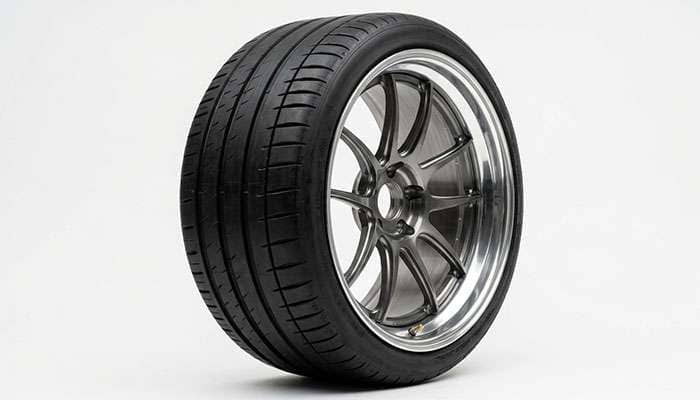
Two constraints govern this, and only one of them is about the wheel.
The first is rim width. The Tire and Rim Association publishes an approved rim width range for every tire size, and every size has one. A 275 section tire is generally approved on rims from about 9 to 10.5 inches wide. Mount it narrower and the sidewalls pinch inward, the contact patch crowns, and the shoulders wear early. Mount it wider and the sidewall is stretched, which sharpens turn-in but leaves the rim flange more exposed to impact. Your wheel width, stamped on the back of the spoke face or the barrel, is the starting point.
The second is overall diameter. Federal Motor Vehicle Safety Standard No. 110 requires the vehicle placard listing the original tire size, and the speedometer, anti-lock braking, stability control, and on many vehicles the adaptive suspension calibration all assume that rolling circumference. Staying within roughly 3 percent of the original overall diameter is the working limit. Beyond that you start introducing speedometer error and, on modern vehicles, torque distribution errors that the traction system will fight.
In practice, 21-inch wheels are made in a fairly narrow set of widths. The bulk of them are 9 and 10.5 inches, with 9.5, 10, 11, and 12 filling in the rest. That width pairing is the tell for something else: 9 front and 10.5 rear is a classic staggered wheel setup, which is how most 21-inch performance fitments are sold.
Here is what the 21-inch wheel landscape actually looks like by bolt pattern, which is the fastest way to know whether a given wheel will even bolt to your hub.
Bolt Pattern |
Platforms You Will See It On |
Offset Range Available in 21-Inch |
Widths Commonly Built |
|---|---|---|---|
5x112 |
Mercedes-Benz, Audi, Volkswagen, newer Ford and Hyundai |
+10 to +48 |
9, 9.5, 10.5, 12 |
5x120 |
BMW, Land Rover, Cadillac, Tesla Model S and Model X |
+15 to +57 |
9, 10, 10.5, 12 |
5x114.3 |
Tesla Model 3 and Model Y, Lexus, Genesis, Infiniti, Mazda |
+20 to +50 |
9, 9.5, 10.5, 12 |
5x130 |
Porsche Cayenne, Panamera, Macan |
+40 to +65 |
9, 10.5, 11, 12 |
5x10⁸ |
Volvo, Jaguar, Range Rover Velar and Evoque, some Ford |
+32 to +45 |
9, 10.5, 12 |
Two things stand out in that table. First, every 21-inch bolt pattern is a five-lug pattern. There is no six-lug or eight-lug 21-inch wheel in meaningful production, which is why you never see one on a half-ton or heavy-duty truck. Second, the offset windows barely overlap between platforms. Porsche fitments live from +40 up to +65. Many Mercedes and Audi fitments start at +10. A wheel that clears a Cayenne brake package and sits correctly in that fender will not sit correctly on a Mercedes even at identical diameter and width. Matching the diameter is the easy part. Matching the offset is the part that decides whether the wheel rubs, whether the bearing loading stays where the engineer intended, and whether the stability control behaves.
If you are moving up from a smaller wheel rather than replacing what came on the car, work the numbers with a plus sizing calculator guide before ordering anything.
21-inch is a factory-first size, which means the answer is a list of specific vehicles rather than a category.
On the German side, BMW offers 21-inch on the X5, X6, X7, and 7 Series. Mercedes-Benz offers it across the GLE, GLS, S-Class, and the EQ electric range. Audi offers it on the Q7, Q8, and the RS and e-tron lines. Porsche offers it on the Cayenne, Panamera, Taycan, and Macan. Bentley and Lamborghini use it on the Bentayga and Urus.
Among electric vehicles, Tesla has offered 21-inch on the Model S and Model X for years. Rivian offers a 21-inch road wheel on the R1T and R1S. Lucid offers 21-inch on the Air.
On the British and Swedish side, Land Rover offers 21-inch across the Range Rover, Range Rover Sport, and Velar. Volvo offers it on the XC90 and the higher trims of the XC60.
Domestically, Cadillac offers 21-inch on the Escalade and Lyriq. Jeep offers it on the upper Grand Cherokee trims. And the Corvette Z06 runs a 20-inch front and a 21-inch rear from the factory, which is where those two-manufacturer rear sizes come from.
The common thread across that list is a vehicle with large brake packages, adaptive damping, and a chassis specifically validated on that wheel and tire combination. That last point is worth holding onto, because it is the difference between a factory 21 and an aftermarket 21 on a car that never came with one.
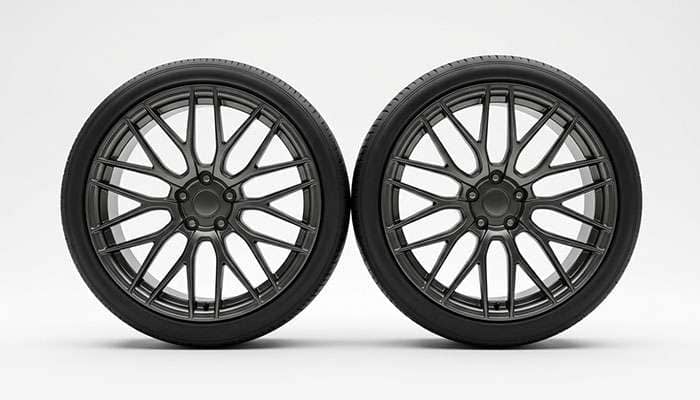
Neither is better in the abstract. They are different trades, and the difference is almost entirely in the sidewall.
Take a 275 section tire. At 19 inches with a 45 series sidewall you have about 4.9 inches of rubber between the rim flange and the road. Move the same section width to a 21-inch wheel and hold the overall diameter, and the sidewall drops to roughly 3.8 inches. You have removed about an inch of vertical compliance from each corner of the car.
That inch is doing real work. The sidewall is a spring, and it is the only spring in the system with no damping and no travel limit besides the rim itself. Shortening it does three things at once. Steering response sharpens, because the sidewall deflects less before the contact patch reacts to a steering input. Ride harshness increases, because the sidewall is absorbing less of every expansion joint before the suspension has to deal with it. And impact tolerance drops, because there is less deflection reserve between a pothole edge and the rim flange.
There is also a mass effect. A 21-inch wheel weighs more than a 19, and that mass sits farther from the axle centerline. Rotational inertia rises with the square of the radius, so the penalty grows faster than the weight number suggests. It shows up as slightly slower acceleration and braking response and as more work for the dampers to control. Whether you feel it depends heavily on the car. Our own testing on how rim size affects ride quality found the ride penalty is far more perceptible than the performance gain on most street-driven vehicles.
The honest summary: 19-inch is the better wheel for a car that lives on real roads, sees winter, or gets driven long distances. 21-inch is the better wheel for a car with adaptive damping that was engineered around it, driven on good pavement, where steering precision and appearance matter more than compliance. If you are weighing sizes one step apart rather than two, our breakdown of 19 versus 20 inch wheels covers the closer comparison.
This is the comparison most people are actually making, because a lot of vehicles offer both from the factory. The gap is smaller than the 19 versus 21 gap, which makes the decision more about ownership cost than about driving feel.
Factor |
20-Inch |
21-Inch |
|---|---|---|
Sidewall on a 275 section, 40 series |
4.3 inches |
4.3 inches at the same series, but fewer tall series exist |
Manufacturers competing in the diameter |
Broad, across every price tier |
Fewer than half as many |
Distinct sizes offered |
Roughly three times as many |
Concentrated in 35 and 40 series |
Typical replacement cost |
Baseline |
Roughly 45 to 50 percent higher |
Winter tire availability |
Good in most fitments |
Limited, and usually the reason people keep a smaller winter set |
Best case for choosing it |
Daily driving, mixed roads, winter climates, lower cost per mile |
Factory-engineered fitment, good pavement, appearance and steering feel |
One myth deserves correcting here, because it gets repeated constantly. Larger wheels do not automatically cost you efficiency. The EPA ratings on the Rivian R1T illustrate this cleanly: the 21-inch road configuration rates higher combined efficiency and longer range than both the 22-inch configuration and the 20-inch all-terrain configuration. The tire compound, tread depth, and construction move the efficiency needle far more than the diameter does. A 21-inch low rolling resistance touring tire will beat a 20-inch aggressive all-terrain every time.
If your vehicle offers both from the factory and you drive on rough roads or in a winter climate, 20-inch is the more sensible ownership decision. If your vehicle came with 21 and you are replacing what is on it, stay with 21. The suspension calibration, brake clearance, and stability control tuning were all validated on that setup.
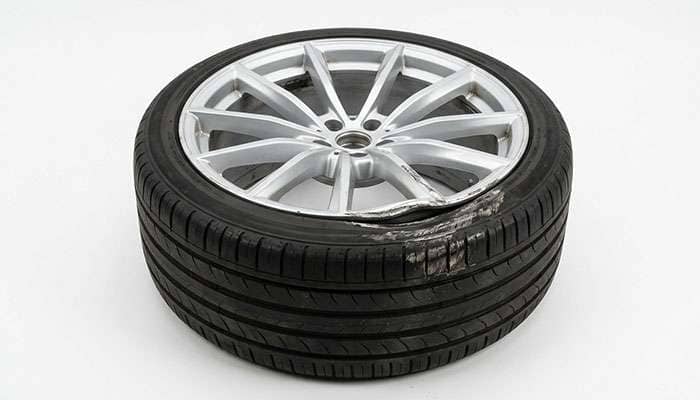
The purchase price is the part everyone budgets for. The part that surprises people is the running cost of a short sidewall, and it escalates in a predictable order.
It starts with the wheel face. Less sidewall means less rubber standing proud of the rim flange. Curb contact that a taller tire would have absorbed as a scuff on the sidewall instead lands directly on the wheel lip. That is curb rash, and on a machined or polished 21-inch face it is not a cheap repair.
Then it moves to the rim itself. When the tire hits a pothole edge, the sidewall compresses. If the impact exceeds the available deflection, the rim flange pinches the tire against the pavement. On a tall sidewall that rarely happens. On a 30 or 35 series tire it happens on roads you drive every day. The result is a bent or cracked rim, and on a forged or multi-piece 21-inch wheel that is a serious bill. Our checklist for what to check after hitting a pothole walks through the inspection.
Then the tire structure. The same impact that bends a rim can break internal sidewall cords without leaving a visible mark on the outside. Days or weeks later a bulge appears. That bulge is air pressure pushing through the gap where the cords separated, and it is the most common precursor to a sidewall blowout. If you find one, the tire is finished. There is no repair. Our guide to tire sidewall damage and whether it is safe to drive explains how to tell a cosmetic scuff from a structural failure, and it is worth reading before you decide to run one more week on it.
Then the suspension. Impact energy that the sidewall does not absorb goes somewhere. It travels through the wheel bearing, the control arm bushings, and the damper. Increased unsprung mass makes the shock loading worse. Over years this shows up as bushings and bearings wearing earlier than they would have on a smaller wheel.
And it ends at the replacement bill. A short-sidewall performance tire on a heavy vehicle wears faster than a touring tire, and in a staggered setup the rears go first with no ability to rotate front to back. That means buying rears more often than a full set, at 21-inch pricing. Anyone considering the move up should read through the real pros and cons of low profile tires before committing, because the appearance gain is immediate and the cost shows up later.
If you are trying to decide whether 21-inch makes sense for your vehicle, work through this in order.
1. Read your door placard. Open the driver door and find the tire and loading information label. Write down the tire size and both pressure figures. If your vehicle has a staggered fitment, front and rear will differ.
2. Identify your aspect ratio band. Take the middle number from that size and find it in the first table above. That tells you how many manufacturers build your tire and how your next replacement will go.
3. Confirm your bolt pattern and offset. These are stamped on the back of the wheel spoke face or inside the barrel. Both have to match, not just the bolt pattern. A wheel with the correct pattern and the wrong offset will change your scrub radius and load your bearings differently than the engineer intended.
4. Check your brake clearance before ordering. Large brake packages are one of the reasons 21-inch exists on these platforms. A wheel that clears one calipers package may not clear another on the same model.
5. Price a full set of tires before you buy the wheels. Not one tire. A set, in your exact size, at your exact fitment. If you are staggered, price fronts and rears separately. This is the number that determines whether you enjoy the wheels for the next five years.
6. Plan for a second set if you see winter. Winter tire availability at 21 inches is limited. Most owners in cold climates keep a smaller wheel and tire package for the season, which is cheaper than it sounds and preserves the expensive wheels from salt and impacts.
7. Verify TPMS compatibility. Federal Motor Vehicle Safety Standard No. 138 requires a functioning tire pressure monitoring system on passenger vehicles. New wheels need sensors that your vehicle will read, and they need to be programmed.
21-inch rims are absolutely a thing. They have been factory equipment on premium platforms for two decades, and there is nothing exotic or improvised about them. But the useful answer is not yes or no. It is which 21 you have.
The diameter is not what determines your ownership experience. The aspect ratio is. A 245/35R21 puts you in a competitive market with real choice. A 275/55R21 or a 345/25R21 puts you in a market with three suppliers or two. Both are 21-inch. They are not remotely the same purchase.
Look at your placard first. Everything else follows from that number.
Yes. 21-inch has been a factory wheel size on premium platforms for about two decades, including BMW, Mercedes-Benz, Audi, Porsche, Land Rover, Cadillac, Tesla, Rivian, and Lucid. It is a five-lug-only diameter, which is why it never appears on trucks. The more useful question is which 21-inch tire size you are running, because replacement availability varies enormously within the diameter.
It depends entirely on your aspect ratio. Sizes in the 35 and 40 series between 245 and 295 section width are widely available from most major manufacturers. Sizes in the 25 series and in the 50 to 55 series are thin, with some built by only two or three tire companies worldwide. Check the middle number on your door placard to know which case applies to you.
Three reasons. Mold tooling is amortized across a much smaller unit count than mainstream diameters. A large share of 21-inch fitments carry manufacturer homologation codes such as Porsche N-spec, Mercedes MO, BMW star, or Tesla T0, each representing a dedicated joint development program. And the category is almost entirely max-performance and ultra-high-performance construction, with no economy tier because no economy vehicle wears the size.
Two constraints apply. The Tire and Rim Association publishes an approved rim width range for every tire size, so your wheel width sets the section width options. A 275 section tire generally fits a 9 to 10.5 inch rim. Separately, overall diameter should stay within about 3 percent of the original size on your placard, since speedometer, anti-lock braking, and stability control calibration all assume that rolling circumference.
BMW X5, X6, X7 and 7 Series. Mercedes-Benz GLE, GLS, S-Class and the EQ range. Audi Q7, Q8, RS and e-tron models. Porsche Cayenne, Panamera, Taycan and Macan. Land Rover Range Rover, Range Rover Sport and Velar. Volvo XC90 and XC60. Cadillac Escalade and Lyriq. Tesla Model S and Model X. Rivian R1T and R1S. Lucid Air. Bentley Bentayga and Lamborghini Urus. The Corvette Z06 uses a 21-inch rear with a 20-inch front.
Moving from 19 to 21 on the same overall diameter removes roughly an inch of sidewall per corner. That sharpens steering response and worsens ride harshness and impact tolerance by the same mechanism. 19-inch is the better choice for rough roads, winter climates, and long distance driving. 21-inch makes sense on a vehicle with adaptive damping that was engineered around it and driven on good pavement.
If your vehicle came with 21-inch from the factory, stay with 21-inch. Brake clearance, suspension calibration and stability control tuning were validated on that setup. If your vehicle offers both and you drive rough roads or see winter, 20-inch is the better ownership decision. It costs roughly 45 to 50 percent less per tire, offers far more manufacturer choice, and has much better winter tire availability.
Ready to see what is available in your fitment? Browse the full range of 21 inch wheels and filter by bolt pattern, width and offset to match your vehicle.



