
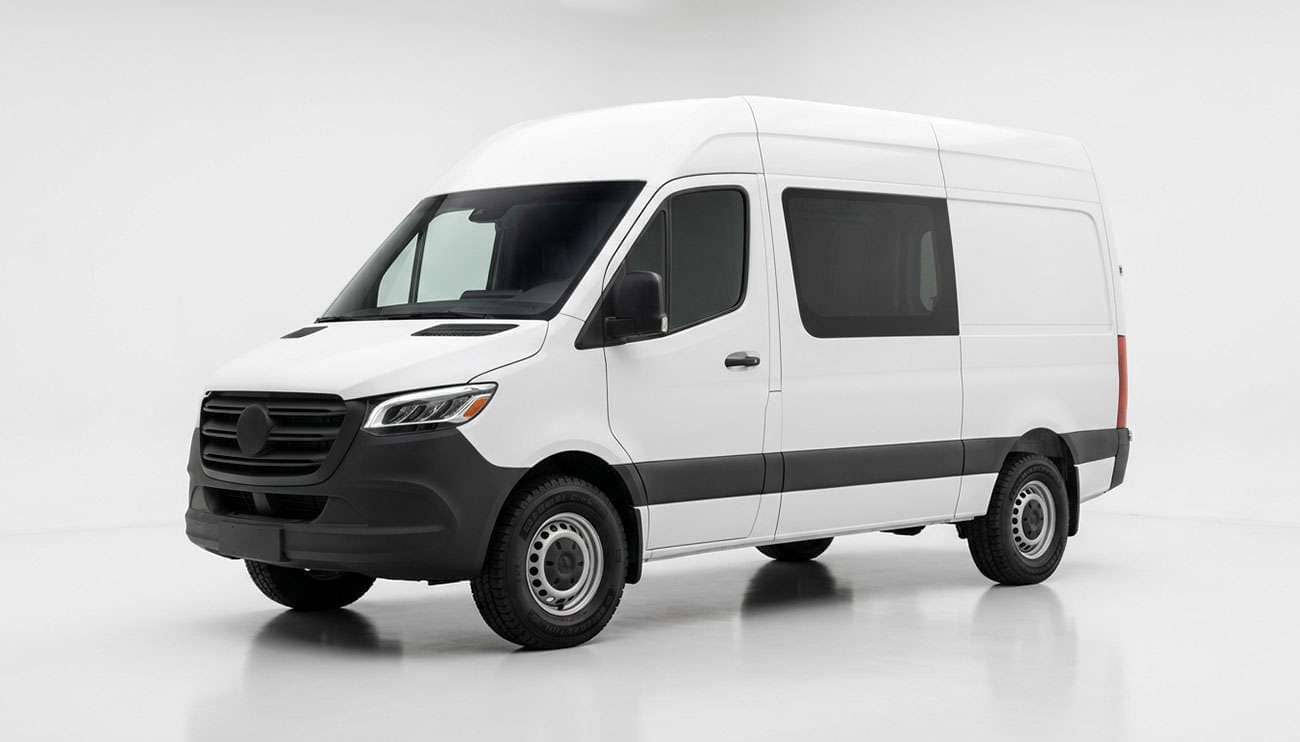
The 6x130 lug pattern belongs to the Mercedes-Benz Sprinter and everything built on or beside it: the Freightliner Sprinter, the old Dodge Sprinter, the VW Crafter, and the Ineos Grenadier. Six studs on a 130 millimeter circle, which is 5.118 inches. That is a short list and it stays short, because 6x130 is a European commercial van pattern that never migrated into the American truck world.
Here is what nobody puts in front of you when you look this up. There are five different six-lug patterns living inside half an inch of each other, and 6x130 sits right in the middle of the pile. Its nearest neighbor is two millimeters away. Two millimeters is less than a sixteenth of an inch, and it is close enough that the wrong wheel will slide onto your studs, take a lug nut, and torque down like it belongs there. It does not belong there. Start with the table.
Six-lug pattern |
In inches |
Distance from 6x130 |
Who runs it |
|---|---|---|---|
6x127 |
6x5.00 |
3 mm smaller |
GM midsize SUVs of the 2000s and the Chevy SSR |
6x130 |
6x5.118 |
Baseline |
Sprinter, Crafter, Grenadier |
6x132 |
6x5.197 |
2 mm larger |
GM full-size crossovers |
6x135 |
6x5.315 |
5 mm larger |
Ford F-150, Expedition, Navigator |
6x139.7 |
6x5.50 |
9.7 mm larger |
GM 1500 trucks, Toyota, Nissan Titan |
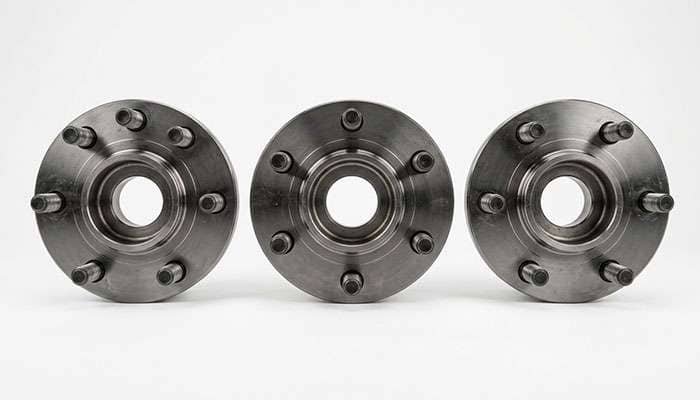
Six studs, arranged evenly around a circle 130 millimeters across. The first number is always the count, the second is always the diameter of the circle the stud centers sit on. That circle has a proper name, pitch circle diameter, and you will see it written as PCD on spec sheets.
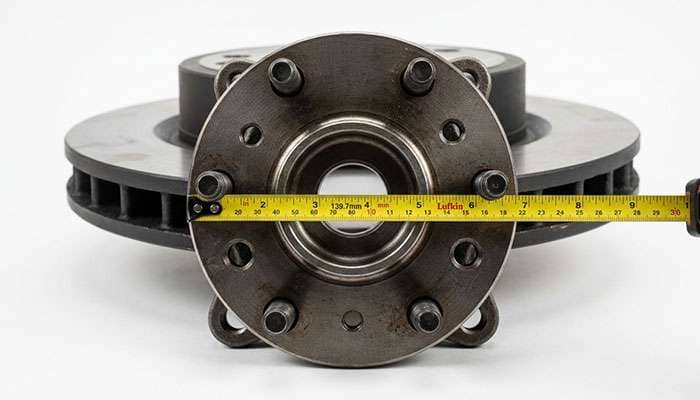
Six lugs are the easy ones to measure, and this is worth knowing because it takes about thirty seconds in your driveway. With an even number of studs, two of them always sit directly opposite each other across the hub. Put your tape on the center of one stud and read the center of the one straight across. That reading is your PCD, no arithmetic required. On a 6x130 you will get 130 millimeters, or right at 5 and an eighth inches.
Odd counts are the ones that make people crazy, because five studs never line up opposite each other and you have to measure from the back edge of one hole to the center of the second one over. If you are working through a five-lug hub, our walkthrough on how to measure lug bolt pattern covers the method for every count.
One more thing on the studs themselves. The Sprinter and the Grenadier both run M14x1.5 threads, which is a heavier fastener than the M12 or half-inch studs on most American light trucks. That is not decoration. These are load-carrying vehicles and the fastener was sized for the job. It also means your old lug nuts from another rig are not going to thread on, and you should not go looking for a way to make them.
It is a genuinely short list, and every vehicle on it earns its way there by hauling something.
Vehicle |
Rough years |
What it is |
|---|---|---|
Mercedes-Benz Sprinter 2500 and 3500 |
2007 to present |
The anchor of the pattern. Cargo, passenger, and cab-chassis |
Mercedes-Benz Sprinter 1500 |
2019 to present |
The lighter Sprinter, same pattern |
Freightliner Sprinter |
2007 to 2021 |
Badge-engineered Sprinter for the commercial channel |
Dodge Sprinter |
2003 to 2009 |
The first-generation US Sprinter under a Dodge badge |
Volkswagen Crafter |
First generation |
Shared the Sprinter platform and the pattern with it |
Ineos Grenadier and Quartermaster |
2022 to present |
Body-on-frame off-road utility, built around the same hub spec |
The pattern tells you what these wheels have to survive. Aftermarket 6x130 wheels come in 16, 17, and 18 inch diameters and essentially nothing larger, with widths clustered between 6.5 and 8 inches. Load ratings sit between roughly 2,700 and 3,650 pounds per wheel, which is heavy-truck territory on what looks like a modest wheel.
Offset tells the same story from a different angle. Every wheel built in this pattern runs positive offset, typically somewhere between 30 and 55 millimeters, against factory numbers up around 55 to 62. Nothing in 6x130 is built to poke out past the fender, because nothing that wears this pattern was built to look good in a parking lot. It was built to carry weight and track straight with a loaded box behind the front seats.
Look back at that first table for a second. From 6x127 to 6x139.7 is 12.7 millimeters. Half an inch. Five distinct, incompatible patterns crammed into half an inch of bolt circle, and 6x130 has neighbors on both sides.
Here is why that matters more than the numbers suggest. A two millimeter difference in pitch circle diameter puts each stud one millimeter off from where the wheel's hole wants it. Lug holes are drilled with clearance around the stud, so one millimeter of error does not stop the wheel from going on. The studs pass through. The nuts start. Everything looks fine.
What is actually happening under there is that the tapered seat in the wheel is no longer concentric with the stud. Instead of the cone sitting evenly all the way around and pulling the wheel flat against the hub, it contacts on one side and gaps on the other. You torque it to spec and you get a fraction of the clamp load you were supposed to get.
Clamp load is the whole point of the exercise. A wheel is not held on by the studs the way a nail holds a board. It is held on by friction between the wheel and the hub face, and that friction is created by the studs stretching under torque and pulling the two surfaces together. Cut the clamp load and the wheel starts to move against the hub, just a hair, on every start and every stop. Now the studs are taking shear load that they were never sized for.
You know the rest, because you have seen the symptom even if you never knew the cause. The lug nuts come loose. You retorque them and they come loose again. The holes in the wheel start to wallow out into ovals. Eventually a stud snaps. Our piece on why lug nuts keep coming loose walks through every cause of that symptom, and a mismatched pattern is at the top of the list.
Different animal entirely, and the only thing it shares with 6x130 is the number 130. Five studs on a 130 millimeter circle is a German performance and luxury pattern, and it has been for decades.
Porsche is the headline. The 911 has worn 5x130 across generations, and so have the Boxster, the Cayman, the Cayenne, and the Panamera. Volkswagen used it on the Touareg, Audi on the first-generation Q7, and Mercedes on the G-Class. Bentley shows up on the list too, which follows from the platforms those cars share.
The practical point is that a five-lug wheel and a six-lug wheel are not interchangeable no matter what the second number says, and there is no adapter that makes it a good idea. If you are chasing 5x130 specifically, we cover the full vehicle list in our guide to the 5x130 bolt pattern.
6x135 is Ford's six-lug pattern, and it is one of the most common six-lug circles on American roads. The F-150 has used it from the 2004 model year forward, and it carries across to the Expedition and the Lincoln Navigator.
Five millimeters separate it from 6x130. That is a fifth of an inch on the circle, roughly a tenth of an inch of radial error per stud. Same story as before: the wheel will very likely go on, and it should not.
Worth knowing if you own an older Ford. The F-150 ran 5x135 before 2004, a five-lug pattern on the same circle diameter, so a 1997 through 2003 truck and a 2004 truck do not share wheels even though both are Fords of nearly the same vintage. Full details in our article on what cars have a 6x135 bolt pattern.
6x132, sometimes written 6x5.2, is a General Motors crossover pattern. It shows up on the Lambda platform vehicles: the Saturn Outlook, the GMC Acadia, the Buick Enclave, and the Chevrolet Traverse of that era.
This is the one that sits two millimeters from 6x130 and causes the most confusion, and there is a second layer to that confusion worth untangling. GM also ran a 6x127 pattern, which is 6x5.00 exactly, on the midsize SUVs of the 2000s: the Chevrolet TrailBlazer, GMC Envoy, Buick Rainier, Oldsmobile Bravada, Isuzu Ascender, Saab 9-7X, and the Chevy SSR.
So within the GM family alone there are two different six-lug patterns five millimeters apart, neither of which is the 6x139.7 that GM's own half-ton pickups use. Three GM six-lug patterns, none interchangeable. If you own one of these and somebody at a counter tells you "it's the Chevy six-lug," ask them which one.
On a Silverado 1500, yes. 6x5.5 and 6x139.7 are the same pattern expressed in different units, since 5.5 inches is 139.7 millimeters. Chevrolet has run that circle on half-ton pickups since the late 1960s, which is why the wheel selection in this pattern is enormous.
On a Silverado 2500 HD or 3500 HD, no. Those are eight-lug trucks and they do not share anything with the 1500. Same nameplate, same showroom, entirely different hub.
Fitting the pattern is also not the same as fitting the truck. Hub bore has to clear the hub, offset has to keep the tire off the control arm and inside the fender, and the wheel's load rating has to cover the axle. We work through the whole compatibility picture in our 6x5.5 bolt pattern guide.
No. The F-150 is 6x135 and a 6x5.5 wheel is 6x139.7. That is 4.7 millimeters of difference on the circle, and it is a hard no.
This trips up more people than any other six-lug question, because both trucks are half-ton American pickups, both run six lugs, and the two patterns look identical sitting next to each other on a rack. They are not identical, and a set of Chevy wheels will not solve your Ford problem.
Do not let anyone talk you into forcing it, and be careful about adapters as a shortcut. A properly engineered hub-centric adapter from a reputable maker, correctly torqued and rechecked, is a real product with a real use case. A cheap spacer with a mismatched pattern drilled into it is how you end up on the shoulder looking at three studs where there used to be six.
Getting the bolt pattern right is necessary and it is nowhere near sufficient. Four more specifications have to line up before that wheel belongs on your vehicle.
Hub bore. The hole in the center of the wheel has to fit over the hub. On 6x130 that is almost always 84.1 millimeters, which is a big bore and a clue about how much weight this pattern was built to carry. If the wheel's bore is larger than your hub, you need hub-centric rings, because the hub is what centers the wheel and the lug nuts are what clamp it. Get those two jobs mixed up and you will chase a vibration forever. Our comparison of hub-centric vs lug-centric wheels explains why.
Thread size and pitch. M14x1.5 on the Sprinter and Grenadier. Not M12, not half-inch. The nuts have to match the studs exactly.
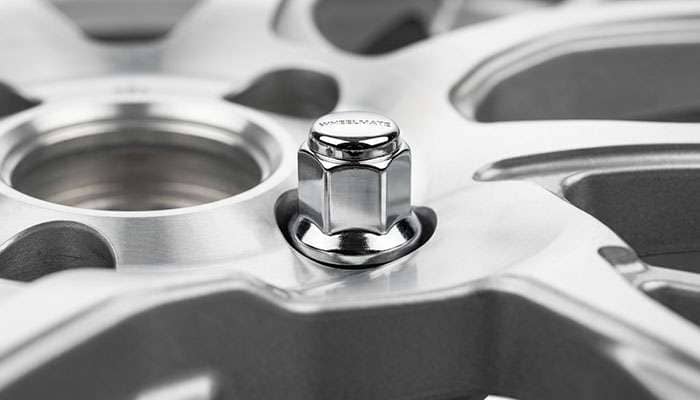
Lug seat style. Conical, ball, and flat seats are three different shapes and they do not substitute for each other. Putting a conical nut into a ball-seat wheel gives you the same failed clamp load as a mismatched bolt circle, from a different direction. Our breakdown of lug nut seat types shows what each one looks like.
Load rating. On a van or a utility rig this is not optional and it is the one people skip. The wheel's rating has to meet or beat the gross axle weight rating divided by two. A pretty wheel rated for a crossover does not go on a 3500 Sprinter, no matter how well the pattern lines up.
I have had these come through the door in every stage, and they arrive in a predictable order.
The first week. Nothing. That is the dangerous part. The wheel is on, the truck drives, and the owner has no idea anything is wrong. Underneath, the clamp load is a fraction of spec and the joint is relying on the studs in shear instead of friction.
The first few hundred miles. A faint vibration that comes and goes, usually worse under braking. People chase it with balancing and alignment and it never quite goes away, because the wheel is not actually centered on the hub and never was.
The first retorque. Lug nuts are loose. Owner snugs them up, feels good about being on top of maintenance, drives off. They come loose again in another few hundred miles, because nothing about the underlying geometry changed.
The failure. By now the lug holes have hammered themselves oval and the seats are galled. The wheel is moving measurably against the hub on every load reversal, and the studs are being worked back and forth. Studs do not stretch and yield gracefully in that situation. They snap, usually two or three at once, usually under braking, and a wheel that loses half its fasteners is not going to stay on the vehicle.
The whole ladder is avoidable at step zero for the price of measuring your hub. That is the trade, and it has never once been a close call.
When you are ready to shop, you can browse wheels built specifically for this pattern in our 6x130 bolt pattern selection and filter by diameter, width, and offset.
6x130 belongs to the Sprinter family, the VW Crafter, and the Ineos Grenadier. Six studs on a 130 millimeter circle, M14x1.5 threads, an 84 millimeter hub bore, positive offset without exception, and load ratings that tell you exactly what these vehicles were built to do.
The size is easy. The trap is the company it keeps. Five six-lug patterns share half an inch of bolt circle, and the closest one to 6x130 is two millimeters away. That is close enough to fool your eyes, close enough to thread on, and nowhere near close enough to hold. Measure the hub, match all four specifications, and the rest of it takes care of itself.
The Mercedes-Benz Sprinter 1500, 2500 and 3500, the Freightliner Sprinter, the Dodge Sprinter of 2003 through 2009, the first-generation Volkswagen Crafter, and the Ineos Grenadier and Quartermaster. It is a European commercial van pattern, so it does not appear on American pickups or SUVs.
Six studs spaced evenly on a pitch circle 130 millimeters in diameter, which is 5.118 inches. Because the stud count is even, two studs sit directly opposite each other, so you can measure the pattern by reading center to center across the hub. Sprinter and Grenadier hubs use M14x1.5 threads and an 84 millimeter center bore.
5x130 is a German performance and luxury pattern. Porsche uses it across the 911, Boxster, Cayman, Cayenne and Panamera. It also appears on the Volkswagen Touareg, the first-generation Audi Q7, the Mercedes-Benz G-Class, and several Bentley models. Despite sharing the number 130, it has nothing in common with the six-lug 6x130 pattern.
Mainly Porsche and its platform relatives. The 911, Boxster, Cayman, Cayenne and Panamera all use 5x130, along with the Volkswagen Touareg, the early Audi Q7, the Mercedes G-Class, and Bentley models built on shared architecture. A five-lug wheel never interchanges with a six-lug hub regardless of the circle diameter.
6x135 is Ford's six-lug pattern, used on the F-150 from 2004 onward and on the Expedition and Lincoln Navigator. Note that F-150 trucks from 1997 through 2003 used a five-lug 5x135 pattern instead, so those wheels do not carry over to a 2004 or newer truck.
6x132, also written 6x5.2, is a General Motors crossover pattern found on the Lambda platform vehicles: the Saturn Outlook, GMC Acadia, Buick Enclave and Chevrolet Traverse of that generation. It is often confused with GM's separate 6x127 pattern, which was used on the TrailBlazer, Envoy, Rainier, Bravada, Ascender, Saab 9-7X and SSR.
Yes on the Silverado 1500, since 6x5.5 and 6x139.7 are the same pattern in different units and Chevrolet has used that circle on half-ton pickups since the late 1960s. No on the 2500 HD and 3500 HD, which are eight-lug trucks. Matching the pattern still leaves hub bore, offset and load rating to verify.
No. The F-150 uses 6x135 and a 6x5.5 wheel is 6x139.7, a difference of 4.7 millimeters on the bolt circle. The wheel may start onto the studs because lug holes are drilled with clearance, but the lug seats cannot sit concentric, clamp load collapses, and the fasteners end up carrying shear they were never designed for.



