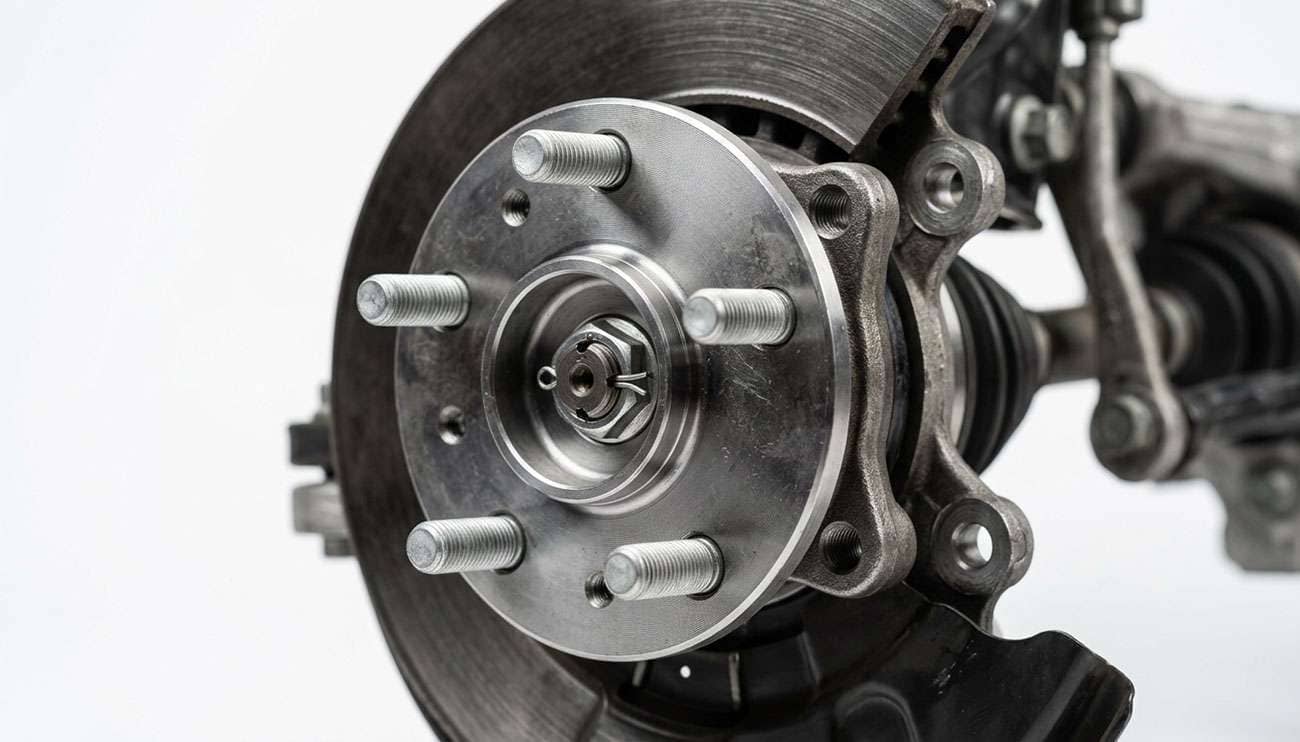
The 5x10⁵ bolt pattern belongs almost entirely to General Motors small cars built on the Delta II and D2XX platforms: the Chevrolet Cruze, Sonic, Trax, Volt, Bolt EV, and Bolt EUV, plus the Buick Encore. But the nameplate alone will not get you a wheel that fits. Three of those names carry the 5x10⁵ pattern for only part of their production run, and the years when they do not, they run 5x115 instead. Your model year and, on one car, your engine, decide which pattern is sitting on your hub.
I have been fitting wheels at this shop since before any of these cars existed, and 5x10⁵ is the pattern that generates the most phone calls with the same opening line: "the wheels came, they will not go on, and the guy said they fit a Cruze." Nine times out of ten they do fit a Cruze. Just not that person's Cruze. Every list you find online gives you the nameplate. Almost none of them tell you where inside the nameplate the pattern changes, and that is the whole ballgame.
Here is the table I wish somebody would put at the top of every one of these pages. Find your car and your year first, then keep reading.
Vehicle |
Years on 5x10⁵ |
Years NOT on 5x10⁵ |
What Those Years Run Instead |
|---|---|---|---|
Chevrolet Cruze (gas) |
2011 to 2019, both generations |
2014 to 2015 Turbo Diesel |
5x115, 70.3 mm bore |
Chevrolet Sonic |
2012 to 2020, all trims |
None |
Not applicable |
Chevrolet Trax |
2013 to 2022, first generation |
2024 and newer, second generation |
5x115 |
Chevrolet Volt |
2016 to 2019, second generation |
2011 to 2015, first generation |
5x115, 70.3 mm bore |
Chevrolet Bolt EV |
2017 to 2023 |
None |
Not applicable |
Chevrolet Bolt EUV |
2022 to 2023 |
None |
Not applicable |
Buick Encore |
2013 to 2022, first generation |
Encore GX, a separate model |
5x115 |
Notice the right-hand column. Every single exception lands on the same pattern: 5x115. That is not a coincidence, and once you understand why, this whole thing stops being confusing. If you want the other side of that story, our guide to the 5x115 bolt pattern lists the vehicles on that spec, and you will see Cruze, Trax, and Volt on that list too. Same nameplates, different cars underneath.
On the Chevrolet side, the 5x10⁵ list is short and specific. The Cruze in gas form from 2011 through 2019 covers both the first-generation J300 sedan and the second-generation J400 sedan and hatch. The Sonic runs 5x10⁵ across its entire North American life, 2012 through 2020, in every trim including the RS. The first-generation Trax, 2013 through 2022, is on the pattern. The second-generation Volt, 2016 through 2019, is on it. And both electrics, the Bolt EV from 2017 and the Bolt EUV from 2022, are on it.
The Buick side of the family adds the first-generation Encore, which shared the Trax platform and shared the pattern with it from 2013 through 2022. Overseas, GM used 5x10⁵ broadly on Opel, Vauxhall, Holden, and Daewoo small cars, including the Opel and Vauxhall Astra J and Mokka, the Holden Barina and Cruze, and the Daewoo Lacetti. If you are shopping for a gray-market or Canadian-spec car, that global list is worth knowing about, but it does not change the North American answer.
What people miss most often on the Chevy list is the Bolt. Search results tend to stop at Cruze, Sonic, Trax, and Encore because those were the high-volume cars. The Bolt EV and Bolt EUV are on the exact same 5x10⁵ spec, and they are the two heaviest vehicles wearing it. I will come back to why that matters, because it is the second half of this article and nobody talks about it.
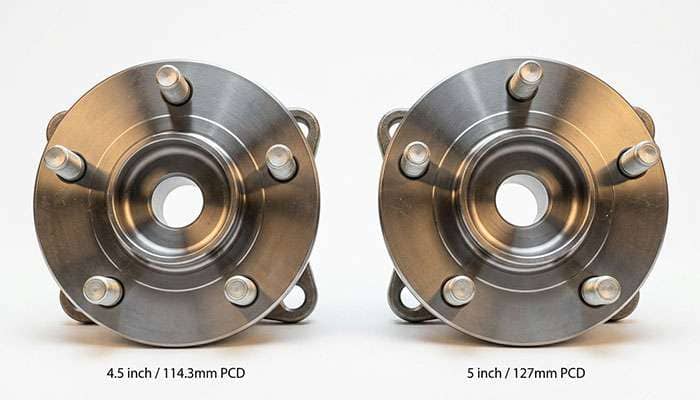
This is the section that will save you a return shipment. Three cars split, and each one splits on a different variable.
Every gas Cruze from 2011 through 2019 is 5x10⁵ with a 56.6 mm bore. The 2014 and 2015 Cruze Turbo Diesel is 5x115 with a 70.3 mm bore. Same nameplate, same showroom, overlapping model years, and two completely different hubs. GM specified the diesel car with heavier hardware because the engine and the brake package were heavier, and the wheels do not cross over in either direction. If you are buying used takeoffs off a marketplace listing and the seller says "off a 2014 Cruze," ask which engine before you send money. I have had that exact set come back through my door more than once.
The first-generation Trax, sold from 2013 through 2022, is 5x10⁵. Chevrolet redesigned the Trax completely for 2024 on a new platform, and the new one is 5x115. In between there was no 2023 model year in the United States, which is part of why this one confuses people so badly. Even dealers and wheel counter staff gave conflicting answers when the new car launched, and owner forums from that period are full of people getting two different numbers from two different shops. If your Trax is a 2024 or newer, none of the wheels on this page fit it.
The first-generation Volt, 2011 through 2015, sits on the Delta II platform and runs 5x115 with a 70.3 mm bore. The second-generation Volt, 2016 through 2019, moved to the D2XX platform it shared with the same-era Cruze and picked up 5x10⁵ with the 56.6 mm bore. Both are five-lug, both look identical from ten feet away, and one will not take the other's wheels. Year is the fastest way to tell them apart.
The Buick Encore has a similar trap, though it is a naming problem rather than a generation problem. The Encore and the Encore GX are two different vehicles that Buick sold at the same time. The original Encore is 5x10⁵. The Encore GX, from 2020 forward, is 5x115. If your paperwork says GX, the pattern is different.
A 5x10⁵ bolt pattern measures 4.13 inches. The math is straightforward: 105 divided by 25.4 equals 4.1339, which rounds to 4.13. You will see it written as 5x4.13 on some listings and simply as 5x10⁵ on most.
Worth doing that division yourself whenever you see an inch figure on a listing, because 105 mm sits in a crowded neighborhood and the inch conversions land close together. For reference, 4.13 inches is 105 mm, 4.25 inches is 108 mm, and 4.5 inches is 114.3 mm. Those are three separate patterns and none of them interchange. If a listing quotes an inch dimension that does not divide back out to the millimeter figure you expect, that is your signal to ask the seller for the metric spec before you commit.
The reason five-lug patterns get measured wrong so often is that the studs do not sit directly across from each other the way they do on a four-lug or six-lug wheel. You cannot just measure straight across. On a five-lug, you measure from the center of one stud to the outer edge of the stud two positions away. Our walkthrough on how to measure lug bolt pattern shows the technique with the five-lug method spelled out, and it takes about ninety seconds with a tape measure.
Five studs, evenly spaced, on a circle 105 mm across. The studs themselves are M12 x 1.5, meaning a 12 mm shank with 1.5 mm thread pitch, and that spec is consistent across every vehicle GM built on the pattern. The center bore is 56.6 mm, also consistent across every one of them. Torque lands right around 100 lb-ft, or roughly 140 Nm, though you should confirm the exact figure against your owner's manual because GM does shift it by model and year.
That consistency is unusual and it is genuinely good news. Compare it to 5x115, where GM front-drivers use 12 mm studs on a 70.3 mm bore while the Mopar cars on the same pattern use 14 mm studs on a 71.5 mm bore. With 5x10⁵, once you have confirmed you are on the pattern, the hardware is settled. One thread spec, one bore, one torque range.
Specification |
5x10⁵ Value |
Why It Matters |
|---|---|---|
Pitch circle diameter |
105 mm / 4.13 in |
Determines whether the wheel goes on at all |
Stud count |
5 |
Five studs share the clamp load |
Thread spec |
M12 x 1.5 |
Governs which lug nuts you can run |
OE center bore |
56.6 mm |
Carries the vehicle weight, not the studs |
Typical OE offset |
+35 mm to +45 mm |
Controls fender and strut clearance |
Lug torque |
About 100 lb-ft / 140 Nm |
Sets clamp load; verify in your manual |
Here is the part nobody puts in front of you when you search this question. Every factory 5x10⁵ vehicle uses a 56.6 mm center bore. Not most of them. All of them. That number is as fixed as the 105.
The aftermarket does not build to it. The overwhelming majority of aftermarket 5x10⁵ wheels are machined with an open bore around 72 to 73 mm so a single casting can serve several bolt patterns at once. That is standard industry practice and there is nothing wrong with it, but it means the wheel arrives with a hole roughly 16 mm wider than the hub it is going onto. Without a hub-centric ring filling that gap, the wheel is centered by nothing but the taper on five lug nuts.
People treat that as a formality. It is not. On a hub-centric setup, the machined pilot on the hub carries the vehicle's weight in shear and the lug nuts only supply clamp load. On a lug-centric setup with a 16 mm gap, the studs are carrying weight they were never designed to carry, and the wheel can settle a fraction of a millimeter off center the first time you hit a pothole. That is where the highway-speed shimmy comes from that no amount of rebalancing will fix. Our breakdown of hub-centric vs lug-centric wheels gets into the load path in detail.
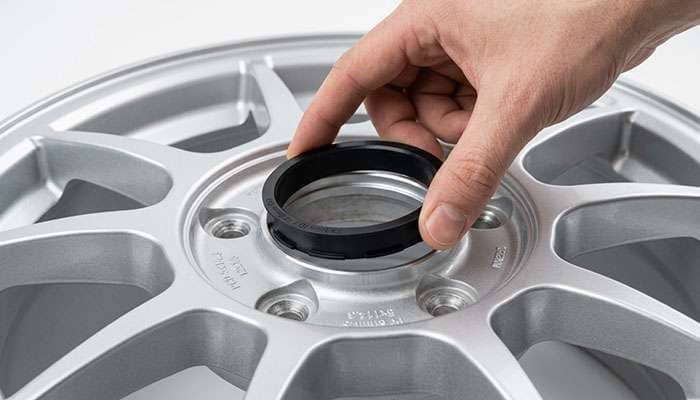
You have two ways to handle it. Buy rings, which are inexpensive, or buy a wheel machined to 56.6 mm from the factory so the question never comes up. There is a modest selection of the second kind. The Katana Racing KR06 in 18x8 with a +40 offset comes bored to 56.6 mm and lands right in the factory offset window, which means it bolts up and centers itself with no extra hardware.
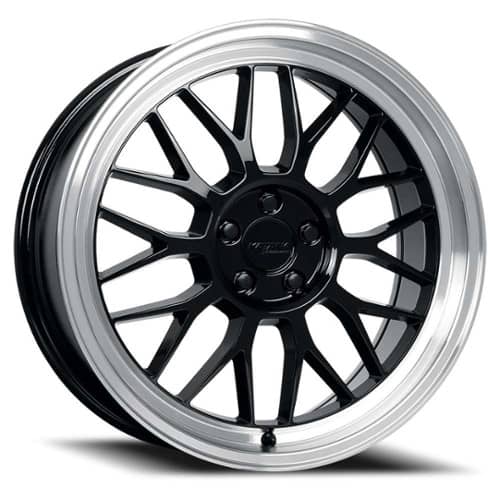
If you do go with an open-bore wheel and rings, get the rings from the wheel supplier so the outside diameter actually matches the bore that wheel was cut to. A 73.1 mm ring in a 72.56 mm bore does not work, and the difference is small enough that people order the wrong one constantly.
This is the number I care about most and the one that never shows up in a bolt pattern list. Five studs on a 105 mm circle tells you the wheel will bolt on. It tells you nothing about whether the wheel can hold the car up.
Look at the weight spread inside this one pattern. A Chevy Sonic comes in around 2,700 pounds. A Bolt EUV comes in at roughly 3,680 pounds. That is nearly a thousand pounds of difference between two cars that take the exact same wheel, and the reason is sitting under the floor: the Bolt's battery pack alone weighs about 947 pounds, which is more than fifteen times what a conventional starting battery weighs.
Now run the arithmetic. Aftermarket wheels in this pattern carry per-wheel load ratings from roughly 1,100 pounds on the light end up past 2,000 pounds on the heavy end, and the rating is stamped or cast on the back of the wheel. A front-motor electric car carries something close to sixty percent of its weight on the front axle. On a 3,680-pound Bolt EUV, that is about 2,200 pounds across the front axle before you put a single person in it, or roughly 1,100 pounds per front wheel at curb weight. A wheel rated at 1,100 pounds is sitting at its limit with an empty car, and then you add four passengers and a trunk full of groceries.
Do not do this by eye. Open your driver's door and read the placard on the jamb. It gives you the gross axle weight rating front and rear, and that is the number your wheel has to beat, not the curb weight. Divide the front GAWR by two and buy a wheel comfortably above it. On the light end of this pattern, a Sonic or a base Cruze, almost anything in the catalog clears the bar with room to spare. On a Bolt, a Bolt EUV, or a loaded Encore, you need to look.
When someone comes in shopping for a Bolt or a heavier Encore, I point them at something like the Helo HE919 in 17x7.5, which carries a 1,900-pound rating and comes bored to 56.5 mm, close enough to the hub that it centers properly on its own. Two problems solved with one part number.
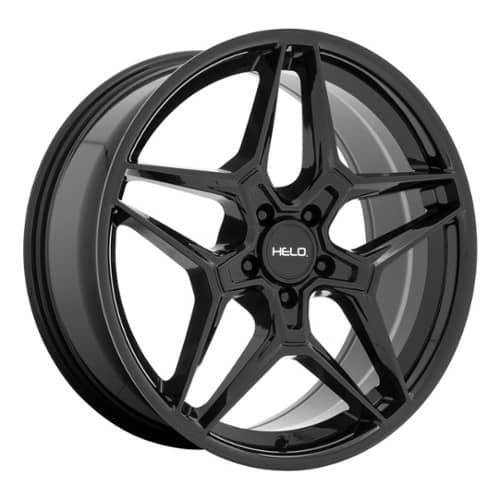
The offset matters too, and it is the third number people skip. Factory 5x10⁵ offsets sit between about +35 and +45 mm. The aftermarket clusters tightly around +40, which is convenient, but a wheel that is 8 inches wide at +40 sits differently than the 6.5-inch factory wheel it replaced, and on a strut-front small car you do not have much room to play with. Our guide on wheel offset, backspacing, and bolt patterns shows how width and offset work against each other on clearance.
No, and this one does not even get far enough to be tempting. The two patterns are 5 mm apart on the circle, which puts every stud 2.5 mm out of position radially. Lug holes on a passenger car wheel have somewhere under a millimeter of clearance around the stud. A 2.5 mm error is several times that. You will not start a single nut past the first thread on more than one hole, and the wheel will not sit flat.
Where people get in trouble is deciding to help it along. Opening the lug holes with a drill to make a 5x100 wheel go onto a 5x10⁵ hub destroys the seat geometry, which is the conical or ball surface the nut pulls against to generate clamp load. Once that seat is gone, the nut is bottoming on a chewed edge instead of a machined taper, the clamp load is a guess, and the wheel will work itself loose. I have seen it. It is not a slow failure.
The 5x100 pattern belongs to a different crowd entirely, mostly Subaru, Volkswagen, Toyota, and a long list of imports. If you want to see that group, our 5x100 bolt pattern guide covers it. If you genuinely need to run a wheel from one pattern on the other, the correct hardware is a bolt-pattern adapter that bolts to your hub at 5x10⁵ and presents 5x100 on its outer face. Adapters push the wheel outward and change your effective offset, so they have to be sized and torqued properly. Our piece on the benefits of wheel spacers and adapters covers how to do that without creating a new problem.
Yes. Those are the same pattern written two different ways. Multiply 4.5 inches by 25.4 and you get 114.3 mm exactly. It is one of the few conversions in this business that comes out clean, which is why both notations survived. American listings tend toward 5x4.5, import and modern listings toward 5x114.3, and a wheel listed either way is the same part.
The reason this question shows up next to 5x10⁵ is that 5x114.3 is the most common five-lug pattern in the world, so it is what people already have a set of sitting in the garage. It is 9.3 mm larger than 5x10⁵ and it does not interchange. Not with rings, not with longer studs, not by lining up two holes and forcing the rest. Adapters are the only correct path between them.
You will also see a fair number of aftermarket wheels sold as dual-drilled 5x10⁵ and 5x114.3, with ten holes cut in the mounting face. Those are legitimate parts and they work, though a dual-drilled face has more material removed than a single-pattern face, which is one more reason to check the load rating before you buy.
A near-miss fit does not announce itself on day one. It degrades, and it takes parts with it on the way down. Here is the order it usually happens in.
Weeks one through four. A faint vibration at highway speed that you tell yourself is the road surface. The wheel is not centered, so it is spinning around a point that is not its own axis, and no balancing machine can correct a centering problem.
Month two. Lug nuts start showing up loose at rotation. This is the warning shot. A wheel that will not stay torqued is telling you the clamp load is not holding, and if you are seeing it on one corner repeatedly, the cause is mechanical, not the technician. If yours are doing this, do not just retorque them and drive off.
Months three through six. The vibration moves into the steering wheel and the tires start wearing unevenly, usually with cupping or feathering across the shoulders. That is money leaving the building. A set of tires killed at half life on a compact car is a few hundred dollars you did not need to spend, and the sidewalls take a beating from the same forces. If you are inspecting the tires that came on a set of used takeoffs, our guide on tire sidewall damage and whether it is safe to drive shows what actually disqualifies a tire.
Past six months. Wheel bearing noise, because the bearing has been absorbing a cyclic side load it was never specified for. Elongated lug holes in the wheel, which makes the wheel scrap. And in the worst version, stud fatigue, which is the failure that separates a wheel from a car at speed. The National Highway Traffic Safety Administration tracks wheel separation as a crash cause, and the Tire Industry Association builds its wheel service training around torque and seating for exactly this reason.
None of that is worth saving the price of a set of hub rings.
Five minutes and you will know exactly what you need.
One. Find your model year and, if you have a Cruze, your engine. Both are on the driver's door jamb placard along with the VIN. This single step resolves the Cruze, Trax, Volt, and Encore questions.
Two. Confirm the pattern by measuring rather than trusting a listing. Center of one stud to the outer edge of the stud two positions over. You should land on 105 mm or 4.13 inches.
Three. Read the gross axle weight rating on that same door placard. Divide the front number by two. That is the minimum per-wheel load rating you should accept, and on a Bolt, Bolt EUV, or loaded Encore it will eliminate some of the lighter wheels on the market.
Four. Check the center bore on any wheel you are considering. If it is not 56.6 mm, order hub-centric rings from that same supplier at the same time. Do not plan to source them later.
Five. Torque to spec in a star pattern with an actual torque wrench, then retorque after fifty to a hundred miles. Aluminum wheels settle, and the retorque is not optional.
The 5x10⁵ bolt pattern is GM's small-car spec, and it covers the Chevrolet Cruze, Sonic, Trax, Volt, Bolt EV, and Bolt EUV plus the Buick Encore. What separates a good answer from a useless one is knowing that the Cruze splits on engine, the Trax splits at the 2024 redesign, the Volt splits between generations, and the Encore GX is a different car entirely, with every one of those exceptions landing on 5x115. Past that, the pattern is refreshingly consistent: M12 x 1.5 studs, a 56.6 mm bore on every factory hub, and offsets clustered between +35 and +45. Get your year right, get a bore that matches or get rings, and check the load rating against your door placard if you are on the heavy end of this family. When you are ready to shop, our full selection of 5x10⁵ bolt pattern wheels is filtered to the pattern, and we will help you sort the bore and offset over the phone if you want a second set of eyes on it.
The 5x10⁵ bolt pattern is used by GM small cars including the gas Chevrolet Cruze (2011 to 2019), Sonic (2012 to 2020), first-generation Trax (2013 to 2022), second-generation Volt (2016 to 2019), Bolt EV, Bolt EUV, and the first-generation Buick Encore (2013 to 2022). Overseas it appears on Opel, Vauxhall, Holden, and Daewoo small cars.
A 5x10⁵ bolt pattern is 4.13 inches. Divide 105 by 25.4 and you get 4.1339 inches. It is sometimes written as 5x4.13 on listings.
No. The two patterns differ by 5 mm on the circle, which puts every stud 2.5 mm out of position. Lug holes have less than a millimeter of clearance, so the wheel will not seat and most nuts will not start. A bolt-pattern adapter is the only safe way to bridge the two.
Yes. They are identical, just written in different units. Multiply 4.5 inches by 25.4 and you get 114.3 mm exactly. Neither one interchanges with 5x10⁵, which is 9.3 mm smaller.
The gas Cruze from 2011 to 2019, the Sonic from 2012 to 2020, the first-generation Trax from 2013 to 2022, the second-generation Volt from 2016 to 2019, the Bolt EV from 2017, and the Bolt EUV from 2022. The 2014 to 2015 Cruze Turbo Diesel and the 2024 and newer Trax are 5x115 instead.
Five M12 x 1.5 studs spaced evenly on a 105 mm circle, with a 56.6 mm center bore on every factory hub. Lug torque runs right around 100 lb-ft or 140 Nm, though you should confirm the figure in your owner's manual.
Usually yes. Every factory 5x10⁵ hub is 56.6 mm, but most aftermarket wheels in this pattern are open-bored around 72 to 73 mm so one casting can serve several patterns. Without rings the wheel is centered only by the lug nut tapers, which is the most common cause of a vibration that will not balance out.