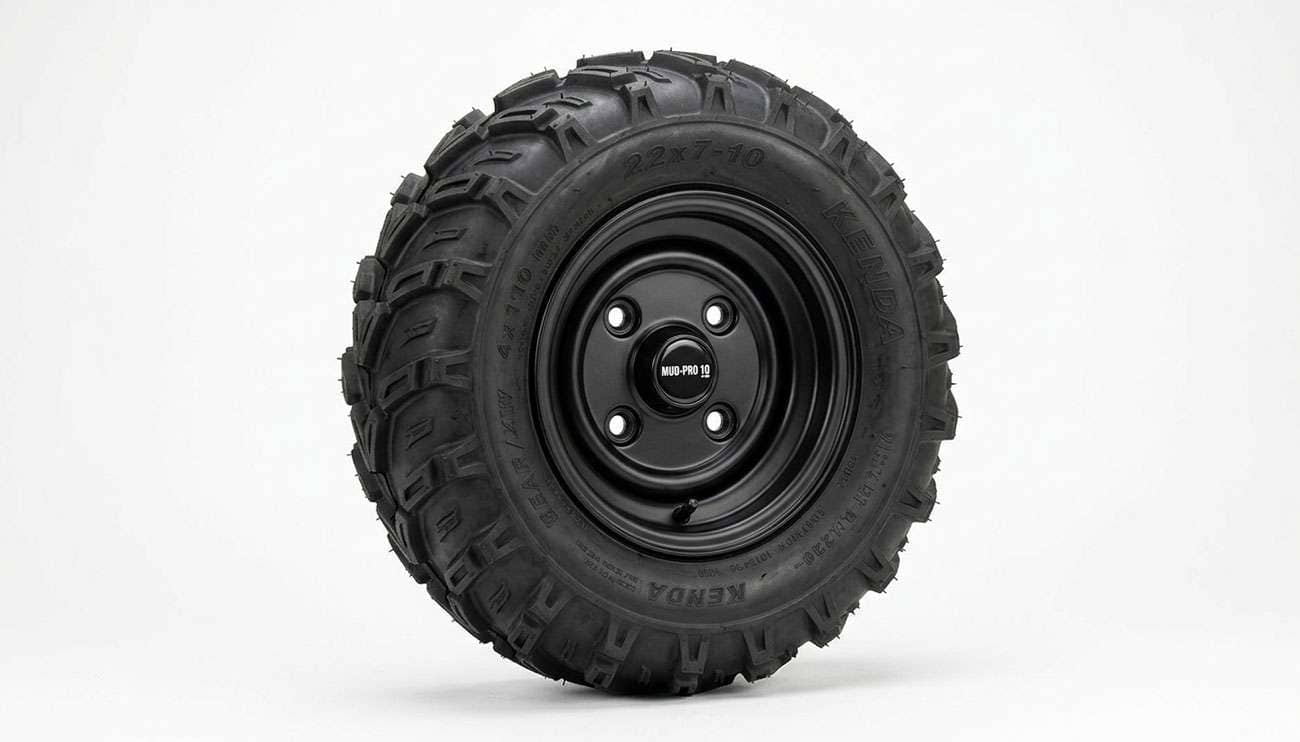
4x110 fits most utility ATVs and side-by-sides from Honda, Yamaha, Suzuki and Kawasaki, plus a lot of CFMOTO, Kymco and Hisun machines. That is the answer you will find everywhere, and it will get you into trouble, because within those exact same brands the pattern changes based on how the machine is built.
Kawasaki is the clearest example. A Kawasaki with a solid rear axle uses 4x137. A Kawasaki with independent rear suspension uses 4x110. Same brand, same model year, two completely different patterns. Nobody sells you a wheel based on your rear suspension design, but that is what decides it.
Honda sport quads are worse. They run 4x110 on the rear and 4x144 on the front. On one machine. Buy a matched set of four 4x110s for a TRX-series sport quad and you have two wheels that fit and two that do not.
Brand |
Machine Type |
Front Pattern |
Rear Pattern |
|---|---|---|---|
Honda |
Utility ATV and side-by-side |
4x110 |
4x110 |
Honda |
Sport quad |
4x144 |
4x110 |
Yamaha |
Utility ATV and most UTVs |
4x110 |
4x110 |
Yamaha |
Sport quad and 2019 and newer YXZ |
4x156 |
4x156 |
Suzuki |
Modern full-size ATV |
4x110 |
4x110 |
Kawasaki |
Independent rear suspension |
4x110 |
4x110 |
Kawasaki |
Solid rear axle, Mule and Teryx |
4x137 |
4x137 |
I have had this conversation across the counter more times than I can count. A guy comes in, tells me he has a Kawasaki, and wants four wheels. If I sell him wheels off the brand name alone, there is a real chance he goes home with the wrong set. What I need to know is whether that machine has a solid axle or independent rear suspension, and whether it is a Mule, a Teryx or a Brute Force. Those questions sound fussy. They are the whole job.
Older machines make it stranger still. Before the industry settled down, Suzuki ran patterns like 4x90 and 4x112, and you will find 4x130, 4x140 and 4x166 on various vintage quads. If you are working on anything from the 1980s or 1990s, measure it. Do not assume.
Here is the practical list. This covers the bulk of what rolls into the shop asking for 4x110.
The point I keep coming back to: a model name is a better starting place than a brand name, and a tape measure beats both. If you have the machine in front of you, measuring takes thirty seconds and settles it permanently.
No, and this is where people get hurt financially. There are at least eight four-lug patterns in regular use in the powersports world, and several of them sit close enough together that a wrong wheel will start onto the studs and feel like it is going on.
Pattern |
In Inches |
Distance From 4x110 |
Commonly Found On |
|---|---|---|---|
4x101.6 (4x4 inch) |
4.000 inch |
8.4 mm smaller |
Older light vehicles and utility equipment |
4x10⁸ |
4.252 inch |
2 mm smaller |
Ford, Peugeot, Citroen passenger cars |
4x110 |
4.331 inch |
This is the one |
Honda, Yamaha, Suzuki, Kawasaki IRS |
4x115 |
4.528 inch |
5 mm larger |
Arctic Cat four-wheelers |
4x136 |
5.354 inch |
26 mm larger |
Can-Am models |
4x137 |
5.394 inch |
27 mm larger |
Kawasaki solid axle, Can-Am, Mule, Teryx |
4x144 |
5.669 inch |
34 mm larger |
Honda sport quad front wheels |
4x156 |
6.142 inch |
46 mm larger |
Polaris, Yamaha sport, Kawasaki KRX 1000 |
Look at the tight ones. 4x10⁸ sits 2 mm from 4x110. 4x136 and 4x137 are 1 mm apart. Those gaps are small enough that a wheel will hang on the studs and look mounted. It is not mounted. On a four-lug wheel the studs are spaced the full pitch circle apart, so a 2 mm error in pitch circle means every stud is off center by 1 mm in its hole. The wheel rides on the shank of the studs instead of centering on the seats.
What that costs you: the lug nuts never fully seat, they back off under vibration, the studs get bent and eventually shear, and you lose a wheel. On a quad in the woods that is a broken machine and a long walk. I have seen the stud damage that comes from a 2 mm mismatch and it is not repairable with a wrench.
The patterns that are far apart are safer in one respect, because they will not go on at all and you find out in the driveway. If you want the neighboring patterns explained in full, we have write-ups on the 4x137 bolt pattern, on what vehicles use 4x156, and on the automotive 4x10⁸ bolt pattern that sits closest to this one.
No. They are 8.4 mm apart and they do not interchange.
4x4 means four lugs on a four-inch pitch circle. Four inches is 101.6 mm. 4x110 is 110 mm, which converts to 4.331 inches. So when somebody writes 4x4, they mean 4x101.6, and that is a genuinely different pattern that exists in its own right on older light vehicles and utility equipment.
The confusion comes from how these get written down. Powersports listings use millimeters almost exclusively. Automotive and trailer listings sometimes use inches. A seller who writes 4x4.33 and a seller who writes 4x110 are describing the same wheel. A seller who writes 4x4 is not.
My rule at the counter: convert everything to millimeters before you compare anything. Multiply the inch figure by 25.4 and work from there. It removes the ambiguity entirely.
110 mm divided by 25.4 gives 4.331 inches. You will see it written as 4x4.33, and occasionally as 4x4-5/16, since 4-5/16 inches works out to 4.313 and rounds to 110 mm.
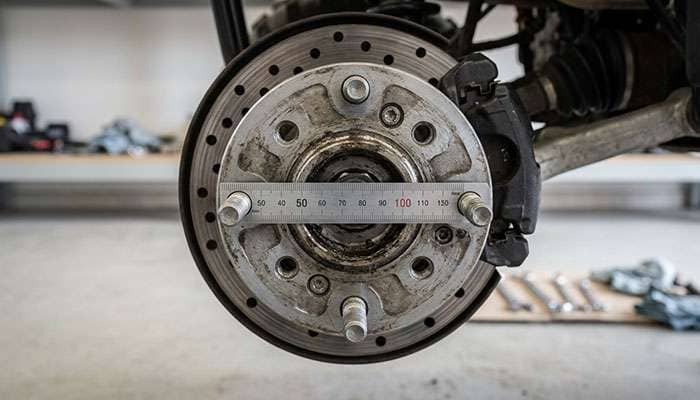
To measure a four-lug pattern yourself, run the tape from the center of one stud straight across to the center of the stud directly opposite. Four-lug and six-lug patterns measure straight across like that. Five-lug patterns do not, which is why they need a different technique. If your reading lands anywhere near 4.31 to 4.33 inches, you have a 4x110.
Measure at the studs, not at the lug nuts, and measure center to center rather than edge to edge. A quarter inch of error in the wrong direction lands you on 4x10⁸ or 4x115, and both of those are close enough to cause the problem described above. Our full guide to measuring offset, backspacing and bolt patterns covers the technique with the other patterns included.
Very few, and almost none you would be shopping wheels for today.
4x110 appeared on a handful of compact imports from the 1970s through the 1990s, with some older Mazda models being the ones people ask about most. It never became a mainstream automotive pattern, and it has essentially disappeared from passenger cars. If you are researching 4x110 in 2026, the odds are overwhelming that you are working on a quad or a side-by-side, not a car.
Here is the part that matters if you did land on this question with a car in the driveway. A matching pitch circle does not make an ATV wheel a car wheel. The 4x110 wheels being manufactured today are built at 12, 14 and 15 inches in diameter for powersports use, with hub bores, load ratings and offsets designed around a quad. Bolting one to a passenger car would be wrong on every spec that is not the bolt pattern, and the bolt pattern is the least important one on that list.
If you have an older import with a 4x110 hub and you want modern wheels, the honest answer is that you are looking at custom drilling, a hub adapter, or a hub swap. None of those are cheap and all of them need to be done by somebody who knows what they are doing.
Getting 4x110 right is step one. Here is what sinks people who got step one right.
Wheel load ratings in 4x110 run from around 350 lbs on the light end to 3,640 lbs on the heavy end. That is better than a ten to one spread inside one bolt pattern. A 350 lb wheel is built for the front of a light sport machine. Load a side-by-side with two people, a full rack and a cooler and you are asking questions that wheel cannot answer.
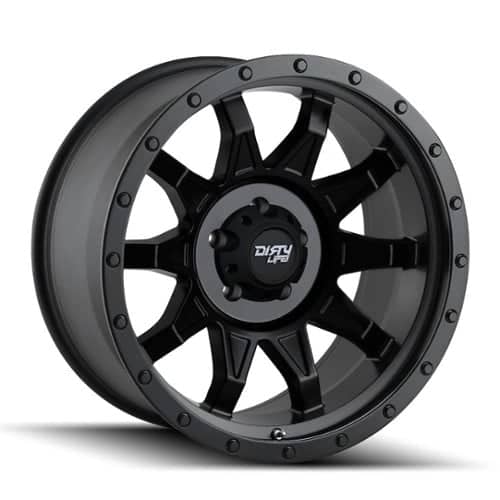
The heavy end of the range is real too. The Dirty Life Roadkill 9301 in 14x7 carries a 3,640 lb rating at around $81.88, which is more capacity than most machines will ever need. The point is not that you must buy the heaviest wheel available. The point is that the number varies by a factor of ten and nothing on the outside of the wheel tells you which one you are holding.
Hub bores on 4x110 wheels range from about 72 mm up past 132 mm. The bore is what actually carries the vehicle's weight on a hub-centric setup, with the lug nuts providing clamping force rather than support. If the wheel bore is larger than your hub, you need centering rings. Skip them and the studs end up carrying weight they were never designed to carry, and you get a vibration that no amount of balancing will fix.
Stud diameter varies across powersports machines, and lug nut seat type varies too. Conical, spherical and flat seats all exist in this world, and the seat has to match the wheel. A conical nut on a wheel machined for a spherical seat contacts on a ring instead of a cone, which means it will not hold clamping load and it will back off. This is the single most common cause of ATV wheels coming loose, and it is entirely preventable.
Buy the lug nuts that match the wheel, not the ones that came off the old wheel. Torque them in a cross pattern to the manufacturer's spec, and re-check after the first ride. Every wheel maker says this and almost nobody does it.
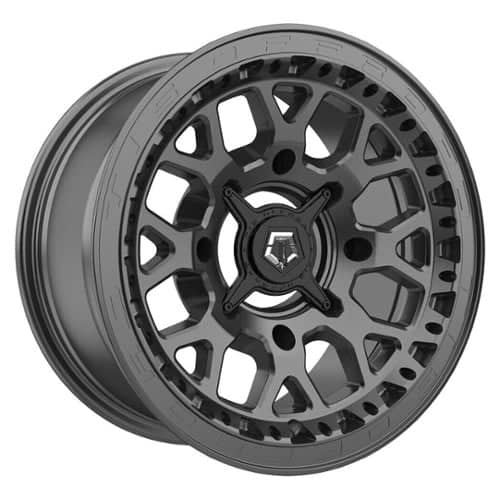
The TIS Offroad UTV 558A in 14x7 with a positive 10 offset is about as mainstream as this pattern gets. An 83.8 mm bore, a 1,000 lb rating, and it starts around $58.81. 14x7 is by a wide margin the most common size in 4x110, followed by 15x7, which lines up with what we found looking at the most common ATV wheel sizes across the board.
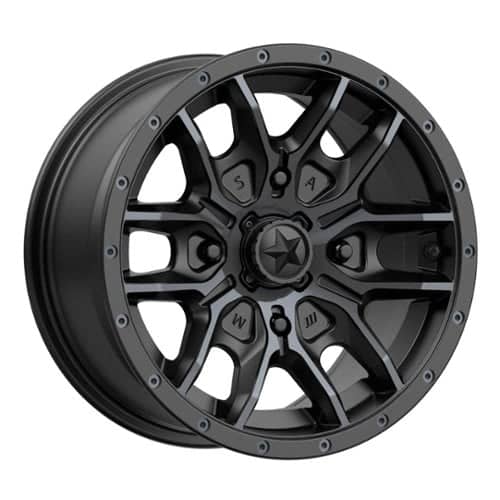
If you run low pressure in sand or rocks, a beadlock is worth the money. The MSA Offroad M44 Cannon Beadlock in 14x7 runs about $120.70 with an 86 mm bore and a 1,250 lb rating. The ring clamps the tire bead mechanically so you can air down without rolling a tire off the rim. MSA, Method, KMC and Fuel all build in this pattern, and we put the field through its paces in our roundup of ATV and UTV wheels tested by brand.
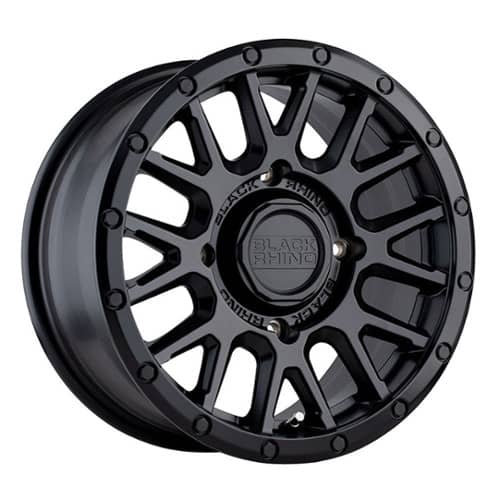
For a heavier side-by-side, the Black Rhino La Paz UTV in 15x7 at positive 36 offset carries 1,600 lbs for around $72.25. Note the offset difference from the TIS above. Offsets in 4x110 span from deep negative all the way past positive 50, and that spread changes your track width considerably. A more positive offset tucks the wheel in and keeps the machine narrower for tight trails.
Six steps. It takes about ten minutes and it beats a return shipment every time.
Step 1: Measure the front and the rear separately. Do not assume they match. Honda sport quads run two different patterns on one machine, and plenty of older quads do the same. Center of one stud to center of the stud directly across, on each end.
Step 2: Convert to millimeters and compare against the table above. Multiply your inch reading by 25.4. If you land between 4.31 and 4.33 inches, or 109 to 111 mm, you have 4x110. If you are near 4.25 or 4.53, stop, you are on 4x10⁸ or 4x115.
Step 3: Measure your hub bore. The diameter of the center hole on your hub. This determines whether you need centering rings and it is not optional information.
Step 4: Check stud diameter and count the threads. Bring one lug nut with you or note the size. This determines your hardware, and hardware that almost fits is worse than hardware that obviously does not.
Step 5: Figure your load requirement. Machine weight plus the heaviest load you carry, divided by four, with margin. Ratings in this pattern span 350 to 3,640 lbs so there is plenty of room to get it wrong.
Step 6: Pick your offset with your trails in mind. A wider track is more stable on open ground and worse in tight timber. Look at what your machine came with before you change it significantly. Our comparison of ATV versus UTV wheels covers where those design priorities diverge.
When you are ready to shop, our 4x110 bolt pattern wheel selection is filtered to this pattern specifically.
4x110 fits most utility ATVs and side-by-sides from Honda, Yamaha, Suzuki and Kawasaki, plus a good deal of CFMOTO, Kymco and Hisun. But the brand on the tank is not what determines it. The axle and suspension design determines it, which is why a Kawasaki with independent rear suspension takes 4x110 and a Kawasaki with a solid rear axle takes 4x137, and why a Honda sport quad wears two different patterns at the same time.
The near misses are what get people. 4x10⁸ is 2 mm away and 4x115 is 5 mm away, and both are close enough to start onto the studs and feel right. They are not right. Measure your machine front and rear, convert to millimeters, and confirm the load rating and hub bore before you look at a single finish. Do that and 4x110 is one of the easiest patterns to shop, with plenty of good wheels available at reasonable money.
It fits most utility ATVs and side-by-sides from Honda, Yamaha, Suzuki and Kawasaki, plus much of the CFMOTO, Kymco and Hisun lineup and select Can-Am models. The critical detail is that the pattern is set by axle and suspension design rather than brand. Kawasaki machines with independent rear suspension use 4x110, while solid rear axle models, Mules and Teryx units use 4x137.
Honda Rancher, Foreman, Rubicon and Pioneer 500; Yamaha Grizzly, Kodiak, Wolverine and Viking; the Suzuki KingQuad range; Kawasaki Brute Force and other independent rear suspension models; and most CFMOTO, Kymco and Hisun utility machines. Honda sport quads such as the TRX250R and TRX300EX use 4x110 at the rear only, with 4x144 at the front.
No. At least eight four-lug patterns are in regular use, including 4x101.6, 4x10⁸, 4x110, 4x115, 4x136, 4x137, 4x144 and 4x156. Several sit dangerously close together. 4x10⁸ is only 2 mm from 4x110 and 4x136 is only 1 mm from 4x137, which means a wrong wheel can start onto the studs without ever seating properly.
No. 4x4 means four lugs on a four-inch pitch circle, which is 101.6 mm. 4x110 is 110 mm, or 4.331 inches. The two are 8.4 mm apart and do not interchange. The confusion comes from mixed units in listings: a wheel described as 4x4.33 is the same as 4x110, but a wheel described as 4x4 is not.
4.331 inches. It is commonly written as 4x4.33 and sometimes as 4x4-5/16, since 4-5/16 inches equals 4.313 and rounds to 110 mm. To measure it, run a tape from the center of one stud straight across to the center of the stud directly opposite. Four-lug and six-lug patterns measure straight across; five-lug patterns require a different method.
Very few. The pattern appeared on some compact imports from the 1970s through the 1990s, with certain older Mazda models the most commonly cited, but it never became mainstream in passenger cars and has essentially disappeared. Today 4x110 is overwhelmingly a powersports pattern, and the wheels being built in it are 12 to 15 inches with hub bores, load ratings and offsets designed for quads rather than cars.
No, and the 5 mm gap is exactly what makes it dangerous. A 4x110 wheel will often start onto 4x115 studs and feel like it is going on, but the studs end up bearing against the sides of the holes rather than centering in the seats. The lug nuts never fully clamp, they loosen under vibration, and the studs bend and eventually shear. Arctic Cat machines commonly use 4x115.