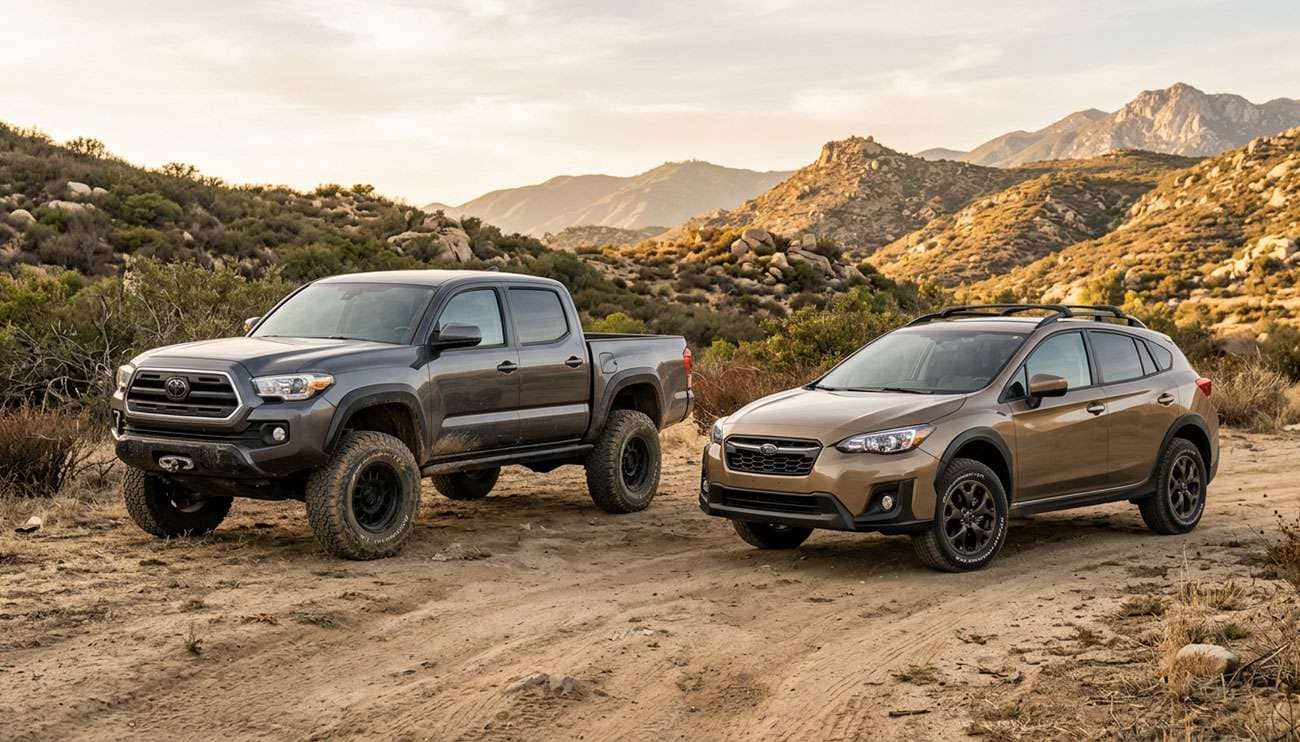
Short answer: 4WD is better for hard off-roading because it has a low-range transfer case and can lock the front and rear driveshafts together. But that lock only works front to rear. The variable most guides skip is what happens at each axle when a wheel lifts, and which tires your drivetrain lets you run. A 4WD with open differentials can stall with one front and one rear wheel spinning. An AWD crossover usually runs out of clearance and sidewall before it runs out of traction.
I'm Dennis Feldman, and I run fitment at Performance Plus Tire. The answer you'll hear most often is "it depends on the terrain." It does, and you deserve the rest of that sentence. It depends on three things: whether your system has low range, whether your axles can keep both wheels driving when one of them lifts, and whether your tires can survive the trail. Find your terrain in the table below, then read the section for your setup.
The columns run from the most common crossover system to a fully equipped trail rig. "Yes" assumes all-terrain tires in good shape and a driver who picks a line instead of spinning through it.
Terrain |
On-Demand AWD |
AWD With Off-Road Mode |
Part-Time 4WD, Open Diffs |
4WD With Low Range and Lockers |
|---|---|---|---|---|
Graded dirt and fire roads |
Yes |
Yes |
Yes |
Yes |
Washboard gravel and desert washes |
Yes, at moderate speed |
Yes |
Yes |
Yes |
Packed snow on a trail |
Yes, on snow-rated tires |
Yes |
Yes, in 4-High |
Yes, in 4-High |
Deep, unplowed snow |
Limited by clearance |
Limited by clearance |
Yes |
Yes |
Soft sand |
Short stretches; coupling heat builds |
Yes, aired down; watch heat |
Yes, aired down |
Yes, aired down |
Mud ruts |
Rarely |
Short sections |
Yes, until it crosses up |
Yes |
Steep, loose climb |
Marginal |
Moderate grades |
Yes, in 4-Low |
Best |
Cross-axle ruts and moguls |
Stalls once a front and a rear wheel unload |
Usually, using brakes or rear clutches |
Stalls unless traction control catches it |
Yes, both sides keep driving |
Rock ledges and crawling |
No |
Mild obstacles only |
Yes, with slow control in 4-Low |
Best |
Look at where the columns split. On graded dirt, washboard and packed snow, every column says yes, and a lot of weekend forest-road and desert-wash driving falls in those rows. The columns split at crossed-up ruts, rock and long stretches of wheelspin. In each case, the cause is a part most people never look at.
The names are marketing more than engineering. SAE International's J1952 recommended practice, revised in May 2024, files every one of these systems under "all-wheel drive" and sorts them by how they operate. Jeep's own 4x4 FAQ describes AWD as almost the same as full-time 4WD. What matters is how the front and rear axles are connected, and whether there is a low gear range. Here are the four layouts you'll actually run into:
So the badge on the tailgate tells you less than the hardware underneath. Off-road, two pieces of that hardware decide the answer: the transfer case, or the lack of one, and the differential at each axle.
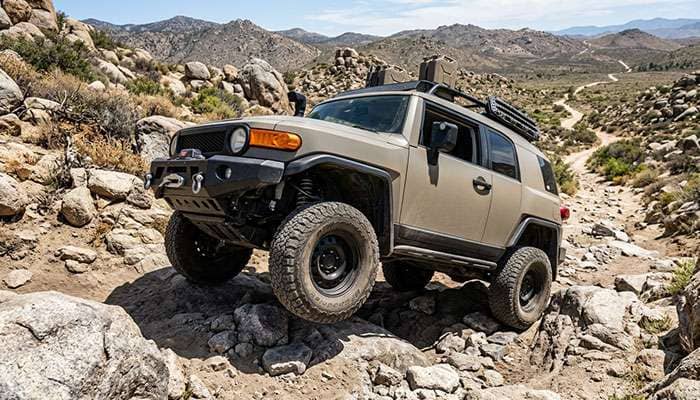
Not always, and this is the part most people never hear. A 4WD transfer case locks the front axle to the rear axle. It does nothing about left and right.
Every axle has a differential so the outside wheel can turn faster in a corner. An ordinary open differential splits torque equally between its two wheels. That sounds fair until one wheel loses grip. If the left wheel can only take a tiny amount of torque before it spins, the right wheel gets the same tiny amount. Lift a wheel off the ground and that axle stops pushing, while the lifted wheel spins happily in the air.
Part-time 4WD helps because a spinning front wheel can't steal the rear axle's torque. The two axles are locked together. But on a diagonal rut, one front wheel and one rear wheel unload at the same time, and now both axles are limited by a spinning wheel. Ford's Bronco Off-Roadeo instructors put it plainly: without lockers, you effectively have one front wheel and one rear wheel driving. That's why a stock 4WD can sit there with two tires spinning and two tires planted.
There are three fixes, from least to most capable:
This is how an AWD crossover with a smart rear drive unit can out-climb a base part-time 4WD on a crossed-up rut, and why a locked Rubicon walks past both of them.
Low range is a second gearbox that multiplies everything the transmission does. The number to compare is the crawl ratio: first gear, times the transfer case low range, times the axle ratio.
Jeep's launch specs for the JL Wrangler show the spread. A Sport or Sahara with the automatic and the 2.72:1 Command-Trac case lands at 44.2:1. A Rubicon with the automatic and the 4.0:1 Rock-Trac case lands at 77.2:1, and 84.2:1 with the manual. Now the crossover side. Subaru publishes a 4.066 first ratio and a 4.111 final drive for the Forester Wilderness, which works out to about 16.7:1. X-MODE's low-ratio gradient control can pull the CVT a little lower on steep grades, but nothing in a crossover multiplies torque the way a transfer case does.
Run the math and the Rubicon has about 4.6 times the gear reduction of the Forester Wilderness in its lowest gear. Even the base Wrangler has about 2.6 times. Here's what that buys you on a trail:
If your trails never need walking-pace control, low range is insurance you won't use. If they do, no AWD calibration fully replaces it.
Yes, and it usually happens at the worst moment. Most on-demand AWD systems send power to the rear through a clutch pack. A slipping clutch turns power into heat. Sustained wheelspin in sand, mud or a long loose climb makes more heat than many of these units were built to shed.
The carmakers say so in their own manuals. Ford lists an "AWD Temporarily Disabled" message, shown when the system shuts itself off to protect against overheating. GM's "ALL WHEEL DRIVE OFF" message appears when the rear drive system is overheating. When that happens, you are driving a front-wheel-drive car at exactly the spot where you needed all four. Ford fitted larger-engine Bronco Sports with extra coolers for the rear drive unit, which tells you the engineers expected the heat.
A part-time 4WD transfer case in 4-Low doesn't have that problem in the same way. When it's locked, power goes through gears or a chain, not a slipping clutch, so slow work doesn't build heat in the case like it does in an AWD coupling.
If you drive AWD on loose ground, keep wheelspin short. Carry momentum, air down in sand, and back off and reset instead of spinning. If the warning comes on, stop and let it cool. Spinning harder won't bring it back any sooner.
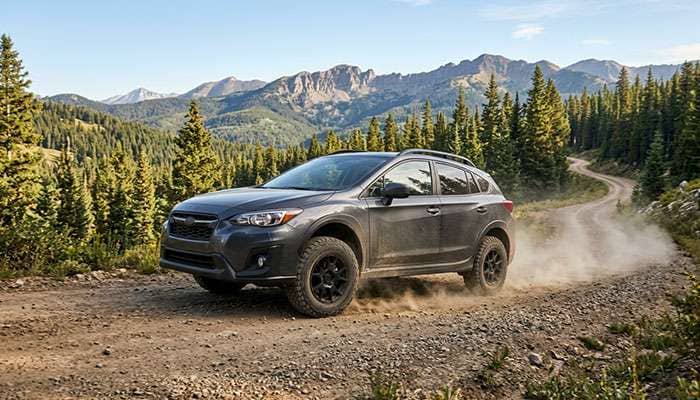
For most people, yes. Graded forest roads, ranch roads and dry desert washes are well within what a healthy AWD system on all-terrain tires can handle. What usually stops an AWD crossover first isn't the drivetrain. It's the clearance and the tires.
Look at what Subaru changed to build the Outback Wilderness. Ground clearance went from 8.7 inches on a standard Outback to 9.5 inches. The approach angle went from 18.6 to 20.0 degrees. The departure angle went from 21.7 to 23.6 degrees. Subaru also added a front skid plate and all-terrain tires. It didn't add a transfer case. When the carmaker builds its most capable trail version, it spends the money on clearance and tires, which tells you where a crossover runs out first.
Two practical limits to plan around:
On plowed roads and packed snow, AWD is often the better tool. It's always on, it reacts on its own, and you can't forget to engage it. On deep, unplowed snow, a 4WD truck pulls ahead for the same reason it does in mud: more clearance, and a drivetrain that can keep turning without heat-soaking a clutch.
California's chain law doesn't separate them at all. Under Caltrans R2 chain controls, 4WD and AWD vehicles skip chains only with snow-tread tires on all four wheels, and both must still carry traction devices. Caltrans treats AWD the same as 4WD for chain control. The drivetrain gets you the exemption. The tires decide whether you qualify. My guide to chains with 4WD or AWD in California covers each level and the sidewall markings that count.
One thing neither system helps with is stopping. Four driven wheels help you climb and pull away. Braking and turning come down to the tires and how much tread is left on them.
Sand is where heat and tires collide. Soft sand needs steady power and steady wheel speed for a long time, which is the exact load that overheats an on-demand AWD coupling. A part-time 4WD in 4-High with the tires aired down is the standard dune setup for a reason.
Airing down matters more than which drivetrain you have. Lower pressure lets the tire flatten into a longer footprint that floats on sand instead of digging. My guide to airing down walks through how far to go and when to stop.
This is where the tire construction gap shows up. A lighter passenger-construction all-terrain on a crossover gives you less room to air down before you're risking the bead or the sidewall. A heavier LT tire on a truck can run lower with more margin. If you're running sand in an AWD crossover, keep the stretches short, keep your momentum, and don't sit there spinning.
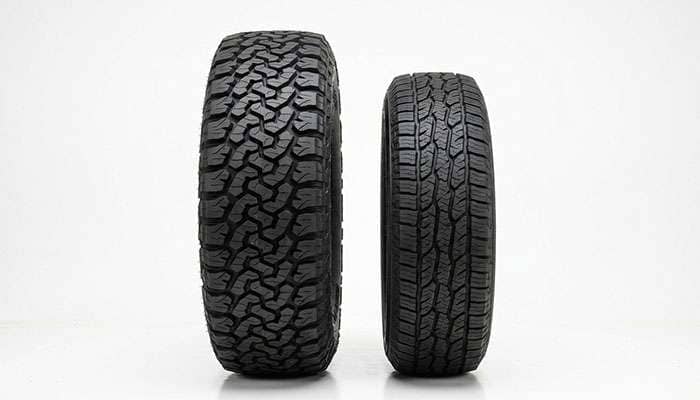
This is the part of the comparison most people skip, and it's where a tire shop sees the difference every day. The drivetrain decides what fits under the vehicle, and what fits decides which tires you can buy.
I pulled the current all-terrain and mud-terrain market in the sizes each class of vehicle wears. In the 17- and 18-inch sizes most AWD crossovers run, about one all-terrain tire in twenty is LT construction, and the few that exist cluster in 225/65R17. Mud-terrains in those sizes barely exist. In midsize 4WD truck sizes, more than half of all-terrains are LT construction, and mud-terrains are a normal option. In heavy-duty truck sizes, more than eight in ten all-terrains are LT.
Factory equipment tells the same story. Subaru ships the Forester Wilderness on Yokohama Geolandar A/T tires in 225/60R17 99T, a passenger-construction all-terrain. That's a good tire for what the vehicle is built to do. It isn't a rock-crawling tire, and no tire in that size is.
Vehicle Type |
Common Off-Road Sizes |
Construction You Can Buy |
Mud-Terrain Options |
Watch For |
|---|---|---|---|---|
Compact and midsize AWD crossover |
225/60R17, 225/65R17, 235/65R17 |
Almost all passenger (SL or XL); a few LT Load Range D in 225/65R17 |
Nearly none |
Buy four at once; tread tolerance can be as tight as 2/32 |
Midsize 4WD SUV or pickup |
265/70R17, 285/70R17, 255/75R17 |
Passenger, XL and LT Load Range C or E |
Common |
LT rides stiffer; set pressure from LT load tables, not the passenger placard |
Half-ton 4WD pickup or SUV |
275/65R18, 275/70R18, 275/60R20 |
About half LT, half passenger or XL |
Common |
Pick the load range for your payload, not the tread |
Heavy-duty 4WD pickup |
LT245/75R17, LT275/70R18, LT275/65R20 |
Mostly LT Load Range E |
Common |
Never drop below the placard load range |
Why does construction matter so much off-road? An LT tire carries more load at higher pressure and is built with a heavier casing, which is what resists a sharp rock edge. My P-metric vs LT tire breakdown covers the load and pressure math. If you're choosing a tread style for a 4WD, start with my all-terrain vs mud-terrain comparison.
Put the two halves together and you get the real answer to 4WD vs AWD. A 4WD truck gets better hardware and also a far wider choice of tires. A crossover owner is choosing from a much shorter list, so picking the right tire from that list matters even more.
On an AWD vehicle, often yes, and that's a cost a 4WD owner rarely thinks about. AWD systems are always comparing wheel speeds. A new tire is taller than a worn one, so it turns slower, and the system reads that difference as constant slip.
Subaru tells owners to keep all four tires within a quarter inch of rolling circumference, which works out to about 2/32 of an inch of tread depth. Most other AWD makers land somewhere between 2/32 and 4/32. My AWD tire requirements guide lists the tolerances by brand.
Now take that to the trail. You cut a sidewall on a rock with your tires half worn. A sidewall cut isn't repairable, for the reasons in my sidewall damage guide. A new replacement tire sits several 32nds taller than the other three. On a Subaru, that means four tires, or one tire shaved down to match.
A part-time 4WD truck is more forgiving here. In 2-High the front and rear axles aren't tied together through the transfer case, so one mismatched tire doesn't load the drivetrain the way it does in AWD. Match it before you shift into 4WD, though, because a locked transfer case with mismatched tires acts like driving on pavement. Check your owner's manual for your truck's limits.
Then there's the spare. The Forester Wilderness ships with a full-size spare, and so do most trucks. Many AWD crossovers carry a compact spare, and GM's manuals note the "ALL WHEEL DRIVE OFF" message comes on when one is installed. My guide to driving an AWD car on a donut spare covers what that means for the drive out.
No. This is the one place where AWD beats 4WD with no argument. Jeep's own FAQ explains that part-time 4WD has no center differential, and that on dry surfaces the extra grip binds the driveline, which Jeep calls "crow hop," and causes unnecessary wear on parts.
The mechanism is simple. In a turn, the front wheels travel a wider arc than the rears, so they need to turn faster. With the driveshafts locked together, they can't. On dirt, the tires slip a little and the strain goes away. On dry pavement they can't slip, so the strain builds in the transfer case, driveshafts and axles until something gives. You'll feel it as a shudder or a bang in tight turns.
Full-time 4WD and AWD have a center differential or coupling to take up that difference, so they're fine on any surface. Some newer 4WD systems add an automatic mode that can stay engaged on mixed surfaces. Jeep's Selec-Trac offers 4WD Auto, for example. That's AWD-style behavior making its way into 4WD trucks, and it's the mode to use when the road keeps switching between wet pavement and dirt.
A mismatch between your trail and your setup rarely fails all at once. It gets more expensive in steps:
Everything on that list starts at the tires: the wrong construction for the trail, a mismatched set, or the wrong pressure. The tires are also the cheapest thing on the list to get right.
When you're ready to compare tires, start with our all-terrain tires and filter by your exact size and load range.
4WD is the better off-road system once the trail gets hard, because it has low range and a locked transfer case. But the transfer case only locks front to rear. What keeps you moving on a crossed-up rut is what happens at each axle, and what keeps you off the tow strap on rock is the tire. An AWD crossover with a smart rear drive unit and the right all-terrain tires handles more than most people expect, right up until clearance, heat or sidewall becomes the limit. Find your terrain row, check your axles and your low range, then choose your tires to match what you actually drive.
AWD is good for graded dirt roads, fire roads, washboard gravel and packed snow, especially on all-terrain tires. It struggles on rock, deep mud and crossed-up ruts, and many on-demand systems overheat during sustained wheelspin. Clearance and tire construction usually limit an AWD crossover before the drivetrain does.
For moderate trails, yes. Wilderness models add X-MODE, a front skid plate, all-terrain tires and more clearance, with 9.5 inches on the Outback Wilderness. There's still no low-range transfer case, and the tires must stay within about 2/32 of each other in tread depth, so plan for four matched tires and a full-size spare.
Not for graded dirt or packed snow. You need 4-Low for rock crawling, steep loose climbs and steep descents, where walking-pace control and engine braking matter. Low range multiplies torque through gears instead of slipping a clutch, so it also keeps the drivetrain cooler during slow, hard work.
On pavement and in mixed weather, AWD is often better because it works full time on any surface. Off-road, 4WD is better once the trail needs low range, more clearance or sustained power. California's chain law treats them the same: both need snow-tread tires on all four wheels to skip chains at R2.
You need them for crossed-up ruts, ledges and moguls, where one front and one rear wheel lose grip at once. Without lockers or traction control, an open differential sends almost no torque to the wheel with grip. For fire roads, sand and snow, good tires at the right pressure matter more.
Yes, as long as all four are the same size and model and are replaced together. In most crossover sizes, the all-terrains on the market are passenger construction, with a few LT options in 225/65R17. Keep the overall diameter close to stock so the AWD system and speedometer read correctly.