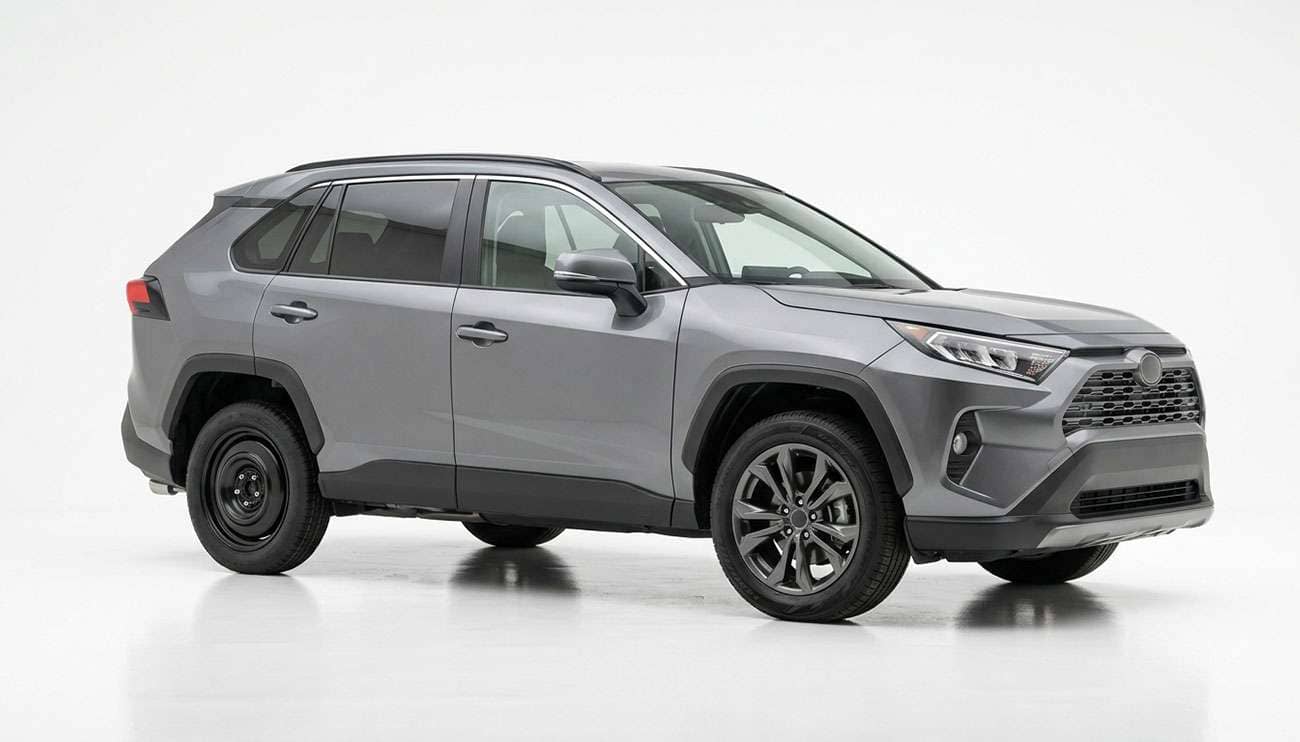
Yes, you can drive most AWD cars on a donut spare, but only as far as the nearest tire shop, at 50 mph or less, with the donut on the axle your owner's manual names. The part nobody puts in front of you is which kind of AWD you have. An on-demand crossover system can switch off its rear drive and limp along as a front-driver. A full-time system has to slip a clutch pack or a viscous coupling every foot you drive. And a part-time 4WD truck needs to stay in 2WD.
Most answers you'll find stop at "it depends on your vehicle." It depends on three specific things: the type of system connecting your front and rear axles, how much shorter your donut is than your road tires, and which corner the donut ends up on. Get those right and a donut is a safe ride to the shop. Get them wrong and you can cook a drivetrain part that costs more than four new tires.
I've been fixing flats in Long Beach since 1971. Back then the spare was a fifth tire that matched the other four. The skinny temporary spare came later (here's when compact spare tires started being used), and today it rides under the cargo floor of AWD crossovers that watch every wheel's speed constantly. That combination is what we're sorting out here.
Find your system in the left column. Your owner's manual names it in the drivetrain section, and your console is a hint: a 2H/4H/4L selector means part-time 4WD, and no selector at all usually means on-demand AWD.
AWD System Type |
Where You'll Find It |
What the Donut Does to It |
OK to Limp to a Shop? |
Where the Donut Goes |
|---|---|---|---|---|
On-demand (front-drive based) |
Most compact and midsize crossovers |
Reads the donut as nonstop wheel slip. Many systems shut off rear drive; older designs keep engaging the rear clutch |
Yes, short and slow |
Rear. If a front tire went flat, move a good rear tire forward |
Full-time, clutch-pack center coupling |
Subaru CVT models, BMW xDrive and other computer-controlled full-time systems |
The clutch slips nonstop to absorb the speed gap and builds heat |
Yes, but distance hurts most here |
Rear, per the manual |
Full-time, mechanical center differential (viscous or Torsen) |
Subaru manual-transmission models, Torsen-equipped Audi quattro, full-time 4WD SUVs |
The center diff absorbs the gap, but its limited-slip element fights it and heats up |
Yes, short and slow. Never lock the center diff |
Rear, per the manual |
Part-time 4WD (2H/4H/4L, no center diff) |
Body-on-frame pickups and SUVs with a 4WD selector |
Nothing unusual in 2H. In 4H or 4L the gap winds up the driveline |
Yes, in 2H only |
Rear if you can |
Electric AWD (separate motor per axle) |
Dual-motor EVs, hybrids with an electric rear motor |
No driveshaft between the axles to bind. Only the axle differential sees the gap |
Yes, the gentlest case |
Per the manual (many ship with no spare at all) |
The common thread: the AWD manuals that address placement point the donut to the rear, nearly all of them cap speed at 50 mph, and every one treats it as a ride to the shop. Where the systems differ is how hard the drivetrain fights the mismatch along the way.
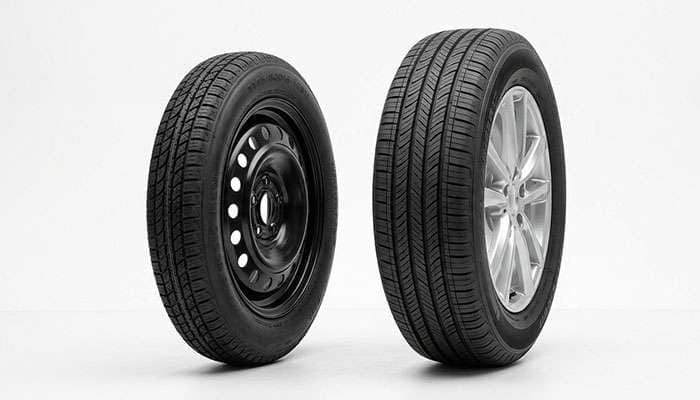
It comes down to rolling diameter. A shorter tire turns more times per mile. A crossover on 225/65R17 tires rides on tires about 28.5 inches tall, turning about 707 times per mile. Bolt a T165/80D17 temporary spare on one corner and that wheel is about 27.4 inches tall, turning about 736 times per mile.
That's 29 extra revolutions every mile, or roughly 1,450 every hour at 50 mph. The donut spins about 4% faster than the tire across from it, all the time, in a dead-straight line. Those extra revolutions land in three places.
The differential lets the outside wheel outrun the inside wheel in a corner. With a donut on one side, it acts like you're in a turn that never ends, spider gears working mile after mile. An open differential tolerates that on a short trip. Honda's owner's manual tells manual-transmission owners not to mount the compact spare on the front because the smaller tire may damage the differential.
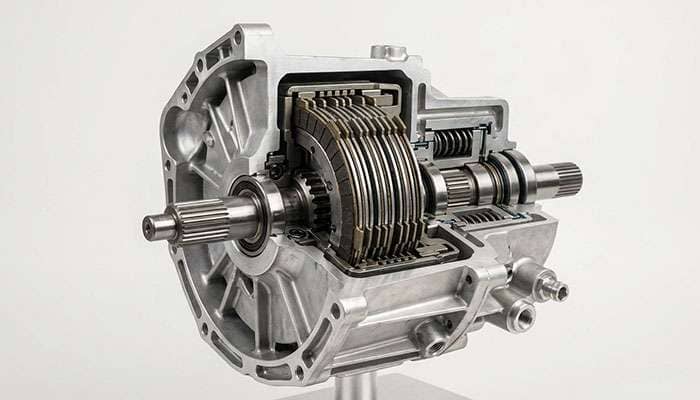
This is what makes AWD different. On a front-drive car, nothing ties the front axle to the rear, so a donut on the back just goes along for the ride. On an AWD car, a center differential, viscous coupling, or clutch pack sits between the axles, and one donut makes one axle's average speed run about 2% faster than the other's.
Normally that coupling sees a speed difference for a few seconds at a time, in a turn or on wet paint. A donut makes it permanent. A clutch pack slips continuously. A viscous coupling shears its silicone fluid continuously, and that fluid heats and thickens, exactly as it's designed to respond to slip. The coupling can't tell a tire spinning on ice from a tire that's simply smaller.
Your ABS, stability control, traction control, and AWD computer read the same wheel-speed sensors, and a donut looks to them like a wheel slipping constantly. Smart systems recognize the pattern and back off. Others keep trying to fix a slip that isn't there.
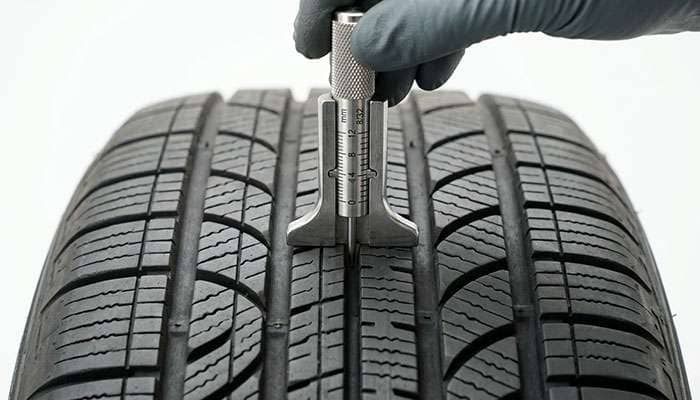
Here's the number that should get your attention. AWD makers fuss over tiny differences between your four road tires. Published limits I've seen run from 2/32 to 4/32 of an inch of tread depth difference, or 1/4 to 1/2 inch of rolling circumference. Then the same car ships with a spare that can be 3 or 4 inches shorter around.
That's not a contradiction. The road-tire limits protect the coupling over years. The donut is engineered for a short emergency trip, and the manufacturer accepted a little coupling wear in exchange for a light spare. The trouble starts when a short trip turns into a week.
Mismatch |
Diameter Gap |
Circumference Gap |
Versus Typical AWD Limits |
What to Do |
|---|---|---|---|---|
New tire with three tires worn 2/32 in |
0.125 in |
0.39 in |
Inside most published limits |
Usually fine to replace just the one tire |
New tire with three tires worn 4/32 in |
0.25 in |
0.79 in |
At or past the edge for many makers |
Shave the new tire to match, or replace all four |
New tire with three tires worn 6/32 in |
0.375 in |
1.18 in |
Past nearly every published limit |
Replace all four, or shave the new one |
T155/90D17 donut with 225/65R17 tires |
0.53 in |
1.67 in |
3 to 7 times past |
Temporary only: 50 mph, straight to a shop |
T165/80D17 donut with 225/65R17 tires |
1.12 in |
3.53 in |
7 to 14 times past |
Temporary only: 50 mph, straight to a shop |
T125/70D18 donut with 235/45R18 tires |
1.44 in |
4.51 in |
9 to 18 times past |
Temporary only: shortest possible trip |
Notice how much the donut rows vary, from about half an inch shorter to almost an inch and a half. That gap is your variable. For everyday tread and circumference rules, see our guide to AWD tire requirements.
Read the tire and loading information placard on the driver's door jamb. Federal Motor Vehicle Safety Standard (FMVSS) No. 110 requires it to list the original tire sizes and cold inflation pressures, spare included. NHTSA takes that seriously: Nissan recalled 4,655 2026 Rogues (NHTSA recall 25V912) because some carried a spare that didn't match the placard size, which could lead an owner to set the wrong pressure.
For each size: width times aspect ratio, divided by 100, times 2, divided by 25.4, plus rim diameter. For 225/65R17, that's 225 x 0.65 x 2 / 25.4 + 17 = 28.5 inches. For T165/80D17, it's 27.4 inches. Subtract for the diameter gap; multiply by 3.14 for circumference. The "T" means temporary and the "D" means diagonal, or bias-ply, construction. Neither is built for the long haul.
The back, in almost every case, even when the flat is up front. That means one extra jack lift: move a good rear tire to the front and put the donut where it was. Figure 15 extra minutes. Here's why it's worth it.
Swap on level ground, in park, brake set, wheels chocked, and never get under a car on the factory jack. If your manual gives a different placement for your model, the manual wins.
A short, slow trip to the shop? Almost never. A week of freeway commuting? It can, and the damage is usually silent until it isn't. Your risk depends on the system.
On-demand AWD often protects itself. GM's Acadia manual says AWD disables automatically on the compact spare, and that you restore it, and prevent excessive clutch wear, by putting the road tire back. Ford's Taurus manual says AWD may drop to front-drive-only mode. Volvo says rear drive can be disconnected and warns that different-size wheels can seriously damage the transmission. Toyota's Grand Highlander manual lists the AWD system among those that may not operate correctly and warns of possible drivetrain harm. Remember: a system protecting itself means you're driving a front-driver on a skinny tire. In rain or snow, drive like it.
Full-time AWD takes the hit. It powers both axles all the time and can't just switch the rear off. A clutch-pack coupling slips the whole trip, a viscous coupling heats and stiffens, and a Torsen center differential keeps trying to bias torque. Heat wears all of them. Keep these trips shortest.
Electric AWD is easiest on the hardware. With a separate motor on each axle, there's no driveshaft to bind. The axle differential and stability systems still see the gap, but the expensive between-the-axles damage is off the table.
Early coupling trouble feels like binding or a crow-hop in tight parking-lot turns, a shudder pulling away from a stop, or a hot-fluid smell. Notice any of that after time on a donut, and have the drivetrain checked, not just the tire.
On a part-time 4WD truck or SUV, keep it in 2H. In 2H it's a rear-drive vehicle, and a donut on the back is just a smaller tire on an open rear differential.
4H and 4L lock the front and rear driveshafts together with no center differential, so both axles must turn at the same average speed. A donut makes that impossible, and the difference winds up the driveline, loading the transfer case, U-joints, and both differentials. It's the same reason you never run part-time 4WD on dry pavement. If you're truly stuck and need 4WD to get moving, keep it brief and slow, check what your manual allows, and shift back to 2H once you're out.
Full-time 4WD SUVs with a center differential behave like full-time AWD. Leave the center diff lock off; locking it creates the same windup. And a full-size spare isn't automatically a match. One that's never touched pavement has full tread while your other four are worn, so treat it as temporary too.
Yes, if it's the spare Subaru supplied and you follow Subaru's rules. Nearly the whole lineup runs full-time AWD, so this question hits my counter more than any other brand. Subaru's Forester and Legacy owner's manuals lay it out:
That original-spare rule matters. I've seen folks grab a "close enough" donut off a friend's car. A different donut can widen the gap and pile strain on the center coupling. CVT Subarus use an electronically controlled transfer clutch; manual-transmission models use a viscous-type center differential. Both are full-time, and both feel the mismatch every foot. Some newer Subaru trims ship without a spare, so check under the cargo floor before you need it.
The Subaru, Toyota, Volvo, Kia, and Honda manuals I checked all cap speed at 50 mph. Treat that as the ceiling, not the target. On AWD, I'd rather see you at 40 to 45 mph on surface streets, because coupling slip grows with road speed and heat builds with time.
Distance is fuzzier. Most manuals say "nearest tire store" or "as soon as possible." Our shop rule for any donut is 50 miles, with 70 as the absolute ceiling, explained in how long you can drive on a flat or spare tire. On AWD, beat those numbers.
Here's an outlier that proves the point. A GM Acadia manual rates its compact spare to 65 mph and 3,000 miles, and the same manual says AWD shuts itself off while that spare is on. The tire can go the distance; the drivetrain sits it out. The spare's rating and the drivetrain's tolerance are two different numbers.
Other rules that show up again and again: no towing, no chains on the donut, no automatic car washes, one temporary spare at a time. The car also sits lower, about an inch less ground clearance by one maker's count, so take driveway lips slowly.
Because your car noticed. Every system that reads wheel speed sees one wheel turning about 4% faster than its partner. Toyota's Grand Highlander manual lists ABS and brake assist, stability control, traction control, the AWD system, tire pressure warning, radar cruise, and the pre-collision system among those that may not operate correctly on the compact spare. Expect some mix of these:
Don't clear codes and keep driving. Once you're back on four matched tires, most lights clear after a short drive. If one stays on, have it scanned. A coupling that got hot on the way to the shop can leave a code behind.
I've had customers roll in on a donut they'd run for three weeks "because the car felt fine." It felt fine because the AWD had turned itself off, and the donut was down to the cords.
You can drive an AWD car on a donut spare. You just can't drive it far, fast, or for long, and the reasons depend on the system under you. On-demand crossovers often switch the rear off and leave you front-drive on a skinny tire. Full-time systems slip a clutch or viscous coupling every foot. Part-time 4WD trucks stay in 2H. In every case, the donut goes on the rear unless your manual says otherwise, 50 mph is the ceiling, and the tire shop is the destination.
Fifty-five years of fixing flats has taught me this about donuts: they're a bridge, not a road. Cross it quickly, get the right tire back on, and your AWD will never know it happened.
Not on a short, slow trip to a tire shop. Risk builds with distance, speed, and heat. Full-time systems with a clutch-pack or viscous center coupling take the most strain, while many on-demand systems protect themselves by turning rear drive off. Stay under 50 mph and replace the donut as soon as you can.
For a temporary donut, most AWD manuals that address it say no. Subaru, Mazda, and Toyota direct the donut to the rear. If a front tire goes flat, move a good rear tire forward and mount the donut on the rear.
As few as possible. Most manuals give no mileage, only "nearest tire store" or "as soon as possible." A good rule for any donut is 50 miles, 70 at the absolute most, and on AWD aim well under that at 40 to 45 mph.
Yes, beyond a short emergency trip. A different-diameter tire forces the center coupling to slip constantly, building heat and wear in clutch packs, viscous couplings, and differentials. Published AWD limits typically allow only 1/4 to 1/2 inch of circumference difference.
Not always. If the other three are close to new, replacing one is usually within limits. If they're worn 4/32 of an inch or more, you'll typically need to shave the new tire to match or replace all four.
Yes, and it's easier on the drivetrain than a donut, but it isn't automatically a match. An unused full-size spare has full tread while your other four are worn, creating its own diameter gap. Treat it as temporary unless its size, model, and tread depth match the other three.