
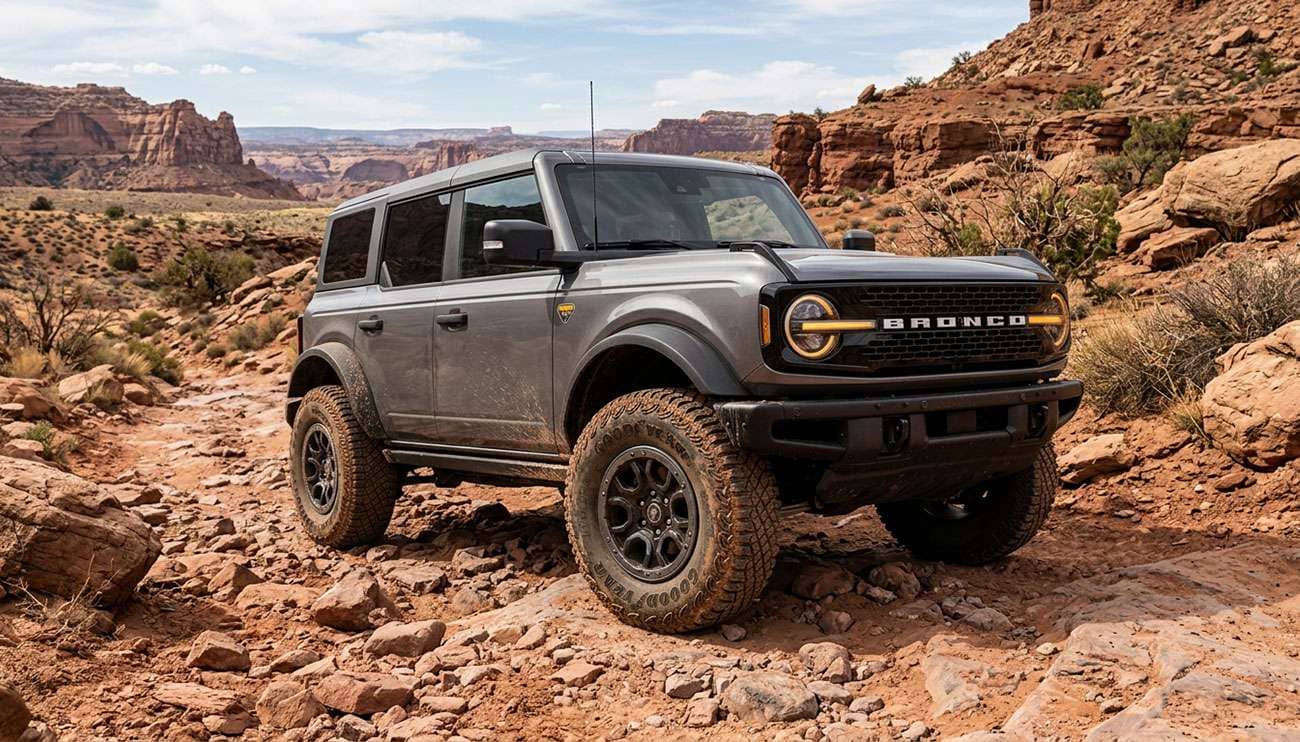
Yes, you can put 35s on a Bronco without the Sasquatch package, but how wide the 35 is decides how much work it takes. A narrow 35x10.50R17 or 35x11.50R17 goes on the factory 17-inch wheels once the front crash bars come off, usually with a small level. A full-width 35x12.50R17 needs what Sasquatch gets from the factory: a +30 mm wheel in place of your +55 mm wheel, taller flares, and some lift. The part most answers skip is where the inside and outside edges of the tire end up.
I've put a lot of tires on Broncos since the new ones came out, and the happy owners are the ones who figure out what Sasquatch is before they order. It isn't magic. It's a list of parts, and you can match most of it one piece at a time.
Your Bronco |
Factory wheel |
The 35 that fits |
What it takes |
|---|---|---|---|
Base on 16s |
16x7, +55 mm |
None on the factory wheel |
17-inch wheels first, then pick a row below |
Big Bend and Black Diamond |
17x7.5 (17x8 on a 2025 Big Bend), +55 mm |
35x10.50R17 or 35x11.50R17 |
Crash bars off; most owners add a 1.25 to 1.5 in. level |
Badlands |
17x8, +55 mm |
35x10.50R17, 35x11.50R17, or 315/70R17 |
Crash bars off; a 315 sits about 0.6 in. closer to the upper control arm |
Outer Banks on 18s |
18x7.5, +55 mm |
35x12.50R18 on lower-offset 18s, or move to 17s |
New wheels plus the full-width list below |
Any trim, full-width 35 |
Needs about +30 mm |
35x12.50R17 |
Lower-offset wheels or spacers, crash bars off, high-clearance flares, 1.5 to 2 in. of lift |
Any 17-inch trim, no cutting at all |
Factory +55 mm |
285/75R17 (33.8 in.) |
Owners report no rub; it's a tall 34, not a 35 |
Every Bronco in that table shares the same 6x139.7 bolt pattern and the same +55 mm factory offset, so the answer comes down to tire width first and wheels second. The Raptor is its own animal on 37s and isn't covered here.
Ford sells Sasquatch as one line on the window sticker, but it's a bundle, and each piece in it solves a different part of the 35-inch problem. On a 2025 Base, Ford listed the package at $8,460. Here's what that money buys and what a non-Sasquatch owner does instead.
Sasquatch part |
What it does for 35s |
What you do without it |
|---|---|---|
17x8.5 beadlock-capable wheels, +30 mm offset |
Moves the tire about 1 in. outboard, away from the upper control arm |
Lower-offset wheels, hub-centric spacers, or a narrower 35 |
LT315/70R17 tires |
Ford's "35," which measures about 34.4 in. on paper |
Choose your 35 by width, not by the number on the sidewall |
High-clearance fender flares |
Covers the tread that now sits farther out, with room above it for flex |
Sasquatch or aftermarket flares, or a tire that stays inside the stock flare |
High-clearance suspension with position-sensitive Bilstein shocks |
Raises the body so the taller tire has room to move |
A 1.25 to 2 in. level or lift |
No front crash bars |
Nothing in the way of the tire at full lock |
Remove the bars or swap to aftermarket bars shaped for bigger tires |
4.7 final drive with front and rear electronic lockers |
Gives back the leverage a taller tire takes away |
Regear, or live with a little less pull |
Ford's own spec sheet shows what the whole bundle is worth on the trail. It lists 11.6 inches of ground clearance and a 43.2-degree approach angle for the 35-inch setup, against 8.4 inches and 35.5 degrees for a base 2-door. Tires alone won't get you every bit of that, but they get you a lot of it.
Here's the first thing I tell anybody asking about 35s on a Bronco: the tire Ford calls a 35 isn't 35 inches tall. A 315/70R17 works out to about 34.4 inches. That's not a knock on it. It's part of why the Sasquatch fits so well. But "35s" covers several very different tires, and on a non-Sasquatch Bronco the width matters more than the height.
Tire size |
Diameter |
Section width |
Rim width range |
Typical weight |
Where it fits |
|---|---|---|---|---|---|
LT285/70R17 (Badlands stock) |
32.7 in. |
11.2 in. |
7.5 to 9.5 in. |
About 57 lb |
Factory fitment |
285/75R17 |
33.8 in. |
11.2 in. |
7.5 to 9.5 in. |
About 63 lb |
Factory wheels and suspension, no rub reported |
35x10.50R17 |
35 in. |
10.5 in. |
Measured on an 8.5 in. rim |
About 67 lb |
Factory 17s; the narrowest true 35 |
35x11.50R17 |
35 in. |
11.5 in. |
7.5 to 10 in. |
About 67 lb |
Factory 17s, including the 7.5 in. wheels |
LT315/70R17 (Sasquatch stock) |
34.4 in. |
12.4 in. |
8 to 10.5 or 11 in. |
About 65 lb |
Sasquatch wheels; the 8 in. Badlands wheel with crash bars off |
35x12.50R17 |
35 in. |
12.5 in. |
8 to 11 in. (8.5 minimum on some) |
About 77 lb |
About +30 mm wheels, or the factory wheel with a spacer |
Two things jump out. First, a 35x10.50R17 is narrower than the tire a Badlands comes with, and it's still a full 35 inches tall. Second, look at the rim width column. Most manufacturers list 8 inches as the narrowest rim for a 315/70R17 or a 35x12.50R17, and the Big Bend and Black Diamond left the factory on 7.5-inch wheels. A tire has to clear the truck and sit on a rim it was built for. If you're still deciding how big to go, our 31s vs. 33s vs. 35s comparison lays out the trade-offs in each size class.
Every non-Sasquatch Bronco on 17s rides on a +55 mm wheel. Here's how the 35-class sizes behave on it, based on what owners have run.
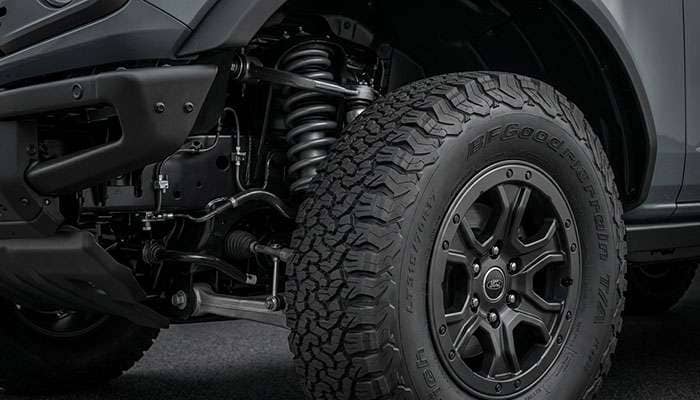
This is the size I wish more Bronco owners knew about. It's a real 35, and at 10.5 inches wide it tucks inside the stock flare better than the Badlands' own 285. Owners run it on factory wheels. The height still puts the front crash bars in the way at full lock, and most people add a small level. The catch is selection: far fewer tread patterns than 35x12.50R17.
An inch wider, with more tread choices, and still rated for a 7.5-inch factory wheel. On the stock +55 mm wheel it sits within about a sixth of an inch of where the Badlands' factory tire sits, inside and out. Same deal on crash bars and leveling.
One Black Diamond owner reported his 315s cleared on factory wheels once the crash bars came off. But on a +55 mm wheel, the inside of a 12.4-inch tire sits about 0.6 inch closer to the upper control arm than the factory 285 does. On the 7.5-inch Big Bend and Black Diamond wheels, you're under the rim width most manufacturers list. On a Badlands' 8-inch wheel, you're at the bottom of the range.
Owners put it plainly: a full-width 35 on factory wheels may not work without rubbing. One owner measured about half an inch between the tire and the upper control arm, and he added 1.5-inch spacers. This is the size that needs a lower-offset wheel and flares that can cover it.
At 33.8 inches and the same 11.2-inch width as the Badlands' stock tire, owners report it runs on factory wheels and suspension with no rubbing. It isn't a 35, but it's the biggest tire I'd put on a stock non-Sasquatch Bronco without picking up a tool. For load ranges and tread types by trim, our Bronco tire buying guide walks through the rest of the choice.
This is the variable nobody puts in front of you. Offset is the distance from the center of the wheel to the face that bolts to the hub. The more positive the number, the farther the wheel tucks in toward the suspension. Your factory wheel is +55 mm. The Sasquatch wheel is +30 mm. That 25 mm is about an inch, and it's most of the room Ford made for 35s.
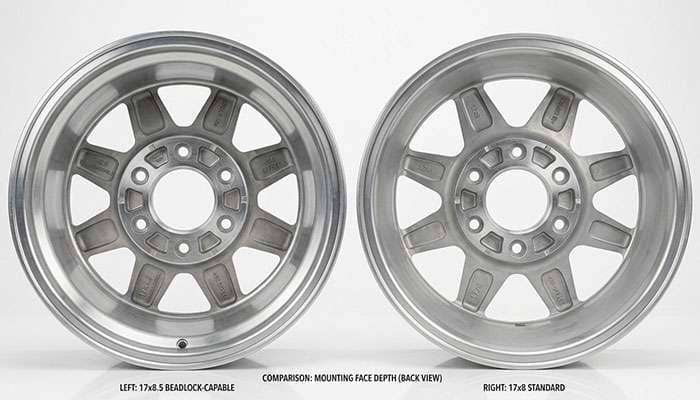
Here's how I explain it at the counter. Every tire has two edges that matter. The inside edge finds the upper control arm. The outside edge finds the flare. Combine width and offset, and you can see where both land compared to the stock Badlands tire.
Tire and wheel |
Inside edge vs. stock Badlands |
Outside edge vs. stock Badlands |
What it means |
|---|---|---|---|
LT285/70R17 on the +55 mm factory wheel |
Baseline |
Baseline |
Factory Badlands |
Sasquatch LT315/70R17 on +30 mm |
0.4 in. more room |
1.6 in. farther out |
Why Sasquatch gets high-clearance flares |
35x10.50R17 on +55 mm |
0.35 in. more room |
0.35 in. farther in |
Same arm clearance as Sasquatch, inside the stock flare |
35x11.50R17 on +55 mm |
0.15 in. less room |
0.15 in. farther out |
Close to stock |
315/70R17 on +55 mm |
0.6 in. less room |
0.6 in. farther out |
Tight at the arm |
35x12.50R17 on +55 mm |
0.65 in. less room |
0.65 in. farther out |
Tight at the arm; owners add spacers or new wheels |
35x12.50R17 on +30 mm |
0.35 in. more room |
1.6 in. farther out |
Lands almost exactly where the Sasquatch tire does |
35x12.50R17 on +55 mm with a 1.5 in. spacer |
0.85 in. more room |
2.15 in. farther out |
Plenty of arm room, more tire outside the flare |
That math uses nominal widths, and real tires vary a bit by brand and rim. But the pattern holds. A 35x12.50R17 on a +30 mm wheel lands within a sixteenth of an inch of where Ford put the Sasquatch tire. A 35x10.50R17 on your factory wheel gets the same arm room as the Sasquatch and stays under your stock flare.
Fitment guides for full-width 35s on non-Sasquatch Broncos run from about +35 mm down to +0 mm. Lower offset buys arm clearance, but it pushes the tire toward the flare and adds steering effort. One owner running 35x12.50s on +30 mm wheels noticed heavier steering and sharper hits over bumps. A hub-centric spacer moves the tire out the same way a lower offset does, and our guide to wheel spacers and tire rub covers when that works and when it only moves the rub somewhere else. The same width-versus-offset math runs through our breakdown of 35s on a Wrangler JL without a lift, if you've got one of those in the family too.
On most non-Sasquatch Broncos, yes. The crash bars are steel bars that sit just ahead of each front tire, tucked in behind the ends of the front bumper. At full lock, the front of a 35 swings right into them.
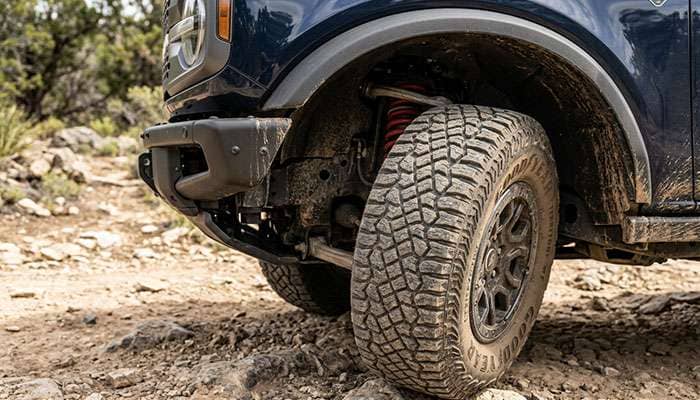
Know what they're for before you pull them. Owners describe them as there to help keep the tire from being pushed back into the footwell in a frontal crash. Owners also point out that Sasquatch Broncos are built without them, which is the argument most people make for taking them off. Others install aftermarket crash bars shaped for bigger tires. It's your call. I'd just make it knowing what the part does.
If you pull them, a heads-up from owners who have: the nuts are welded in place, so you remove the bolts, and the bars may not slide out until the end of the bumper is loosened and moved out a little.
It depends on which edge of the tire you moved.
If your tire sits inside the stock flare, like a 35x10.50R17 on the factory wheel, the flare still covers the tread. If you pushed it out, like a 35x12.50R17 on a +30 mm wheel, about 1.6 inches more tread hangs out than on a stock Badlands. That's when owners switch to Sasquatch flares, aftermarket flares, or fender deletes, and owners report standard flares rub during articulation even when the tire clears at ride height. Several states also have rules about how much tread a fender or flare has to cover, so check yours.
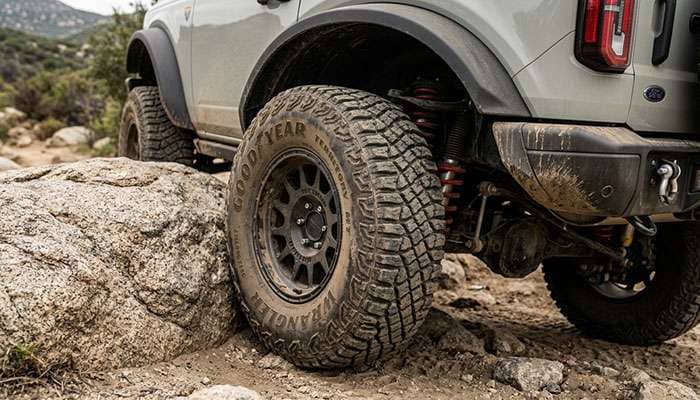
A 35 is more than 2 inches taller than the Badlands' stock tire, so the top of the tread gets more than an inch closer to everything above it. Among owners running 35s without Sasquatch, a 1.25 to 1.5 in. level is the common move. For a full-width 35x12.50R17 on a base Bronco, fitment guides put it closer to 2 inches of lift. The Sasquatch gets that height from its own high-clearance suspension, so matching Sasquatch fitment means matching that too.
A little rub sounds harmless, and at first it is. The trouble is that rub doesn't stay little. Here's the usual order on a Bronco, cheapest to most expensive.
Every step on that list costs more than picking the right width and offset in the first place.
Not to make it move. But look at what Ford did. When it put a 34.4-inch tire on the Sasquatch, it put 4.7 gears in the axles with it. Non-Sasquatch Broncos left the factory with numerically lower gears. Ford's 2025 spec sheet lists 4.27, 4.46, and 4.70 for the standard Bronco, and some earlier trucks came with 3.73s.
Your axle ratio |
Same gearing on Ford's 34.4 in. tire |
Leverage vs. a Sasquatch |
|---|---|---|
4.70 on 35x12.50R17 |
About 4.62 |
About 2 percent less |
4.46 on 35x12.50R17 |
About 4.38 |
About 7 percent less |
4.27 on 35x12.50R17 |
About 4.20 |
About 11 percent less |
3.73 on 35x12.50R17 |
About 3.67 |
About 22 percent less |
Another way to look at it: a Big Bend with 4.27s on its stock 32.1-inch tire would need about a 4.66 to feel the same on 35s. That's the 4.7 Ford picked for Sasquatch, almost to the decimal. The 10-speed automatic hides a lot of the difference on the highway, and plenty of owners run 35s on 4.46s happily. With 4.27s you'll feel it more, and with 3.73s or a manual you'll feel it most, crawling and on grades. Our guide to regearing after bigger tires walks through when it's worth the money.
Most 35-class sizes are LT tires, and they're heavy. A typical 285/70R17 like the Badlands' stock tire is around 57 pounds, a typical 315/70R17 around 65, and a typical 35x12.50R17 around 77. On a Big Bend coming off a 255/75R17 in the mid-40s, a full-width 35 adds more than 30 pounds a corner, and a fifth one goes on the tailgate. One owner reported dropping from about 19.5 mpg to about 16.
LT tires also need the right air pressure to carry the truck. The door jamb placard required under FMVSS 110 lists the pressure for the factory tire, and the Tire and Rim Association load-and-inflation tables tell you what your new LT tire needs to carry the same load.
Going from a 32.7-inch Badlands tire to a 35 puts your speedometer about 7 percent low. At an indicated 65, you're doing about 70. On a Big Bend coming off a 32.1-inch tire, you're doing about 71. On a Base coming off a 30.1-inch tire, it's closer to 76. The Bronco's tire size is a setting in the body control module, and owners change it with Forscan or have a dealer do it. Our guide to bigger tires and speedometer error covers getting it right.
Get it aligned after the tires go on, especially if you changed wheels, added spacers, or leveled it. A heavy LT tire a hair out of spec wears the edges fast.
Here's the order I'd go in, and most of it happens before you spend a dime.
So, can you put 35s on a Bronco without Sasquatch? Yes. A narrow 35x10.50R17 or 35x11.50R17 goes on the factory 17s with the crash bars off and a small level. A 315/70R17 works on a Badlands' 8-inch wheel but sits tight to the upper control arm. A full-width 35x12.50R17 needs about +30 mm of offset, flares that cover it, and some lift, which is most of the Sasquatch list. And if you don't want to cut or unbolt anything, a 285/75R17 gets you a tall 34 on a stock truck. Read your wheel, pick by width, plan the crash bars, and you'll be happy with your 35s the first time out.
Owners report that a 285/75R17, about 33.8 inches tall, runs on factory 17-inch wheels and suspension with no rubbing. Narrow 35s like 35x10.50R17 and 35x11.50R17 also fit the factory wheels, but most owners remove the front crash bars and add a 1.25 to 1.5 in. level.
On most non-Sasquatch Broncos, yes. The bars sit just ahead of the front tires behind the ends of the bumper, and a 35 hits them at full lock. Sasquatch Broncos are built without them. Some owners replace them with aftermarket crash bars shaped for bigger tires instead of removing them.
Owners have run them on factory wheels with the crash bars removed. On the +55 mm factory wheel, the tire sits about 0.6 inch closer to the upper control arm than the stock 285/70R17, and the 8-inch Badlands wheel is at the bottom of the rim width range most manufacturers list for a 315/70R17.
About +30 mm, the same as the Sasquatch wheel, puts a 35x12.50R17 almost exactly where Ford puts the Sasquatch tire. Fitment guides range from about +35 mm down to +0 mm. Lower offset adds control arm clearance but pushes the tire toward the flare and adds steering effort.
Not to make it drive, but you lose leverage. On 35x12.50R17s, 4.46 gears leave you about 7 percent short of a Sasquatch and 4.27 gears about 11 percent short. The 10-speed automatic hides much of that on the highway. Manual transmission trucks and lower gear ratios feel it most.
Yes. Going from the Badlands' 32.7-inch tire to a 35 reads about 7 percent slow, so an indicated 65 is about 70. From a Big Bend's 32.1-inch tire it's about 71. The tire size setting lives in the body control module, and owners change it with Forscan or at a dealer.



