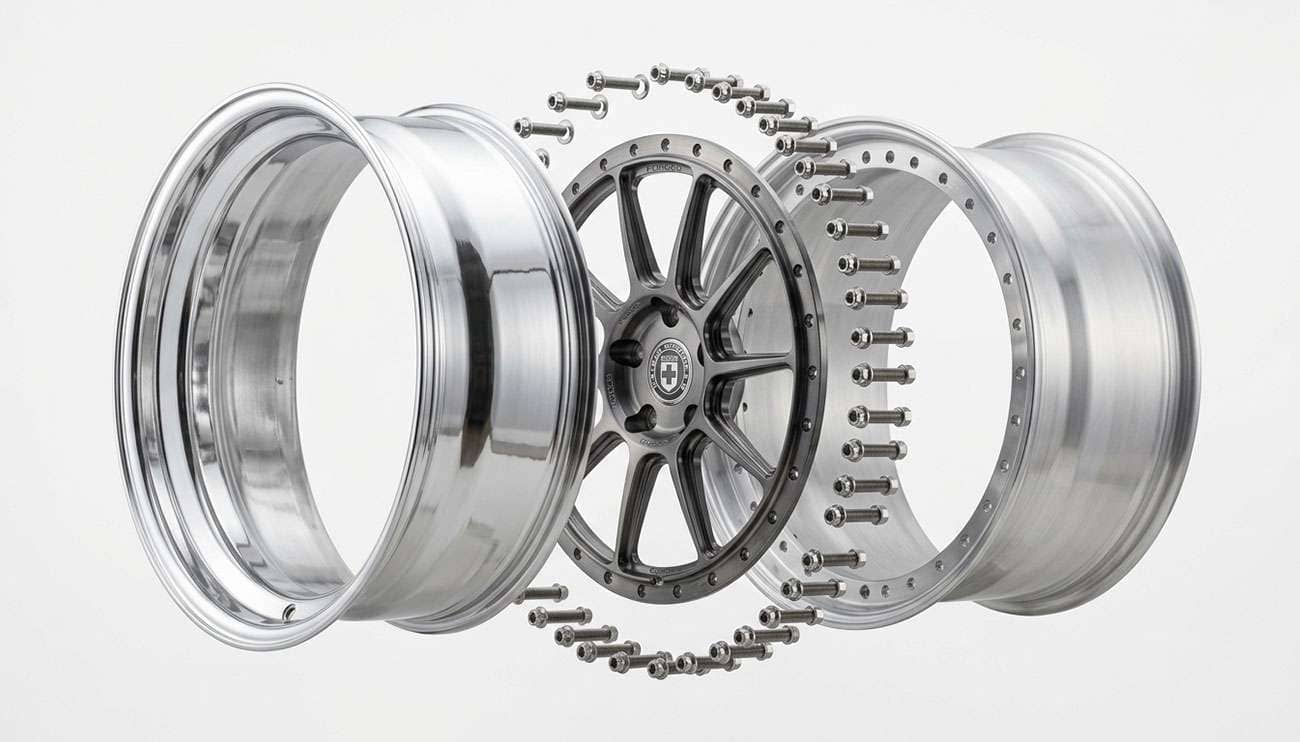
Here's the thing about a one-piece wheel: the width and offset are cast or forged into a single chunk of aluminum the day it's made. You buy what exists. A 3-piece wheel works the opposite way. The width and offset aren't fixed dimensions you shop for, they're built from separate components you select, which is exactly why this construction style can land a fitment a monoblock simply can't be ordered in.
I spend most of my week translating a customer's "I want it to sit like this" into actual numbers on an order form, and the 3-piece platform is the one place where the geometry is fully in your hands. So let's take it apart, literally, and look at how those two numbers, width and offset, get assembled out of three pieces of metal.
A 3-piece wheel is made of a center disc (the face that bolts to your hub), an outer barrel half, and an inner barrel half. The two barrel halves bolt together around the center disc with a ring of perimeter fasteners, and the seam between them is sealed so the assembly holds air like any other wheel.
That sounds like a manufacturing detail, but it's actually the whole story for fitment. On a one-piece wheel, the mounting face and the barrel are one object: move the face and you move everything. On a 3-piece, the center disc is its own part, the barrel halves are their own parts, and each one contributes independently to the final dimensions. Change a barrel half and you change width or offset without touching the face design. That separation is what makes the platform so flexible, and it's the reason 3-piece wheels show up under luxury cars, vintage restorations, and track builds where an off-the-shelf size won't cut it.
If you're still deciding between this and a simpler two-piece design, our breakdown on the 2-piece vs 3-piece making the right choice walks through where each one earns its keep. And if you want the construction-method context, cast vs forged vs flow formed wheels covers how the pieces themselves are produced.
Overall wheel width on a 3-piece is just the sum of the two barrel halves plus the small amount of material at the center where they meet. In practice, you spec it by choosing how deep the outer half is and how deep the inner half is. Want a wider wheel? Order deeper halves. Want it narrower? Shallower halves. The center disc doesn't change.
Barrels are typically available in half-inch increments, so you're building width in 0.5-inch steps. Here's the part that trips people up: how you add that width determines what happens to offset. Add a half inch to the outer half only, and you've pushed the face outward. Add a half inch to the inner half only, and you've tucked the wheel inward. Add a half inch to each, a full inch of width total, and the face stays put because you've grown the wheel symmetrically around the mounting surface.
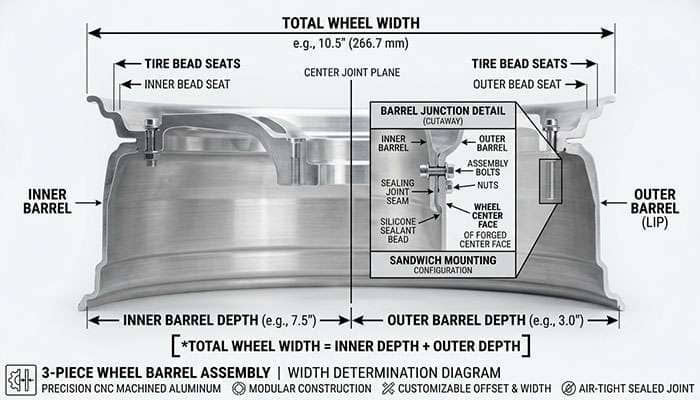
This is the single most useful concept on the platform: you can grow a wheel wider while keeping the same offset, simply by splitting the added width evenly between the two halves. A one-piece wheel can't do that, you'd have to find a completely different part number, and it may not exist. On a 3-piece, it's just two slightly deeper barrels. That flexibility is also a big part of why 3-piece wheels are so expensive, since you're paying for made-to-spec components rather than mass-produced castings.
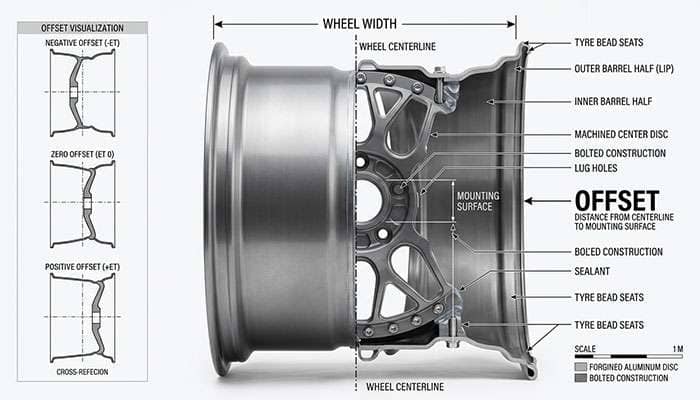
Offset is the distance between the wheel's mounting surface and its true centerline. Positive offset puts the mounting face toward the street side of the wheel (tucked in), negative offset pushes it toward the brake side (poked out). Backspacing is a related but separate measurement: the distance from the mounting face to the inner edge of the wheel. If those terms are fuzzy, our guide on wheel offset backspacing bolt patterns explained lays out the fundamentals.
On a 3-piece wheel, offset is set two ways working together: the depth of the center disc (how far the mounting pad sits relative to the wheel face) and the split between your inner and outer barrel halves. The geometry is predictable. As a working rule, every 1.0 inch you shift between the inner and outer halves moves offset by roughly 13mm. Half-inch changes move it about 6.5mm, and I round that to 7mm when I'm doing quick math at the counter.
Direction matters. Adding depth to the outer half (a bigger lip up front) effectively lowers offset and pokes the wheel out. Adding depth to the inner half raises offset and pulls it in. Change only one side and offset moves by half of whatever you added to width; change both sides equally and offset doesn't move at all. That predictability is why a 3-piece can be dialed to a target number instead of rounded to the nearest available part. For the practical side of choosing a number that clears your fenders and suspension, wheel offset explained how to get the perfect fit every time is the companion read.
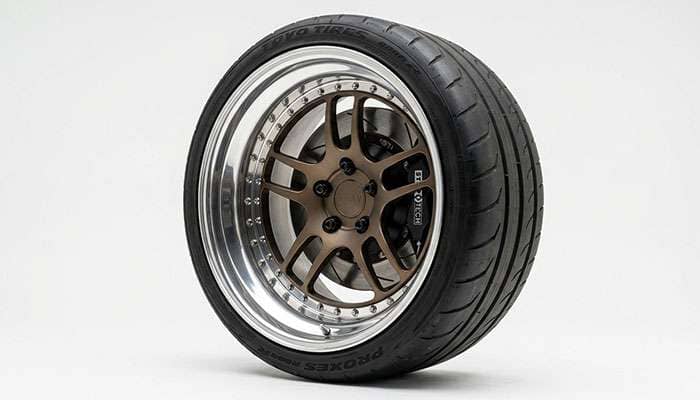
The outer lip, that exposed band of polished or finished metal you see on a deep-dish 3-piece, isn't just styling. It's the visible portion of the outer barrel half, and its depth is a fitment decision before it's an aesthetic one. A deeper outer lip means a deeper outer barrel, which means the face sits further inboard relative to the street edge of the wheel. You get the dish you want, but you've also lowered the effective offset and changed how the tire sits in the well.
This is the trade every builder negotiates. You can chase a dramatic lip for the look, common on the deep dish wheels people love on stance and show cars, but the deeper you go, the more you push the assembly's geometry around, and the more carefully you have to watch tire clearance, fender lines, and suspension travel. A shallower lip is more conservative both visually and dimensionally. The center disc concavity, how far the face is recessed, stacks on top of all this. Brands like Asanti and American Racing offer 3-piece lines specifically because that lip-and-concavity flexibility is what their customers are after.
If you're weighing the deeper engineering behind multi-piece construction versus a single forged block, the different types of forged wheels from mono-block to multi-piece is worth a look.
Let's make this concrete. Say you've got an 18x9.5 wheel at +35 offset that fits, but you want a deeper lip and a more aggressive stance, sitting at +12, while keeping the same 9.5 width. On a one-piece wheel, that's a different part you'd have to hope exists. On a 3-piece, it's the same center disc with a redistributed barrel.
The 23mm offset change (+35 down to +12) is roughly 1.8 inches of metal shifted from the inner half to the outer half, using the ~13mm-per-inch rule. In real builds you don't usually do it that extreme on a non-staggered set, but the math shows how the platform thinks: you're moving width from one side to the other, not buying a new wheel.
Spec |
Build A (Tucked) |
Build B (Aggressive) |
|---|---|---|
Overall width |
18x9.5 |
18x9.5 |
Offset |
+35mm |
+12mm |
Center disc |
Same part |
Same part |
Outer barrel / lip |
Shallower |
Deeper (~1.8 in more) |
Inner barrel |
Deeper |
Shallower |
Face position |
Tucked inboard |
Poked outboard |
Now apply the other rule. If instead you wanted to keep that +35 offset but widen from 9.5 to 10.5, you'd add a half inch to each barrel half. Width grows a full inch, the face stays exactly where it was, and the wheel just gets wider symmetrically. Same wheel, wider tire, no fitment surprise. That's the kind of move that's trivial on a 3-piece and impossible to special-order on most one-piece designs.
Flexibility cuts both ways. Because you're specifying the dimensions yourself, you're also responsible for getting them right, and there are a few places I see builds go sideways.
Chasing lip and forgetting clearance. A huge outer lip looks incredible and lowers offset, but it pushes the tire toward the fender and the inner barrel toward the strut and brake hardware. Always confirm caliper and suspension clearance for the actual offset you're building, not the one you started with.
Mismatched barrels or hardware. The halves and center disc have to be a matched, compatible set with the correct fasteners and a proper seal. Mixing components that weren't designed to bolt together is how you get leaks or a wheel that won't hold spec. This is a job for the manufacturer's catalog, not a guess.
Hub bore and bolt pattern. All the offset math in the world doesn't help if the center disc doesn't match your hub. The disc has to carry the correct bolt pattern and an appropriate center bore for your vehicle, ideally hub-centric.
Forgetting tire stretch limits. A wider barrel needs a tire that can actually live on it. Going too wide on rim width for a given tire, or too narrow, creates its own handling and bead-seating problems independent of the wheel itself.
The reason a 3-piece wheel can nail a fitment a one-piece can't comes down to one idea: width and offset aren't fixed when the wheel is made, they're assembled from a center disc and two independently chosen barrel halves. Split your added width evenly and you widen without touching offset. Shift width from one side to the other and you change offset without changing width. Once you understand which barrel half controls what, you're not shopping for a number anymore, you're building it. When you're ready to spec a set, our 3 Piece Wheels selection from brands like Asanti and the broader Forged Wheels lineup is the place to start, and our team can help you turn a target stance into the right barrel and disc combination.
Yes. Because offset is set by the center disc depth and the split between the inner and outer barrel halves, you can change offset by swapping barrel halves and keeping the same center disc, as long as compatible barrels are available for that wheel.
Add the same amount of depth to both barrel halves. Adding a half inch to each grows the wheel a full inch wider while keeping the mounting face in the same position, so offset stays the same.
As a working rule, shifting about 1.0 inch of width between the inner and outer halves changes offset by roughly 13mm, and a half-inch change moves it about 6.5 to 7mm. Adding to the outer lip lowers offset; adding to the inner barrel raises it.
It does. The lip is the visible part of the outer barrel, so a deeper lip means a deeper outer half, which lowers effective offset and pushes the wheel face outward. That changes how the tire sits relative to the fender and suspension, so clearance has to be checked for the final offset.
A one-piece wheel's width and offset are fixed when it's manufactured, so you can only buy sizes that already exist. A 3-piece builds those dimensions from separate, made-to-spec components, so width and offset can be dialed to a target rather than rounded to the nearest available part.