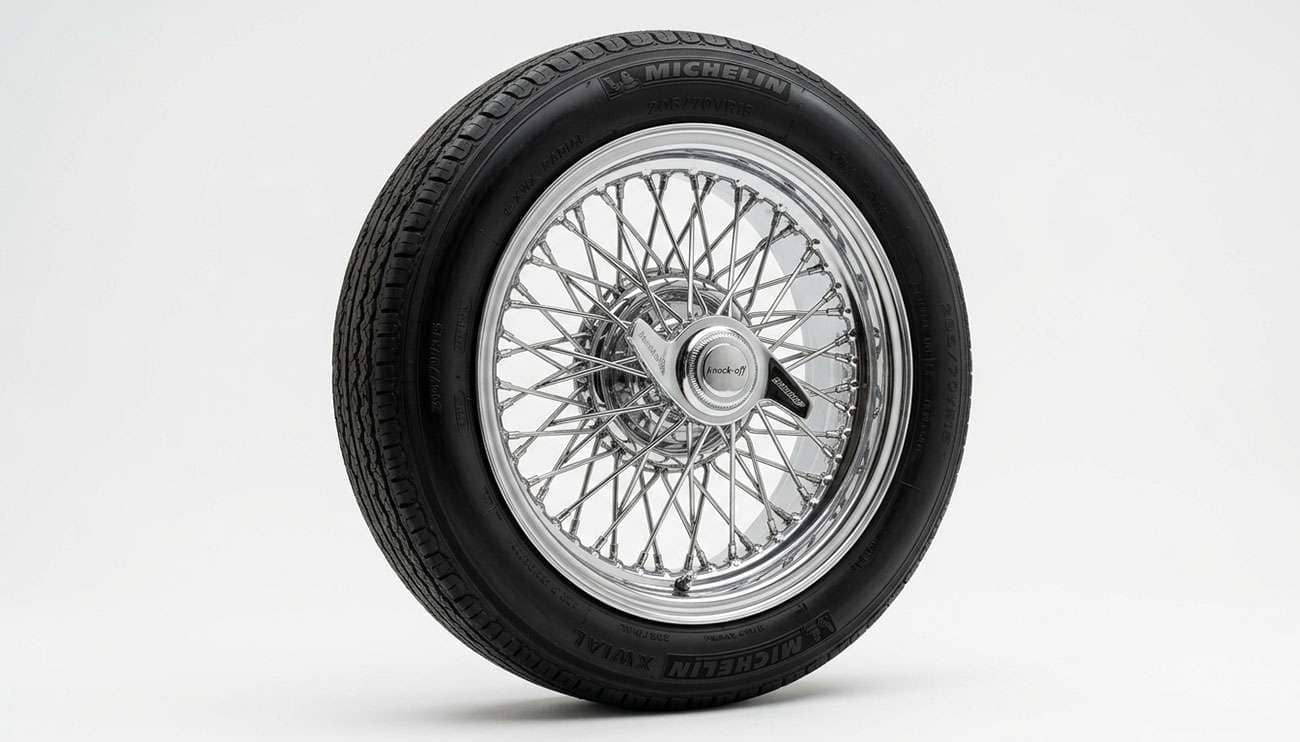
A wire wheel is exactly what it sounds like: a rim and a hub tied together by a web of thin metal spokes instead of a solid cast or forged center. Those spokes carry the load, let light shine straight through the wheel, and give you that jewelry-box look you cannot fake. A true knock-off is the mounting style that goes with them, where a single big center nut, spun on by hand with a soft mallet, holds the whole wheel to the axle. Bolt-on wire wheels do the same job with a standard lug pattern. Here is how to tell them apart and pick the right set.
I have been bolting wheels onto cars since before some of you were born, and nothing gets a crowd around a car at a show faster than a clean set of wires. They started life on horse carriages and early race cars because they were light and strong for their day. A hundred years later they are still the crown jewel on Cadillacs, Jaguars, lowriders, and the occasional hot rod that wants to dress up instead of scowl. Let me walk you through what they are, how they hang on, and what it takes to live with them.
Strip away the shine and every wire wheel is three parts: an outer rim that holds the tire, an inner hub at the center, and the spokes that connect the two. On a solid wheel the center is one piece of metal. On a wire wheel that center is open, and the spokes are laced in a criss-cross pattern and pulled to tension, the same way a bicycle wheel is built, only heavier duty. That lacing is what gives the wheel both its strength and its look.
Because the spokes are thin, a wire wheel can actually run lighter than a chunky solid rim of the same size, which is one reason the old racers loved them. The spokes also flex a hair over bumps, so a lot of drivers swear wires ride a touch softer than a stiff cast wheel. The trade-off is that all those spokes are more to keep clean and more to keep tight, but we will get to that. For a broader look at how wires stack up against the rest of the classic lineup, our rundown of classic car wheel styles lays out the whole family tree.
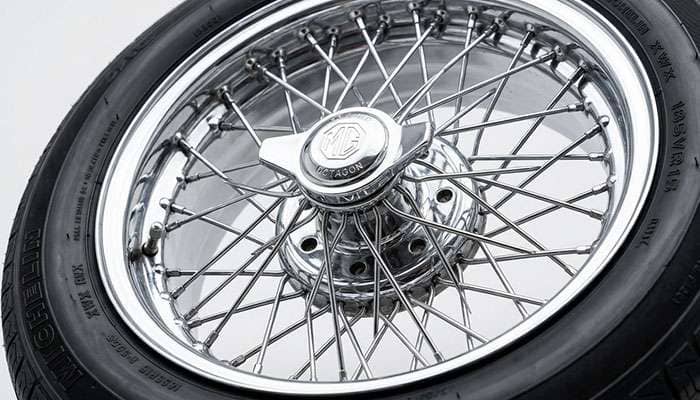
This is the part that trips up first-time buyers, so let me clear it up right now. A wire wheel mounts one of two ways, and the difference is all about the center of the wheel. Knock-offs use a splined hub and a single spinner nut. Bolt-ons use a normal bolt pattern, just like the wheels already on your car. Both are perfectly good. Which one you want comes down to how original you are going and how much fuss you are willing to put up with.
On a true knock-off setup, a splined adapter bolts to your axle where the wheel studs normally live. The wire wheel slides onto those splines, and a big center nut, the knock-off, threads on and clamps everything tight. You do not use a torque wrench and lug nuts. You use a lead or brass mallet, or a soft-faced knock-off hammer, and you whack the spinner ears until it stops moving. The old-timers had a good rule for it: set the car down, note where the spinner points relative to one spoke, give it a sharp hit, and if the spinner does not move relative to that spoke, it is tight.
Here is the safety detail that matters most. The threads are handed. The left side of the car uses a right-hand thread and the right side uses a left-hand thread, so the natural rotation of the wheel driving forward keeps tightening the nut instead of backing it off. Put the spinners on the wrong sides and they will loosen and walk right off. That is also why you never tow a wire-wheel car backward on a dolly. Knock-offs get a bad rap from folks who installed them wrong. Done right, they stay put. Two-ear and three-ear winged spinners were the classic look until federal rules pushed builders toward hex-style safety knock-offs on later cars. If the spinner talk has you curious, our full knockoff wheels guide digs deeper into the hardware.
Bolt-on wire wheels skip the splined adapter and the spinner. The wire assembly is built around a solid center that carries a standard bolt pattern, so it mounts to your hubs with regular lug nuts, torqued to spec, exactly like any other wheel. Most wear a center cap to hide the lugs and finish the look. That cap is the one thing purists grumble about, since it covers the middle where a real spinner would sit, but for a daily driver the convenience is hard to argue with. No special hammer, no handed threads, no adapters to fuss over. If your classic never came with wires from the factory, a bolt-on set is usually the easiest way to get the look without re-engineering your hubs.
Yes, when they are installed and maintained correctly. The horror stories almost always trace back to two mistakes: spinners mounted on the wrong sides, or a knock-off that was never kept tight. A loose knock-off lets the wheel work against the splines, and worn splines are the number one killer of wire wheels. Let it go long enough and the hub can spin inside the wheel, which is exactly as bad as it sounds. Keep the nut tight, keep the splines in good shape, mount the correct spinner on the correct side, and a knock-off wheel is as trustworthy as any lug-mounted rim. Traditional knock-off setups are happiest as cruisers, so most owners keep the speeds sensible rather than running them hard on the interstate day after day.
Wire wheels are not for every build. Slap them on the wrong car and it looks like a costume. Put them on the right one and it looks like a million bucks. Here is where they earn their keep.
Wires built their reputation on early to mid-century European sports cars and high-end American iron. Jaguars, Austin-Healeys, Triumphs, and MGs wore knock-off wires from the factory, and the look carried straight into premium American cruisers. Cadillac, Buick, and the big personal-luxury coupes leaned on wire wheels to say money without saying a word. The open, chrome-spoke face has a formal, almost jewelry-like quality that a stamped steel wheel simply cannot match, which is why concours restorations and elegant cruisers still reach for them.
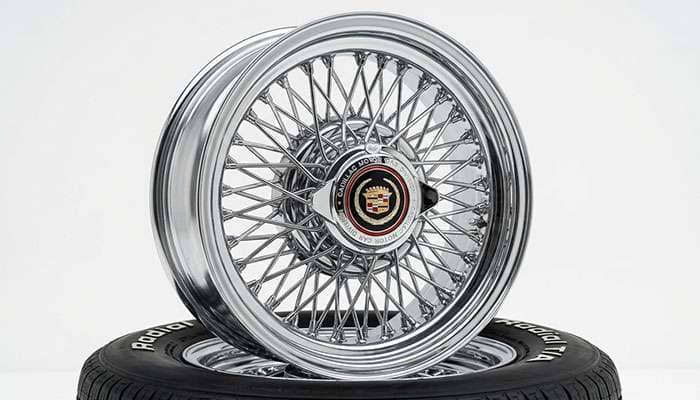
If wires have a spiritual home, it is the lowrider. Reverse-offset wire wheels, most famously in a 13x7 or 14x7 size, are the signature of the whole scene, usually wrapped in one of the best whitewall tires for classic cars and tucked under the fender. Chrome is king, but gold plating, two-tone spokes, and eye-popping spoke counts turn a set of wires into a rolling statement. Names like Dayton and Zenith became legends because the show circuit demanded quality that would hold a mirror shine. To see how deep that culture runs, read our brief history of lowriders. The skinny whitewall look that pairs with them has its own story too, told in the history of Vogue Tyre and the white and gold sidewall.
Wires are less common on muscle cars, which were born on steel and styled wheels, but a thoughtful hot rod or custom can absolutely pull them off. On a traditional roadster or an early street rod, a set of skinny wires up front with a proper stance reads pure period-correct nostalgia. The trick is restraint. A wire wheel wants to complement clean bodywork and a nice paint job, not fight a bunch of other loud parts for attention. When it works, it gives a rod an upscale, old-money attitude that a billet wheel never will.
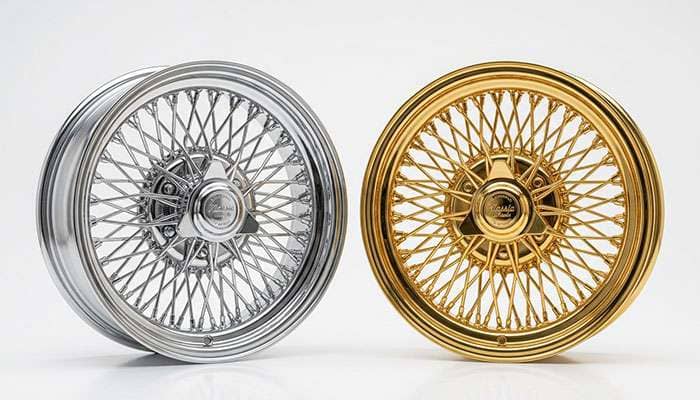
Two choices define the personality of a wire wheel more than anything else: how many spokes it has and how it is finished. Spoke count sets the mood. A lower count, around 60 or 72 spokes, gives you the traditional, slightly beefier vintage look you see on British sports cars and older restorations. Step up to 100, 150, or even higher spoke counts and the face gets busier, finer, and more overtly luxurious, which is the territory show lowriders live in. Neither is stronger by default. A well-built wheel with the right materials beats a poorly built one no matter how many spokes it wears.
Finish is where you set the budget and the vibe. Chrome is the default and still the most popular, because nothing throws light like a fresh chrome spoke. Gold plating, including real 24-karat on high-end show wheels, kicks the flash up a level, and painted or powder-coated spokes let you match body color or run a subtle satin look. Powder coat is the practical pick if you want color that holds up better than chrome in the weather. A set of trim rings and the right center caps can finish the whole look off, and our guide to center caps and trim rings covers those dress-up details.
A wire wheel has to fit your car just like any other wheel, and getting the numbers right is not optional. Four measurements do the heavy lifting: diameter, width, bolt pattern, and backspacing or offset. Diameter and width set the size of the wheel and how much tire you can run. The bolt pattern, on a bolt-on set, has to match your hub exactly, so a 5x114.3 stays 5x114.3. On a knock-off set, the splined adapter has to be the correct one for your axle instead.
Backspacing and offset decide how far the wheel tucks in or pokes out, which is what makes a reverse-offset lowrider wheel sit the way it does. And do not forget brake clearance. Bigger modern brakes can crowd the back of a wire wheel, so the spoke design and inside profile have to clear the caliper. When in doubt, measure twice and ask before you buy. A wheel that looks perfect in the box is no good if it rubs a control arm or will not clear the brakes.
I will be straight with you: wires ask for more attention than a solid wheel. All those spokes trap brake dust and grime, so cleaning takes a soft-bristle brush, a mild soap, and some patience to reach between every spoke. Chrome likes a wipe-down and a polish to keep it from spotting, and any surface rust wants dealing with sooner rather than later. On knock-off sets, you check the spinner tightness now and then, especially after a fresh install or a long drive, and you keep an eye on the splines for wear. None of it is hard. It is just a routine, and the payoff is a wheel that stops people in a parking lot.
On cost, wires cover a wide range. Budget street-quality sets can start in the few-hundred-dollar range, while premium name-brand chrome or gold show wheels climb well past a thousand dollars per set, and the fanciest hand-built pieces go higher. Buying used is a gamble, since a cheap set of used wires is often cheap for a reason, usually worn splines or tired chrome. The best money is spent on a quality wheel from the start. Our own catalog runs from powder-coated rod wires around $436 up to forged premium sets past a thousand dollars each, so there is a rung for every build.
Here are three sets from our shelves that show the range, from a mirror-chrome classic cruiser wheel to a forged premium piece. Every one is a genuine wire wheel, not a lookalike, and you can browse the full lineup on our classic wheels page.
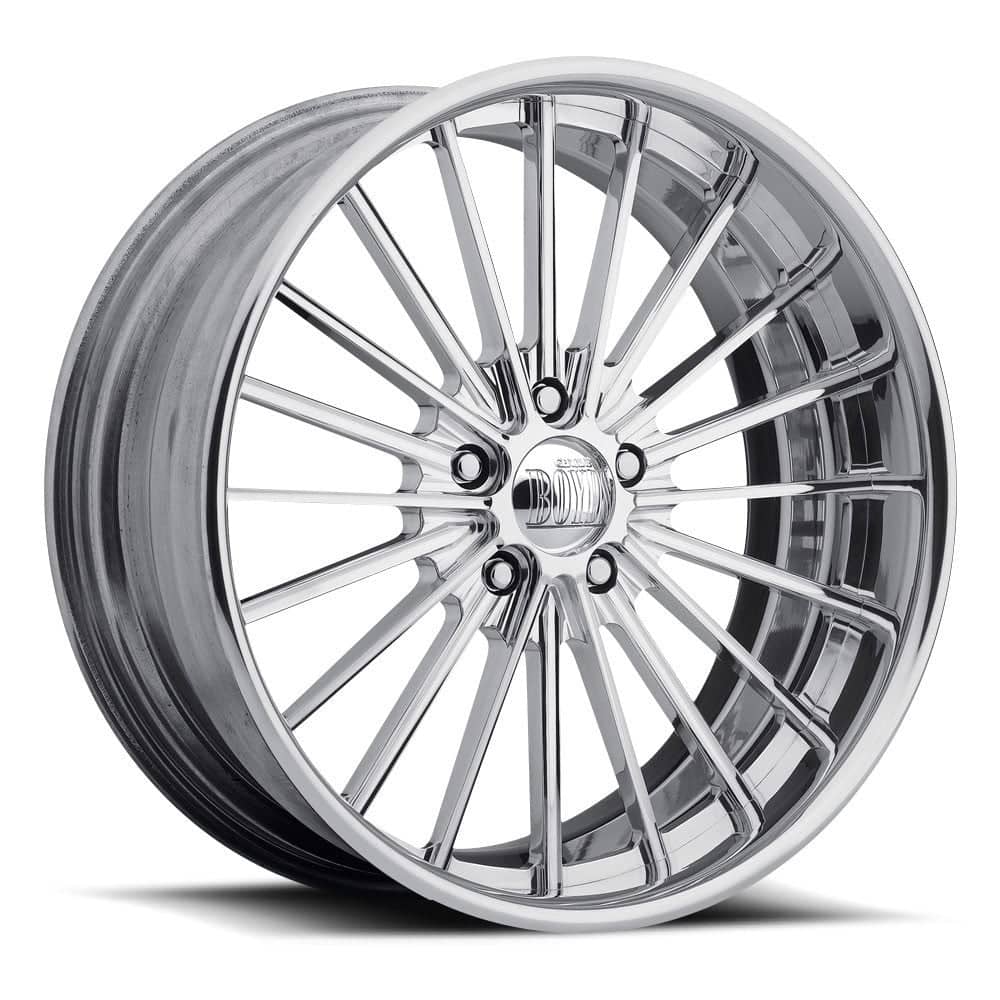
Boyd Coddington Forged Wire (17x10, Polished) - about $1,024. This is the top of the range and a house favorite. It takes the classic wire look and builds it on a modern forged foundation, so you get the elegance of laced spokes with the strength and larger diameter a contemporary build wants. If your project deserves a statement wheel, this is it. See the full range on the Boyd Coddington wheels page.
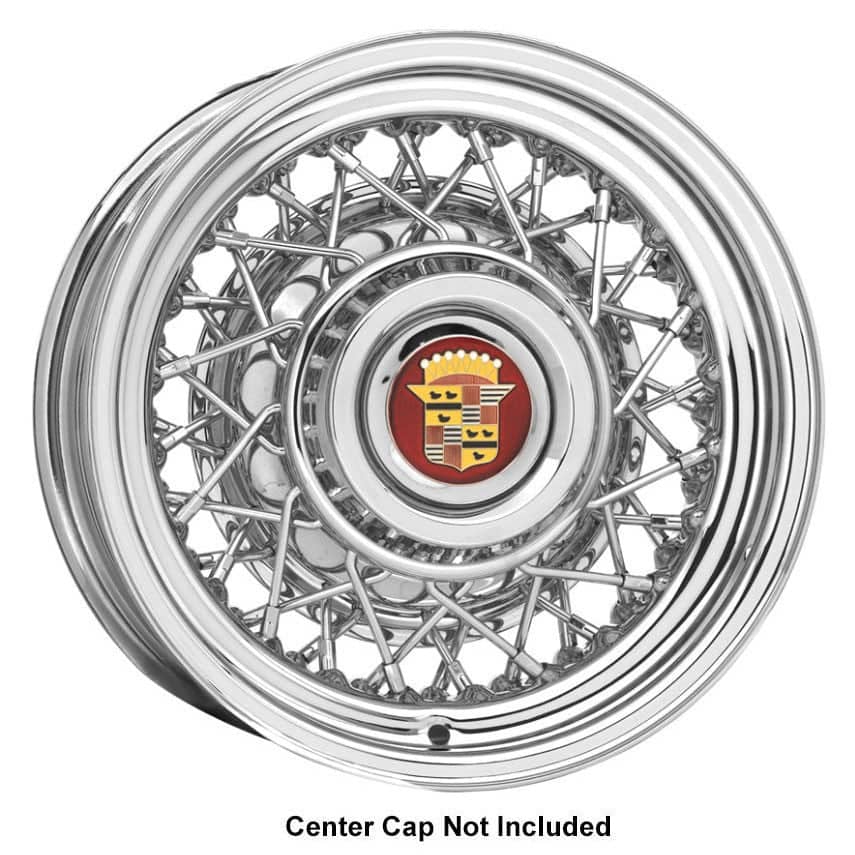
Wheel Vintiques 74 Series Cadillac Style Wire (15x6, Chrome) - about $747. This is the quintessential American-luxury wire wheel in triple-plated chrome. Built for the Cadillac-style 5x127 pattern, it delivers that formal, jewelry-like cruiser face that made wires famous in the first place. Ideal for a period-correct luxury restoration or a clean lowrider build, and if you want the full rundown on the maker, our take on whether Wheel Vintiques wheels are good spells it out.
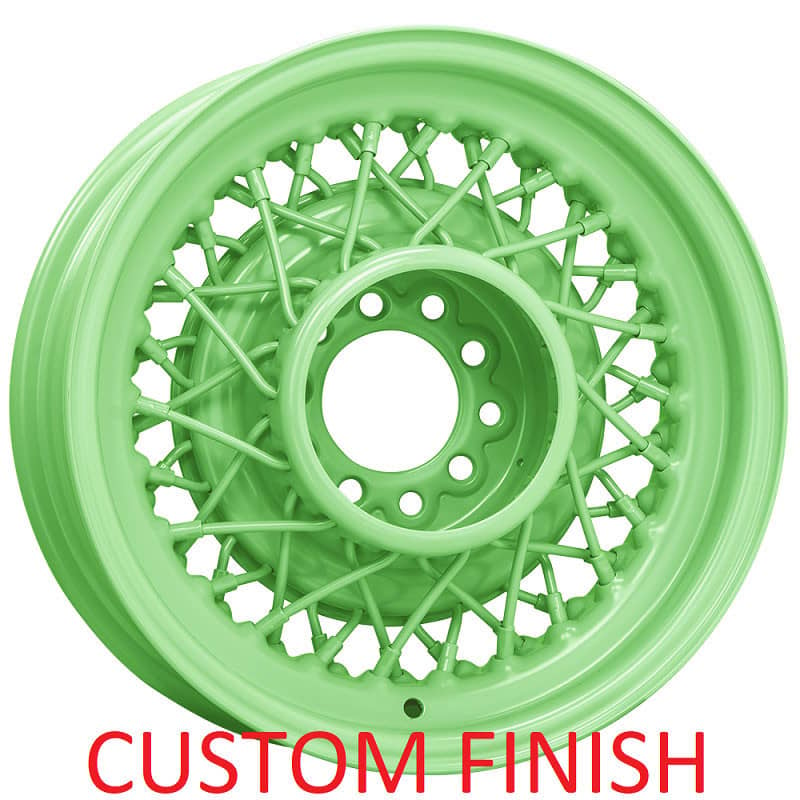
Wheel Vintiques 71 Rod Wire (14x5, Custom Powder Coat) - about $436. The value pick and the hot-rodder's choice. A skinny 14-inch rod wire in a durable custom powder coat gives you traditional street-rod attitude without the chrome upkeep, and it is the easy way to add period flavor to a roadster or early build. Both Wheel Vintiques styles live on the Wheel Vintiques wheels page.
Yes, when they are installed and maintained correctly. Mount the correct spinner on the correct side, keep the knock-off tight, and watch the splines for wear. Traditional knock-off setups are happiest as cruisers, so most owners keep speeds moderate rather than hammering them on the interstate every day. Bolt-on wire wheels, torqued like any lug-mounted wheel, are the simplest choice for regular driving.
Knock-off wheels slide onto a splined adapter and are held by a single center spinner nut that you tighten with a soft mallet. Bolt-on wheels have a solid center with a standard bolt pattern and mount with regular lug nuts, usually hidden by a center cap. Knock-offs look more original; bolt-ons are easier to live with.
Prices cover a wide range. Budget street-quality sets can start in the few-hundred-dollar range, while premium name-brand chrome or gold show wheels run well past a thousand dollars per set, and hand-built pieces go higher. Our catalog spans powder-coated rod wires around $436 to forged premium sets past $1,000 each.
They can, but fitment matters. The bolt pattern or splined adapter must match your hub, and the offset, width, and inside profile have to clear larger modern brake components. Wire wheels are popular on restomod builds that combine classic styling with updated mechanicals, as long as the measurements are checked carefully first.
Use a soft-bristle brush and a mild soap to reach between the spokes, then dry and polish chrome to prevent spotting. Deal with any surface rust early. On knock-off sets, check the spinner tightness after installation and after long drives, and inspect the splines periodically for wear.
It is a style choice, not a strength rule. Lower counts around 60 to 72 spokes give a traditional vintage look, while 100, 150, or higher counts create the intricate, luxurious face seen on show lowriders. Build quality and materials matter more to strength than spoke count alone.