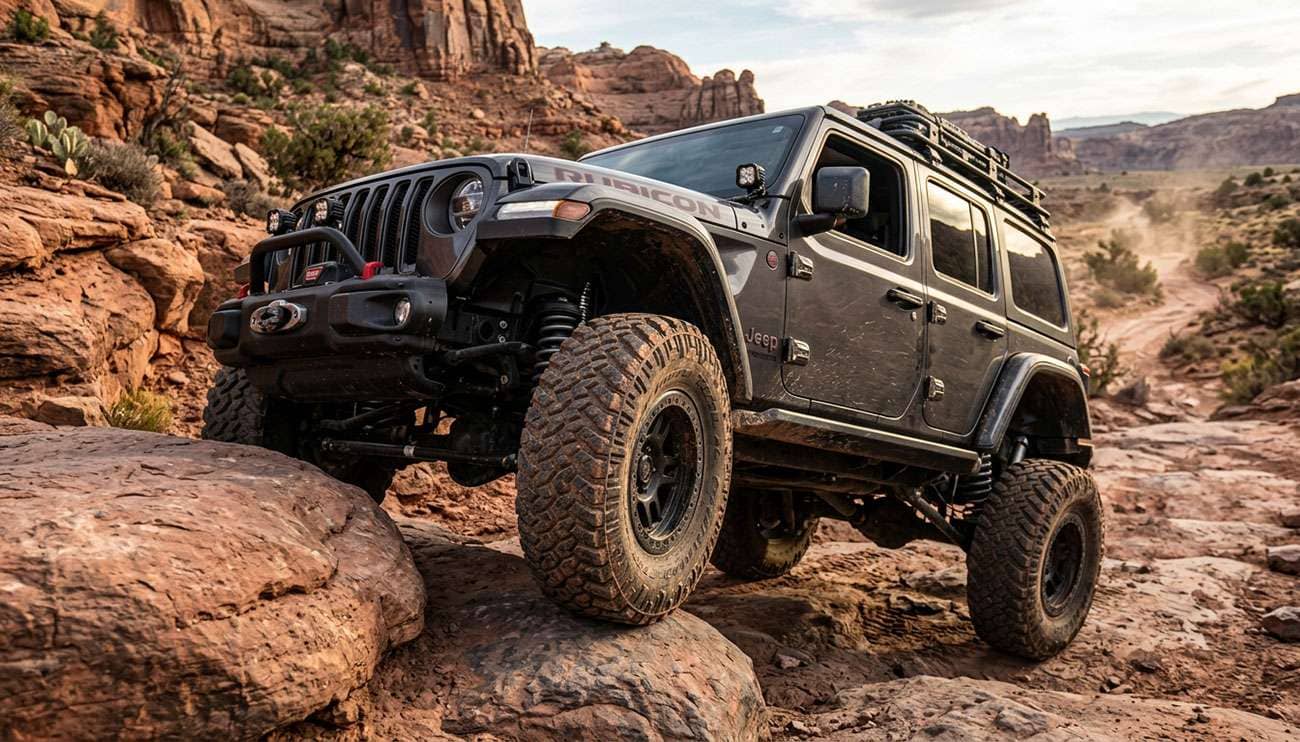
Yes on a Rubicon, with about 2 inches of added bumpstop and wheels at 4.5 to 5 inches of backspacing. On a Sport or Sahara, 37s clear at ride height and hit the flares when the suspension compresses, unless you swap to high-line flares or run more bumpstop than most 2.5-inch kits include. Most answers stop at "it depends on your setup." It depends on two parts nobody puts in front of you: the bumpstop under the axle and the fender flare over the tire.
The lift number is the wrong place to start. A 2.5-inch kit on a Rubicon and the same kit on a Sport are two different builds once the tire stuffs into the fender. Find your Jeep below.
Your JL |
Factory Flare |
Factory Tire and Diameter |
Height a 37 Adds at the Top |
Bumpstop to Add on a 2.5-Inch Lift |
Verdict |
|---|---|---|---|---|---|
Rubicon, Rubicon X, 2024 and newer Willys |
High-line |
LT285/70R17, 32.7 in |
2.1 in |
About 2 in, front and rear |
Fits; expect to trim the rear inner fender liners |
Rubicon EcoDiesel or Rubicon 392 |
High-line |
LT285/70R17 (32.7 in) or LT315/70R17 (34.4 in) |
1.2 to 2.1 in |
About 2 in at the rear; the front bumpstop tower already sits lower |
Easiest fit of any JL |
Any Xtreme Recon (factory 35s) |
High-line |
LT315/70R17, 34.4 in |
1.2 in |
Enough to total about 2 in over a base Rubicon's stops |
Fits; check the factory wheel against the tire's rim range |
Sport, Sport S, Sahara, 2018 to 2023 Willys |
Low-line, about 1.5 to 2 in lower |
245/75R17 (31.5 in), 255/70R18 or LT255/75R17 (32.1 in) |
2.4 to 2.7 in |
About 3.5 to 4 in on stock flares, or about 2 in with high-line flares |
Street yes; full flex only with high-line flares, extra bump or trimming |
4xe versions follow the flare of their trim. The math assumes a 37x12.50R17 measuring about 36.8 inches mounted, where most land. If you are coming from the no-lift side of this question, start with whether 35s fit a Wrangler JL without a lift.
Because a lift moves the body at ride height, and rubbing does not happen at ride height. It happens when one corner compresses all the way: a rock under one tire, a dip at 50 mph, a hard landing. At that moment the only thing deciding where the axle stops is the bumpstop, which hangs from the frame and lands on a pad on the axle. A coil spacer or taller spring moves neither one.
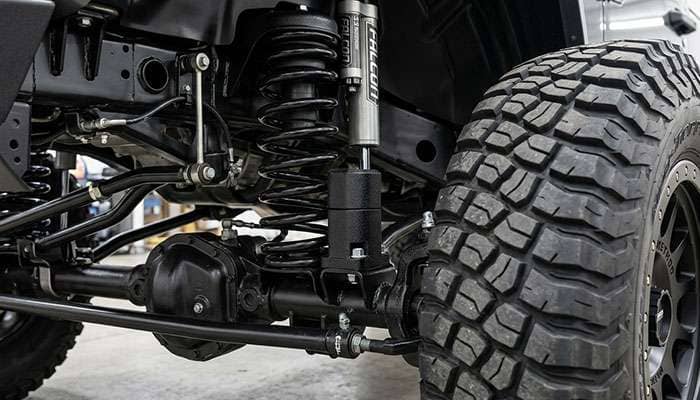
So with factory bumpstops, a JL on a 2-inch lift and a JL on a 4.5-inch lift stuff the axle to exactly the same spot. Put a 37 on it and the top of the tread sits about 2.1 inches higher in the wheel well than a factory Rubicon tire did. On a Rubicon, that 2.1 inches comes from about 2 inches of added bumpstop.
Here is why 2.5 inches is the right lift. Adding 2 inches of bumpstop takes 2 inches of up-travel away. The 2.5-inch lift gives 2.5 inches back. Net, a Rubicon ends up with about half an inch more up-travel than stock and a 37 that stops where the factory tire stopped. Many 2.5-inch kits include bumpstop extensions, but they are sized for the lift, not your tire. Measure what came in the box.
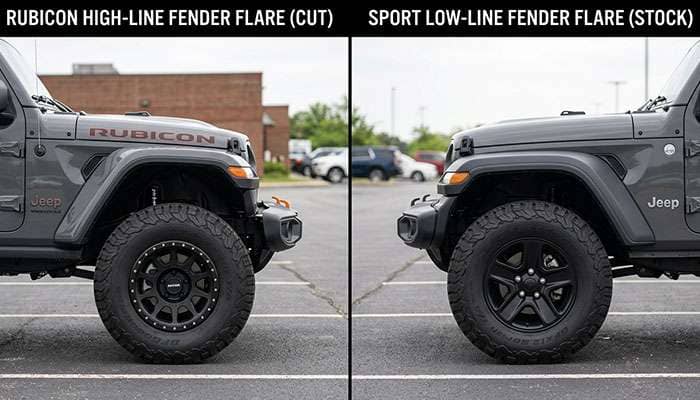
Yes. The Rubicon's high-line flares are cut roughly 1.5 to 2 inches higher than Sport and Sahara flares, and that is the whole reason it is the easy 37 platform. Rubicon X and the 2024 and newer Willys share them. With about 2 inches of added bumpstop at each axle and 4.5 to 5 inches of backspacing, a 37x12.50R17 cycles with little more than liner trimming.
Published flex tests on a 2.5-inch Rubicon cleared even 37x13.50s at full lock on 4.75 inches of backspacing, with bumpstop extensions and trimmed rear liners. The 12.50-wide tire is the easier fit and the one I would start with.
The Rubicon also has the axles for the job: a Dana M210 front and M220 rear, both Dana 44-class. In Dana's naming the number is the ring gear diameter in millimeters, so these are the largest gears in the JL lineup.
At ride height, yes. The problem is the low-line flare, which sits roughly 1.5 to 2 inches lower than a Rubicon's. The same 2 inches of bumpstop that works on a Rubicon leaves the tire hitting the flare at full compression. Owners running this combination report the same thing: fine on the street, rubbing at full flex on a trail.
Four ways to close that gap:
The other variable is the axles. Most automatic Sport and Sahara models without the rear limited-slip run a Dana M186 front and M200 rear, the smallest ring gears in the JL lineup. A manual or the limited-slip option typically moves the rear to an M220; your build sheet will tell you. Plenty of M186 and M200 Jeeps run 37s on the street and mild trails, but lockers, sticky mud-terrains and wheel spin on rocks give those small gears a longer lever to break.
Between 4.5 and 5 inches, and 4.75 or more for the least liner contact on a 2-inch bumpstop. That means a 17x8.5 at about 0 mm offset or a 17x9 between -12 and 0 mm. Most 17x9 wheels drilled 5x5 already sit in that window, which is why it has become the default JL fitment.
The factory 17x7.5 at roughly +44 mm, close to 6 inches of backspacing, fails twice. Its 7.5-inch width is narrower than the approved rim range of almost every 37x12.50R17, and that much backspacing pulls the wider tire toward the frame and control-arm mounts at full lock.
Backspacing tells you where the wheel's inner lip sits. Offset sets the tire's centerline, and that is what moves the tire. Compared to a factory Rubicon tire on a factory wheel:
Wheel |
Offset |
Backspacing |
Inner Shoulder vs. Factory Tire |
Outer Shoulder vs. Factory Tire |
What It Means |
|---|---|---|---|---|---|
Factory 17x7.5 |
+44 mm |
6.0 in |
0.6 in further in |
0.6 in further out |
Rim too narrow for most 37s; tire crowds the frame at full lock |
17x8.5 or 17x9 |
0 mm |
4.75 or 5.0 in |
1.1 in further out |
2.4 in further out |
The sweet spot with 2 in of bumpstop |
17x9 |
-12 mm |
4.5 in |
1.6 in further out |
2.9 in further out |
Works; more liner contact and steering effort |
17x10 |
-24 mm |
4.6 in |
2.1 in further out |
3.3 in further out |
Reaches the flare at full stuff; add bump or trim |
The 17x10 has nearly the same backspacing as the 17x9 at -12, yet the tire sits half an inch further out. A wider wheel at the same backspacing pushes the tire outward. Going from +44 to -12 mm also moves the centerline out about 2.2 inches, adding scrub radius and leverage on the ball joints, wheel bearings and steering. Our 17x9 negative offset setup guide covers that trade in detail.
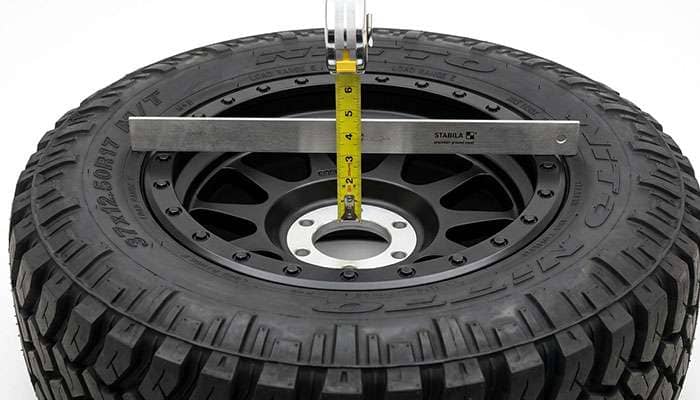
Match the JL hub: 5x5 (5x127 mm) pattern, 71.5 mm center bore, 1/2-20 lug studs. Buy wheels tested to SAE J2530, the aftermarket wheel standard, rated for at least half your heavier axle rating from the door sticker.
On a Rubicon with 2 inches of added bump and 4.75 inches of backspacing, usually just plastic. The most common contact is the lower edge of the rear inner fender liner, a few minutes with a sharp utility knife. Up front, watch the inner liner at full lock with the suspension compressed. Less backspacing, wider tires and low-line flares add the flare edges, more of the front liners and, on some four-doors, the body seam behind the rear tire.
Chasing a rub you cannot place? Our guide on why your tires are rubbing walks through the usual suspects.
Not to make it move. The JL's eight-speed automatic has a very low first gear, about 4.71 to 1, so it launches a 37 far better than older Wranglers did, and some Rubicon owners run 37s on factory 4.10s for years. The cost shows up on the highway: eighth gear goes unused, the transmission hunts on grades, and it runs hotter doing it. A taller tire lowers your effective ratio by the same percentage it grows, about 12.5 percent on a Rubicon and 17 percent on a Sport.
Factory Setup |
Factory Ratio |
Effective Ratio on a 37 |
Ratio That Restores Factory Feel |
Common Choice on 37s |
|---|---|---|---|---|
Sport or Sahara, standard gears |
3.45 |
About 2.95 to 3.01 |
About 4.0 |
4.88; 5.13 on a heavy 3.6-liter build |
Sport or Sahara, optional gears |
3.73 |
About 3.19 to 3.25 |
About 4.3 |
4.88 or 5.13 |
Rubicon and 2024 and newer Willys |
4.10 |
About 3.64 |
About 4.6 |
4.88 on a 2.0-liter turbo; 5.13 on a 3.6-liter |
Xtreme Recon |
4.56 |
About 4.26 |
About 4.9 |
Often left alone, or 4.88 |
Rubicon 392 |
3.73 |
About 3.32 to 3.48 |
About 4.0 to 4.2 |
Often left alone; 4.10 or 4.56 to restore the punch |
"Restores factory feel" is the floor, not the target. It ignores the 15 to 30 extra pounds per corner a 37 carries, plus bumpers, armor and a winch. That is why gear suppliers commonly steer 3.6-liter Jeeps on 37s toward 5.13, while the 2.0-liter turbo and diesel, with more low-end torque, usually land at 4.88. Front and rear ratios must match, ring-and-pinion sets exist for every JL axle in 4.88 and 5.13, and the new ratio has to be programmed into the Jeep along with the tire size. For the full decision, read our guide on when to regear after bigger tires.
Less than most people buy. This is the part 37 guides skip, and it changes what belongs on the Jeep. Door stickers on four-door Rubicons commonly list 3,100 pounds per axle, which is 1,550 pounds per front tire at maximum rated load. A 37x12.50R17 carries far more than that at almost any pressure you would drive on.
The Tire and Rim Association's flotation table, which sets the load for sizes like 37x12.50R17, ties load to pressure. Load range only sets the maximum inflation and the ceiling. A Load Range C and a Load Range D at 30 psi carry the same weight.
Pressure |
Load per Tire |
vs. Rubicon Front Axle Share (1,550 lbs) |
vs. Factory Rubicon Tire at 37 psi (about 2,190 lbs) |
|---|---|---|---|
25 psi |
2,150 lbs |
600 lbs over |
About 40 lbs short |
26 psi |
About 2,215 lbs |
About 665 lbs over |
Matches it |
30 psi |
2,470 lbs |
920 lbs over |
About 280 lbs over |
35 psi (Load Range C maximum) |
2,755 lbs |
1,205 lbs over |
About 565 lbs over |
50 psi (Load Range D maximum) |
About 3,525 lbs |
About 1,975 lbs over |
About 1,335 lbs over |
The last column sets your pressure floor. The rule tire makers and the Tire Industry Association teach installers is that a replacement tire must carry at least what the factory tire carried at placard pressure. A factory LT285/70R17 at the JL's 37 psi placard carries about 2,190 pounds, and a 37 matches that at about 26 psi. Sport and Sahara passenger tires land in the same mid-to-high 20s once the standard truck derating is applied. Treat that as a floor; most JLs on 37s settle in the high 20s to low 30s on the street after a chalk test.
Most 37x12.50R17s on the market are Load Range D at a 124 load index. A handful come in Load Range C at 116; BFGoodrich's KO2, for example, is sold in this size as both. On a JL, the extra plies in a D or E buy puncture resistance on sharp rock and a stiffer sidewall when aired down, not capacity you will use. Tread type moves the weight more than load range does: all-terrains generally run in the low 70s in pounds, mud and rugged-terrains in the high 70s to upper 80s, against the high 50s of a typical factory Rubicon tire.
My default for a JL is Load Range D. Go C for a pavement-and-fire-road Jeep and a softer ride. Go E only for sharp-rock wheeling or an overland build living near its weight rating. For how these two ratings relate, see load range vs. load index.
A 37 on a JL missing the right bumpstop, backspacing, gears or pressure gets more expensive one step at a time:
With bumpstops and wheels sorted, compare tread types, load ranges and weights in our 37x12.50R17 tires lineup.
37s fit a JL on a 2.5-inch lift, but the lift is not what makes them fit. On a high-line JL (Rubicon, Rubicon X, 2024 and newer Willys, EcoDiesel, 392) it takes about 2 inches of added bumpstop, 4.5 to 5 inches of backspacing and some rear liner trimming. On a Sport or Sahara, the low-line flare means more bumpstop, a flare swap or trimming before the tires can flex.
After the fit, regear to suit your engine, buy load range for the sidewall rather than capacity a JL will never use, and keep pressure at or above the roughly 26 psi it takes to carry what the factory tire carried.
Yes on a Rubicon, Rubicon X, 2024 and newer Willys, EcoDiesel or 392, with about 2 inches of added bumpstop, 4.5 to 5 inches of backspacing and rear liner trimming. On a Sport or Sahara, 37s clear at ride height but hit the low-line flares at full compression unless you swap flares, run about 3.5 to 4 inches of bumpstop or trim.
About 2 to 2.5 inches on a Rubicon, because the lift's real job is to give back the up-travel the bumpstop extensions take away. Sport and Sahara models with low-line flares usually need a 3.5-inch lift or a swap to high-line flares to flex 37s without rubbing.
Yes. A lift does not change where the axle stops at full compression; the bumpstop does. A Rubicon needs about 2 inches of added bumpstop front and rear to cycle a 37. The EcoDiesel and 392 already have a lower front bumpstop tower, so most of their added bump goes at the rear.
Between 4.5 and 5 inches, with 4.75 or more for the least rubbing on 2 inches of bumpstop. That is a 17x8.5 at about 0 mm offset or a 17x9 between -12 and 0 mm. The factory 17x7.5 wheel is narrower than most 37x12.50R17 tires allow.
Not for the Jeep to move, since the eight-speed's low first gear handles the launch, but highway driving suffers. A 37 drops a Rubicon's 4.10 to about 3.64 effective. The common choice is 4.88 for 2.0-liter turbo and diesel Jeeps and 5.13 for heavier 3.6-liter builds.
On a Rubicon with 2 inches of added bumpstop and about 4.75 inches of backspacing, usually only the lower edge of the rear inner fender liners. Low-line flares, wider tires or less backspacing add flare edges, front liners and sometimes body seams. Trim plastic first and add bumpstop before cutting sheet metal.