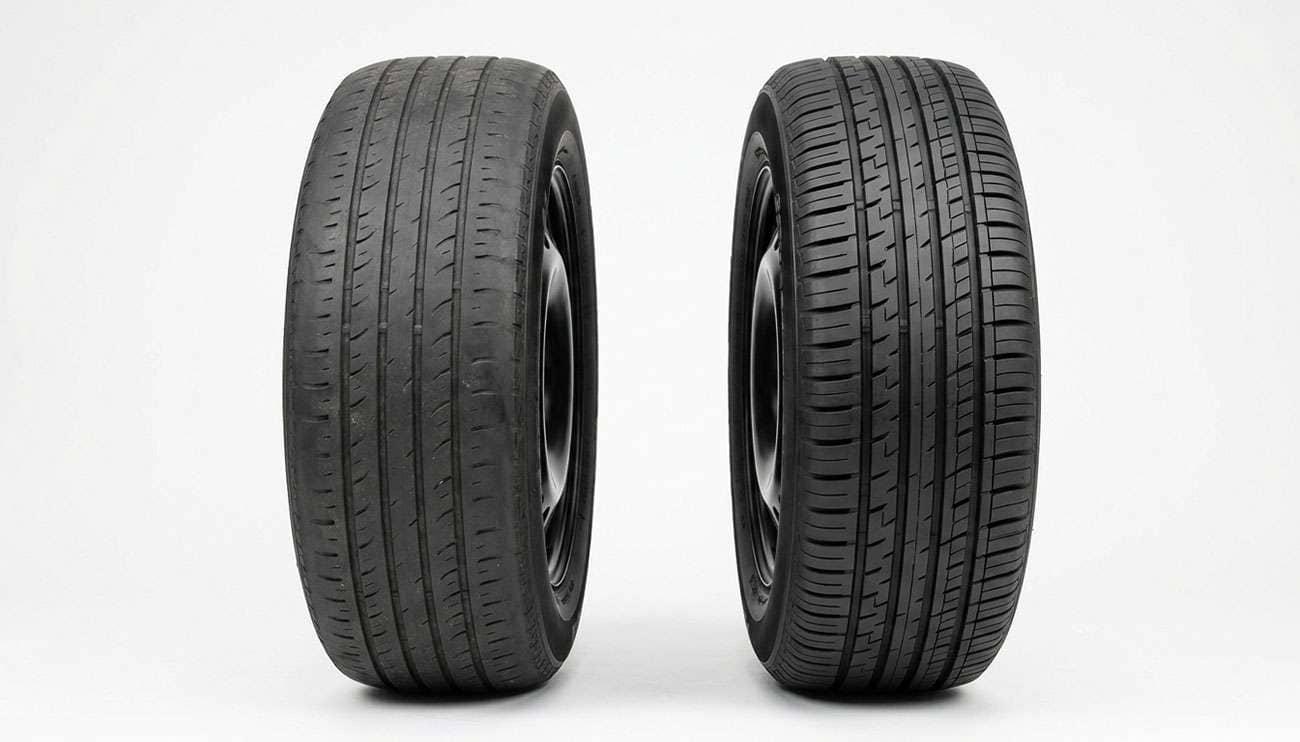
On most cars, the front tires go bad first, and on a front-wheel drive car they can wear up to twice as fast as the rears. But that answer only holds if two things are true: your tires are the same size on both axles, and nobody has been rotating them. Rotate a square setup on schedule and all four wear out together. Run a staggered setup with wider rears and the rears almost always go first. Leave the rears alone on a FWD car long enough and they "go bad" by age or irregular wear while still showing plenty of tread. Most answers to this question stop at "it depends on your drivetrain." The variable that actually decides it is whether your setup can be rotated, and whether it has been.
Find your drivetrain and fitment in the left column. The middle columns tell you which axle typically loses tread first and roughly by how much, assuming normal street driving and no rotation. The right column tells you what actually ends that tire's life, because "bad" does not always mean "worn out."
Feature |
Goes Bad First (No Rotation) |
Typical Wear Gap |
What Usually Ends Its Life |
|---|---|---|---|
FWD car or crossover, same size all around |
Front |
Fronts wear up to about 2x faster |
Front: tread depth and shoulder wear. Rear: age or diagonal wear |
Front-engine RWD, same size all around, daily driving |
Usually front, sometimes even |
Small; driving style decides it |
Front shoulders from steering and braking |
Front-engine RWD, hard launches or high torque |
Rear |
Rears can wear noticeably faster |
Center tread wear on the drive tires |
Staggered setup (wider rears) |
Rear |
Rears often last about half the front mileage, sometimes less |
Rear tread depth; cannot be rotated front to back |
Mid- or rear-engine car |
Rear |
Rears carry most of the weight and all the power |
Rear tread depth |
AWD (FWD-based crossover) |
Front |
Smaller than FWD, but the gap itself is the problem |
Tread-depth mismatch across axles stressing the drivetrain |
Pickup, mostly empty |
Front |
Front shoulders wear from steering a heavy nose |
Front shoulder wear; rear center wear if over-inflated |
Pickup that tows or hauls regularly |
Rear |
Depends on load, pressure, and load range |
Heat and load damage on the rear axle |
Any square setup rotated every 5,000 to 7,500 miles |
Neither |
All four stay within a small spread |
All four reach replacement depth or age together |
Once you know which axle is going first, the next question is what to do about it. That depends on how big the tread-depth gap has gotten. Measure each tire in the center groove and use this table:
Feature |
What It Means |
What to Do |
|---|---|---|
Front-to-rear gap under 2/32 inch |
Normal; rotation is working |
Keep rotating on schedule |
Gap of 2/32 to 4/32 inch, all tires above 4/32 |
Rotation has been skipped or is overdue |
Rotate now; on AWD, check your owner's manual tread-spread limit |
One axle at 4/32 inch or less |
Wet-road grip on that axle is dropping fast |
Replace that pair; new tires go on the rear on a square setup |
One axle at 2/32 inch (wear bars flush) |
Legally worn out in most states |
Replace before driving in rain |
AWD with a gap beyond the manufacturer limit |
Drivetrain is compensating for mismatched diameters |
Replace all four, or shave one new tire to match |
Any tire six or more years old, regardless of tread |
Rubber compound may be hardening and aging internally |
Have it inspected; plan replacement by year ten at the latest |
Yes, and by a wide margin. A front-wheel drive car asks its front tires to do almost everything. Tire manufacturers commonly put the gap at up to twice the wear rate of the rears, and what I see on cars that come in after 25,000 unrotated miles backs that up.
Here is the mechanism, job by job:
A typical FWD sedan or crossover carries roughly 60 percent of its weight over the front axle, because the engine and transaxle both sit there. More weight on a tire means a larger contact patch working harder against the road, and more scrubbing every time that patch deforms.
Every bit of engine torque goes through the front tires. Each time you pull away from a light, the front contact patches are slipping a small amount against the pavement to transmit that power. That slip is how a tire makes traction, and it costs rubber every time.
The front tires are the only ones that turn. In a corner, the front tires run at a larger slip angle than the rears, meaning the direction the tire points and the direction it actually travels differ by a few degrees. That twist drags the tread sideways across the road. It is why front tires on FWD cars wear their outer shoulders first.
When you brake, weight transfers forward and the front brakes do the majority of the stopping. Brake systems on most passenger cars are biased so the front axle handles roughly 70 percent of the braking force. The front tires carry that load at the same moment their contact patches are compressed by the weight transfer.
Stack those four jobs and the rear tires on a FWD car are mostly along for the ride. That easier life creates its own problem, covered below.
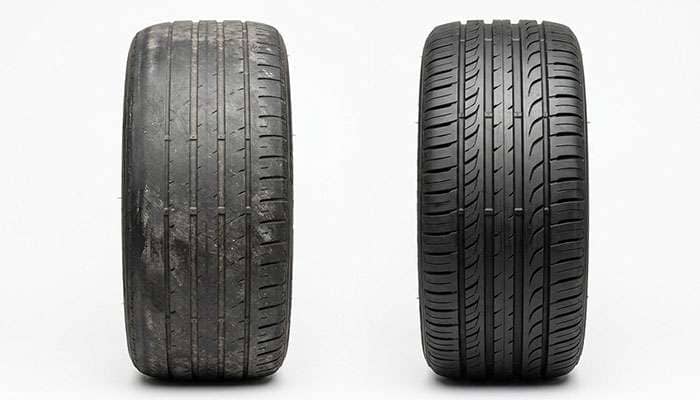
Sometimes, and this is where the usual answer gets too simple. Rear-wheel drive moves the acceleration job to the back, but it leaves steering and most of the braking at the front. On a front-engine RWD car with the same tire size on both axles, that splits the work much more evenly than FWD does.
On a front-engine RWD sedan or a pickup driven gently, the fronts frequently still wear a little faster because steering and braking never stop happening, while hard acceleration is occasional. Drive the same car with frequent hard launches, add horsepower, or spend time at the track, and the rear tires take over the lead. Drive tires under heavy throttle wear in the center of the tread, and the faster the car, the faster that happens.
The clearer cases are cars that put the weight in back as well as the power. Mid-engine cars carry roughly 60 percent of their weight on the rear axle, and rear-engine cars push that bias further. On both, the rears go first, consistently.
So for RWD, ask two questions: where is the engine, and how do you drive? A front-engine RWD car driven calmly is close to even. Anything with a rear weight bias, high torque, or a heavy right foot will chew through the rears first.
On most AWD crossovers, the front tires still wear faster. Many of these systems are built on a front-wheel drive platform and send most of the torque to the front axle until the system detects slip. The weight sits up front, the steering is up front, and the brakes are biased toward the front. The rears see more work than they do on a pure FWD car, so the gap is smaller, but the fronts still usually lead.
The bigger issue with AWD is not which axle goes first. It is how far apart the axles are allowed to get. A tire with 10/32 inch of tread has a slightly larger rolling diameter than the same tire at 5/32. That difference means the worn tires have to spin a few more revolutions per mile than the fresh ones. On a two-wheel drive car, the axles are not connected, so that doesn't matter much. On an AWD vehicle, the center differential or coupling has to absorb the difference continuously, every mile you drive.
That constant slip creates heat and wear inside components that were not designed for it. It is the reason several AWD manufacturers publish a maximum tread-depth spread between tires in the owner's manual, commonly in the range of 2/32 to 4/32 inch. Exceed it and the manufacturer may recommend replacing all four tires rather than a pair, even when the other two still have usable tread.
Part-time 4WD trucks running in two-wheel drive behave like 2WD trucks on the road, since the axles are not locked together until you engage 4WD. Full-time 4WD and AWD systems do not get that break, so for those owners rotation is the main thing keeping all four tires inside the spread the drivetrain can tolerate.
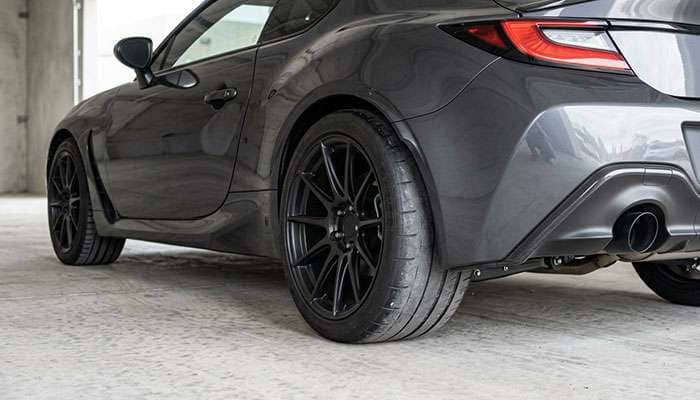
A staggered setup runs wider tires, and often wider wheels, on the rear axle than on the front. You find it on many RWD sport sedans, muscle cars, and sports cars, either from the factory or as an aftermarket upgrade. If you are weighing that decision, our breakdown of square vs. staggered setups covers the tradeoffs in detail.
Staggered rears go bad first for three reasons that stack on top of each other.
Different sizes cannot swap axles. That removes the single most effective tool for evening out wear. If the tires are also directional, they cannot be crossed side to side without being dismounted and remounted on the wheels, so in practice many staggered sets are never rotated at all. Whatever wear rate each axle has, it keeps for the life of the tires.
Staggered cars are almost always rear-wheel drive and usually make serious power. The rear tires handle every bit of acceleration on a car built to accelerate hard.
Staggered fitments are usually paired with summer or ultra-high performance tires. Those compounds trade tread life for traction. Across the market, summer tires typically carry a UTQG treadwear grade in the 200 to 300 range, while all-season tires cluster around 500 and above. Fewer than a third of summer tires carry any mileage warranty at all, and the ones that do mostly top out around 30,000 to 35,000 miles, compared with 50,000 to 65,000 for typical all-seasons. Some tire makers also reduce or exclude warranty coverage on staggered fitments, so read the fine print.
Put those together and it is common for staggered rears to reach replacement at about half the mileage of the fronts, and sometimes less on high-horsepower cars. Plan for two sets of rears per set of fronts. That is not a defect; it is the cost of the setup.
It depends on what is in the bed, and this is the variable most guides leave out for trucks. A pickup is one of the few vehicles where the weight on each axle changes dramatically from day to day.
An empty pickup is nose-heavy. The engine, transmission, and cab sit over or near the front axle, while the rear axle carries little more than the bed. Unloaded, many trucks put well over half their weight on the front. Add steering and front-biased braking and the fronts usually wear first, especially on the shoulders. Heavy diesel engines make this more pronounced.
Meanwhile, rear tires on an empty truck often run more pressure than their load requires, especially when set to the sidewall maximum. An over-inflated, under-loaded tire crowns and wears the center of the tread first.
Load the bed or hook up a trailer and the balance flips. Payload and tongue weight land on the rear axle. Now the rear tires carry the most weight and build the most heat, and heat is what kills tires under load. A rear tire under-inflated for its load flexes more, runs hotter, and degrades from the inside long before the tread looks worn.
This is where load range becomes the deciding purchase spec. A truck that tows regularly needs tires whose load capacity covers the real rear-axle weight with margin. If rears go bad early on a working truck, check the load range on the sidewall before you blame the brand.
Yes, and on FWD cars this is the part that catches people. "Go bad" and "wear out" are not the same thing. A tire can become unsafe or unpleasant to drive on through age or irregular wear while the tread still looks healthy.
The rear tires on a FWD car carry little weight and no power. With nothing pressing them firmly into the road, small alignment settings like rear toe can make the tread scrub and skip slightly instead of rolling cleanly. The result is often a diagonal wear pattern across the tread or a cupped, scalloped surface. Both show up as road noise that rises and falls with speed, and sometimes a vibration. Our guide to what causes tire cupping covers how to identify it by feel and by hand.
Once that pattern sets in, rotation helps less, because moving a cupped tire to the front makes the noise more noticeable through the steering. The fix is to catch it early, which rotating on schedule does.
Rubber oxidizes and hardens over time whether the car is driven or not. A hardened tire loses wet grip and becomes more prone to cracking and internal separation. NHTSA notes that some vehicle manufacturers recommend replacing tires six years after they were made, regardless of tread depth, and many tire manufacturers set ten years as the maximum service life.
On a FWD car that is never rotated, the fronts get replaced once, maybe twice, while the rears keep rolling with tread to spare. By the second front replacement, those rears can be six or seven years old. They look fine, but they are the oldest tires on the car, sitting on the axle that matters most for stability. You can read the age of any tire from the DOT code on the sidewall; our walkthrough on how to tell how old your car tires are shows exactly where to look.
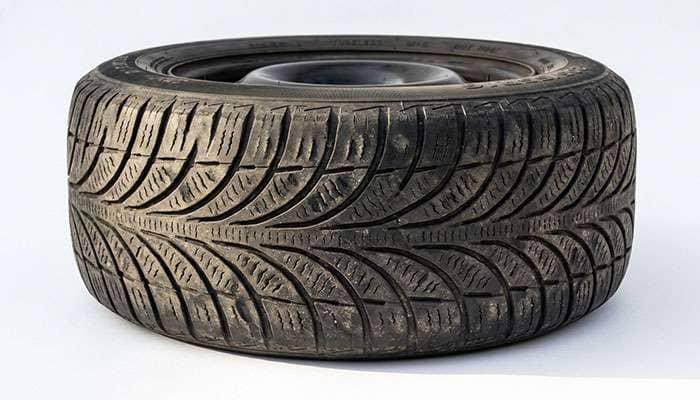
On a square setup, yes. Rotation does not change how fast each axle wears. It changes which tires are on that axle. By moving each tire through every position, you spread the front-axle wear across all four tires, so all four reach replacement depth at about the same time.
Most vehicle manufacturers specify a rotation every 5,000 to 7,500 miles, and your owner's manual has the exact interval and pattern for your drivetrain. The pattern matters: FWD, RWD, and AWD vehicles use different patterns to cross tires in the right direction. For the intervals and patterns in detail, see our guide on how often to rotate tires.
Rotation has limits:
That last point matters because of where worn tires belong. When tread depth differs between axles on a square setup, the deeper tires go on the rear. Tire manufacturers and the Tire Industry Association recommend this because a car that loses rear grip first in the wet tends to spin, and that is much harder for a driver to correct than the front pushing wide. We cover that decision in depth in new tires: front or back.
Uneven wear does not announce itself. The car still drives. Here is what is happening underneath, roughly in the order it gets worse.
Skip rotation on a FWD car and you replace the fronts before the rears have used half their tread. That is extra tire purchases you did not need to make, and it is entirely avoidable.
Once the axles differ by more than a few 32nds, worn fronts push wide in corners and worn rears make the tail feel light. Neither is dramatic on a dry road, which is why people miss it.
Tread grooves exist to move water out of the contact patch. As depth drops toward 4/32 inch, the tire's ability to clear water drops sharply, and hydroplaning starts at lower speeds. Stopping distances in the rain grow long before the tire is legally worn out. If the worn pair is on the rear, the first loss of grip in the wet is the back of the car stepping out. Our guide to tread depth to replace tires lays out the thresholds.
On an AWD vehicle, a tread gap beyond the manufacturer's limit keeps the center differential or coupling slipping constantly. That creates heat and wear in parts that are expensive to repair. Repairs to these components commonly run well into four figures, which makes four new tires look cheap by comparison.
A tire worn past 2/32 inch, an aged tire with cracking, or a heavily loaded truck tire running hot is now at risk of a sudden failure: tread separation, a blowout, or a sidewall breach. Damage that started as a slow wear problem can end as a roadside emergency. If you have already spotted a bulge or cut, read tire sidewall damage: is it safe to drive before you go anywhere.
The end of every one of these stages is the same: new tires. The only question is whether you buy them on your schedule or on the tire's schedule. When you're ready, you can shop tires for sale by size and match the load and speed ratings your vehicle calls for.
This takes about ten minutes with a tread depth gauge, which costs a few dollars at any parts store. Do it with the car parked on level ground.
On a typical front-wheel drive car with matching tires, the fronts go bad first, often by a factor of up to two. That is the answer you usually hear, but it covers one case. Staggered setups, mid- and rear-engine cars, hard-driven RWD cars, and working trucks wear out the rears first. AWD vehicles care less about which axle goes first than about how far apart the axles drift. And on almost any car, the tires that see the least work can go bad from age or irregular wear before the tread ever reaches the wear bars.
The single variable that collapses most of those cases into one answer is rotation. Rotate a square setup on schedule and nothing goes first; all four tires wear out together and get replaced together. If your setup can't be rotated, plan your budget around the axle that will go first. Either way, measure, read the date codes, and replace on your schedule instead of waiting for the tire to choose it for you.
On most front-wheel drive cars, the front tires wear faster, up to about twice as fast as the rears, because they handle steering, acceleration, and most of the braking while carrying the engine's weight. Rear tires wear faster on staggered setups, mid- and rear-engine cars, and trucks that tow or haul.
Not always. On a front-engine RWD car with the same tire size all around and gentle driving, front and rear wear can be close, and the fronts sometimes still lead because of steering and braking. Rears wear faster with hard acceleration, high horsepower, a rear weight bias, or a staggered setup.
When you replace only two tires on a vehicle with the same size front and rear, the new tires go on the rear axle. Deeper tread on the rear helps prevent the back of the car from losing grip first on wet roads, which is harder for a driver to control than the front pushing wide.
On most two-wheel drive vehicles, yes, as long as the new pair matches the size and type of the old pair and goes on the rear of a square setup. On AWD vehicles, check the owner's manual. If the tread-depth difference would exceed the manufacturer's limit, replace all four or have the new tire shaved to match.
Most vehicle manufacturers specify every 5,000 to 7,500 miles, often lined up with oil changes. Your owner's manual lists the exact interval and the rotation pattern for your drivetrain. Staggered setups cannot be rotated front to back.
The most common causes are a rear-wheel drive layout driven hard, a staggered setup with wider rear tires, a vehicle with its engine behind the driver, or a truck carrying heavy loads. On a front-wheel drive car, faster rear wear usually points to rear alignment problems or incorrect tire pressure.