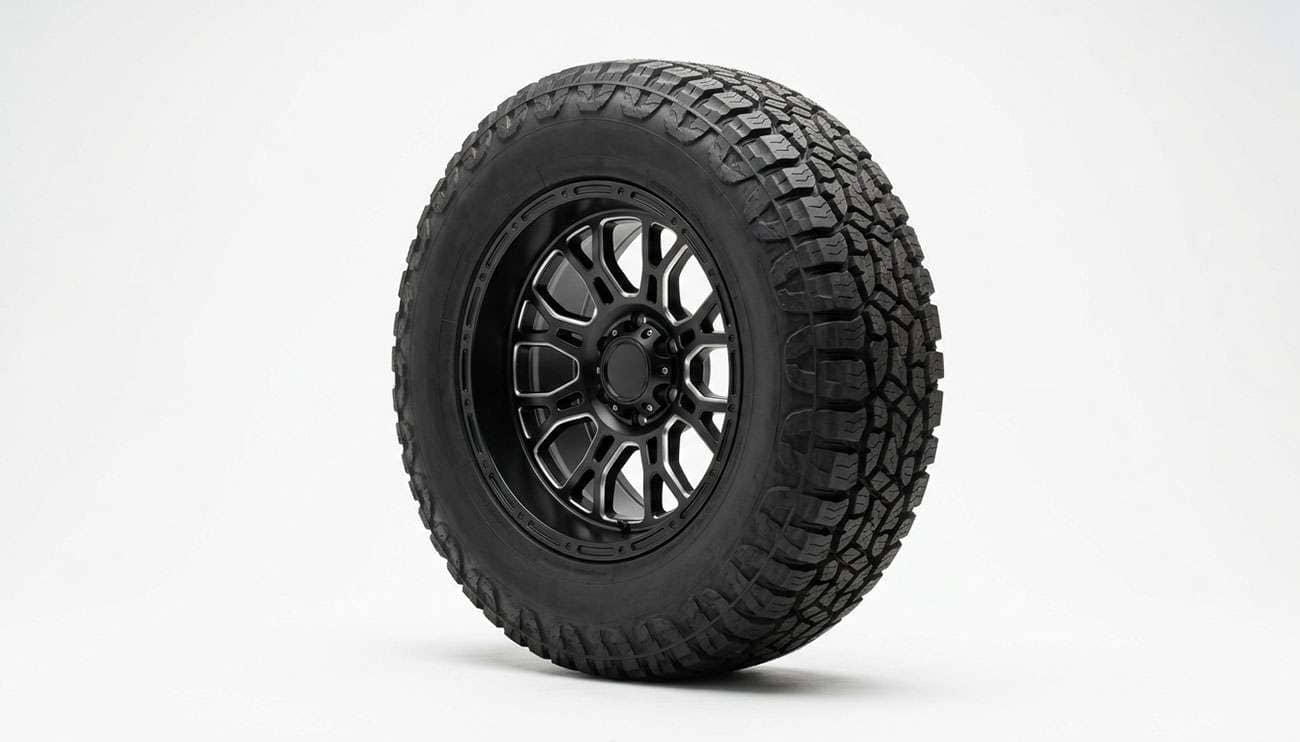
An 18x9 takes tires from roughly 265 up to 305 section width, with 275 and 285 sitting in the sweet spot. That is the easy half of the answer. The hard half is that rim width only tells you what will mount and hold air. Whether it rubs is decided by offset, and 18x9 is sold everywhere from deep negative to past plus fifty. Same rim width, more than four inches of difference in where the tire actually sits. Get your size from the table, then check backspacing before you order.
I have had this conversation across a counter more times than I can count. Somebody walks in holding a printout of a tire-to-wheel-width chart, points at a row, and says the internet told him this size fits his 18x9. And he is right. It does fit the wheel. It just does not fit his truck.
Those charts answer one question: what tire can safely seat on a nine-inch rim and hold air under load. That question is settled by the Tire and Rim Association, the ranges are published, and they do not change. It is a real answer to a real question. It is just not the question most people are actually asking.
What they are asking is whether it will rub. And rim width has almost nothing to do with that.
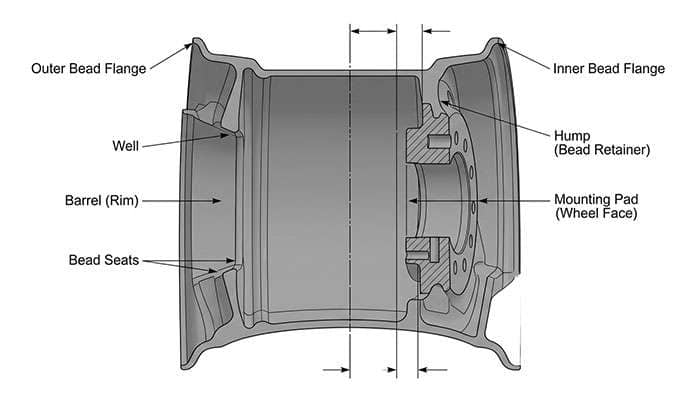
Here is the piece nobody puts in front of you. An 18x9 is not one wheel. It is a rim width, and rim width says nothing about where that rim sits relative to your hub. Offset does. Across what the aftermarket actually builds in 18x9, offset runs from deep negative all the way past plus sixty millimeters. The middle of that range sits right around zero, which tells you something about who buys this size.
Translate that to backspacing, which is the number that actually matters when you are looking at a fender lip. A nine-inch wheel measures ten inches across the bead flanges, so backspacing equals five inches plus the offset converted to inches. Run the math across the range and an 18x9 can put the tire anywhere from about 3.3 inches of backspacing to nearly 7. That is more than three and a half inches of swing on wheels that all say 18x9 on the box.
Offset on an 18x9 |
Backspacing |
Where the Tire Sits |
What Usually Goes Wrong |
|---|---|---|---|
-38 to -24 mm |
3.5 to 4.1 in |
Pushed well outboard, aggressive stance |
Fender lip contact at full lock and over bumps; added stress on wheel bearings |
-12 to 0 mm |
4.5 to 5.0 in |
Slightly proud of the fender, the common aftermarket look |
Front fender liner rub on a lifted truck; usually trimmable |
+12 to +25 mm |
5.5 to 6.0 in |
Roughly flush, close to most factory geometry |
Inner tire shoulder catching upper control arm or sway bar on wide sizes |
+35 to +50 mm |
6.4 to 7.0 in |
Tucked inboard, factory or European fitment |
Inner clearance runs out first; strut and spring contact on anything over 275 |
Look at that table and notice which column changed. The rim width was nine inches in every row. The tire could be identical in every row. And the failure mode is completely different in every row, because the only thing that moved was where the wheel put it.
There is a second wrinkle that catches people, and it is worth understanding before you shop. A tire's stamped section width is measured on a designated measuring rim, not on whatever you bolt it to. Mount that tire on something wider and it grows, roughly a fifth of an inch for every half inch of extra rim width. That growth splits evenly, about a tenth of an inch to each side. So a 285 on an 18x9 is genuinely wider than the same 285 on an 18x8, and that tenth of an inch on the inboard side is exactly the clearance you did not have to spare. Our piece on what putting the same size tire on different rim widths does goes deeper on how the carcass shape changes along with it.
Here is the approved rim width range for the sizes that matter on a nine-inch 18, straight from the published tables, along with where nine inches lands inside each window.
Tire Size |
Overall Diameter |
Approved Rim Width |
Where 18x9 Lands |
|---|---|---|---|
265/60R18 |
30.5 in |
7.0 to 9.0 in |
Top of the range. Legal, but the sidewall pulls upright |
265/65R18 |
31.6 in |
7.5 to 9.5 in |
Upper middle. Clean fit |
265/70R18 |
32.6 in |
7.0 to 9.0 in |
Top of the range |
275/65R18 |
32.1 in |
7.5 to 9.5 in |
Upper middle. One of the best matches for this rim |
275/70R18 |
33.2 in |
7.0 to 9.0 in passenger, 7.0 to 8.5 in LT |
Depends entirely on construction. See below |
285/60R18 |
31.5 in |
8.0 to 10.0 in |
Dead center. The ideal pairing |
285/65R18 |
32.6 in |
8.0 to 10.0 in |
Dead center. The ideal pairing |
305/65R18 |
33.6 in |
8.5 to 11.0 in |
Bottom of the range. Approved, but the sidewall bulges |
If you want the short version: 285/60R18 and 285/65R18 are what a nine-inch rim was built around. Both sit precisely in the middle of their approved window, which is where a tire carcass is happiest, where the tread sits flattest on the road, and where you get the most even wear out of a set.
You will notice most of these are truck and SUV sizes. That is not an accident. The fitment matrices that show up in search tend to start with 225/40R18 and work up through passenger-car widths, and those are perfectly good numbers, but the 18x9 wheels that come through my shop are almost all bolted to something with a truck bolt pattern. Six by 139.7 for Tacomas and Colorados, six by 135 for F-150s, five by 127 for Wranglers, eight by 165.1 for heavy-duty GM. If you are running a nine-inch 18, odds are you are in the truck table, not the car one.
Eighteen inches of diameter, nine and a half inches of width. That is the whole translation.
The first number is the bead seat diameter, measured where the tire's bead locks onto the rim, not the outer edge of the lip. That is why an 18-inch wheel measures a little over 19 inches across if you put a tape on the outside. The second number is the distance between the inside faces of the two bead flanges, which is again an inside measurement, not the overall width of the casting.
That second point trips people up when they are checking clearance. A wheel stamped 18x9 is actually about ten inches wide across the flanges, and wider still across the outer lip depending on the profile. If you are measuring for clearance with a straightedge, add that inch before you decide you have room.
The half-inch step matters more than it sounds. Going from 9 to 9.5 shifts every tire's fit up half a window. A 265/60R18 that is already at the top of its range on a nine is out of range on a 9.5. A 305 that was pinched at the bottom of its window on a nine sits properly on a 9.5. Half an inch of rim moves the whole conversation.
By the book, a 305. The 305/65R18 carries an approved rim width range of 8.5 to 11.0 inches, so a nine-inch rim is inside that window and it is a legitimate mount.
That is the technical ceiling. It is not the answer I would give a customer.
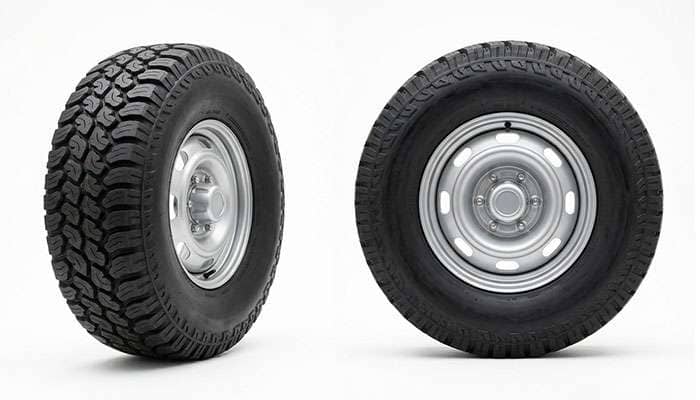
Nine inches puts a 305 at the very bottom of its approved range, and a tire mounted at the bottom of its window carries a pronounced sidewall bulge. The tread crowns slightly, so the center of the contact patch carries more load than the shoulders and wears faster for it. The sidewall sits at a steeper angle, which means it takes more of the impact when you hit a pothole and gives you less warning before it gives up. And you have just added twelve inches of section width to a vehicle whose fenders were designed around something narrower.
My honest ceiling for an 18x9 is 285. Not because 305 will not mount, but because 285 sits centered in its window, and centered is where a tire does everything it was engineered to do. If you want a 305 to sit right, buy an 18x10. If you want a 305 look on a nine-inch rim, you are going to pay for it in tread wear and sidewall exposure, and that exposure is worth understanding. Our guide on tire sidewall damage and whether it is safe to drive covers what a compromised sidewall actually looks like and when it ends the tire.
The other ceiling, the one that gets people, is not on the tire at all. It is your fender. A 285 on a plus-thirty-five offset 18x9 tucks in far enough to hit the strut. That same 285 on a minus-twelve sits proud of the fender and rubs the lip at full lock. Same tire, same rim width, two completely different problems. That is why I keep coming back to offset.
Yes, if it is a passenger or Euro-metric tire. No, if it is an LT.
This is the one distinction I almost never see spelled out, and it matters because 275/70R18 is a popular size that comes both ways. In standard passenger construction the approved rim width range is 7.0 to 9.0 inches, which puts a nine-inch rim exactly at the top edge but inside the window. In LT construction, the same nominal size carries a range of 7.0 to 8.5 inches, and a nine-inch rim is outside it.
The reason is structural. An LT casing has a stiffer sidewall and a different bead package built to hold higher inflation pressures, and stretching that stiffer casing onto a wider rim changes how the bead loads against the flange. The manufacturers publish a narrower window because the tire is a different animal, even though the numbers on the sidewall look the same.
So before you order a 275/70R18 for a nine-inch wheel, look at the prefix. If the size reads LT275/70R18, you want an 18x8.5 or you want a different size. If it reads 275/70R18 with no letter, or P275/70R18, you are inside the range. The tire size for wheel width breakdown walks through how to read these windows on a spec sheet.
One more thing on this size. At 33.2 inches it is a genuine 33, which is roughly two and a half inches taller than the 265/60R18 a lot of these trucks left the factory on. That is a real lift in effective diameter, and it will throw your speedometer, your odometer, and your effective gearing. Worth knowing before you commit.
Yes, and comfortably. This is one of the better matches for a nine-inch 18.
The 275/65R18 carries an approved rim width range of 7.5 to 9.5 inches, so nine sits in the upper middle of that window. That is a good place to be. The sidewall stands close to vertical without being stretched, the tread lays flat, and you get even wear across the contact patch.
At 32.1 inches overall it lands squarely in the 32-inch class, which is a modest and usually drama-free step up from a factory 265. Half an inch of width over a 275 predecessor, an inch or so of diameter over a 265/65R18. On most half-ton trucks and midsize SUVs with a mild lift, this size goes on without cutting anything.
The caveat is the same as always. Approved rim width tells you it will mount. It does not tell you your particular truck, at your particular offset, with your particular suspension, has room. Measure before you order.
They do, and plenty of them. Eighteen by ten is a standard production width across the major aftermarket brands, and it is the natural next step when nine inches runs out of room for the tire you want.
What is different about 18x10 is where the offsets live. Nine-inch wheels cluster around zero. Ten-inch wheels skew noticeably more negative, with the typical offering landing well below zero. That makes sense once you think about it. Nobody buys a ten-inch wheel to tuck it in. They buy it to run a wider tire and push it out where you can see it.
Practically, an 18x10 opens up 305 and 315 section widths at the center of their approved windows instead of the bottom, and it is where 33x12.50 and 35x12.50 flotation sizes start to make sense. It also demands more of your vehicle. More negative offset means a longer lever arm on your wheel bearings and more scrub radius change in your steering, which you will feel in the wheel over broken pavement.
If you are weighing nine against ten, the question is not which is better. It is which tire you actually want, and then which rim width centers that tire. Our what tires fit 20x9 wheels guide runs the same exercise a diameter up, and the 17x9 negative offset setup piece covers the aggressive end of the same width a diameter down.
The thing about a fitment mistake is that it rarely stops you from driving away. It just starts a bill that takes a year to arrive.
Day one, you hear it. A rub at full lock in a parking lot. Most people decide they can live with it and back off the steering a little. That decision is the whole problem.
Week two, the tire is marked. Wherever it is touching, the fender liner or the plastic trim is grinding a flat spot into the shoulder or the outer sidewall. Shoulder rubber is thinner than tread rubber. Sidewall rubber is thinner still, and it is the only thing standing between the cords and the road.
Month two, the wear pattern goes sideways. A tire that is pinched at the bottom of its rim width window crowns in the middle and wears the center strip early. A tire stretched at the top of its window rounds the shoulders and wears those instead. Either way you are throwing away tread you paid for on the corners that are not carrying their share.
Month six, the bearings start talking. Aggressive negative offset moves the tire's centerline outboard of the bearing, which is a lever arm the hub was never designed for. On a heavy truck with a wide tire that is real load, applied every mile, and it shows up as a hum that gets worse on one side during long sweeping turns.
The day it matters, the sidewall lets go. A sidewall that has been ground thin by a fender liner for eleven months fails without warning, because sidewalls do not have wear bars and there is nothing to inspect from the outside once the damage is under the surface. That is the one that ends badly, and it started with a noise somebody decided to live with.
None of that is fear-mongering. It is just the order things happen in, and I have watched it play out enough times to know the sequence.
One. Find the offset stamp on the wheel you already have. It is cast or laser-etched on the back of a spoke or the inner barrel, usually as ET followed by a number. ET35 means plus thirty-five millimeters. If there is no stamp, measure backspacing directly: lay a straightedge across the back flange and measure to the mounting pad.
Two. Convert to backspacing. On a nine-inch wheel, backspacing equals five inches plus your offset divided by 25.4. Positive offset adds, negative offset subtracts. Write the number down. This is the one that predicts rubbing.
Three. Measure what you have to work with. Turn the wheel to full lock in both directions and look at where the tire comes closest to the fender liner, the sway bar, and the upper control arm. Measure the tightest gap in each direction with the suspension at ride height. Then account for suspension travel: a tire that clears at ride height can still hit at full compression.
Four. Pick your size from the table above, then add the rim-width growth. If your chosen tire's measuring rim is narrower than nine inches, add about a tenth of an inch per side for every half inch of difference. Subtract that from the clearance you measured in step three.
Five. Check the load rating against your placard, not just the size. Fitment and capacity are different problems. A tire that clears beautifully and cannot carry your payload has not solved anything.
Six. If you are within a quarter inch, change something. A quarter inch is not margin. It is a rub waiting for a full-load turn on a driveway apron. Move to a narrower size, a different offset, or accept that trimming is part of the plan. Spacers can buy outboard room but they move the load further from the bearing, so read up on the benefits of wheel spacers and adapters before you go that route.
An 18x9 will take anything from a 265 to a 305 by the published rim width tables, and 285/60R18 or 285/65R18 will sit better on it than anything else. That part is settled and you can order from the table above with confidence.
What is not settled by any table is whether that tire clears your truck. Offset on this width ranges across more than three and a half inches of backspacing, and the same tire on two wheels both stamped 18x9 will either tuck under a strut or hang past a fender lip. Measure your backspacing, measure your clearance at full lock, and give yourself more than a quarter inch. Do that and you will only buy the tires once. For a deeper dive on the geometry, wheel offset explained covers how the whole system fits together.
When you are ready to shop, browse the full 18 inch wheel selection and filter by the offset your measurements call for.
It means an 18-inch bead seat diameter and a 9.5-inch width measured between the inside faces of the bead flanges. Both are inside measurements, so the wheel is physically about an inch wider than the stamped number and a bit over 19 inches across the outer lip. The extra half inch over an 18x9 shifts every tire's fit up half a window, which can move a size in or out of its approved range.
It depends on construction. In passenger or Euro-metric form the approved rim width range for 275/70R18 is 7.0 to 9.0 inches, so a nine-inch rim is inside the window at the top edge. In LT form the range narrows to 7.0 to 8.5 inches and a nine-inch rim falls outside it, because the stiffer LT casing and bead package are specified for a narrower rim. Check the prefix on the sidewall before ordering.
Yes. The approved rim width range for 275/65R18 is 7.5 to 9.5 inches, which puts a nine-inch rim in the upper middle of the window. At 32.1 inches overall diameter it is a clean step up from a factory 265 on most half-ton trucks and midsize SUVs. Confirm fender and suspension clearance at your specific offset before ordering.
By the published tables, a 305/65R18 is approved because its rim width range runs 8.5 to 11.0 inches. Practically, 285 is the better ceiling. A 305 on a nine-inch rim sits at the very bottom of its window, which crowns the tread, loads the center of the contact patch harder than the shoulders, and leaves the sidewall at a steeper angle with less impact protection.
Yes, 18x10 is a standard production width across the major aftermarket brands. Offsets in that width skew considerably more negative than 18x9 offsets do, since the size is generally bought to push a wider tire outboard. An 18x10 centers 305 and 315 section widths properly and opens up 33x12.50 and 35x12.50 flotation sizes, at the cost of more load on the wheel bearings.
Add one inch to the stamped width to get the flange-to-flange measurement, halve it, then add the offset converted to inches. On a nine-inch wheel that works out to five inches plus the offset divided by 25.4. A plus-25 offset gives about 6.0 inches of backspacing; a minus-24 offset gives about 4.1 inches. Positive offset adds backspacing, negative offset subtracts it.