
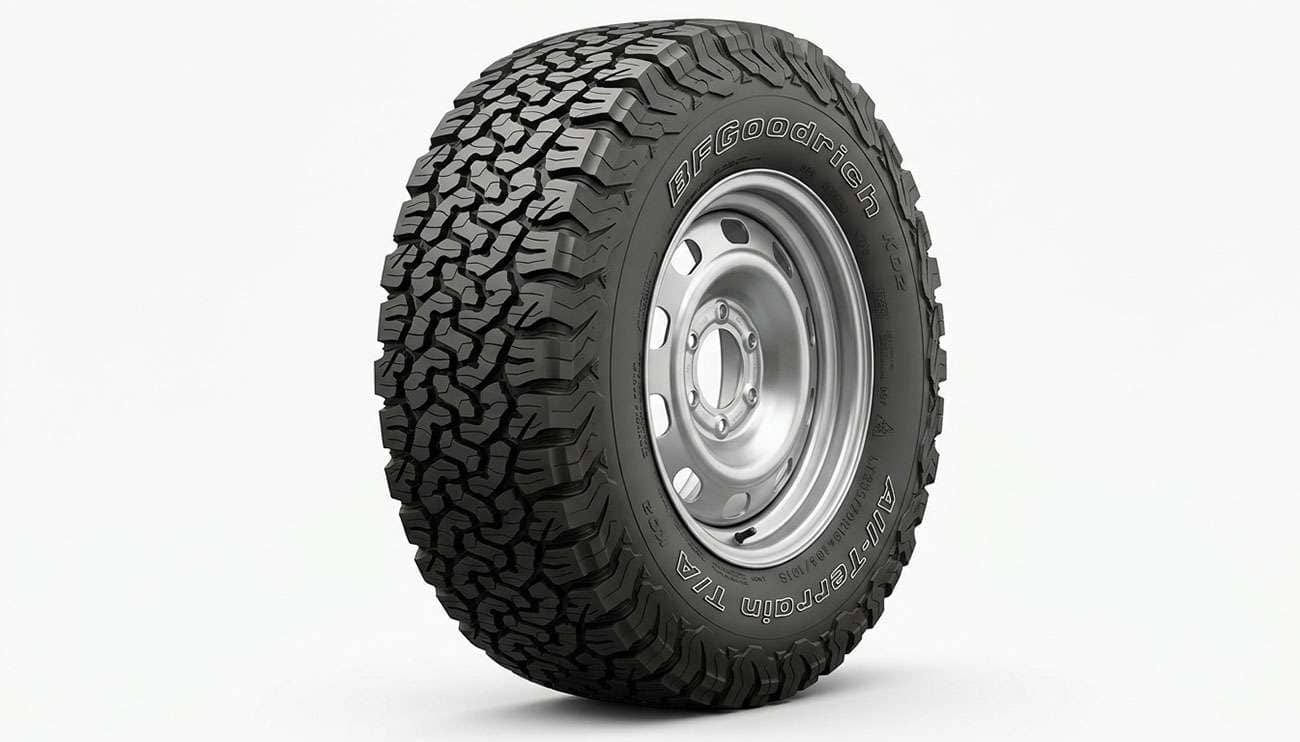
A 235/70R16 stands about 29.0 inches tall, measures 9.25 inches across the section, carries roughly 6.48 inches of sidewall, and mounts on a 16 inch wheel. That geometry is the same on every 235/70R16 ever built. What is not the same is the load index. This one size code covers seven of them, from 101 to 110, and that is a 518 lb spread in what a single tire can carry. Add the derating rule for passenger-metric tires on trucks and the real gap widens past 530 lbs a corner.
I have been fitting this size since it showed up on Explorers and Cherokees, and the geometry is the easy part. The part that puts people in trouble is assuming that because two tires say 235/70R16, they are the same tire. They can be over 2,100 lbs apart across a set. Let me walk you through both halves.
Here is the size decoded. The 235 is section width in millimeters, the 70 is the aspect ratio meaning the sidewall stands 70 percent as tall as the tire is wide, the R means radial construction, and the 16 is the wheel diameter in inches.
Measurement |
Metric |
Inches |
|---|---|---|
Section width |
235 mm |
9.25 in |
Sidewall height |
164.5 mm |
6.48 in |
Overall diameter |
735.4 mm |
28.95 in |
Circumference |
2,310 mm |
90.95 in |
Revolutions per mile |
433 per km |
697 per mile |
Approved rim width, passenger |
152 to 203 mm |
6.0 to 8.0 in |
Approved rim width, LT |
152 to 190 mm |
6.0 to 7.5 in |
Notice the last two rows. The LT version of this size runs a narrower approved rim range than the passenger version, and almost nobody prints that. If you are moving from a P-metric tire to an LT tire on the same wheels, check that your rim width is 7.5 inches or under before you order. The ideal target for either construction is 6.5 to 7.0 inches.
You will sometimes see this size rounded to 29x9.3R16 in flotation terms. That is close enough for a conversation and not close enough for a spec sheet. Use 28.95 inches when you are calculating speedometer error or checking clearance.
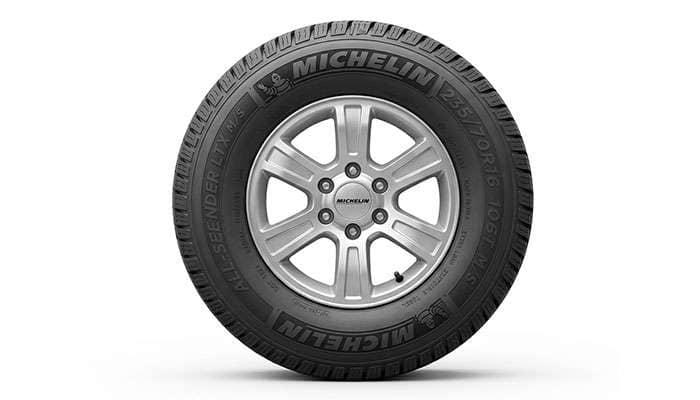
This is the part I actually want you to take away. Pull up any listing for 235/70R16 and you will find tires marked 101, 104, 105, 106, 107, 109, and 110. Same 29 inch diameter. Same 9.25 inch section. Wildly different capacity.
Load Index |
Capacity Per Tire |
Set of Four |
Where You See It |
|---|---|---|---|
101 |
1,819 lbs |
7,276 lbs |
Rare, light passenger applications |
104 |
1,984 lbs |
7,936 lbs |
The standard P-metric tier |
105 |
2,039 lbs |
8,156 lbs |
Occasional touring option |
106 |
2,094 lbs |
8,376 lbs |
The most common tier by a wide margin |
107 |
2,149 lbs |
8,596 lbs |
Extra load highway and all-terrain |
109 |
2,271 lbs |
9,084 lbs |
Extra load winter and all-terrain |
110 |
2,337 lbs |
9,348 lbs |
LT-metric off-road construction |
Bottom to top that is 518 lbs per tire and 2,072 lbs across a set. That is more than the curb weight difference between a Honda CR-V and a Ford E-150, and both of those vehicles show up on the fitment list for this exact size.
Here is the piece that catches people who did their homework. When a P-metric tire is fitted to a light truck, SUV, or van, its published load capacity does not carry over at face value. The Tire and Rim Association standard requires you to divide the marked capacity by 1.10 to get the usable figure on a truck application.
Run that on a P235/70R16 marked 104. On paper it carries 1,984 lbs. Bolt it to a Ford Ranger and the working number becomes 1,804 lbs. That drops it below where the lowest-index tire in the whole size started. Against an LT235/70R16 marked 110 at 2,337 lbs, you are 533 lbs apart per corner, over 2,100 lbs apart across the axle set, with both tires stamped 235/70R16.
NHTSA and FMVSS 110 set the governing principle: replacement tires must meet or exceed the load capacity the vehicle manufacturer specified. Nothing in that standard cares that the size code matches. It cares about the number.
The failure mode is not dramatic and that is what makes it sneaky. An underspecified tire holds air, drives straight, and feels fine on a short empty errand. Load it up with people and gear on a hot afternoon and the casing runs hotter than it was designed to run. Sidewall flex generates heat, heat degrades the bond between the belt package and the carcass, and the result eventually shows up as a separation at speed. That is the mechanism, and it is the same one behind most of what I see come through the shop as tire sidewall damage.
Going the other way is fine. A higher load index than your placard calls for costs you a bit of ride softness and nothing else. If you cannot verify, go up.
If you want the full background on the two construction families, we laid it out in P-metric vs LT tires, and the terminology around ratings is covered in load range vs load index.
This size shows up as original equipment across roughly 140 models from 37 manufacturers, and the range is unusually broad. It served the compact crossover market and the light truck market at the same time, which is exactly why the load index spread got so wide.
Category |
Examples |
What to Expect |
|---|---|---|
Compact crossovers |
Honda CR-V, Toyota RAV4, Ford Escape, Hyundai Santa Fe, Kia Sorento |
P-metric, usually 104 or 106 |
Midsize SUVs |
Ford Explorer, Explorer Sport Trac, Jeep Cherokee, Jeep Liberty |
P-metric or Euro-metric, 104 to 106 |
Compact pickups |
Ford Ranger, Dodge Dakota |
Derating applies to P-metric fitments |
Full-size vans |
Ford E-150 |
Highest load index in the size |
Body-on-frame utilities |
Land Rover, Mitsubishi, Isuzu, GMC and Chevrolet applications |
Often LT-metric for off-road duty |
Look at that spread. A CR-V weighs somewhere around 3,400 lbs. An E-150 gets past 5,000 empty and is rated to carry considerably more. Same tire size on the box. Different tire entirely on the sidewall.
Because of that range, the honest answer to "what fits my vehicle" always comes back to the door jamb placard rather than to any list. The placard gives you the size and the load index the engineers signed off on. If someone before you already swapped to something else, the tire currently on the vehicle will not tell you the truth.
Same width, shorter sidewall. A 235/65R16 stands 28.03 inches tall against 28.95 for the 70 series, which puts it 3.2 percent smaller. That sits right at the outer edge of the window most people use, and here is what it actually costs you.
My answer: it will physically mount and drive, and if the vehicle originally offered both sizes from the factory it is a legitimate option. If your placard says 235/70R16 and only that, I would stay put. The 3.2 percent is enough to nudge ABS and stability control calibration, and you are giving up clearance and ride to gain nothing.
This one goes the other direction and the numbers are bigger than people expect. A 215/70R16 stands 27.85 inches. Moving up to 235/70R16 at 28.95 inches adds 1.10 inches of diameter, which is a 3.9 percent increase. It also adds 20 mm, about 0.79 inches, of section width.
Spec |
215/70R16 |
235/70R16 |
Change |
|---|---|---|---|
Overall diameter |
27.85 in |
28.95 in |
+1.10 in (+3.9%) |
Section width |
8.46 in |
9.25 in |
+0.79 in |
Sidewall height |
5.93 in |
6.48 in |
+0.55 in |
Revs per mile |
724 |
697 |
-27 |
Min rim width |
5.5 in |
6.0 in |
+0.5 in |
At 3.9 percent you are past the 3 percent window that keeps a speedometer honest and keeps electronic stability control reading wheel speeds the way it was calibrated to. Your speedometer will read low, meaning an indicated 70 is actually about 72.7.
Three things to check before you commit. First, rim width: 235/70R16 needs a minimum 6.0 inch rim, and plenty of vehicles that came on 215 wear a 5.5 or 6.0 inch wheel. If yours is 5.5, the answer is no. Second, clearance at full lock and full suspension compression, because you added most of an inch of width and half an inch of sidewall. Third, load index, same as always.
If the vehicle offered 235/70R16 as a factory option on another trim, this is an easy yes and a common upgrade. If it never did, treat it as a modification and check the three items above rather than assuming.
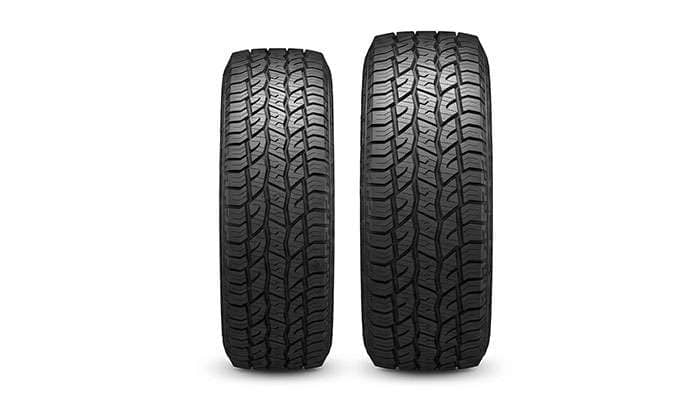
Size |
Overall Diameter |
Difference |
Verdict |
|---|---|---|---|
225/75R16 |
29.29 in |
+1.2% |
Closest match, narrower with more sidewall |
225/70R16 |
28.40 in |
-1.9% |
Comfortably inside tolerance |
245/70R16 |
29.50 in |
+1.9% |
Slight upsize, check clearance |
235/75R16 |
29.88 in |
+3.2% |
At the edge, popular on lifted rigs |
235/65R16 |
28.03 in |
-3.2% |
At the edge, loses clearance |
255/70R16 |
30.06 in |
+3.8% |
Outside tolerance, treat as a modification |
No, and the reason is that "wide" only means something relative to the vehicle it is bolted to.
At 9.25 inches of section width, a 235 sits squarely in the middle of the light truck and SUV range. On a 16 inch wheel it is the standard-issue width for a crossover or a compact pickup. Nobody at a trailhead is going to look at your 235s and think you did something.
Where the answer flips is on a passenger car. Put 235 mm under a compact sedan that came on 195 or 205 and it is genuinely wide, enough that you would need to check fender and strut clearance. Same number, completely different reading.
Here is roughly how I think about it in the SUV and light truck world:
The thing people miss is that section width is a nominal figure measured on a reference rim. Mount a 235 on a 6.0 inch wheel and it pinches in slightly; mount the same tire on an 8.0 inch wheel and it spreads out. Actual measured width varies an eighth of an inch or so between brands in this size, which matters when you are chasing clearance.
P235/70R16 spans a wide band. The bottom of the market sits around $87 a tire and the top runs past $450, with most of the volume landing between roughly $100 and $215. The midpoint of the P-metric side of this size is right around $127.
The Euro-metric and no-prefix versions run a little higher through the middle, with a median closer to $153, because that group carries more of the extra-load and winter product. LT-metric is the most expensive tier, generally $130 to $280, and that premium buys you a heavier casing with more plies rather than a nicer tread pattern.
What actually moves the price in this size:
My honest advice on budget: this is a size where the cheap end is genuinely usable for a light crossover on paved roads. It is not usable for a van or a loaded pickup, because the cheap end is also where the load indexes are lowest and the warranties are shortest. Buy the load index first and shop price inside that constraint, not the other way around. If you need LT construction, the LT235/70R16 tires are a separate category for exactly that reason.
Five minutes with a flashlight settles all of this. Here is the order I do it in.
If you come up unsure at any step, call the shop with your year, make, and model and we will read it against the manufacturer data before anything ships. It costs nothing and it is a lot cheaper than a set of tires that do not carry what your vehicle needs.
A 235/70R16 is 28.95 inches tall, 9.25 inches wide, with 6.48 inches of sidewall on a 16 inch wheel, turning 697 revolutions per mile. Those numbers hold for every tire wearing this size code, and they are what most people came here for.
What they usually did not come for is the second half. This size code covers load indexes from 101 to 110, and once you factor the 1.10 derating rule for a P-metric tire on a truck, the working spread runs from about 1,804 lbs to 2,337 lbs per corner. That is over 2,100 lbs across a set, hiding behind identical geometry and identical printing on the sidewall.
Read the placard. Match the load index. Then shop tread pattern, brand, and price all you like, because at that point every option in front of you will actually hold up your vehicle.
When you are ready to look at what is available, browse the full range of 235/70R16 tires, or contact us with your year, make, and model and we will confirm size, load index, and rim width before you order.
A 235/70R16 measures 28.95 inches in overall diameter, 9.25 inches in section width, and 6.48 inches in sidewall height, mounting on a 16 inch wheel. Circumference is 90.95 inches and it turns approximately 697 revolutions per mile. Approved rim width is 6.0 to 8.0 inches for passenger construction and 6.0 to 7.5 inches for LT construction.
This size appears as original equipment on roughly 140 models across 37 manufacturers. Common applications include the Honda CR-V, Toyota RAV4, Ford Escape, Ford Explorer and Explorer Sport Trac, Ford Ranger, Ford E-150, Jeep Cherokee and Liberty, Hyundai Santa Fe, Kia Sorento, and Dodge Dakota, along with Land Rover, Mitsubishi, GMC, and Chevrolet applications.
A 235/65R16 stands 28.03 inches tall against 28.95 for the 70 series, making it 3.2 percent smaller. That sits at the outer edge of acceptable tolerance. You lose about half an inch of ground clearance, your speedometer reads high by roughly 2 mph at 70, and ride comfort drops with the shorter sidewall. Only substitute if the factory offered both sizes for your vehicle, and verify the load index carries over.
Moving from 215/70R16 to 235/70R16 adds 1.10 inches of overall diameter, a 3.9 percent increase that falls outside the usual 3 percent window, plus 0.79 inches of section width. Your speedometer will read low by about 2.7 mph at an indicated 70. Confirm your rim is at least 6.0 inches wide, check clearance at full steering lock and full suspension compression, and verify load index before proceeding.
On an SUV or light truck, no. At 9.25 inches of section width, 235 mm sits in the standard range where most factory fitments live. Wide begins around 265 to 285 mm in that class. On a compact passenger car that came on 195 or 205, however, 235 is genuinely wide and would require checking fender and strut clearance.
P235/70R16 runs from roughly $87 to over $450 per tire, with most of the market between about $100 and $215 and a midpoint near $127. Euro-metric versions sit somewhat higher through the middle because that group carries more extra-load and winter product. LT-metric is the most expensive tier at roughly $130 to $280, reflecting a heavier casing rather than a different tread.
Because this size served compact crossovers and full-size vans at the same time. Manufacturers built it in passenger, Euro-metric, and LT constructions to cover that range, producing load indexes from 101 through 110. The geometry stays identical across all of them, so the only way to tell them apart is to read the load index stamped after the size on the sidewall.
More on sizing in this family: 235/85R16 in inches covers the tall-sidewall version on the same wheel, 265/70R16 steps up in width at the same aspect ratio, what vehicles use 225/75R16 tires handles the nearest equivalent, and 215/65R16 in inches works the smaller end of the 16 inch range.



