
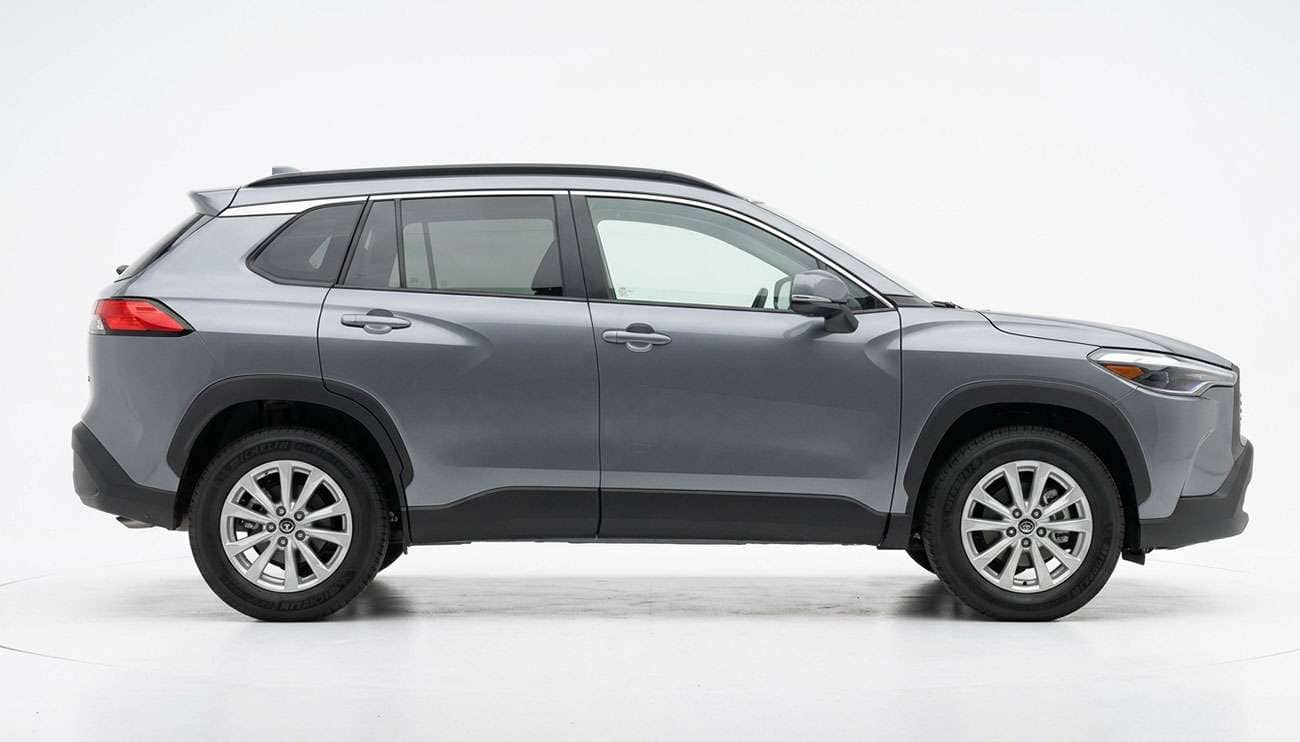
A 215 65R16 stands 27.0 inches tall and 8.5 inches wide, with a 5.5-inch sidewall on a 16-inch wheel. Circumference is 84.8 inches and it turns 747 revolutions per mile. That is the answer, and it took me one line, and it will not keep you out of trouble.
Here is what I have watched happen in the shop for thirty-odd years. Somebody comes in with those eight characters written on the back of an envelope, figuring one size means one tire. It does not. In this particular size I can hand you a passenger touring tire rated 98H, an extra-load crossover tire rated 102, a light-truck tire rated 109, and a trailer tire that must never go on a car. All four are stamped 215/65R16 or something close enough that you would not blink at it on the shelf. The inches are identical on every one of them.
So the numbers are the easy part. What separates a correct tire from a bad afternoon is the stuff printed after the size, plus the width of the wheel you are bolting it to. Let me walk you through both, then take the questions people actually ask me about this size.
Three pieces to the code, and each one converts straight across.
215 is the section width in millimeters. Divide by 25.4 and you get 8.46 inches. Important thing to understand: that is measured at the widest point of the inflated tire, which is the bulge in the sidewall, not the tread. The rubber actually touching the road on a tire this size is usually closer to 6.5 or 7 inches. Folks mix those two up constantly and then wonder why the tire looks narrower than the number says.
65 is the aspect ratio. Sidewall height as a percentage of section width. So 215 times 0.65 gives you 139.75 millimeters, or 5.50 inches from the bead seat up to the tread face. On a car this size that sidewall is doing most of the work absorbing potholes.
16 is the wheel diameter in inches. No conversion needed. Bead seats on a 16-inch wheel, nothing else.
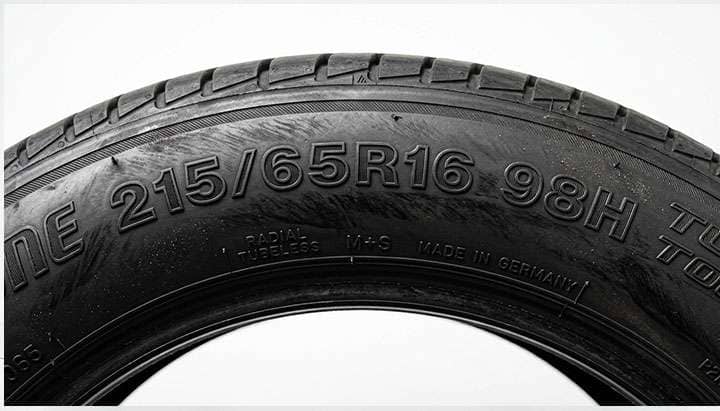
Add it up. Wheel diameter plus two sidewalls: 16 + 11.00 = 27.0 inches overall, or 686 millimeters. Multiply that by pi and you get a circumference of 84.8 inches. Divide 63,360 inches in a mile by 84.8 and the tire turns 747 revolutions per mile.
That revs-per-mile figure is the one your speedometer and odometer are geared to. Every mile the car reports, every mile-per-hour on the dial, traces back to it. Change the diameter and you change all of that, which is why the size swap questions further down matter more than they look.
If you want it in the flotation language the truck crowd uses, a 215/65R16 works out to roughly 27x8.5R16. You will never see it marked that way, but the math is the math.
This is a crossover and small-SUV size, and a popular one. It sits right in the sweet spot where a vehicle is taller and heavier than a sedan but not carrying a truck's weight.
You will find it as a factory or common replacement size on the Honda CR-V, Toyota RAV4, Subaru Forester, Ford Escape, Nissan Rogue, Hyundai Tucson and Santa Fe, Kia Sportage, Mazda CX-5, Chevrolet Equinox, Jeep Compass and Patriot, Mitsubishi Outlander, Volkswagen Tiguan, Honda Element, and Suzuki Grand Vitara, depending on model year and trim. Early Toyota Highlanders ran it too.
Now here is the part I have to say every time, because I have seen the other outcome. Do not buy off a model-year list, including mine. Manufacturers change sizes mid-generation and between trims all the time. A base Escape and a loaded Escape from the same year can want different tires. Open the driver's door and read the placard on the jamb. Federal Motor Vehicle Safety Standard 110 requires that placard to be there, and it tells you the original size, the load rating, and the cold inflation pressure the vehicle was certified with. That yellow-and-white sticker beats any chart on the internet, mine included.
One more wrinkle worth knowing. Because 215/65R16 shows up on cargo vans and light commercial vehicles in some markets, you will occasionally run across a version built for that duty. Those are not interchangeable with the crossover version, and the next section is about exactly why.
This is the section I would tape to the counter if I could. The size tells you the shape. The service description tells you the job.
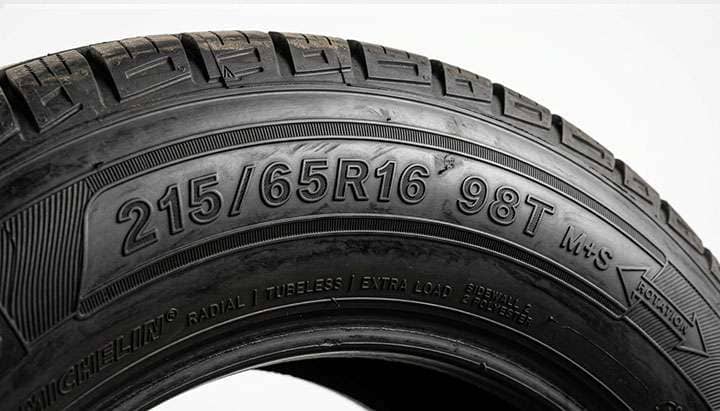
Right after the size on the sidewall you will find a number and a letter, something like 98H. The number is the load index, which maps to a maximum weight the tire can carry at its rated pressure. The letter is the speed rating. In 215/65R16, both of those numbers move around a lot more than people expect.
Marking |
Load Index |
Max Load Per Tire |
What It Is Built For |
|---|---|---|---|
P215/65R16 96 or 98 SL |
96 to 98 |
1,565 to 1,653 lb |
Passenger-metric build for sedans, wagons, and lighter crossovers. Capacity is derated when fitted to an SUV or van. |
215/65R16 98 SL |
98 |
1,653 lb |
The volume replacement spec. Covers most crossover placards in this size and is what you will see on the shelf most often. |
215/65R16 102 XL |
102 |
1,874 lb |
Extra Load casing for heavier crossovers, roof boxes, third-row loads, and vehicles that spend time near their rated weight. |
LT215/65R16 109 Load Range D |
109 |
2,271 lb |
Light-truck construction with a stiffer casing and higher inflation. Wrong tire for a crossover; harsh and heavy for no benefit. |
From a 96 to a 109 is 706 pounds per tire. Across four corners that is almost 2,800 pounds of difference living inside one size marking. Fitting a 96 where the placard calls for a 102 is not a shortcut. It is a real reduction in what the vehicle can safely carry, and NHTSA is clear that a replacement tire should meet or exceed the original load index.
Prefixes matter too, and this is where I lose people. A tire marked P215/65R16 is built to passenger-car standards, and when you fit a P-metric tire to an SUV, van, or truck, its rated capacity gets divided by 1.10 before you compare it to the placard. A 98 P-metric worth 1,653 pounds only counts for about 1,503 pounds on a crossover. A tire with no prefix at all is Euro-metric and takes no such haircut. If the difference between the two rating systems has never been laid out for you plainly, our guide to load range versus load index is worth ten minutes.
And then there is ST215/65R16. ST stands for Special Trailer. Those tires are built with stiff sidewalls for trailer duty and are not certified for a steered or driven axle. Same numbers, entirely different animal. I have seen one show up on a car exactly once and once was enough.
Speed rating in this size spans further than almost any size I deal with: Q at 99 mph on studded winter tires, R at 106, S at 112, T at 118, H at 130, and V at 149 on the performance versions. Most crossover placards in 215/65R16 call for H or T. Going above the placard rating is fine. Going below it changes the casing construction and the heat capability of the tire, not just a number on a chart. If Extra Load is new territory for you, we break down what XL load range means in plain English.
Usually yes, and it is one of the more forgiving swaps in the book. But run the numbers before you commit.
A 205/65R16 has a 5.25-inch sidewall, so it stands 16 + 10.49 = 26.49 inches. Your 215/65R16 stands 27.0 inches. That is 0.51 inches taller, a 1.9 percent change in diameter. Section width goes up 10 millimeters, a bit under four tenths of an inch.
The industry convention is to stay inside plus or minus 3 percent of the original diameter, because that is roughly where the speedometer, ABS wheel-speed comparison, and transmission shift logic stay in their designed window. At 1.9 percent you are comfortably inside it. That is the honest answer and it is why this swap is so common.
What actually changes:
The one I will push back on is doing it on two corners only. If your car is all-wheel drive, mismatched rolling circumference between the axles puts continuous load on the center differential or transfer case. Manufacturers publish a maximum circumference difference for a reason. Change all four or leave it alone. And if the diameter change is bigger than this one and you are wondering about recalibration, our piece on how bigger tires affect your speedometer covers what is involved.
Everything else being equal, the 65. But "everything else being equal" is carrying the whole sentence, and that is where this question goes wrong.
The aspect ratio is a percentage of the section width, not a measurement. Sixty-five percent of a small number can easily be less than sixty percent of a big one. So a 65 is not automatically taller than a 60. It depends entirely on what width and what wheel you are comparing.
Size |
Sidewall Height |
Overall Diameter |
The Point |
|---|---|---|---|
215/65R16 |
5.50 in |
27.0 in |
Our reference size |
215/60R16 |
5.08 in |
26.2 in |
Same width, same wheel, so here the 65 really is taller by 0.85 in |
235/60R18 |
5.55 in |
29.1 in |
A 60 with a taller sidewall and two inches more diameter than our 65 |
185/65R15 |
4.73 in |
24.5 in |
A 65 that is 2.5 in shorter than our 65, because the width and wheel changed |
Read that table twice and you have got it. Comparing aspect ratios only means something when the width and the wheel diameter are identical. The moment either one moves, the percentage stops telling you anything about height on its own. This trips up more people than any other part of tire sizing, and our breakdown of tire aspect ratio decoded takes it apart step by step.
For the specific comparison most people mean when they ask, 215/65R16 against 215/60R16: the 65 is 0.85 inches taller, which is a 3.2 percent difference. That is just past the 3 percent substitution window, so it is a swap that wants a look at clearance and speedometer accuracy first rather than a blind yes. We cover that size on its own in our guide to 215/60R16 tire size, specs, and compatibility.
Every published spec you have read for this size, including the 27.0 by 8.5 numbers up top, describes the tire mounted on one specific wheel. For 215/65R16 the Tire and Rim Association approved range is 6.0 to 7.5 inches, and the measuring rim is 6.5 inches. That 6.5-inch wheel is where the published figures come from.
Move within that range and the tire changes shape. The working rule is about 5 millimeters, roughly two tenths of an inch, of section width for every half inch of rim width. Pull the beads apart and the sidewalls stand up straighter and push the tire wider. Squeeze them in and the sidewalls bow and the tire narrows slightly while gaining a touch of height.
Rim Width |
Approx. Section Width |
Approx. Mounted Diameter |
How It Behaves |
|---|---|---|---|
6.0 in (narrowest approved) |
8.3 in |
27.1 in |
Most sidewall bulge, softest ride, most roll in a hard corner |
6.5 in (measuring rim) |
8.5 in |
27.0 in |
The published spec, and what every tire review is written against |
7.0 in |
8.7 in |
26.9 in |
Flatter contact patch, crisper steering response, very common factory width |
7.5 in (widest approved) |
8.9 in |
26.8 in |
Tread pulled nearly flat, firmest ride, wheel lip more exposed to curbs |
Across the full range the same tire goes from about 8.3 to about 8.9 inches wide. Six tenths of an inch of swing on a size marking that never changes. Your wheel width is usually stamped on the back of the spoke face or inside the barrel, written like 16x6.5. Worth knowing before you assume the number on the shelf is the number you will get, and there is more on the trade-offs in our piece on what putting the same size tire on different rim widths does.
I am not going to hand you a top-five list that ignores your car and where you live. What I will give you is the order I ask questions in when somebody stands at my counter with this size.
First question: what does the placard say? If it calls for 102 XL, everything rated 98 is off the table no matter how good the reviews are or how much cheaper it is. That single filter usually cuts the field in half, and it is not negotiable.
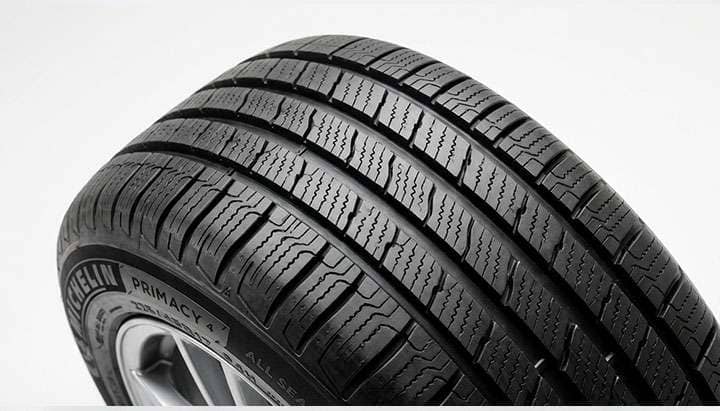
Second question: do you see real winter? If you do, look for the three-peak mountain snowflake symbol, which means the tire passed a standardized snow traction test. The older M+S marking is a tread-geometry designation, not a performance test, and the two are not the same claim. Winter-specific tires exist in this size in decent variety, and a dedicated set on their own wheels is still the best money you can spend if you live where it snows.
Third question: how many miles are you keeping this car? Mileage warranties in 215/65R16 run from around 40,000 to 90,000, and UTQG treadwear grades run from the low 400s to the 700s. A grand touring tire with a long warranty and a 700 treadwear grade will outlast a performance tire by a wide margin. It will also feel duller in the corners. That is not a defect on either one, it is the trade you are choosing.
Fourth question: what is bothering you about the current set? Noise, wet grip, and ride comfort are the three complaints I hear about crossover tires, and no tire wins all three. If your last set was loud, sort by touring and grand touring rather than performance. If they hydroplaned, look at the groove volume and the wet ratings. Tell whoever is helping you what actually annoyed you and you will get a better tire than any list can give you.
The good news with this size is that the field is deep. Touring and grand touring all-seasons dominate the category, with performance options and a solid winter selection alongside them. You are not short on choices here.
215/65R16 is a high-volume size, which works in your favor. It is stocked broadly across warehouse clubs, big-box retailers, independent shops, and online sellers, and pricing runs from around $40 per tire at the very bottom to over $400 for premium performance construction. The median sits near $120.
That spread should tell you something. A $40 tire and a $400 tire in the same size are not the same product with different stickers on them. Here is what I tell people to check no matter where they end up buying:
You can look through the full range of 215/65R16 tires and filter by load index, season, and speed rating so you are comparing like against like.
Nobody puts an under-rated tire on a car and drives off the lot with a problem. That is what makes this one sneaky. The bill arrives in installments.
The first month or two: wear you cannot see yet. A tire carrying more than it is rated for runs hotter and flexes further in the sidewall on every rotation. Shoulder wear starts long before it shows up in a walkaround. A tire mounted at the far edge of its approved rim width does the same thing from the opposite direction, wearing the shoulders on a too-wide wheel or the center on a too-narrow one.
Months two through six: heat building up in the casing. Here is the mechanism, because I would rather you understand it than take my word. Every time the tire rolls through the contact patch, the sidewall flexes and springs back. That flexing generates heat inside the rubber. Heat is what breaks down the bond between the rubber and the steel belts underneath the tread. An overloaded casing flexes further every single revolution, so it makes more heat, and none of that damage undoes itself when you take the load out of the car. The Tire Industry Association treats sustained overload and chronic underinflation as the same failure, and this is why.
Months six through eighteen: the belt edge starts letting go. This is where a tire that has been running past its rating shows its hand. Usually it is a vibration that comes and goes with speed, sometimes a visible wave or bulge in the tread face. By the time you can feel it in the wheel, the separation inside is already well along.
Whenever it decides: failure when the car is working hardest. A casing that has been accumulating heat damage does not let go in a parking lot. It lets go loaded, at highway speed, in summer. Sidewall damage is one where I have never once regretted telling somebody to replace the tire, and our guide to tire sidewall damage and whether it is safe to drive walks through how to judge what you are looking at.
None of that takes abuse. It takes one wrong character on a sidewall and enough Tuesdays.
A 215 65R16 is 27.0 inches tall, 8.5 inches wide, with a 5.5-inch sidewall, an 84.8-inch circumference, and 747 revolutions per mile. Those figures describe the tire on a 6.5-inch measuring rim. Put it on a 7.5-inch wheel and it comes out closer to 8.9 inches wide.
But the inches were never the hard part. In this one size the load index runs from 96 to 109, the speed rating runs from Q to V, and the prefix can be P, LT, ST, or nothing at all. That is the difference between a tire that fits your crossover and one built for a trailer. Read the placard, read the whole sidewall, know your wheel width, and this size will treat you well. It is a good size with deep choices behind it.
A 215/65R16 measures approximately 27.0 inches in overall diameter and 8.5 inches in section width, with a 5.5-inch sidewall on a 16-inch wheel. Circumference is 84.8 inches and it turns 747 revolutions per mile. Those figures are measured on a 6.5-inch rim; actual mounted width varies by about 0.2 inches per half inch of rim width within the approved 6.0 to 7.5-inch range.
It is a common size on compact and mid-size crossovers, including the Honda CR-V, Toyota RAV4, Subaru Forester, Ford Escape, Nissan Rogue, Hyundai Tucson and Santa Fe, Kia Sportage, Mazda CX-5, Chevrolet Equinox, Jeep Compass, Mitsubishi Outlander, and Volkswagen Tiguan, depending on year and trim. Sizes change between trims and model years, so confirm against the placard on your own driver's door jamb rather than a model list.
In most cases yes. The 215 is 0.51 inches taller and 10 millimeters wider, a 1.9 percent diameter change that sits inside the accepted plus-or-minus 3 percent window. Your speedometer will read about 1.9 percent slow. Two things to confirm first: your wheels must be at least 6.0 inches wide, since that is the narrowest rim approved for the 215, and on all-wheel-drive vehicles all four tires should be changed together.
Only when the section width and wheel diameter are identical. Aspect ratio is a percentage of the width, not a fixed measurement, so a 65 is taller than a 60 only in a direct comparison like 215/65R16 against 215/60R16, where the 65 wins by 0.85 inches. Change the width or the wheel and it flips easily: a 235/60R18 has a taller sidewall and two more inches of diameter than a 215/65R16.
That is the service description. The 98 is the load index, worth 1,653 pounds per tire at rated inflation. The H is the speed rating, good to 130 mph. In this size you will also see 96 at 1,565 pounds, 102 XL at 1,874 pounds, and LT builds at 109 for 2,271 pounds, with speed ratings from Q through V. Match or exceed whatever your door placard specifies.
The Tire and Rim Association approved range is 6.0 to 7.5 inches, with 6.5 inches as the measuring rim that published specs are based on. Factory crossover wheels in this size are most often 6.5 or 7.0 inches wide. Individual tire models sometimes specify a narrower range than the general size standard, so check the manufacturer's spec sheet if your wheels sit at either extreme.
Yes. The P prefix means passenger-metric construction. When a P-metric tire is fitted to an SUV, van, or light truck, its load capacity is divided by 1.10 before being compared against the vehicle placard, so a 98 P-metric counts for about 1,503 pounds instead of 1,653. A tire with no prefix is Euro-metric and takes no reduction. On a crossover the difference can decide whether a tire actually meets the placard requirement.



