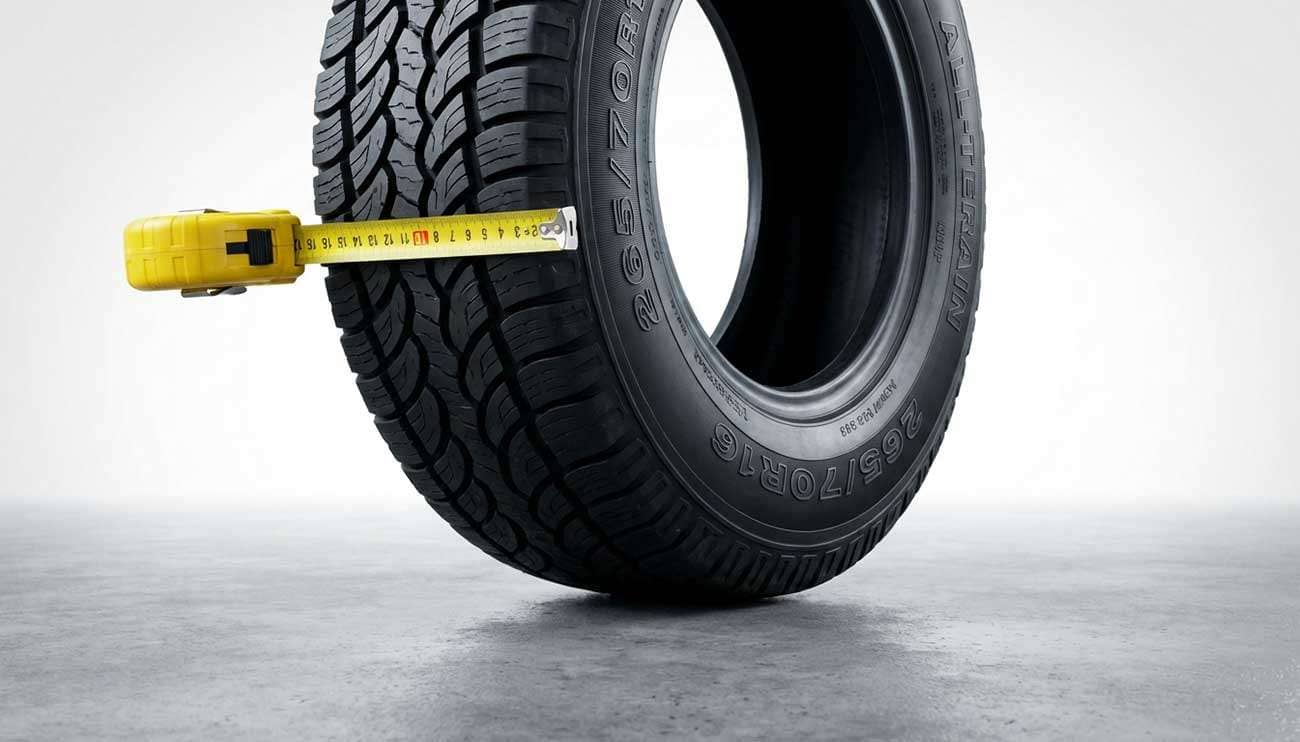
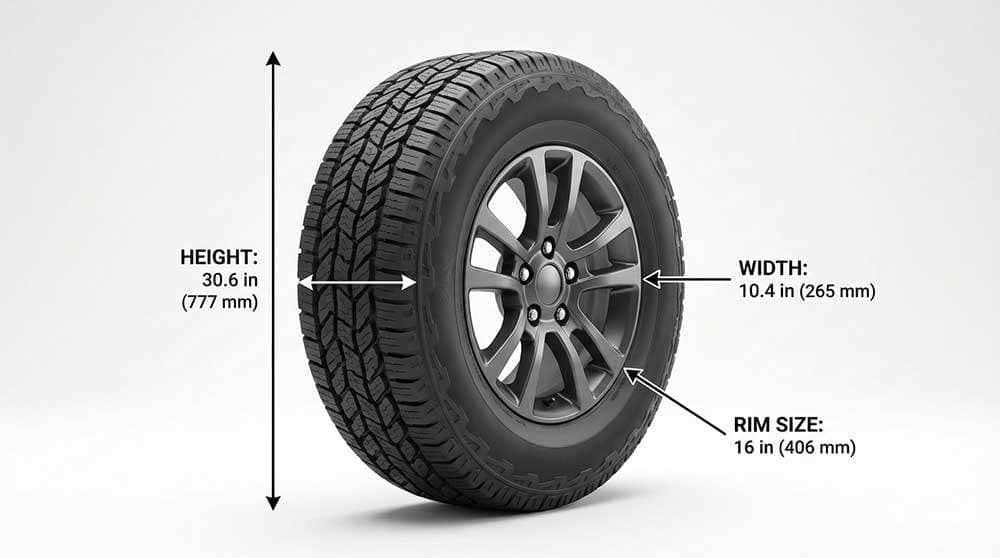
The 265/70R16 tire measures 30.6 inches (778 mm) in diameter, making it a popular choice for SUVs and light trucks that need versatile performance. This tire size delivers a width of 10.4 inches (265 mm) and fits perfectly on 16-inch wheel diameter. With a sidewall height of 7.3 inches (186 mm) and circumference of 96.1 inches, this specification provides excellent balance between on-road comfort and off-road capability.
The 265/70R16 tire completes approximately 659 revolutions per mile, a critical specification that directly affects your vehicle's performance metrics. This revolution count influences speedometer accuracy, fuel economy calculations, and overall drivetrain efficiency. The tire's precise dimensions make it exceptionally versatile for drivers who demand both daily driving comfort and weekend off-road adventures.
We'll break down exactly what each number and letter in the 265/70R16 tire code means, provide precise measurements in both inches and millimeters, and show you how this tire size compares to alternatives like 275/65R16 or 245/75R16. You'll also discover compatibility considerations and learn whether this tire size matches your vehicle's requirements perfectly.
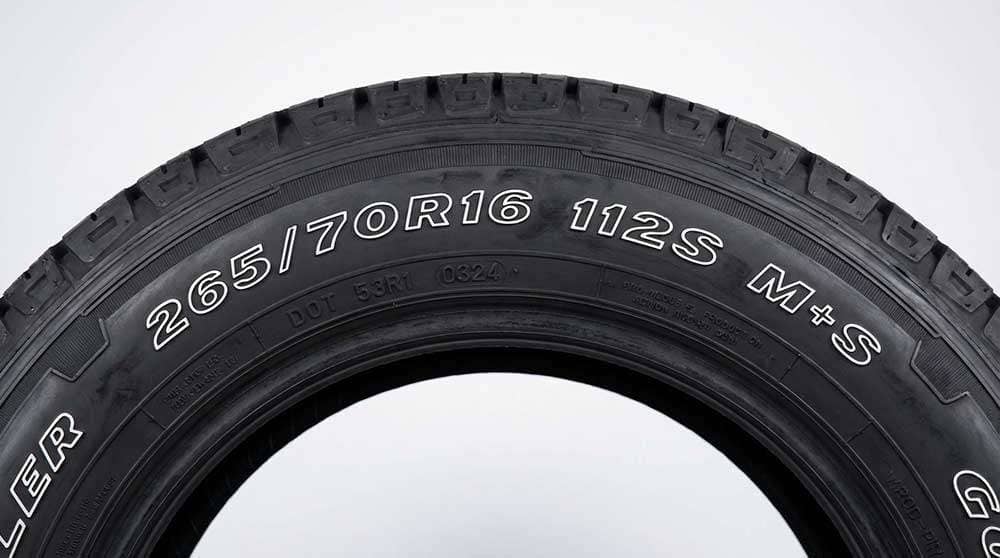
The 265/70R16 tire code contains four distinct elements that define the tire's exact specifications and construction. Each number and letter tells you something different about how the tire will perform on your vehicle. Let's decode what these markings actually mean.
The "265" represents the tire's section width measured in millimeters. This measurement spans from sidewall to sidewall at the tire's widest point. At 265mm, which equals approximately 10.43 inches, you get a substantial contact patch with the road.
Wider tires like this 265mm size deliver several performance benefits. You'll experience better traction and stability during cornering, plus improved grip in both dry and wet conditions. However, the increased width does create slightly higher rolling resistance, which can impact fuel economy by a small margin.
The "70" indicates the aspect ratio—how the sidewall height relates to the tire's width. This percentage means the sidewall height equals 70% of the tire's width.
Here's the math:
265mm × 70% = approximately 185.5mm
Converting to inches gives you about 7.3 inches
This 70 aspect ratio strikes an excellent balance for most drivers. The taller sidewall provides better ride comfort by absorbing road imperfections and offers more protection for your wheels against curb damage. At the same time, it maintains reasonable handling precision compared to ultra-low-profile tires.
The "R" stands for radial construction. This describes how the tire's internal cord plies are arranged—running perpendicular to the direction of travel, radiating outward from the tire's center.
Radial construction has dominated the tire industry for more than 25 years, replacing older bias-ply designs because of clear advantages:
Superior road grip and traction
Reduced rolling resistance for better fuel efficiency
Improved ride comfort with less road noise
Extended tread life and better durability
More consistent road contact for even wear
The final "16" specifies wheel diameter in inches. This measures the distance across the wheel from bead seat to bead seat—where the tire seals against the rim.
Matching this number exactly is essential when buying new tires. A 265/70R16 tire only fits 16-inch diameter wheels. Most 265/70R16 tires mount properly on rim widths ranging from 7 to 9 inches for passenger applications and 7 to 8.5 inches for light truck variants. This range gives you some flexibility in wheel selection while maintaining optimal tire performance.
Understanding these tire code elements helps you make smart decisions about replacements and upgrades. Whether you're maintaining your current setup or considering changes, knowing what these numbers mean ensures you'll choose tires that work perfectly with your vehicle's specifications.
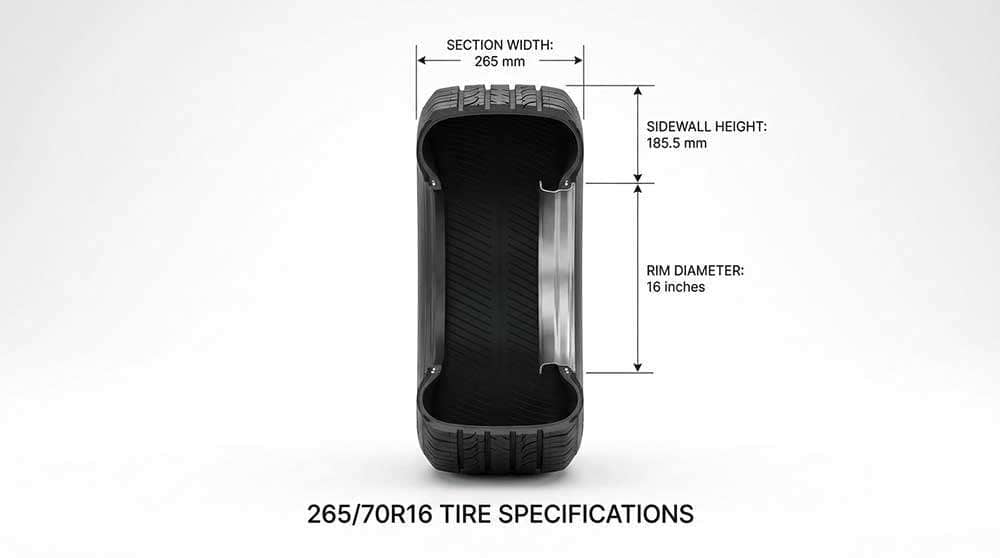
The precise measurements of a 265/70R16 tire reveal why this size performs so well across different driving conditions. These exact dimensions help you understand how this tire will affect your vehicle's performance and appearance.
A 265/70R16 tire measures 30.6 inches or approximately 778 millimeters in overall diameter. This represents the complete height from one edge to the other when properly mounted and inflated. Some manufacturers show slight variations ranging from 30.61 to 30.63 inches, reflecting differences in construction methods and materials across brands.
This 30.6-inch diameter positions the tire in the moderately large category, providing excellent ground clearance for SUVs and light trucks without creating excessive vehicle height. The diameter directly impacts your vehicle's stance, gear ratios, and speedometer calibration.
The section width measures 10.4 inches (265 millimeters) from sidewall to sidewall. When mounted and inflated, some manufacturers list the overall width as up to 10.7 inches to account for the natural bulge that occurs during inflation.
This 265mm width creates a substantial contact patch with the road or trail surface. The balanced width delivers reliable stability and traction while fitting comfortably in standard wheel wells, making it ideal for drivers who need both highway comfort and off-road capability.
At 7.3 inches or approximately 186 millimeters, the sidewall height provides several performance advantages. This dimension equals 70% of the tire's width (hence the "70" in the tire code). The moderately tall sidewall creates a cushioning effect that absorbs bumps and road imperfections better than low-profile alternatives.
This sidewall height also offers added protection for your wheels when you encounter potholes or curbs. Off-road enthusiasts appreciate the extra flex during trail driving, while daily commuters enjoy the smooth, comfortable ride quality. The taller sidewall contributes to improved traction in loose surfaces like gravel or sand.
The circumference measures approximately 96.1 inches (2,440 millimeters) around the tire's outer edge. This measurement directly affects how your vehicle's systems calculate distance and speed. Each complete rotation of the tire moves your vehicle forward exactly this distance.
The circumference determines revolutions per mile—how many times the tire rotates to cover one mile. For the 265/70R16, this equals about 659 revolutions per mile. This specific count becomes important when comparing different tire sizes and understanding how changes will affect your vehicle's performance metrics.

Changing tire sizes affects your speedometer and odometer readings more than most drivers realize. The accuracy of these instruments depends entirely on tire diameter—when you alter that diameter, you create discrepancies that can impact your driving experience and even your legal compliance with speed limits.
A 265/70R16 tire completes approximately 659 revolutions per mile. Your vehicle's computer system uses this rotation count to calculate speed and distance. When you switch to a different diameter tire, you change how many revolutions it takes to cover a mile.
The speed variance depends directly on the size difference. If you install larger tires, your actual speed exceeds what the speedometer displays. Conversely, smaller tires make you travel slower than indicated. For example, switching from 265/70R16 to a tire with 3% larger diameter means your actual speed reaches about 61.8 mph when your speedometer shows 60 mph.
The odometer faces similar issues. With larger tires, your vehicle actually travels farther than the odometer records. Over thousands of miles, this discrepancy becomes substantial. A 3% diameter increase means your odometer under-reports distance by 3%—your actual 10,000 miles registers as only 9,700 miles.
This affects more than just record-keeping. Your vehicle's fuel economy calculations rely on accurate distance measurements. When tire diameter changes, your displayed fuel efficiency numbers become inaccurate. The actual fuel consumption remains the same, but the computer's calculations shift because it incorrectly estimates how far you've traveled.
Modern vehicles integrate tire size into multiple electronic systems. The anti-lock braking system (ABS), traction control, and stability control all depend on accurate wheel speed data. Changing tire diameter by more than 3% can confuse these safety systems.
The transmission control system also factors in tire size for optimal shift points. Larger tires effectively create taller gearing, potentially causing the transmission to shift differently than intended. This can affect acceleration feel and long-term transmission wear patterns.
For these reasons, automotive manufacturers and tire experts recommend staying within 3% of your original tire diameter when selecting replacements. This guideline keeps speedometer error minimal (typically under 2 mph at highway speeds) and preserves proper function of all vehicle systems that rely on wheel speed data.
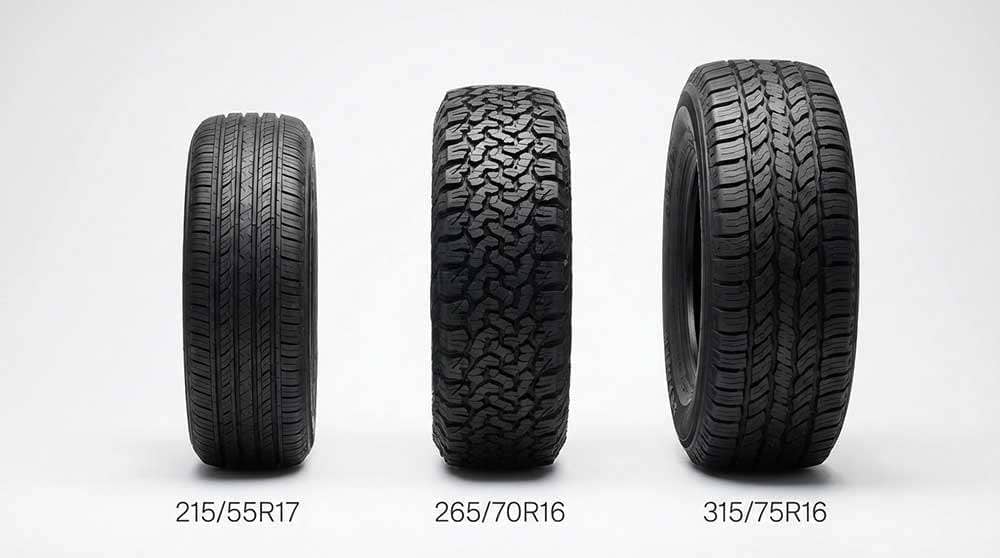
Understanding how 265/70R16 compares to similar sizes helps you make smart decisions about tire replacements and upgrades. This comparison reveals the practical differences between popular sizes that might work on your vehicle.
Tire Size |
Overall Diameter (inches) |
Width (inches) |
Sidewall Height (inches) |
Circumference (inches) |
Revs/Mile |
|---|---|---|---|---|---|
265/70R16 |
30.6 |
10.4 |
7.3 |
96.1 |
659 |
275/70R16 |
31.2 |
10.8 |
7.6 |
97.9 |
647 |
255/70R16 |
30.1 |
10.0 |
7.0 |
94.4 |
671 |
245/75R16 |
30.5 |
9.6 |
7.2 |
95.7 |
662 |
275/65R16 |
30.1 |
10.8 |
7.0 |
94.4 |
671 |
265/75R16 |
31.7 |
10.4 |
7.8 |
99.4 |
637 |
The chart shows how small changes in tire code numbers create measurable differences in actual dimensions. The 275/70R16 offers slightly more diameter and width than the 265/70R16, while the 255/70R16 goes marginally smaller in both measurements. These differences directly affect vehicle height, speedometer accuracy, and overall performance characteristics.
Notice how changing the aspect ratio (the middle number) significantly alters tire height. The 265/75R16 measures a full inch taller than the 265/70R16 despite having identical width. This demonstrates why aspect ratio matters just as much as width when selecting tires.
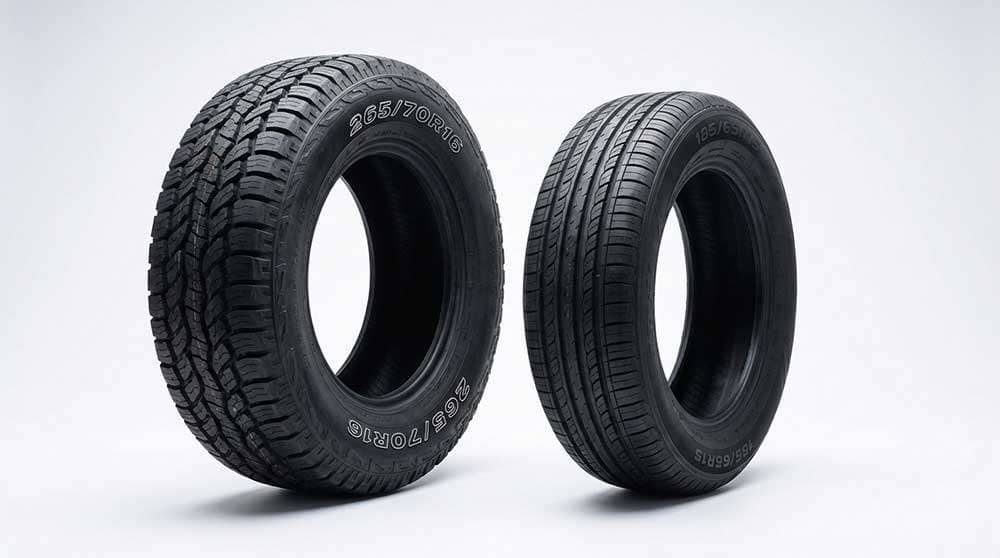
Drivers frequently ask about the relationship between similar tire sizes. Understanding these comparisons helps you evaluate whether alternative sizes might work better for your specific needs.
The 265/70R16 tire measures 30.6 inches in overall diameter and 10.4 inches in width. The sidewall height reaches 7.3 inches from the rim edge to the tread surface. These measurements convert directly from the metric tire code to imperial dimensions that many drivers find easier to visualize.
The 275 tire is wider than the 265. Specifically, a 275mm tire provides approximately 0.4 inches (10mm) more width than a 265mm tire. This represents about a 3.8% width increase.
However, "bigger" depends on what aspect you're measuring. If both tires share the same aspect ratio and wheel diameter (like 265/70R16 versus 275/70R16), the 275 will also be slightly taller due to its proportionally taller sidewall. The 275/70R16 measures 31.2 inches in diameter compared to 30.6 inches for the 265/70R16—a 0.6-inch height difference.
When comparing the same width tire (like 265/70 versus 265/75), the 75 aspect ratio produces a taller tire. The aspect ratio represents sidewall height as a percentage of tire width, so a higher number means taller sidewalls.
For 265mm width tires specifically:
265/70R16 has 7.3-inch sidewalls (70% of 10.4 inches)
265/75R16 has 7.8-inch sidewalls (75% of 10.4 inches)
This creates an overall diameter difference of 31.7 inches for the 265/75R16 versus 30.6 inches for the 265/70R16—more than a full inch taller.
The primary difference between 265 and 285 involves width. The numbers represent millimeters of section width, so:
A 285 tire is 20mm (approximately 0.79 inches) wider than a 265 tire
This represents about a 7.55% width increase
For matching aspect ratios, the 285 will have proportionally taller sidewalls
When comparing aspect ratios on identical width tires, the 75 series produces a taller tire:
A 265/75R16 measures 31.66 inches versus 30.61 inches for a 265/70R16 – a full 1-inch difference
The taller sidewall of a 75-series tire offers more flex and better bump absorption
The shorter 70-series sidewall delivers crisper handling and improved lateral stability
This 1-inch height difference results in only a 0.5-inch increase in ground clearance
Finding the right alternative to 265/70R16 requires staying within the 3% diameter rule for safe tire swapping. Automotive experts recommend replacement tires should not differ by more than 3% from the original diameter to avoid performance issues.
Two sizes deliver excellent compatibility with the 265/70R16. The 245/75R16 measures 30.47 inches in diameter—just 0.39 inches (10mm) smaller than the 265/70R16, representing only a 1.3% difference. The 275/65R16 offers remarkable similarity at 30.07 inches—only 0.54 inches smaller, or about 1.8% difference.
The width difference between these options is more substantial. The 245/75R16 runs significantly narrower at 9.65 inches (245mm) versus 10.43 inches for the 265/70R16. The 275/65R16 provides extra width at 10.83 inches (275mm).
Even within the 3% diameter range, upsizing affects vehicle performance. Switching to wider tires like the 275mm variants delivers slightly improved traction but potentially decreases fuel efficiency. The diameter difference generally adds about 0.5 inches to ground clearance—usually clearing suspension components without modification.
Tire size changes affect speedometer accuracy. With 245/75R16 tires, your actual speed reaches approximately 60.79 mph when your speedometer reads 60 mph. For sizing differences exceeding 3%, recalibration becomes important to avoid potentially dangerous speed miscalculations.
For drivers seeking proper-fitting 265/70R16 tires or compatible alternatives, Performance Plus Tire offers numerous options from leading manufacturers with various tread patterns.
The 265/70R16 tire delivers exactly what most SUV and light truck owners need—reliable performance that handles daily driving and weekend adventures equally well. This tire size offers the sweet spot of 30.6-inch diameter and 10.4-inch width that provides excellent traction without sacrificing comfort or fuel economy.
When you understand tire size codes, you make better decisions about replacements and upgrades. The 265/70R16 specification gives you substantial sidewall height for bump absorption, adequate width for stability, and proven radial construction for durability. Your vehicle's performance will change with any tire size switch, but staying within the 3% diameter rule keeps those changes manageable.
The 245/75R16 and 275/65R16 alternatives work well if you need slightly different width characteristics while maintaining similar overall diameter. These options let you fine-tune your vehicle's stance and handling without major performance compromises.
Most drivers find the 265/70R16 tire size hits the perfect balance. You get solid traction and stability without excessive bulk. Highway cruising remains comfortable while light off-road capability stays strong. This size fits a wide range of popular vehicles and delivers dependable performance across various driving conditions.
At Performance Plus Tire, we carry an extensive selection of 265/70R16 tires from leading manufacturers. Our fitment experts help ensure you choose the right tire for your specific vehicle and driving needs. Whether you're replacing worn tires or upgrading for better performance, we have the selection and expertise to get you rolling with confidence.
Understanding tire size codes helps you make informed decisions about replacements and ensures proper vehicle performance and safety.
• 265/70R16 measures 30.6 inches diameter and 10.4 inches width - perfect for SUVs and light trucks needing balanced on-road comfort and off-road capability.
• Tire size changes affect speedometer accuracy and fuel economy - larger tires can create 1-4 mph speed variance and reduce fuel efficiency by 0.5-2 mpg.
• Stay within 3% diameter difference when switching sizes - alternatives like 245/75R16 and 275/65R16 offer safe compatibility without performance issues.
• The "70" aspect ratio provides optimal sidewall flexibility - delivering better ride comfort and impact absorption compared to lower-profile tires.
• Width directly impacts traction and handling characteristics - wider tires offer better stability but may increase rolling resistance and road noise.
The 265/70R16 represents an ideal compromise between performance and versatility, making it suitable for drivers who need reliable all-around capability without sacrificing comfort or fuel efficiency.
A 265/70R16 tire has an overall diameter of 30.6 inches (778 mm), a width of 10.4 inches (265 mm), and a sidewall height of 7.3 inches (186 mm). It's designed to fit on a 16-inch wheel diameter.
Changing to 265/70R16 tires can impact speedometer accuracy, fuel economy, and acceleration. You may experience a slight decrease in fuel efficiency (0.5-2 mpg) and initial acceleration, while your actual speed might be slightly higher than what the speedometer indicates.
Yes, you can generally use 275/70R16 tires instead of 265/70R16. The diameter increase is about 0.55 inches, which falls within the acceptable 3% threshold. However, be aware that this change might slightly affect braking distance and ABS performance.
Two close alternatives are 245/75R16 and 275/65R16. The 245/75R16 is slightly narrower but almost identical in diameter, while the 275/65R16 is wider but marginally smaller in diameter. Both options stay within the recommended 3% diameter difference.
The "70" aspect ratio in 265/70R16 indicates a moderately tall sidewall, which provides a good balance between ride comfort and handling. It offers better absorption of road imperfections compared to lower-profile tires, while still maintaining decent responsiveness and stability.