
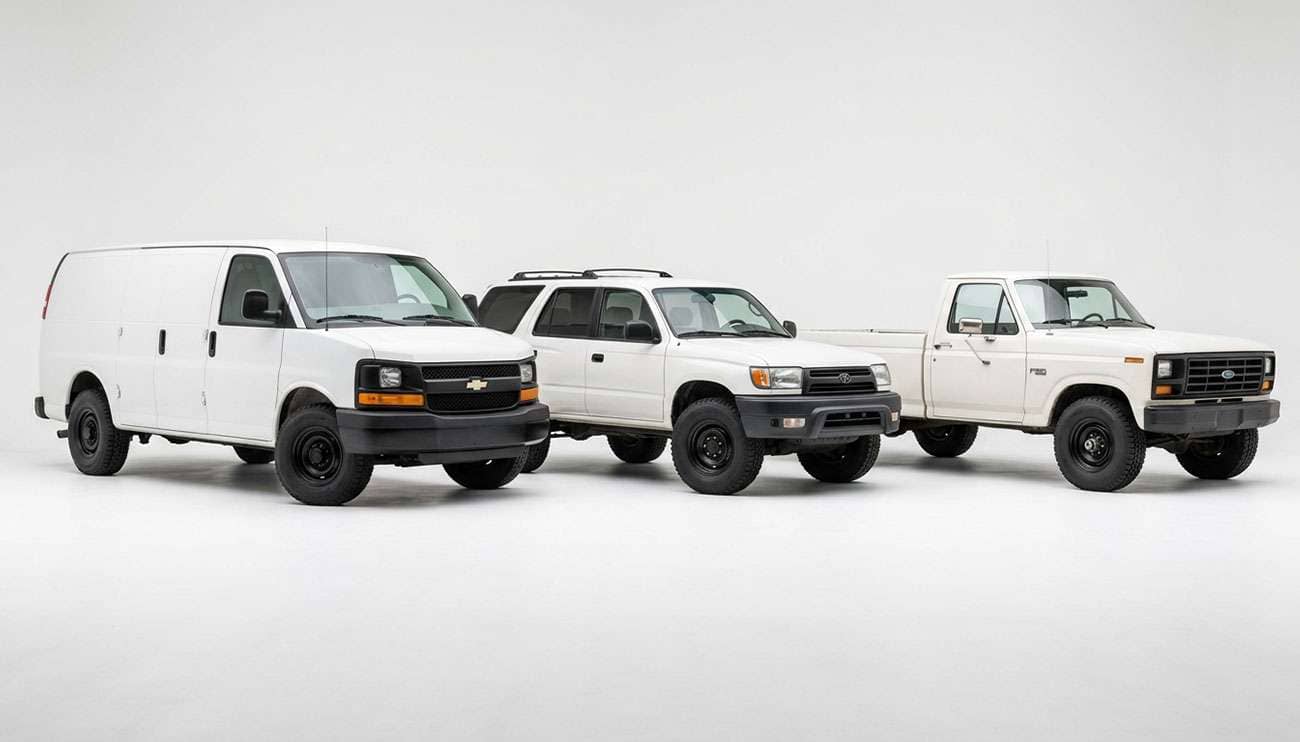
225/75R16 is factory equipment on full-size cargo and passenger vans, older three-quarter-ton pickups, and a group of body-on-frame SUVs and crossovers. The common names are the Chevrolet Express 2500 and GMC Savana 2500, Ford E-350 Club Wagon, Dodge Ram 1500 and Ram 2500, Jeep Liberty and Grand Cherokee, Honda Passport, Isuzu Rodeo and Trooper, Dodge Nitro, Kia Sorento, Hyundai H-1 and earlier Mercedes-Benz G-Class. The size code is shared. The tire is not. Load ratings in 225/75R16 run from 1,819 lb per corner up to 3,197 lb.
That spread is the whole story, and it is the part most fitment lists leave out. A list of model names tells you the numbers on the sidewall will match. It does not tell you whether the tire underneath those numbers was built to carry a loaded Express 2500 at 64 psi or a Jeep Liberty at 32 psi. Those are two different tires wearing the same three digits, and one of them will fail early under the other one's job.
225/75R16 is sold in four service descriptions in the North American market: P-metric (marked P225/75R16), Euro-metric or ISO metric (marked 225/75R16 with no prefix), light truck metric (marked LT225/75R16), and commercial C-type (marked C225/75R16 or carrying a C-type dual load index). The prefix letter, or the absence of one, is not decoration. It changes the internal construction, the maximum inflation pressure, and the load the tire is certified to carry.
Across current production in this size, the light truck version is the dominant build by a wide margin, and Load Range E is the dominant construction inside that group. Load Range D and Load Range F exist in 225/75R16 but they are the exceptions, not the shelf. If you walk into this size expecting one tire, you will find a wall of E-rated LT truck tires with a smaller island of passenger-rated and Euro-metric SUV tires beside them.
Here is the table that should decide your purchase before you look at a single tread pattern.
Service Type |
Sidewall Marking |
Typical Load Index |
Load Per Corner |
Max Sidewall Pressure |
Built For |
|---|---|---|---|---|---|
P-metric passenger |
P225/75R16 |
104 to 106 |
1,984 to 2,094 lb |
44 psi |
SUVs and crossovers with placards near 29 to 35 psi |
Euro-metric SUV |
225/75R16 (no prefix) |
104 to 110 |
1,984 to 2,337 lb |
44 to 51 psi |
Import SUVs and light crossovers, no load reduction on trucks |
Light truck metric |
LT225/75R16 |
115/112 (Load Range E) |
2,679 lb single, 2,469 lb dual |
80 psi |
Vans, older 3/4-ton pickups, loaded work vehicles |
Commercial C-type |
C225/75R16 or 121/120R |
121/120 |
3,197 lb single, 3,086 lb dual |
80 psi |
Euro-style cargo vans and high-payload commercial duty |
Read the far right column of that table against the far left. A passenger-rated 104 tire carries 1,984 lb. A C-type 121 carries 3,197 lb. That is 1,213 lb of capacity per corner separating two tires that both say 225/75R16 on the sidewall, and roughly 4,800 lb across an axle set. No tread pattern, brand reputation, or price tier closes that gap. Only the service description does.
Federal tire selection rules under FMVSS 110 are built on the vehicle placard, not on the size string. The placard on your door jamb lists the size the vehicle was certified with and the cold inflation pressure that goes with it. NHTSA's replacement guidance holds that a replacement tire must carry at least as much as the original at the placard pressure. That is the legal floor, and it is why the prefix matters more than anything else printed on the tire. If you want the construction differences in full, our breakdown of P-metric versus LT tires covers why the same size behaves differently under load.
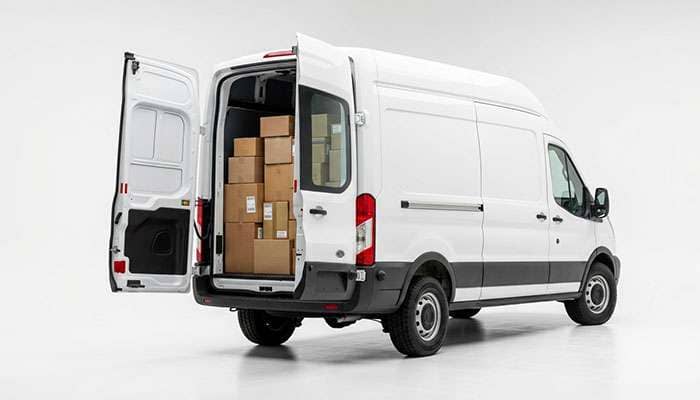
Global fitment data puts 225/75R16 on 62 vehicle models across 24 manufacturers, which is why the answer to this question is never a short list. What follows is the North American slice, grouped by the service type the factory placard actually calls for. Year ranges vary by trim and market, so treat these as the families to check rather than a guarantee for a specific VIN.
Group 1: LT-metric and C-type vans and heavy light-duty. Chevrolet Express 2500 and Express Cargo, GMC Savana 2500, Ford E-350 Club Wagon, Dodge Ram 1500 and Ram 2500 from the mid-1990s through the early 2000s, Hyundai H-1, and the European cargo van family that includes the Fiat Ducato and Citroen Jumper and Relay. These vehicles carry payload as their job description. Their placards sit in the high range, commonly 49 psi and running as high as 64 psi on the heaviest configurations, and they were certified on tires with load indexes of 115, 118 or 121.
Group 2: P-metric and Euro-metric SUVs and crossovers. Jeep Liberty and Grand Cherokee, Honda Passport, Isuzu Rodeo and Trooper, Dodge Nitro, Kia Sorento, and earlier body-on-frame Mercedes-Benz G-Class configurations. These placards land in the 29 to 35 psi range and the certified load index is usually 103, 104 or 108. A Liberty does not want an 80 psi E-rated truck tire. It will run one, but the ride penalty and the wear pattern are real and the extra capacity does nothing for you.
Group 3: Aftermarket and overland builds. A large share of 225/75R16 sales are not OE replacements at all. Owners of 4x4 pickups and body-on-frame SUVs choose this size for its tall sidewall and narrow tread when they want sidewall protection on trail without the width penalty of a 265 or 285. If you are in this group, the placard is not your reference point, because you have already left it. Your reference point is your loaded corner weight plus a margin.
That group split determines what you shop for. This second table keys the same question to your vehicle's job rather than to the badge on the hood, which is the axis that actually routes you to the right tire.
Your Vehicle's Job |
Placard Pressure Range |
Minimum Load Index To Match |
Service Type To Shop |
Tread Family That Fits |
|---|---|---|---|---|
Cargo van loaded daily |
49 to 64 psi |
115 or 121 per placard |
LT-metric Load Range E or C-type |
Commercial highway or highway terrain |
Passenger van or shuttle |
44 to 55 psi |
115 |
LT-metric Load Range E |
Highway terrain with a long tread warranty |
Older 3/4-ton pickup |
50 to 65 psi rear |
115 |
LT-metric Load Range D or E |
All terrain or highway terrain |
Body-on-frame midsize SUV |
29 to 35 psi |
104 to 108 |
P-metric or Euro-metric |
All terrain or touring highway |
Compact SUV or crossover |
29 to 32 psi |
103 to 104 |
P-metric |
Touring or highway terrain |
Overland or trail build |
Set by corner weight, not placard |
115 minimum |
LT-metric Load Range E |
All terrain or mud terrain |
A 225/75R16 stands 29.3 inches tall with a section width of 8.9 inches and a sidewall height of 6.6 inches. Published fitment data lists the overall diameter as 744 mm and the sidewall height as 169 mm, which converts to 29.29 inches and 6.65 inches respectively. Rolling circumference works out to roughly 92.0 inches, or 7.67 feet, giving about 689 revolutions per mile.
The math behind those numbers is worth understanding because it is what lets you evaluate any alternate size without a calculator app. The 225 is section width in millimeters. The 75 is the aspect ratio, meaning sidewall height equals 75 percent of section width. So 225 x 0.75 gives 168.75 mm of sidewall, or 6.64 inches. Double that for the top and bottom of the tire, add the 16-inch wheel, and you get 29.29 inches of overall diameter.
Measurement |
Metric |
Inches |
|---|---|---|
Section width |
225 mm |
8.86 in |
Sidewall height |
169 mm |
6.65 in |
Overall diameter |
744 mm |
29.29 in |
Rolling circumference |
2,337 mm |
92.0 in |
Revolutions per mile |
428 per km |
689 per mile |
In the old imperial shorthand that shops still use on the counter, a 225/75R16 is close to a 29x8.9R16. You will sometimes see it called a 29-inch tire, and for clearance planning that rounding is fine. For speedometer math and for comparing against a neighboring size, use 29.29 inches, because the difference between 29 and 29.29 is enough to change a percentage calculation.
The approved rim width range for 225/75R16 is 6.0 to 7.5 inches, and 6.0 inches is the industry measuring rim for the size. Across current production, the great majority of 225/75R16 tires publish an approved range that starts at 6.0 inches, and a meaningful share of the LT-metric versions cap the top end at 7.0 inches rather than 7.5. A few outliers extend higher, but building a wheel plan around them is a bad bet.
The measuring rim matters more than most people realize. Every published dimension for a tire, including that 29.29-inch overall diameter, is measured on the industry measuring rim. Mount the same tire on a 7.5-inch wheel and the section width grows by roughly 0.2 inches while the sidewall pulls in slightly and overall diameter drops a hair. Mount it on the narrow end and the sidewall bows outward, which is exactly what you want for trail sidewall protection and exactly what you do not want for steering response on a highway van.
The practical effects at each end of the range break down like this. On a 6.0-inch wheel the tread crowns slightly, the shoulders lift under cornering load, and steering feel goes vague, but you gain sidewall bulge and pinch-flat resistance. On a 7.5-inch wheel the tread sits flatter, the contact patch squares up, steering response sharpens, and shoulder wear evens out, but the sidewall is more exposed to rock strikes. Neither is wrong. They are different tools. If your wheels fall outside 6.0 to 7.5 inches, our guide to choosing tire size for wheel width walks through what happens when the pairing goes out of range.
The 3% rule is the industry convention that a replacement tire should stay within 3 percent of the original overall diameter. It is a trade practice rather than a federal regulation, but it is the number nearly every fitment tool and tire shop uses as the go or no-go line, and there is real engineering behind it.
Three percent is roughly where the compounding effects stop being trivial. Below that threshold, speedometer error stays inside the tolerance most manufacturers already build in, ABS and stability control wheel-speed comparisons stay inside their expected window, transmission shift points stay close enough to their calibration, and clearance at full lock and full droop is usually still there. Above it, all of those start drifting at once.
For a 225/75R16 at 29.29 inches, 3 percent is 0.88 inches. That gives you a working window of roughly 28.4 to 30.2 inches of overall diameter for any alternate size you are considering. Write that window down before you start shopping alternates, because it turns a vague question into a pass-fail test.
Alternate Size |
Overall Diameter |
Change vs 225/75R16 |
Inside 3% Window? |
|---|---|---|---|
225/70R16 |
28.40 in |
0.89 in shorter, 3.0% smaller |
Borderline, at the edge |
235/75R16 |
29.88 in |
0.59 in taller, 2.0% larger |
Yes |
245/75R16 |
30.47 in |
1.18 in taller, 4.0% larger |
No |
245/70R16 |
29.50 in |
0.21 in taller, 0.7% larger |
Yes |
31x10.50R16 |
30.98 in |
1.69 in taller, 5.8% larger |
No |
The mechanism behind the speedometer half of this is simple. Most vehicles calculate road speed from wheel rotations, so the system is counting revolutions and multiplying by a stored circumference. Change the real circumference and the stored value is now wrong by the same percentage. A taller tire under-reports your speed, a shorter tire over-reports it, and the odometer drifts in step. Our piece on how bigger tires affect your speedometer covers the correction math if you have already gone out of the window.
A 235 is taller than a 225 when the aspect ratio and wheel diameter are the same. In 16-inch, a 235/75R16 stands 29.88 inches against 29.29 inches for a 225/75R16, so the 235 is 0.59 inches taller in overall diameter and gives you 0.30 inches more ground clearance at the axle centerline.
The reason is that aspect ratio is a percentage, not a fixed measurement. Because 75 percent of 235 mm is more than 75 percent of 225 mm, the wider tire automatically gets the taller sidewall. Sidewall height goes from 168.75 mm on the 225 to 176.25 mm on the 235, and that 7.5 mm gets doubled across the diameter of the tire.
The practical outcome for a 225/75R16 owner is that 235/75R16 is one of the cleanest upsize paths available. It is 2.0 percent larger in diameter, comfortably inside the 3 percent window, it adds 0.39 inches of section width, and it usually fits the same 6.0 to 7.5 inch rim width range. Speedometer error at an indicated 60 mph works out to about 1.2 mph, which most drivers will never notice. Check clearance at full steering lock before you commit, because 0.39 inches of width on the inner edge is where interference shows up first on a van.
A 75-series tire is taller than a 70-series tire at the same section width and wheel diameter. A 225/75R16 measures 29.29 inches tall while a 225/70R16 measures 28.40 inches, so the 75-series is 0.89 inches taller overall and carries 0.44 inches more sidewall.
That aspect ratio number is the ratio of sidewall height to section width, expressed as a percentage. At 75, the sidewall is 75 percent of the 225 mm width, or 168.75 mm. At 70, it is 70 percent, or 157.5 mm. Same tread width, shorter sidewall, shorter overall tire. Our full breakdown of what tire aspect ratio actually controls covers how that single number drives ride, load, and clearance.
The tradeoff runs in both directions and it is not subtle on a 16-inch wheel. More sidewall means more air volume, more impact absorption, more flex for off-road traction at reduced pressure, and more sidewall material between a rock and your wheel lip. Less sidewall means less flex under cornering load, sharper turn-in, less squirm when the vehicle is loaded, and a firmer ride over expansion joints. Vans and work trucks generally do better with the taller sidewall because payload flex is the enemy of belt life, and because the extra air volume runs cooler under sustained load.
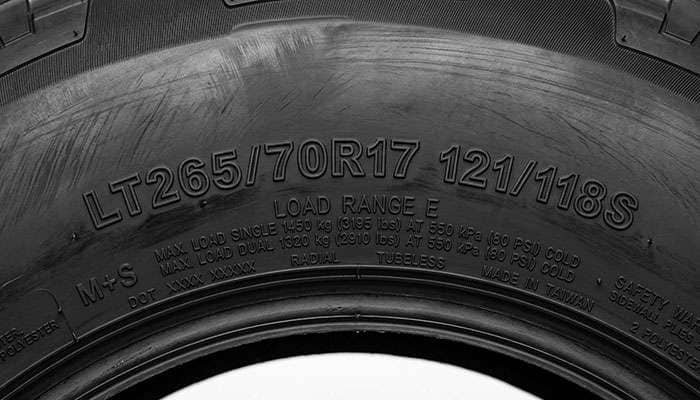
A 245/75R16 is 0.79 inches wider and 1.18 inches taller than a 225/75R16. That works out to a 4.0 percent increase in overall diameter, which puts it outside the 3 percent window and makes it a modification rather than a direct substitute.
The 20 mm of extra section width is the smaller half of the difference. The bigger half is what that width does to the sidewall. Because aspect ratio is a percentage, going from 225 to 245 at a fixed 75 adds 15 mm of sidewall height, which becomes 30 mm across the diameter. You are not just buying a wider tire. You are buying a taller one, and the height is what breaks the calibration.
Here is what changes when you make that jump. Revolutions per mile drop from 689 to 662. Your speedometer will read 60 mph while you are actually traveling about 62.4 mph. Your odometer will under-count by roughly 4 percent, so 10,000 indicated miles is closer to 10,400 real miles, which quietly shifts your service intervals and any mileage-based warranty math. Final drive ratio effectively gets taller, which costs you low-end response and can push an automatic into hunting between gears on grades. Ground clearance gains 0.59 inches at the axle. If you want the full dimensional workup on the larger size, we have a dedicated breakdown of what size 245/75R16 is in inches.
Clearance is the part that decides whether the swap is even possible. The 245 needs roughly 10 mm more room on each side of the tire at full lock, and on full-size vans that space is frequently occupied by the inner fender liner and the steering stops. On a body-on-frame SUV it is more often the upper control arm or the sway bar end link. Measure before you buy, at full lock in both directions, with the suspension at ride height and again compressed.
Reliability in 225/75R16 is decided by three things in this order: whether the service type matches your placard, how old the tire is when it goes on, and how consistently the manufacturer holds uniformity across production runs. Brand is the third factor, not the first, which is why two people can buy the same well-regarded brand and get opposite results.
Sixty-plus brands offer this size, and they sort into recognizable tiers. The manufacturers that supply original equipment in 225/75R16 and maintain dedicated light truck and commercial van lines include Michelin, Goodyear, Bridgestone, Continental, Toyo, Firestone, Yokohama and Falken. Below that sits a broad mid-tier of established replacement brands, and below that a value tier of import brands that compete almost entirely on price. The tier does not determine whether a tire is safe. Every tire sold for road use in the United States must meet FMVSS 139, which sets the endurance, high-speed, low-pressure and bead-unseating requirements for this class of tire. The tier determines consistency, tread life, wet performance at half-worn depth, and how well the tire holds its rating in year four.
What actually separates outcomes in this size is more specific than brand. Check the DOT date code and refuse anything older than two years from manufacture, because the rubber ages whether it rolls or not. Match or exceed the load index on your placard, never round down. On any van or work truck, prioritize a commercial or highway terrain tread over an aggressive all terrain, because the noise and wear penalty of an aggressive tread on a highway van is severe and the traction benefit is close to zero on pavement. And check that the model you are considering is still in current production rather than old stock, since this size has a long tail of discontinued models still floating around.
The Tire Industry Association and manufacturer service literature agree on the underlying point: a correctly specified mid-tier tire, inflated to placard and rotated on schedule, outlasts a premium tire that is under-rated for the vehicle or run 8 psi low.
Fitting an under-rated 225/75R16 does not produce a warning light or an immediate symptom. It produces a slow, ordered sequence of failures, and the reason it goes unnoticed is that every stage looks like normal wear until the last one.
Stage one, week one: excess sidewall deflection. A P-metric 104 tire on a van placarded for a 115 is operating past its designed deflection every time the vehicle is loaded. The sidewall flexes further on each rotation, and each flex cycle generates heat that the tire was not built to shed.
Stage two, the first few thousand miles: shoulder wear and cupping. Because the sidewall is over-deflecting, the shoulder ribs carry load they were not designed to carry. You see feathering across the outer ribs, then irregular cupping, then a noise that gets louder with speed. Most owners diagnose this as an alignment problem and get an alignment, which does not help.
Stage three, sustained heat load: belt-edge separation begins. Heat accumulates at the interface between the steel belt edges and the surrounding rubber, which is the highest-stress boundary inside a radial tire. Adhesion at that interface degrades. Nothing is visible from outside yet, and the tire still holds air normally.
Stage four: visible sidewall distress. Fatigue in the over-flexed sidewall shows up as a bulge, a wavy sidewall section, or a soft spot you can feel with your hand. At this stage the tire is finished, and any bulge is a stop-driving condition rather than a monitor-it condition. Our guide to tire sidewall damage and whether it is safe to drive covers what each type of sidewall defect actually means.
Stage five: tread and belt detachment. The separated belt package leaves the carcass, usually at highway speed and usually when the vehicle is loaded, because that is when the stress peaks. On a full-size van with a high center of gravity and a rear load, a rear tread separation is a directional control event, not just a flat.
The cost ladder runs the same direction. You start by paying for tires that wear out in half the expected miles. Then you pay for an alignment that was never the problem. Then you pay for a set of tires and the fuel penalty you carried the whole time from running the wrong construction. At the end of the ladder, the bill is not measured in tires. Buying the correct service type at the start is the cheapest point on that entire curve, and it costs nothing extra at the counter.
Five steps, in this order. Do not skip to step four, because the first three are what make step four meaningful.
Step 1: Read the door jamb placard, not the tire on the vehicle. Open the driver's door and find the certification label on the B-pillar or door edge. It lists the original size, the load index and speed rating, and the cold inflation pressure front and rear. The tire currently mounted may be the wrong one already, which is why the placard is the reference and the mounted tire is not.
Step 2: Write down the service prefix and the load index. If the placard says LT225/75R16 115/112S, your minimum is a 115 single load index. If it says P225/75R16 104S, your minimum is 104. This is the number you match or exceed. Never round down to save money, and be aware that a dual load index like 115/112 means the second number applies if the tire runs in a dual-rear-wheel position. Our reference on reading tire load range and ply ratings decodes the letters if the placard uses Load Range instead of a load index.
Step 3: Measure your wheel width. Confirm you are inside 6.0 to 7.5 inches. Wheel width is stamped on the back of the wheel face or the inner barrel on most factory wheels, formatted as something like 16x6.5 or 6.5Jx16. If you cannot find it, measure bead seat to bead seat, not lip to lip, because the lips add roughly one inch to the measurement.
Step 4: Match the tread family to the actual job. Highway and commercial treads for vans and loaded work vehicles. All terrain for mixed-surface trucks and SUVs. Mud terrain only if you genuinely leave pavement, because the on-road wear and noise penalty is significant. In a size this heavily weighted toward light truck construction, the tread family choice has more effect on your daily experience than the brand choice does.
Step 5: Check the DOT date code before it goes on the wheel. The last four digits of the DOT code give week and year of manufacture. A code of 1225 means the twelfth week of 2025. Anything more than two years old at the time of installation is old stock, and rubber compound aging starts at manufacture, not at installation.
When you are ready to shop, you can browse the full 225/75R16 tire selection and filter to the service type and load index your placard calls for.
The vehicle list for 225/75R16 is long and it spans two very different worlds. Full-size vans and older three-quarter-ton pickups sit at one end, carrying payload on light truck and commercial construction at pressures that reach 64 psi. Midsize and compact SUVs sit at the other, running passenger and Euro-metric construction in the low 30s. The size code is identical across both. The tire is not, and the capacity gap between the extremes exceeds 1,200 lb per corner.
That makes the question of what vehicles use 225/75R16 less useful than it looks on its own. The useful question is which of the four service types your vehicle was certified with, because that is the specification that has to be matched. Find the placard, note the prefix and the load index, and everything after that is preference. Get it backwards and you will spend the next twenty thousand miles paying for it in ways that never look like a tire problem until they do.
The Chevrolet Express 2500 and GMC Savana 2500, Ford E-350 Club Wagon, Dodge Ram 1500 and Ram 2500, Jeep Liberty and Grand Cherokee, Honda Passport, Isuzu Rodeo and Trooper, Dodge Nitro, Kia Sorento, Hyundai H-1 and earlier Mercedes-Benz G-Class configurations all use 225/75R16. Fitment data lists roughly 62 models across 24 manufacturers. The service type differs by vehicle, so check the door jamb placard for the prefix and load index.
A 225/75R16 is 29.29 inches in overall diameter, 8.86 inches in section width, with a 6.65-inch sidewall. Rolling circumference is about 92.0 inches, which gives roughly 689 revolutions per mile. On the counter it is often called a 29-inch tire.
The approved rim width range is 6.0 to 7.5 inches, and 6.0 inches is the industry measuring rim for the size. Some LT-metric versions cap the approved range at 7.0 inches, so check the specific tire before ordering wheels wider than 7.0.
The 3% rule is the industry convention that a replacement tire should stay within 3 percent of the original overall diameter, which keeps speedometer error, ABS wheel-speed comparison and transmission shift calibration inside their expected tolerance. For a 225/75R16 at 29.29 inches, that gives a window of about 28.4 to 30.2 inches.
A 235 is taller when the aspect ratio and wheel diameter match. A 235/75R16 measures 29.88 inches against 29.29 inches for a 225/75R16, making it 0.59 inches taller and 0.39 inches wider. That is a 2.0 percent diameter change, which stays inside the 3 percent window.
A 75-series tire is taller. At 16 inches and 225 mm wide, the 75-series stands 29.29 inches while the 70-series stands 28.40 inches, a difference of 0.89 inches. Aspect ratio is the sidewall height as a percentage of section width, so a higher number always means a taller sidewall.
The 245/75R16 is 0.79 inches wider and 1.18 inches taller, a 4.0 percent increase in overall diameter that falls outside the 3 percent window. Revolutions per mile drop from 689 to 662, an indicated 60 mph becomes about 62.4 mph actual, and the odometer under-counts by roughly 4 percent.
Yes, the LT version will physically fit and it exceeds the required load capacity. The tradeoffs are a firmer ride, more weight per corner, a fuel economy penalty and higher required inflation pressure to reach the same load capacity. Going the other direction, fitting a P-metric or Euro-metric tire on a vehicle placarded for LT, is the one to avoid, because it leaves you short of the certified load capacity.



