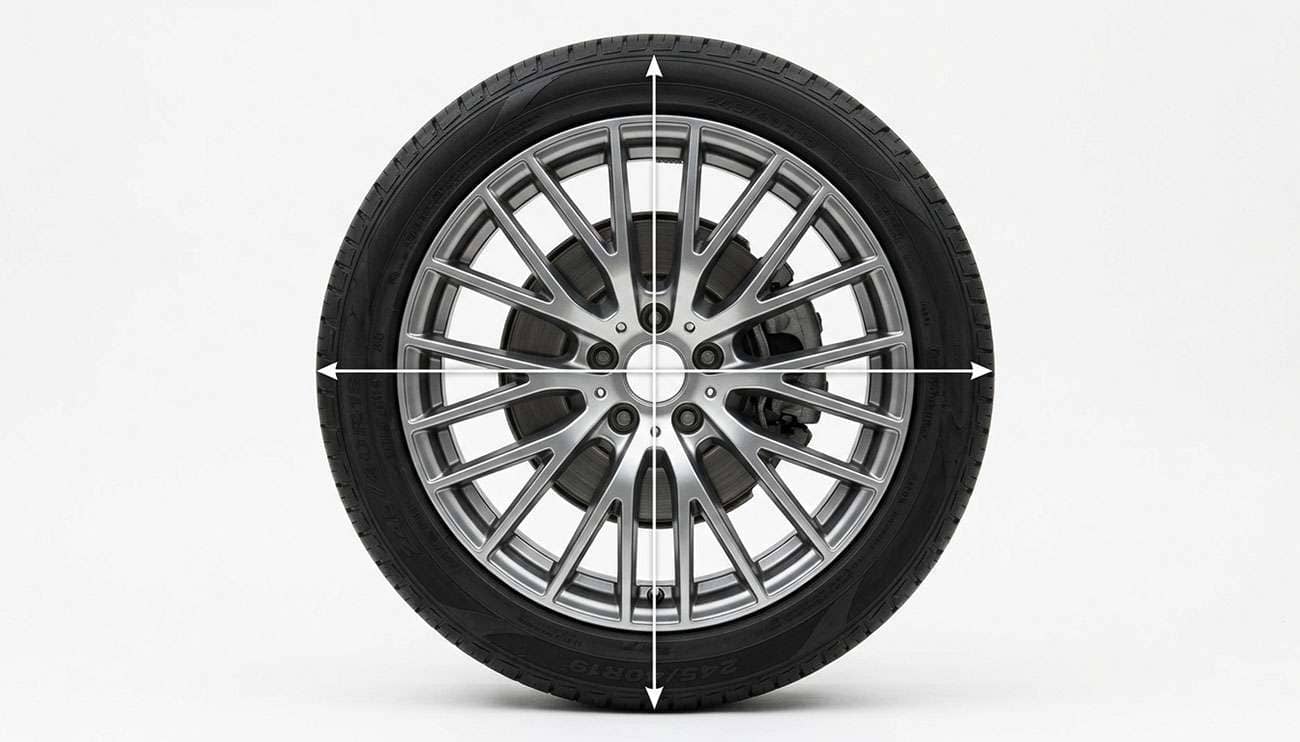
18x8 means the wheel is 18 inches in diameter and 8 inches wide. Both numbers are measured at the bead seats, where the tire actually grips, not across the outer lips. That is the whole answer to the size code, and it is also the easiest half of the question. Fitment is decided by five numbers, and 18x8 only gives you two of them. Offset, bolt pattern and hub bore are the other three, and offset is the one that decides whether the wheel clears your strut.
I have had this conversation across the parts counter more times than I can count. Somebody reads 18x8 off a listing, measures the gap in their fender well, and orders. Then the wheel shows up and the tire is kissing the spring perch, or sitting an inch proud of the fender. Nothing was wrong with the listing. The size code just was never going to tell them that. Here is what the rest of the numbers do, and what tire actually belongs on an 8-inch rim.
A full wheel spec reads something like 18x8 +40 5x114.3 with a 72.6mm bore. Every one of those pieces has a job, and skipping any of them is how a wheel ends up in a box going back where it came from.
Spec |
What It Controls |
Included In 18x8? |
What Goes Wrong If It Is Off |
|---|---|---|---|
Diameter |
Which tire diameter mounts, brake caliper clearance |
Yes, the 18 |
Tire will not mount, or the wheel sits on the caliper |
Width |
Which tire section widths are approved, contact patch shape |
Yes, the 8 |
Tire runs stretched or bulged, shoulder wear goes uneven |
Offset |
How far in or out the wheel sits, fender and strut clearance |
No |
Rubbing at full lock or full compression, altered scrub radius |
Bolt pattern |
Whether the wheel physically bolts to the hub |
No |
It does not go on at all, or goes on wrong and loosens |
Hub bore |
Whether the hub carries the load instead of the studs |
No |
Vibration at speed, studs loaded in shear, lugs backing off |
Offset is the one that catches people. Across the 18x8 wheels on the market today, offsets run from deep negative territory all the way past +50mm, and the bulk of them sit in the +35 to +45 range because that is where most modern front-drive and all-wheel-drive cars want them. But deep-dish 18x8 wheels with negative offset exist in real numbers, and they are built for a completely different chassis. Two wheels both marked 18x8 can place the tire more than an inch apart laterally. Same size code, different car.
Hub bore is the quiet one. A large share of aftermarket 18x8 wheels ship with an oversized bore, commonly around 72.5mm, so that one casting can serve a lot of different vehicles. That means hub-centric rings are not an upsell, they are part of the install. Without them the wheel centers on the lug seats instead of the hub, and you get a vibration that no amount of balancing will chase out. Our full walkthrough of wheel offset and how to get the fit right covers the measuring end of this in detail.
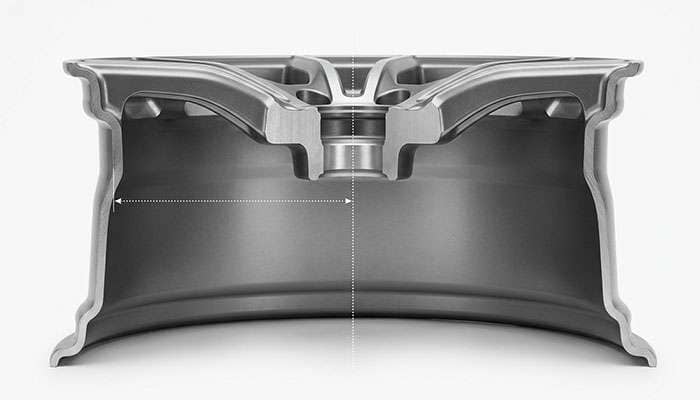
This is the part that trips up more people than anything else in wheel fitment, and it is worth two minutes. The 8 inches in 18x8 is measured bead seat to bead seat, meaning the flat shelves inside the barrel where the tire beads sit. It is not measured lip to lip.
The flanges add roughly half an inch on each side. So an 8-inch wheel is about 9 inches across its actual widest point. If you measure the gap in your wheel well with a tape and come up with 9 inches of room, you do not have room for a 9-inch wheel. You barely have room for an 8. That single misunderstanding accounts for a lot of returned boxes.
That extra inch is also baked into the backspacing math, which is why the formula looks the way it does. Backspacing is the distance from the mounting pad to the inner lip. On any 8-inch wheel, backspacing equals 4.5 inches plus the offset converted to inches. The 4.5 comes from half of 9, not half of 8.
Offset At 18x8 |
Backspacing |
Where The Wheel Sits |
Typical Application |
|---|---|---|---|
-12mm |
4.03 in |
Pushed well outboard |
Deep-dish and wide-body builds |
0mm |
4.50 in |
Mounting pad on centerline |
Classic and rear-drive muscle |
+20mm |
5.29 in |
Slightly inboard |
Rear-drive sport, mild aggressive fitment |
+35mm |
5.88 in |
Inboard, near flush |
Very common OE replacement range |
+40mm |
6.07 in |
Inboard |
The single most common 18x8 spec |
+45mm |
6.27 in |
Well inboard, tucked |
European and AWD platforms |
Read that table as a ruler. Every 25.4mm of offset moves the wheel exactly one inch laterally. Going from +40 to +20 pulls the wheel about 0.79 inches further out, which is often the difference between tucked and flush. Going the other way, from +20 to +45, pushes it an inch inboard and straight into the strut on plenty of cars.
One more marking worth knowing. You will sometimes see the width written as 8J or 8JJ. That letter is the flange contour designation from the Tire and Rim Association standard, and it describes the shape and height of the lip that holds the bead. For passenger cars, J is the ordinary contour and you can treat 8J and 8 as the same thing for fitment purposes.
An 8-inch rim accepts tires from roughly 215mm to 255mm in section width. That is the honest outer envelope. The usable window is narrower than that, and where your tire falls inside it depends as much on aspect ratio as it does on width.
Here is the mechanism nobody explains. Every tire is designed around a measuring rim, and every published dimension for that tire, including its section width and overall diameter, is measured mounted on that rim. The manufacturer then publishes an approved range around it, usually about an inch and a half wide. Mount the tire toward the narrow end of its range and the sidewalls pull inward, the tread crowns, and the shoulders lift under cornering load. Mount it toward the wide end and the sidewalls pull outward, the tread flattens, and the sidewall loses some of its ability to absorb impacts.
Neither end is dangerous inside the approved range. But the middle of the range is where the tire behaves the way its engineers intended, and that is a real thing you can feel through the steering wheel. Our piece on what happens when you put the same size tire on different rim widths gets into what changes at each end.
The practical translation for an 8-inch rim: 215mm is workable but only in low-profile aspect ratios, 225 through 245 is the comfortable middle, and 255 is workable only in taller aspect ratios. Push past 255 and you are outside what any 18-inch tire approves for an 8-inch rim.
Three sizes list 8.0 inches as their measuring rim, which means the tire was literally designed around a wheel exactly like yours: 225/40R18, 235/45R18 and 245/45R18. If you want the shortest possible answer to what belongs on an 18x8, it is one of those three.
Everything else is a compromise in one direction or the other, and the table below shows which direction. This is the chart to keep open while you shop, because it tells you not just whether a size fits but where inside its range your wheel lands.
Tire Size |
Approved Rim Range |
Where 8.0 In Falls |
Overall Diameter |
What You Get |
|---|---|---|---|---|
215/45R18 |
7.0 to 8.0 in |
At the maximum edge |
25.62 in |
Slightly stretched look, quick steering, minimal sidewall |
225/40R18 |
7.5 to 9.0 in |
Measuring rim, ideal |
25.09 in |
Sport sedan standard, sharp turn-in, firm ride |
225/45R18 |
7.0 to 8.5 in |
Upper middle |
25.97 in |
The most common 18-inch size, easy to source |
235/40R18 |
8.0 to 9.5 in |
At the minimum edge |
25.40 in |
Slight sidewall bulge, protects the lip, softer turn-in |
235/45R18 |
7.5 to 9.0 in |
Measuring rim, ideal |
26.33 in |
Balanced grip and ride, the safest all-round pick |
235/50R18 |
6.5 to 8.5 in |
Upper middle |
27.25 in |
Crossover height, comfort bias, more sidewall |
245/40R18 |
8.0 to 9.5 in |
At the minimum edge |
25.72 in |
Wide contact patch on a narrow rim, noticeable bulge |
245/45R18 |
7.5 to 9.0 in |
Measuring rim, ideal |
26.68 in |
Maximum width the rim handles properly, strong grip |
255/45R18 |
8.0 to 9.5 in |
At the minimum edge |
27.03 in |
The widest that approves, sidewall bulges past the lip |
255/35R18 |
8.5 to 10.0 in |
Below minimum |
25.03 in |
Does not approve on an 8-inch rim, skip it |
Notice the pattern in that middle column. The 40-series tires want a wider rim as they get wider, so 235/40 and 245/40 both bottom out at exactly 8.0 inches. The 45-series tires are more forgiving, which is why 235/45 and 245/45 both center on 8.0. If you want the tire operating in its designed window rather than at an edge, stay in the 45-series.
Yes, and it is one of the better choices you can make. But which 235 matters, because the three common aspect ratios put your wheel in three different places inside the approved range.
A 235/45R18 lists 8.0 inches as its measuring rim. Dead center. This is the size I would put on an 18x8 without a second thought if the overall diameter works for the car. A 235/40R18 approves from 8.0 to 9.5 inches, so your wheel is the narrowest rim the tire allows. It will mount and run fine, but the sidewall will bulge slightly outboard of the lip and turn-in softens a touch compared to the same tire on a 9-inch wheel. A 235/50R18 approves from 6.5 to 8.5 inches, putting your 8-inch wheel near the top of its range, which pulls the sidewalls out flat and tightens up the tread profile.
The section width itself is 235mm, or 9.25 inches, on the measuring rim. On an 8-inch wheel a 235 is about 1.25 inches wider than the rim it sits on, which is a completely normal relationship. Tires are always wider than their wheels. The bulge people worry about is by design, and it is what protects your lip from curbs.
The real question with any 235 is not whether it fits the rim. It is whether the overall diameter matches what your car expects, which is the next section.
Correct and best are two different questions, and this is where most guides blur them together. The best tire size for an 18x8 rim is a question about the wheel. The correct tire size for your 18x8 is a question about your car, and the answer is whichever of those approved sizes lands within 3 percent of the overall diameter your vehicle was built around.
That 3 percent figure is the trade convention, not a federal rule, but it is the line every fitment tool draws. Stay inside it and your speedometer stays honest, your stability control keeps comparing wheel speeds against numbers it recognizes, and your transmission shifts where it was calibrated to shift. Drift outside it and all of those start wandering at once.
So the process is two filters, in this order. First filter: does the tire approve on an 8.0-inch rim? Use the table above. Second filter: is its overall diameter within 3 percent of your original? Find your original size on the driver's door jamb placard, calculate its diameter, and multiply by 0.97 and 1.03 to get your window.
Working an example, because this is easier shown than described. Say the car came on 225/50R17, which stands 25.86 inches tall. Your window is 25.09 to 26.64 inches. Run that against the approved 18-inch sizes and 225/45R18 at 25.97 inches lands almost dead on, 235/45R18 at 26.33 inches fits comfortably, and 245/45R18 at 26.68 inches just misses the top. Two clean answers and one to leave alone, and it took less than a minute.
Do that math before you fall in love with a tire. Our guide to picking tire size for wheel width walks the same process from the other direction if you already have the tire and are choosing wheels.
For the overwhelming majority of cars on the road, no. Eighteen inches has quietly become the mainstream size. It is factory equipment on midsize sedans, most crossovers, sport compacts and half-ton trucks, which means the tire selection is deep, prices are competitive, and the engineering compromises are well understood.
Whether 18 is too big for your specific car comes down to three checks. First, brake clearance from below, which is rarely a problem going up in diameter. Second, whether you can find a tire in the right overall diameter, which gets harder on small cars where an 18-inch wheel forces you into a very short sidewall. Third, and this is the one people underestimate, whether the sidewall left over can absorb what your roads dish out.
That last one is where I see people regret the jump. On a compact car, going to 18 inches can leave you with roughly four inches of sidewall. That is not much rubber between an expansion joint and your wheel lip. If you live somewhere with rough pavement or hard winters, the wheel damage and the ride penalty are both real. On a midsize car or a crossover with a 45 or 50-series tire, none of that applies and 18 inches is a comfortable place to be.
There is also a weight consideration that gets glossed over. Larger diameter wheels carry more unsprung and rotating mass, which the suspension has to control and the brakes have to stop. Going from 17 to 18 is a small enough step that most drivers will not feel it. Going from 17 to 20 is not. Our honest take on what 18-inch rims actually deliver covers the tradeoffs without the sales pitch.
Seventeen is better for ride quality, wheel durability and cost. Eighteen is better for steering response, brake clearance and appearance. Neither one wins outright, and anybody who tells you otherwise is selling something.
The mechanism is the sidewall. At a fixed overall diameter, going up one wheel inch means losing about half an inch of sidewall height. That sidewall is a spring, and it is the first thing between your tire and a pothole. Shorter sidewall means less deflection under cornering load, so the tire responds to steering input faster and holds its shape better in a corner. It also means less cushion, so impacts transmit harder into the chassis and the wheel lip is more exposed.
Where I land after decades of this: if the car is a daily driver on ordinary roads, 17 is the smarter buy nine times out of ten. Tires cost less, they last a little longer, and you will bend fewer wheels. If the car is a sport sedan or a coupe you enjoy driving, 18 earns its keep in steering feel. If you are going bigger to clear a big brake kit, that is a clearance requirement and not a preference, and it makes the decision for you.
The one thing I would not do is jump sizes to chase a look and then buy the cheapest tire available to make the budget work. A 17-inch wheel with a good tire beats an 18-inch wheel with a bad one every single time, on every measure that matters. If you are weighing the move, our 17-inch to 18-inch wheel guide lays out the math on tire cost and availability.
Eighteen is better for ride, unsprung weight, tire cost and pothole survival. Twenty is better for stance, brake clearance and steady-state cornering grip on smooth pavement. The gap between them is much wider than the gap between 17 and 18, and it runs almost entirely against the 20.
Two wheel inches at a fixed overall diameter costs you roughly an inch of sidewall. On most cars that takes you from a comfortable 45 or 50-series tire down to a 35 or 30-series, which is a genuinely different driving experience. Impact harshness goes up noticeably. Wheel damage from potholes goes from unlikely to routine. Tire prices climb, sometimes steeply, and the selection thins out in the sizes that fit.
You also carry more mass at the worst possible place. A 20-inch wheel and tire package is heavier than an 18-inch package in nearly every comparison, and that weight is both unsprung and rotating. Your dampers work harder to keep the tire on the road, your brakes work harder to slow it, and acceleration suffers a little. The steady-state grip gain from the wider, shorter tire is real, but on public roads you spend far more time absorbing bumps than you do at the limit in a corner.
My rule of thumb is that 18 is the last size where you get most of the visual payoff without paying a real comfort penalty. Past that you are trading ride and durability for looks, which is a perfectly valid trade as long as you make it with your eyes open. The full comparison lives in our breakdown of 18 versus 20 inch wheels.
Here is what I want you to understand about a wheel that is the right size and the wrong offset. It bolts up. It looks fine in the driveway. Nothing warns you. The bill arrives in stages, and by the time you can see the problem, you have already paid most of it.
Stage one, the first drive. The tire contacts the fender liner at full lock, or the inner sidewall touches the strut over a big bump. You hear it once in a parking lot and write it off as a rock.
Stage two, the first month. Repeated contact abrades the sidewall. On the outer edge it is the fender lip taking material off in a band. On the inner edge it is the spring perch or strut body, which is worse because you cannot see it without getting under the car.
Stage three. Abrasion works through the outer rubber and reaches the body cords underneath. A sidewall has no steel belt protecting it, just fabric cords carrying the load, and once those are compromised the tire is finished. Any exposed cord, bulge or cut deep enough to see fabric is a stop-driving condition rather than a watch-it condition. Our guide on tire sidewall damage and whether it is safe to drive covers what each type of damage actually means.
Stage four, running quietly the whole time. Offset does not just move the wheel, it changes scrub radius, which changes the load path into the wheel bearing. Push the wheel outboard far enough and the bearing carries a bending load it was not sized for. Bearings fail slowly and then all at once, and the noise usually gets blamed on the tires first.
Stage five, if the hub bore was wrong too. A wheel centered on its lug seats instead of its hub loads the studs in shear every time you hit a bump. You chase a vibration through two balance jobs, then a road force balance, then new tires. The vibration is still there because it was never the tires.
The cost ladder runs the same direction as the damage. You pay for a tire that should have lasted three more years. Then a set of balance jobs that were never going to work. Then a bearing. The wheel that would have been correct cost the same as the one that was not. That is the part that stings.
Five steps, in order. Do not skip to the shopping.
Step 1: Get your current wheel spec off the wheel itself. Most factory wheels have the size and offset cast into the back of the spokes or the inner barrel, formatted like 18x8J ET40 or 8Jx18 H2 ET40. ET is the offset in millimeters. If nothing is cast in, the placard and the owner's manual will have the original size.
Step 2: Confirm your bolt pattern, and confirm it precisely. Five-lug patterns that differ by a couple of millimeters exist and they will start onto the studs before binding. Measure from the center of one stud to the outer edge of the stud two positions away on a 5-lug, or straight across on a 4 or 6-lug. A wheel that almost fits a bolt pattern is more dangerous than one that clearly does not.
Step 3: Write down your hub bore and plan for rings. Measure the center hub on your vehicle. If the wheel you want has a larger bore, order hub-centric rings in the correct pair of sizes at the same time as the wheels. Do not install without them and plan to sort it out later.
Step 4: Stay inside 5mm of your factory offset unless you know exactly why you are moving. That is my rule for a street car on stock suspension and stock fenders. Moving more than that is a modification, not a substitution, and it needs clearance checked at full lock both directions and at full suspension compression, not just sitting in the driveway.
Step 5: Pick the tire from the approved list, then check diameter against 3 percent. Wheel first, tire second, diameter check last. Doing it in that order means you never fall in love with a combination that was never going to work.
When the numbers are settled, you can browse the full 18x8 wheel selection and filter by the bolt pattern and offset your car actually needs.
18x8 means an 18-inch diameter and an 8-inch width, both measured at the bead seats where the tire grips. That is the true and complete answer to the size code, and it is also why the size code alone has never been enough to buy a wheel. Offset decides where the tire sits. Bolt pattern decides whether it goes on. Hub bore decides whether it stays smooth. None of those are in the number.
On the tire side, an 8-inch rim gives you a working range from about 215mm to 255mm of section width, and three sizes were designed around exactly your wheel: 225/40R18, 235/45R18 and 245/45R18. Pick from the approved list, check the diameter against 3 percent of what your car came with, and you will get a package that drives the way the engineers meant it to.
Get the offset right and everything else falls into place. Get it wrong and you will spend a year chasing symptoms that never looked like a wheel problem, because they never do.
18x8 means the wheel is 18 inches in diameter and 8 inches wide, both measured at the bead seats inside the barrel rather than across the outer lips. Because the flanges add roughly half an inch per side, an 8-inch wheel measures about 9 inches at its widest point. The size code does not include offset, bolt pattern or hub bore, which are the three specs that determine whether the wheel actually fits your vehicle.
225/40R18, 235/45R18 and 245/45R18 all list 8.0 inches as their measuring rim, meaning the tire was designed around a wheel exactly that width. Of the three, 235/45R18 is the most balanced all-round choice. The best size for your car is whichever of those falls within 3 percent of your original overall diameter.
For most cars, no. Eighteen inches is factory equipment on midsize sedans, crossovers, sport compacts and half-ton trucks, so tire selection and pricing are both good. It becomes questionable on small cars where 18 inches leaves only about four inches of sidewall, and on rough roads where that short sidewall means more wheel damage and a harsher ride.
Yes. A 235/45R18 is the ideal match because 8.0 inches is its measuring rim. A 235/40R18 also fits, with your wheel at the minimum of its 8.0 to 9.5 inch range, which gives a slight sidewall bulge. A 235/50R18 fits near the top of its 6.5 to 8.5 inch range. All three mount safely; they just sit in different places inside their approved windows.
Seventeen wins on ride quality, wheel durability and tire cost. Eighteen wins on steering response, brake clearance and appearance. At a fixed overall diameter, moving up one wheel inch costs about half an inch of sidewall, which is the tradeoff in a single sentence. For a daily driver on ordinary roads, 17 is usually the smarter buy.
An 8-inch rim accepts section widths from roughly 215mm to 255mm, with 225 to 245 as the comfortable middle. The exact window depends on aspect ratio, because each tire publishes its own approved rim range. A 255/35R18, for example, requires at least 8.5 inches and will not approve on an 8-inch wheel even though a 255/45R18 will.
Eighteen is better for ride comfort, unsprung weight, tire cost and pothole survival. Twenty is better for stance, brake clearance and steady-state grip on smooth pavement. The two-inch jump costs about an inch of sidewall, which usually moves you from a 45 or 50-series tire to a 35 or 30-series and makes impact harshness and wheel damage noticeably worse.
Two filters. First, the tire must approve on an 8.0-inch rim, which covers roughly 215mm through 255mm depending on aspect ratio. Second, its overall diameter must land within 3 percent of the size your vehicle was built around, which you find on the driver's door jamb placard. Any size that passes both filters is correct for your car.