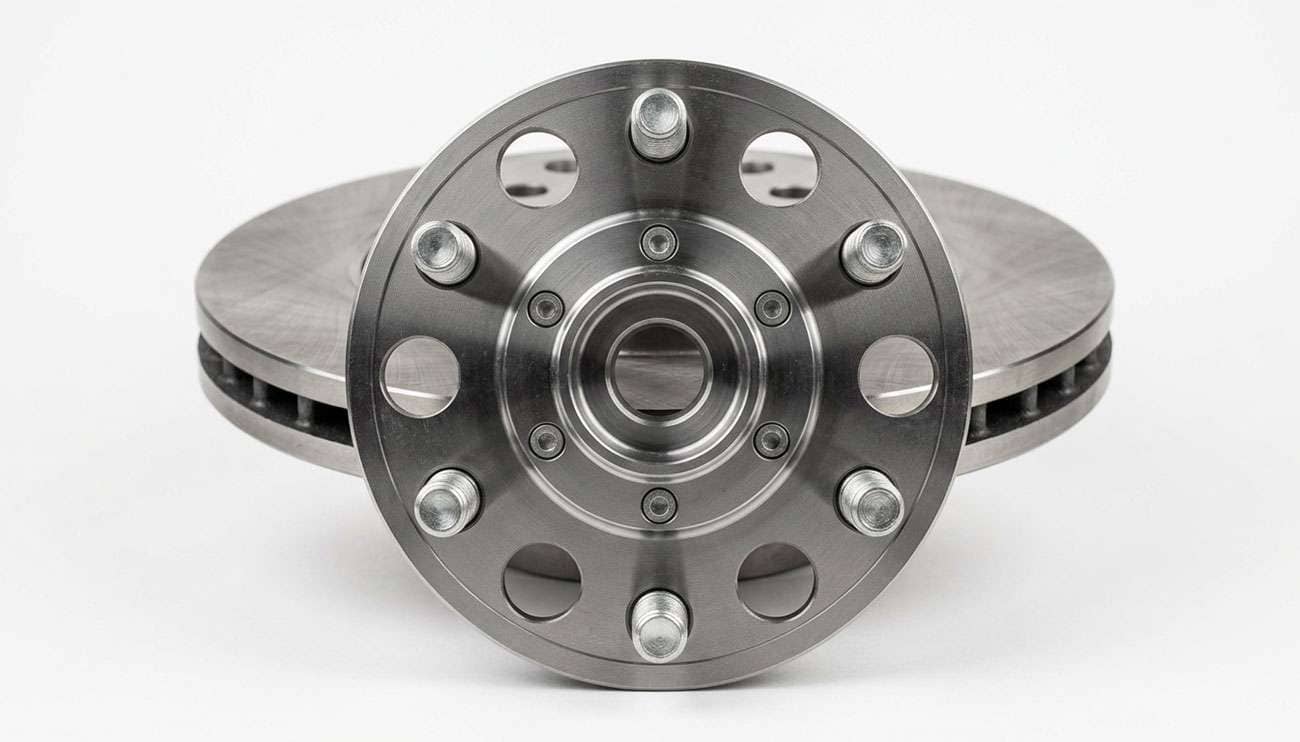
The short answer: 6x127 is used on one family of vehicles, the GM midsize SUV platform built from 2002 to 2009, plus the Chevrolet SSR. That is the Chevrolet TrailBlazer, GMC Envoy, Buick Rainier, Oldsmobile Bravada, Isuzu Ascender and Saab 9-7X. What most lists never tell you is the consequence: 6x127 is the only six-lug pattern at 127mm, and the two patterns sitting closest to it are 8mm and 12.7mm away. Both look identical on a shelf. Neither will work.
This is a short list, and that is the most important thing about it. 6x127 appears on a single GM platform generation and a single unrelated GM sports truck. Nothing else, from any manufacturer, in any market.
Vehicle |
Model Years |
Platform |
Notes |
|---|---|---|---|
Chevrolet TrailBlazer |
2002-2009 |
GMT360 |
The volume vehicle in this pattern |
Chevrolet TrailBlazer EXT |
2002-2006 |
GMT370 |
Long wheelbase version, same pattern |
GMC Envoy, Envoy XL and Envoy XUV |
2002-2009 |
GMT360 and GMT370 |
All three body styles share it |
Buick Rainier |
2004-2007 |
GMT360 |
Badge variant of the Envoy |
Oldsmobile Bravada |
2002-2004 |
GMT360 |
Final Bravada generation |
Isuzu Ascender |
2003-2008 |
GMT360 |
Rebadged TrailBlazer |
Saab 9-7X |
2005-2009 |
GMT360 |
Rebadged TrailBlazer |
Chevrolet SSR |
2003-2006 |
GMT368 |
Shares GMT360 architecture and hardware |
Because these are all the same architecture, wheels interchange freely among them. A factory Envoy wheel bolts to a TrailBlazer. A Saab 9-7X wheel bolts to a Bravada. That part is easy.
One trap worth flagging. Chevrolet revived the TrailBlazer nameplate in 2021 on a small crossover. It is a five-lug vehicle and it shares nothing with the 2002-2009 truck, including the bolt pattern. If you are shopping by model name rather than by model year, that is where the mistake happens. Count the studs on your own hub before you order anything.
6x127 is exactly 6x5.00 inches. There is no rounding involved. 127 millimeters divided by 25.4 millimeters per inch gives you 5.000 inches on the nose, which is why this pattern is written both ways and why you will see the same wheel listed as 6x127 by one seller and 6 on 5 by another. They are the same specification.
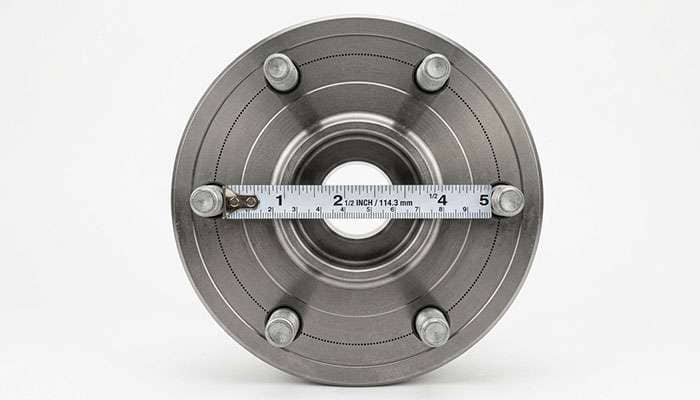
What that measurement describes is the diameter of the imaginary circle that passes through the center of all six studs. On a six-lug hub you get to measure it the easy way, because six is an even number and the studs sit directly opposite each other. Put your tape on the center of one stud and read straight across to the center of the stud on the far side. That distance is your pattern. Five-lug hubs have no stud directly opposite any other stud, which is why those require the skip-a-hole method described in how to measure lug bolt pattern.
Measure across two or three different pairs and average them. A single measurement on a rusty hub can read a couple of millimeters off, and on this particular pattern a couple of millimeters of error is enough to put you in the wrong answer.
Here is the part that actually matters when you go shopping, and the part almost every vehicle list leaves out.
Look at what else exists in six lugs:
Pattern |
In Inches |
Distance From 6x127 |
What Runs It |
|---|---|---|---|
6x114.3 |
6x4.50 |
12.7mm smaller |
Nissan Frontier and Pathfinder, Honda Ridgeline, Suzuki Equator |
6x120 |
6x4.72 |
7mm smaller |
Chevrolet Colorado and Traverse, GMC Canyon and Acadia, Cadillac XT5 |
6x127 |
6x5.00 |
Your pattern |
GMT360 family and the Chevrolet SSR |
6x135 |
6x5.31 |
8mm larger |
Ford F-150 2004 and newer, Expedition, Navigator |
6x139.7 |
6x5.50 |
12.7mm larger |
Silverado 1500, Sierra 1500, Tacoma, 4Runner, Ranger, Hummer H3 |
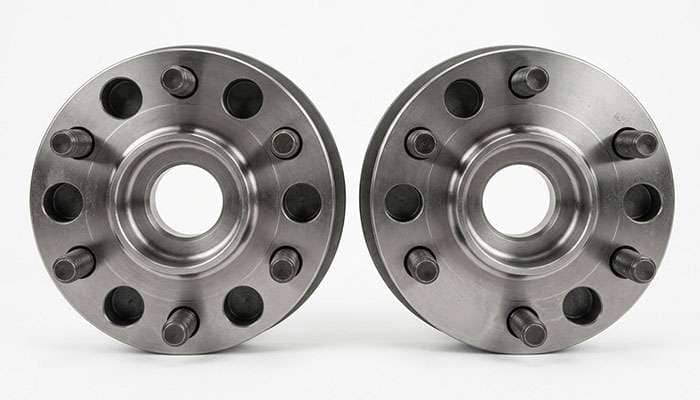
Now put that in perspective. 6x139.7 and 6x135 are the two patterns that cover essentially every full-size pickup and body-on-frame SUV sold in North America. They are enormous. 6x127 covers one platform that went out of production in 2009. For every wheel the industry builds in 6x127, it builds something on the order of a hundred in 6x139.7.
That ratio is the whole problem. Walk into any wheel selection and the overwhelming majority of the six-lug inventory is a pattern your truck cannot use. The listings all say "6 lug." The photographs are indistinguishable. An 8mm difference in bolt circle diameter is about five thirty-seconds of an inch, and you cannot see it by eye across a showroom floor or in a product photo. You find out when the wheel is in your hands and four of the six holes line up.
None of this means you are stuck. It means you filter by the full pattern and never by lug count. The patterns on either side of yours are covered in what cars have a 6x135 bolt pattern and the 6x114.3 bolt pattern if you want to see exactly how different the vehicle lists are.
Yes. Those are two ways of writing the same specification. 139.7 millimeters divided by 25.4 gives 5.500 inches exactly, so 6x5.5 and 6x139.7 are identical and interchangeable as terminology.
But read that carefully, because this is where the 6x127 owner gets burned. 6x5 and 6x5.5 are not the same pattern. They are half an inch apart in bolt circle diameter, which is 12.7 millimeters. The half-inch in the name is doing real work.
I bring this up because the two names look almost the same in a listing, in a text message from a seller, and in a hand-written note from a shop. 6x5 is yours. 6x5.5 is a Silverado. If you are buying used wheels from a classified ad and the seller writes "6x5," ask them to measure it and tell you the millimeter figure, because a lot of people write 6x5 when they mean 6x5.5. We covered that pattern in depth in the 6x5.5 bolt pattern guide and the 6x139.7 guide to compatible trucks.
The same ones listed at the top of this article, because 6x5 is 6x127. TrailBlazer, TrailBlazer EXT, Envoy in all three body styles, Rainier, Bravada, Ascender, 9-7X and SSR.
The reason this question gets asked separately from the 6x127 question is that the two naming conventions circulate in different places. Wheel manufacturers and online retailers generally use the millimeter figure. Tire shops, salvage yards and classified listings often use the inch figure. Same pattern, two dialects, and searching one will not always surface results written in the other.
If you are searching used listings, run both. Search 6x127 and search 6x5, and when you find a promising set, confirm the millimeter figure before money changes hands.
6x120 is GM's replacement for 6x127 on its modern midsize platforms, and it is the pattern people most often confuse with 6x127 because the vehicles look like the natural successors to a TrailBlazer.
It runs on the Chevrolet Colorado and Traverse, GMC Canyon and Acadia, Buick Enclave, and Cadillac SRX and XT5. Those are all newer GM midsize crossovers and trucks, which is exactly why the mix-up happens: a TrailBlazer owner shopping for a set of takeoffs sees a Traverse wheel that looks right and is the correct lug count and comes off a comparable GM vehicle. It is 7mm off and it will not mount. The full breakdown is in the 6x120 bolt pattern guide.
Worth noting for the same reason: the first-generation Chevrolet Colorado and the Hummer H3, both GM midsize trucks from the same era as the GMT360, are 6x139.7. Same manufacturer, same years, same segment, different pattern. GM used three different six-lug patterns across its midsize lineup in overlapping years, and none of them cross over.
Yes. The Silverado 1500 uses 6x139.7, which is 6x5.5, so a 6x5.5 wheel is the correct pattern for that truck. The same goes for the GMC Sierra 1500.
Two things to check before you treat that as a green light. First, heavy duty Silverados are a different animal entirely. The 2500HD and 3500HD run eight lugs, generally 8x180 on newer trucks and 8x165.1 on older ones, so "Silverado" alone is not enough information. Second, a matching bolt pattern still does not guarantee the wheel fits the truck, for the reasons in the next section.
And to close the loop for anyone who arrived here from a TrailBlazer: no, a Silverado wheel will not fit your truck, and your wheel will not fit a Silverado. The two patterns are half an inch apart.
Matching the bolt pattern gets the wheel onto the studs. It does not get the wheel onto the truck correctly. There are two more specs that have to line up, and the second one is the one that gets skipped most often.
Check |
What to Confirm |
Typical 6x127 Figure |
What Goes Wrong If You Skip It |
|---|---|---|---|
Bolt pattern |
Six studs on a 127mm circle |
6x127 or 6x5.00 |
The wheel will not mount at all |
Hub bore |
Center bore matches or exceeds the hub, with rings if it exceeds |
78.1mm on the GMT360 family |
Wheel is not hub centric. Vibration at speed, lug studs carry loads they were not designed for |
Offset and load rating |
Offset keeps the tire clear of suspension and fender, load rating meets or exceeds the axle requirement |
Load ratings around 1,520 to 2,500 lb per wheel |
Rubbing at full lock or full articulation, or a wheel working beyond its rated capacity |
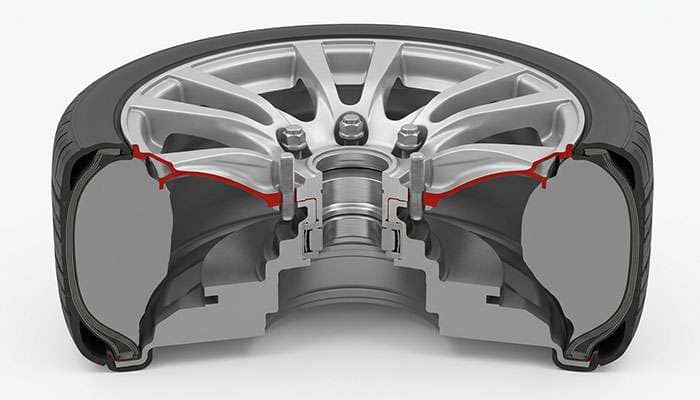
The hub bore is the one to pay attention to. These trucks are hub centric, which means the machined center bore of the wheel is designed to sit against the hub flange and carry the vehicle's weight through that contact. The lug nuts are there to clamp the wheel against the hub, not to hold it up. Fit a wheel with a bore larger than 78.1mm without hub centric rings and the wheel hangs on the studs instead of resting on the hub. That is where you get a vibration at highway speed that no amount of balancing will cure, and it puts shear load into fasteners that were designed for clamp load. Rings are inexpensive and they need to be specified when you order, not discovered afterward. Offset and backspacing are laid out in wheel offset, backspacing and bolt patterns explained.
This is the section I would most like every 6x127 owner to read, because the temptation in an orphan pattern is to force the answer.
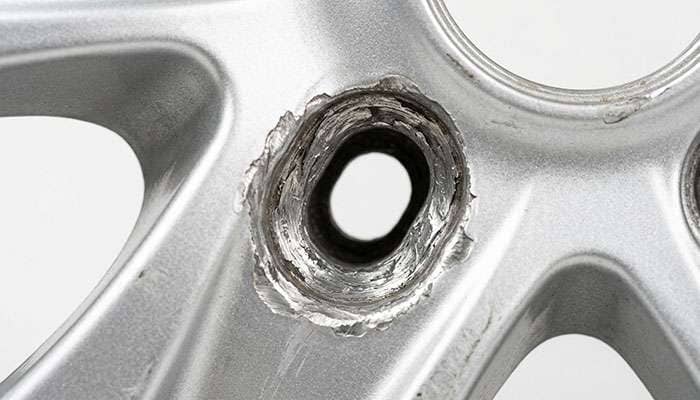
The near-miss mount. With a pattern only 7mm or 8mm off, the studs will often start into the holes. People take that as a sign it will work. It will not. The studs are entering the holes at an angle and bearing against the side of each hole rather than sitting centered in it. Torque the lug nuts down and you are cocking the wheel against the hub face.
What that does over the following weeks. Clamp load is what holds a wheel on. It comes from the conical seat of the lug nut pulling squarely into the matching seat in the wheel, stretching the stud slightly and holding the wheel flat against the hub by friction. When the seats are not aligned, you cannot develop proper clamp load no matter what the torque wrench reads, because you are reading friction from a nut binding on a misaligned seat rather than tension in a stretched stud. The wheel then works against the hub every time you brake, turn or hit a bump.
The visible progression. Lug holes wear oval. Lug nuts loosen repeatedly and get blamed on somebody not torquing them. Studs stretch past their elastic range and stop holding tension. Then studs snap, usually one or two at first, which loads the remaining ones harder and accelerates the rest. The failure is a wheel separating from the vehicle at speed, and it does not announce itself with much warning.
On adapters. A properly engineered, correctly thick, hub centric adapter from a reputable manufacturer is a real product with real applications. It is also not a fix for the situation most people want to use it for, which is making a cheap set of the wrong pattern work. An adapter adds a second joint, a second set of fasteners, and pushes the wheel outward, which changes your offset and your bearing loads. If you are considering one, the honest question is whether the wheel you want is worth the engineering it takes to mount it safely. In an orphan pattern, the better answer is almost always to buy the correct pattern in the first place.
We keep wheels in this pattern in stock and can confirm the hub bore and offset against your specific truck before anything ships. You can see what is available in the size and finish you want on our 6x127 bolt pattern wheels page, or call the shop in Long Beach at 3910 Cherry Avenue with your year, make and model and we will pull the factory specification for you.
6x127 belongs to one family of vehicles: the GM midsize SUVs built on the GMT360 architecture from 2002 to 2009, plus the Chevrolet SSR. TrailBlazer, TrailBlazer EXT, Envoy, Rainier, Bravada, Ascender and 9-7X. Wheels move freely among all of them.
The thing to carry away is not the list. It is that 6x127 is the only six-lug pattern at 127mm, sitting between a 6x120 that is 7mm smaller and a 6x135 that is 8mm larger, in a market where the vast majority of six-lug wheels are 6x139.7. The difference is invisible in a photograph and small enough that the wrong wheel will often start onto the studs.
Measure your hub. Write down the pattern and the bore. Filter on both. In an orphan pattern that discipline is the whole job.
The Chevrolet TrailBlazer and TrailBlazer EXT, GMC Envoy including the XL and XUV, Buick Rainier, Oldsmobile Bravada, Isuzu Ascender, Saab 9-7X and Chevrolet SSR. All are built on GM's GMT360 architecture from 2002 to 2009, and wheels interchange freely among them. No other manufacturer uses this pattern.
Exactly 6x5.00 inches. Dividing 127 millimeters by 25.4 gives 5.000 inches with no rounding, which is why the same wheel is listed as 6x127 by some sellers and 6 on 5 by others. Both notations describe six studs on a 5-inch bolt circle.
Yes, they are identical. 139.7 millimeters is exactly 5.5 inches. Be careful not to confuse 6x5.5 with 6x5, however. Those are two different patterns half an inch apart in bolt circle diameter, and wheels do not interchange between them.
The same vehicles as 6x127, because 6x5 and 6x127 are the same specification written two ways. That means the TrailBlazer, TrailBlazer EXT, Envoy, Rainier, Bravada, Ascender, Saab 9-7X and SSR. When searching used listings, run both notations, since retailers favor millimeters and classified sellers often favor inches.
The Chevrolet Colorado and Traverse, GMC Canyon and Acadia, Buick Enclave, and Cadillac SRX and XT5. It is GM's modern midsize pattern and it is 7mm smaller than 6x127, which makes it a common mix-up for TrailBlazer owners looking at newer GM takeoff wheels. The two do not interchange.
Yes for the Silverado 1500, which uses 6x139.7, the same thing as 6x5.5. Heavy duty models are different: the 2500HD and 3500HD are eight lug, typically 8x180 on newer trucks and 8x165.1 on older ones. Also confirm hub bore, offset and load rating, since a matching pattern alone does not guarantee correct fitment.
Adapters exist and quality ones are engineered products, but they add a second fastener joint, push the wheel outward and change offset and wheel bearing loads. They are not a shortcut for making a cheaper set of the wrong pattern work. In a pattern with limited selection, buying the correct 6x127 wheel is almost always the better answer.
78.1mm on the GMT360 family. These vehicles are hub centric, so the wheel's center bore should seat against the hub flange. If the wheel you want has a larger bore, order hub centric rings at the same time. Without them the wheel hangs on the studs and you get vibration that balancing cannot fix.