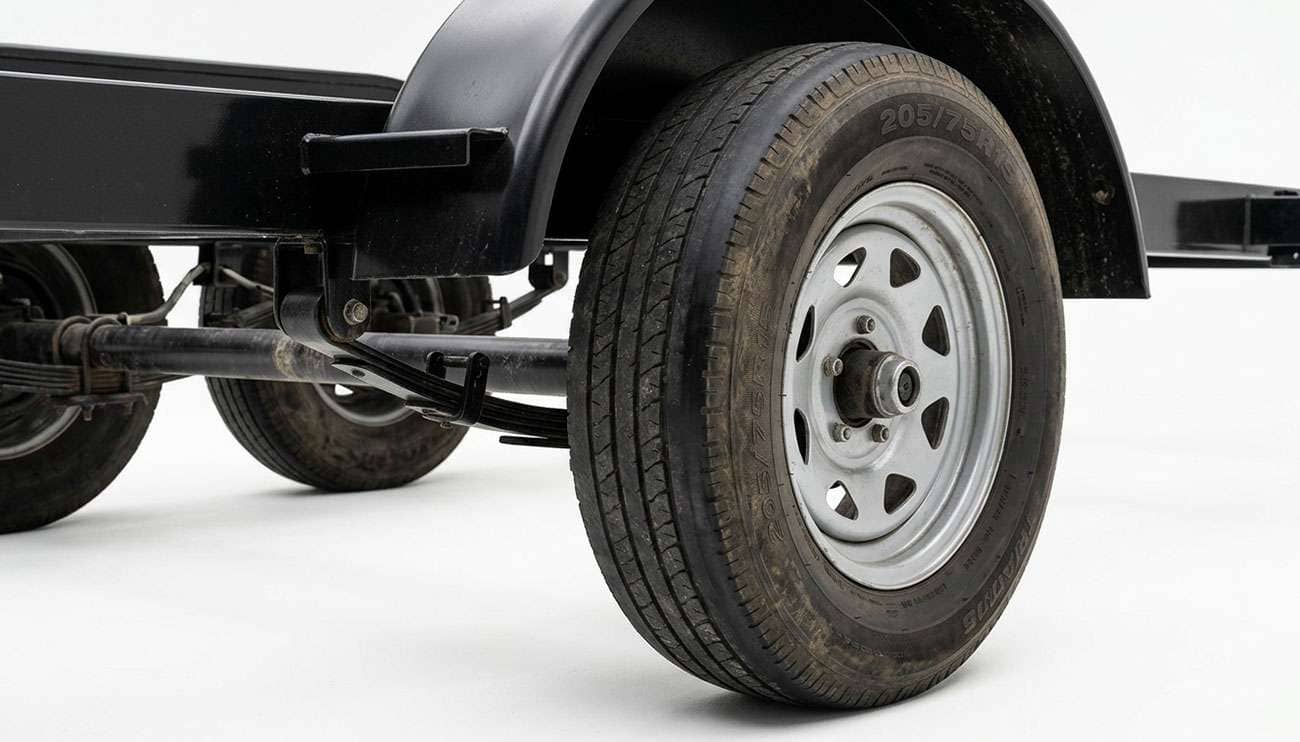
Inside wear on trailer tires almost always traces back to the axle, not the tire. Trailer axles are built with a slight upward arch, called camber, so the wheels stand straight at the axle's rated load. Load the trailer past that rating, or bend the beam or a spindle, and the tops of the wheels lean in until the inside shoulder carries the weight. Smooth inside wear on both tires points to load. One tire, or a feathered edge, points to a bent spindle or toe.
You'll hear "overloading, a bent axle, or alignment" a lot, and all three are right. What nobody puts in front of you is how to tell which one you've got by looking at the tire, and why your axle's rated capacity is the number that decides it. I've been reading worn trailer tires across our counter in Long Beach since 1971. Here's how I do it.
What You See |
Which Tires |
What It Feels Like |
Most Likely Cause |
First Check |
|---|---|---|---|---|
Inside shoulder worn |
Both tires on the same axle |
Smooth, rounded shoulder |
Load at or past the axle rating, or a sagged beam |
Weigh each axle and compare to the GAWR |
Inside shoulder worn |
One tire only |
Smooth, rounded shoulder |
Bent spindle or bent axle end |
Compare camber at that wheel to the other side |
Inside edge feathered |
One or both tires on an axle |
Sharp edges in one direction, smooth in the other |
Toe-out from a bent spindle or an axle knocked out of square |
Measure coupler to each axle end |
Scuffed, torn tread |
All tires on a tandem |
Rough, chewed tread blocks |
Scrub from tight turns under load |
How you back and turn, and load per axle |
Outside shoulder worn |
Both tires, trailer often runs light |
Smooth, rounded shoulder |
Built-in camber with no load on it, or toe-in |
How often the trailer runs empty |
Both shoulders worn |
Any |
Smooth, center tread left standing |
Underinflation |
Cold pressure against the sidewall |
Cups or flat patches |
Any |
Dips around the tread, or one flat patch |
Loose bearings, imbalance, or brake lockup |
Bearing play and brake controller gain |
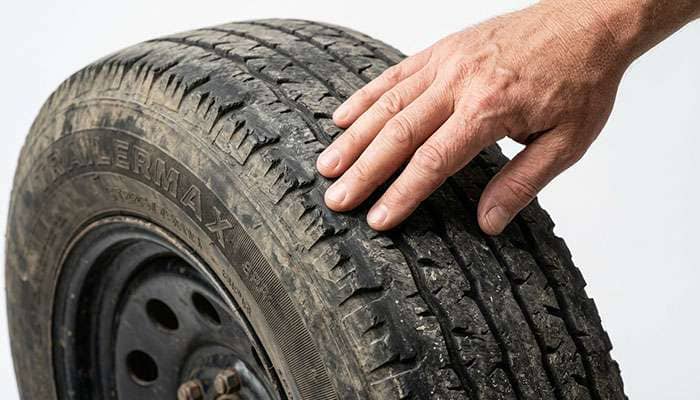
Before you do anything else, run your palm across the worn shoulder, first from the inside of the tire toward the outside, then back. That one test splits the problem in half. A smooth, rounded shoulder is a camber problem. A shoulder that feels like a saw blade in one direction is a toe problem. The fixes are different, and so is the bill.
Because the axle bends exactly the way it was designed to, just too far. A leaf-spring trailer axle isn't straight from the factory. The beam is built with a small upward arch so that when it carries its rated load, the steel flexes down, the spindles level out, and the tires roll flat on their full tread. Lippert describes the camber as being built in so the wheels sit flat under load.
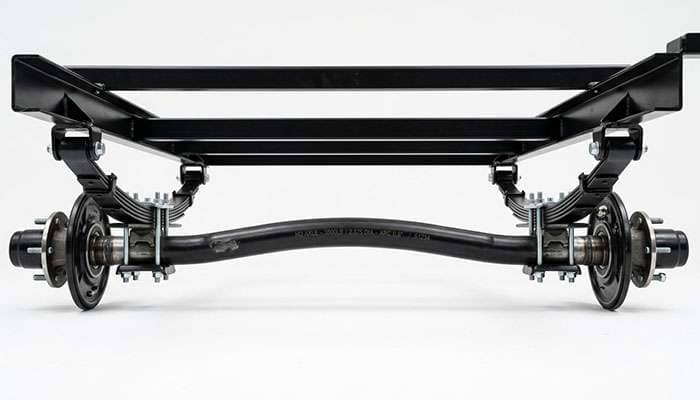
Pile on more weight than the axle was built for and the beam keeps bending past flat. Now the wheel tops lean inward, which is negative camber, and the inside shoulder of every tire on that axle takes more than its share. Dexter's axle service manual lists side wear under two causes, loss of camber or overloading, and the first fix it gives is to make sure the load doesn't exceed the axle rating. That's why inside wear that shows up evenly on both tires of one axle is the first thing I'd blame on weight.
Where the weight sits matters as much as how much there is. Load the box heavy in the back and the rear axle of a tandem carries far more than the front, so the rear tires wear on the inside while the fronts look fine. Getting the tongue weight and load placement right, the way our 60/40 rule for loading a trailer lays out, spreads that weight the way the axles were rated to take it.
Your trailer's certification label lists a Gross Axle Weight Rating, or GAWR, for each axle, along with the tire size and cold inflation pressure that rating assumes. Under FMVSS 120, the federal standard NHTSA enforces for tire selection, the combined maximum load ratings of the tires on an axle can't be less than that GAWR. So if the tires are the weak link, the GAWR on the sticker gets set to the tires, even when the axle tube underneath is stamped for more.
That's where the trouble starts. Folks replace tires with a lower load range than the original, or bolt on a bigger axle without changing tires, and the margin disappears. Here's how common trailer sizes line up against common axle ratings, using the maximum load each tire carries at its maximum cold pressure.
Axle Rating |
Tire Size |
Load Range |
Max Load Per Tire |
Two-Tire Capacity |
Margin Over Axle Rating |
|---|---|---|---|---|---|
3,500 lb |
ST205/75R15 |
C |
1,819 lb |
3,638 lb |
+4% |
3,500 lb |
ST205/75R15 |
D |
2,149 lb |
4,298 lb |
+23% |
5,200 lb |
ST225/75R15 |
D |
2,535 lb |
5,070 lb |
-2.5% (short) |
5,200 lb |
ST225/75R15 |
E |
2,833 lb |
5,666 lb |
+9% |
7,000 lb |
ST235/80R16 |
E |
3,417 to 3,527 lb |
6,834 to 7,054 lb |
-2.4% to +0.8% |
7,000 lb |
ST235/85R16 |
E |
3,638 lb |
7,276 lb |
+4% |
Look at that ST235/80R16 row. Load Range E in that size runs load index 123 or 124 depending on the tire, a 110-pound-per-tire spread inside the same letter. On a 7,000-pound axle, the lower one leaves you short before you've loaded a thing. Our breakdown of load range versus load index explains why the letter alone doesn't tell you the capacity. I like to see at least a 10 percent cushion over what the axle actually carries on the scale.
Yes, and the giveaway is that it usually hits one wheel, not two. Overloading bends the whole beam evenly, so both tires on the axle wear alike. A curb strike, a pothole at speed, or backing into a boulder at the launch ramp bends one end or one spindle, and only that wheel leans in.
Park on flat, hard ground with the trailer loaded the way you normally tow it. Hold a level or a magnetic camber gauge flat against the face of the wheel on both sides of the same axle. The two readings should match each other closely. If one wheel leans in noticeably more than its partner, that end of the axle or that spindle is bent. Unlike a car, trailer axle camber isn't adjustable, so the fix is a spindle, a torsion arm, or the whole axle.
Here's one that surprises people. If a leaf-spring axle was ever pulled and reinstalled upside down, or swapped from under-spring to over-spring mounting without care, the arch points the wrong way. Now the beam starts out with the wheel tops leaning in and gets worse with every pound you add. Look under the trailer: the middle of the beam should sit slightly higher than the ends, not lower.
Torsion axles don't use a bowed tube the same way. Each wheel rides on its own arm, so a bent arm or spindle shows up at one wheel, and a trailer that's been badly overloaded can bend both. The diagnosis is the same: compare the two wheels on the axle, then compare them to the other axle.
Feathering means toe, and toe is a different animal from camber. Toe is whether the front edges of the two tires on an axle point toward each other or away from each other. When a tire is pointed even slightly off straight, it gets dragged sideways a little with every revolution, and the tread ribs wear into ramps with one sharp edge. Rub inward and it feels smooth; rub outward and it bites.
In the heavy-truck world, the Technology and Maintenance Council ranks toe as the most common alignment cause of irregular tire wear, with axle camber second. Too much toe-in scrubs the outside edge. Toe-out scrubs the inside edge. On a small trailer, toe-out usually means a bent spindle or a bent axle end, because nothing else on the axle can steer the wheel. If you want the background on how camber and toe differ, our explainer on camber, caster, and toe walks through it.
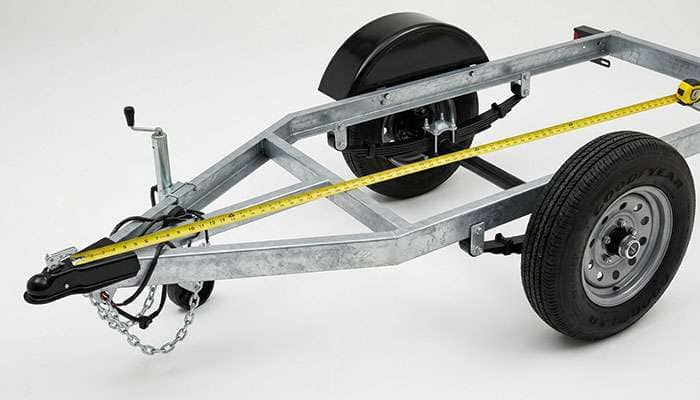
If the whole axle sits crooked under the frame, from a worn spring hanger, a shifted U-bolt, or a loose equalizer, the trailer "dog tracks" off to one side and the tires scrub. Dexter's installation spec measures from the kingpin to each end of the axle and allows no more than a 1/16-inch difference on a single axle. On a bumper-pull, measure from the coupler. More than that and the axle needs to come back to square.
Outside wear is often the same camber story in reverse, and it's frequently normal. That built-in arch is sized for a loaded trailer. Run the trailer empty most of the time, and the wheel tops lean slightly out, so the outside shoulders take the wear. A landscaper's utility trailer that runs empty half the day will show it.
The other two causes are worth ruling out. Toe-in drags the outside edge and leaves the same feathered feel described above. Underinflation lets both shoulders carry the load while the center stands tall, so if both edges are worn, check pressure before you blame the axle. Dexter's manual calls tire inflation the most important factor in tire life and says to check it cold.
Because they don't steer, and in a turn they can't all point where the trailer is going. On a single axle, the trailer pivots around the tires and they roll through the corner. On a tandem, the trailer pivots somewhere between the two axles, so every tire gets dragged sideways through every turn. The tighter the turn, the harder the drag. Backing a loaded tandem into a tight spot, or a three-point turn in a parking lot, puts more side load on those tires than a hundred miles of highway.
Scrub tears tread blocks rather than polishing them, and it can leave black marks on the pavement during sharp turns. It hits both shoulders depending on the turn direction, and it tends to be worst on the heaviest-loaded axle. If one axle carries more than the other because of how the load sits or a tired equalizer, that axle scrubs harder and wears faster.
Swing wider in turns, avoid pivoting a loaded tandem in place, and keep the load balanced front to rear so both axles share it. ST tires are built with stiffer sidewalls for exactly this kind of side load, which is one reason trailer tires carry the ST prefix in the first place.
Cupping, those scalloped dips around the tread, comes from a tire that bounces instead of rolling. Dexter's chart puts it down to out-of-balance and tells you to check bearing adjustment and balance the tires. On a trailer, loose wheel bearings are the usual suspect. Jack up the wheel, grab it at the top and bottom, and rock it. Any clunk or play means the bearings need adjusting or replacing before they do worse damage than wearing a tire.
Flat spots come in two kinds. A flat patch across the tread on one axle usually means the brakes locked, from a controller set with too much gain for the load or a panic stop. Dexter's fix is to adjust the brakes and avoid sudden stops where you can. The other kind comes from sitting: a trailer parked for months on the same patch of tire can develop a set that thumps for the first few miles. Our guide to tire flat spots from sitting covers when that rolls out and when it doesn't.
More than the tire. Inside wear hides on the side of the tire you can't see without crawling under the trailer, so it often goes too far before anybody notices. Here's how it escalates.
Compare that to the cost of doing it right: fix the cause, then put on a matched set with enough load range to carry what's really on the axle. That's cheaper than buying the same tires twice.
Fix the cause first, then the tires. Here's the order I'd work it in.
Once the axle's straight and the load's right, shop our trailer tires by size and load range, and compare the load index on each listing, not just the letter.
Trailer tires don't wear on the inside by accident. The axle is built to stand the wheels up straight at one load, and inside wear tells you it's carrying more than that, or that something got bent. Feel the shoulder, weigh the axles, check the camber, and you'll know which one you've got before you spend a dime on rubber.
Then buy tires that can actually carry the job. Trailer tires also age out before they wear out, so if yours are getting up there, our guide to how old is too old for trailer tires will tell you whether the tread even matters anymore.
Five things to remember the next time you crawl under a trailer.
No. A little uneven wear happens on any trailer, but steady inside wear means the wheels are leaning in. That usually comes from carrying more weight than the axle is rated for, a bent spindle or axle, or toe-out. Weigh the axles and check camber before you replace the tires.
Partly. A shop can square the axle to the frame so it tracks straight, but camber on most trailer axles isn't adjustable. If a spindle or beam is bent, the fix is replacing that part or the whole axle.
Look for inside or outside wear on one wheel but not its partner, or a trailer that tracks off to one side. Park on level ground, hold a level or camber gauge against each wheel on the same axle, and compare. A noticeable difference between the two sides means something is bent.
A trailer tire carries its full rated load only at the maximum cold pressure on its sidewall, so most owners run them there. Follow your tire maker's load and inflation guidance, check pressure cold before every trip, and never bleed air from a hot tire.
It helps. An out-of-balance trailer tire bounces, which shows up as cupping and shortens tread life, and Dexter's axle manual lists balancing as the fix for cupped tires. Check the wheel bearings at the same time, because loose bearings cause the same pattern.