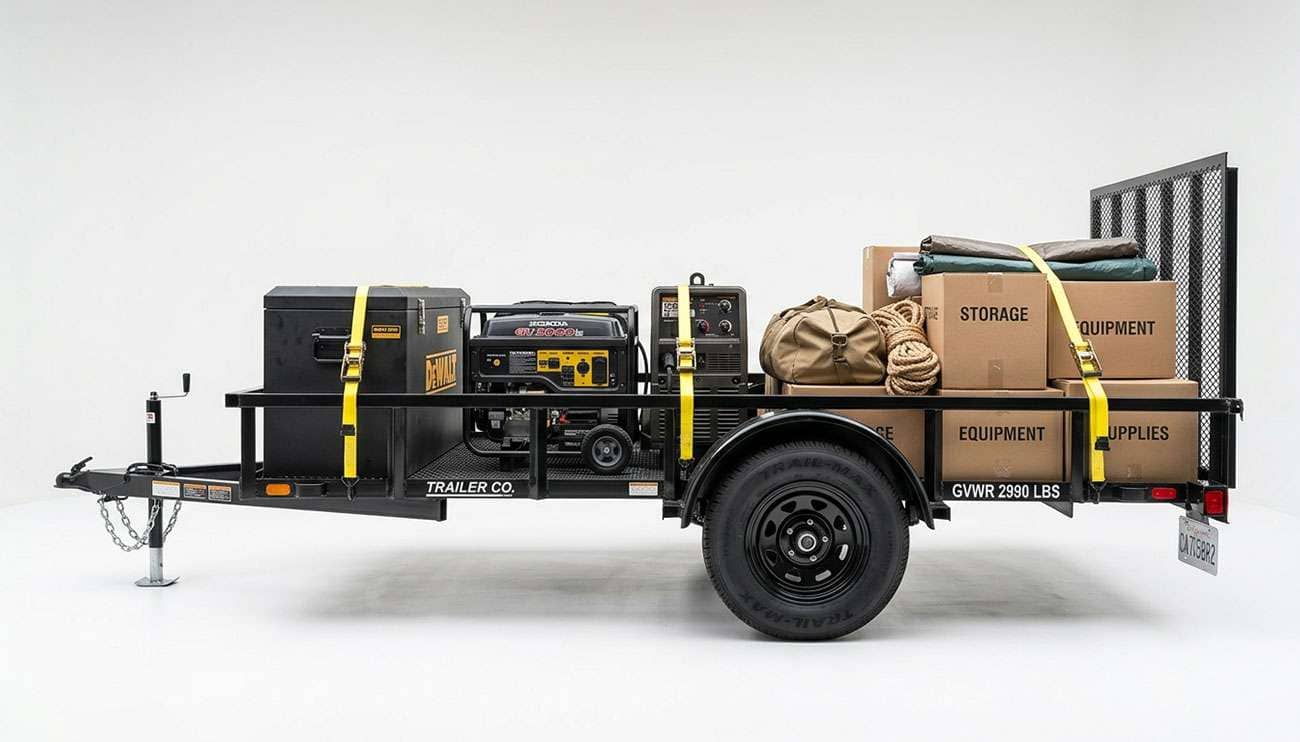
If you've ever towed a trailer that started whipping side to side on the highway, you know the sinking feeling — the trailer suddenly steering the truck instead of the other way around, and that brief moment where you wonder if you're going to keep it between the ditches. That's trailer sway. And in most cases, it's caused by one thing: the load wasn't balanced right.
The 60/40 rule is the single most important guideline in trailer loading, and most people who tow don't know it exists. I've been selling trailer tires and hearing sway stories for decades, and almost every one of them traces back to a violation of this rule. Let me break it down in plain English.
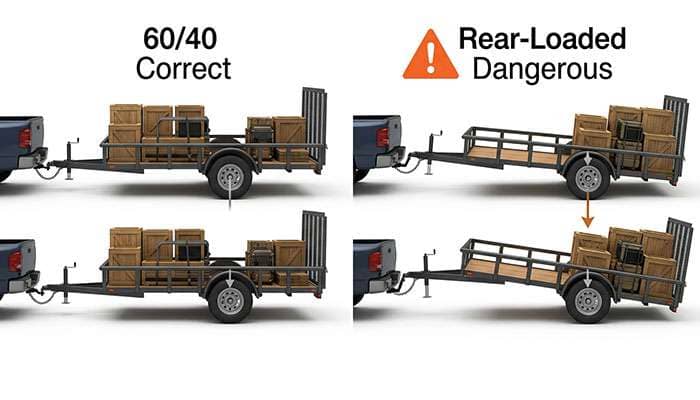
The 60/40 rule says that 60% of your cargo weight should sit in front of the trailer's axle, and 40% should sit behind it. That's it. Simple in concept, but critical in execution. That distribution keeps the trailer stable, puts the right amount of weight on the hitch, and prevents the side-to-side oscillation that causes most trailer accidents.
The rule applies to virtually every bumper-pull trailer you'll tow — utility trailers, enclosed cargo trailers, boat trailers, toy haulers, travel trailers, equipment trailers. Single-axle, tandem-axle, triple-axle — doesn't matter. Whether you've got a small 5x8 utility trailer or a 24-foot cargo hauler, the 60/40 split applies. Just make sure your trailer tires are properly sized and rated for the total loaded weight.
Seems like 50/50 would make sense, right? Split the load evenly, keep things balanced. But that's not how trailers work physically.
A trailer is a pivot. The axle is the pivot point, and the cargo hanging off each end acts like a lever. When you put too much weight behind the axle, the rear of the trailer wants to act like a pendulum — any small disturbance (a wind gust, a lane change, hitting a seam in the road) makes it swing. Once it starts swinging, the momentum builds. Each swing gets bigger than the last. That's the oscillation that causes sway, and it can go from "a little shimmy" to "totally out of control" in about three seconds.
Putting more weight in front of the axle loads the hitch. That hitch weight — called tongue weight — is what anchors the trailer to your tow vehicle. Enough tongue weight means the trailer behaves like an extension of the truck. Not enough tongue weight means the trailer behaves like an independent object looking for a reason to swing sideways.
So why not 70/30 or 80/20? Because too much weight forward creates its own problems. It overloads the tow vehicle's rear axle, squats the truck's suspension, reduces steering response, and puts excess force on the hitch receiver. 60/40 is the sweet spot — enough tongue weight to prevent sway, but not so much that it damages your truck or the hitch.
Here's where the 60/40 rule connects to something you can actually measure: tongue weight.
Tongue weight should be 10-15% of your total loaded trailer weight for bumper-pull trailers. A 3,000-pound loaded trailer should put 300-450 pounds down on the hitch ball. A 7,000-pound loaded trailer should put 700-1,050 pounds down. When you follow the 60/40 rule for cargo placement, your tongue weight almost always falls within this range automatically. The two rules work together.
Why 10-15%?
Below 10%: The trailer doesn't have enough hitch anchor weight. Sway becomes likely with any crosswind, lane change, or road disturbance. Every trailer accident caused by sway I've ever heard about traces back to low tongue weight.
Above 15%: Too much weight squats the tow vehicle's rear suspension, lifts the front wheels, reduces steering traction, overloads the hitch receiver, and stresses the truck's rear axle and tires. Your headlights point at the sky at night. Your steering feels light. Braking distances increase.
The 10-15% window is narrow but critical. Fifth-wheel and gooseneck trailers operate differently — they typically want 20-25% of their weight on the hitch because the pivot point is over the truck's axle rather than behind it. But for standard bumper-pull trailers, 10-15% is the target.
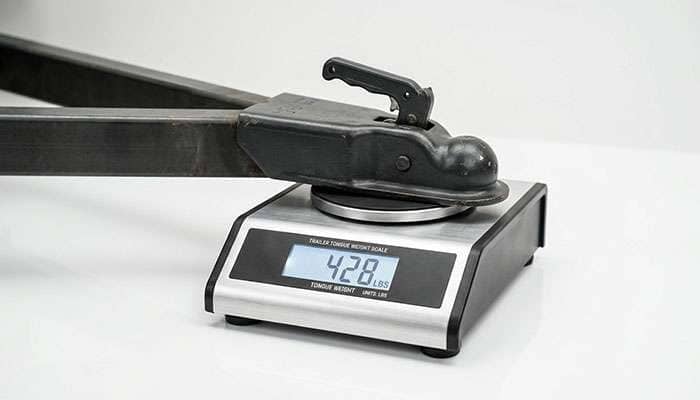
You can talk about the 60/40 rule all day, but at some point you need to verify that your actual tongue weight is in the right range. Here are the three ways to measure it:
The easiest and most accurate method. A tongue weight scale sits under the trailer coupler and reads the downward force in pounds. Shurflo, Weigh Safe, and Sherline all make good ones for $75-$250. If you tow regularly, this is the right investment. You can check tongue weight in five minutes before any trip and know exactly what you're towing.
Drive to a truck stop with CAT scales. Weigh your truck and trailer together with all three axles on the scale ($12-$15). Then disconnect the trailer and weigh just the truck. The difference between the two weights — specifically the rear axle weight difference — is your tongue weight. This is free-ish, accurate, and works for any setup. Keep the receipts for future reference.
For smaller trailers under about 300 pounds of tongue weight, you can use a standard bathroom scale. Place a sturdy 2x4 or pipe across the scale and a support block positioned to match the coupler height, then rest the trailer coupler on the 2x4 directly over the scale. Not as accurate as a dedicated scale, but works in a pinch for small utility trailers.
For tongue weights above 300 pounds, bathroom scales max out and aren't reliable. Use a CAT scale or buy a dedicated tongue weight scale.
I've seen trailer loading disasters across the entire spectrum. Here are the common failure modes:
Rear-loaded trailer (the worst case). Too much weight behind the axle, not enough tongue weight. The trailer sways at highway speeds, amplifies with every oscillation, and eventually loses control. This is the classic jackknife or fishtail scenario. Every time you see a news story about a trailer flipping on the highway, this is usually what happened. The skid loader, the ATV, the heavy equipment was loaded too far back.
Front-loaded trailer. Too much weight forward, too much tongue weight. The truck's rear squats, the front lifts, steering feels light, brakes feel weak. At highway speeds this is less immediately dangerous than sway, but it accelerates wear on the truck's rear axle, tires, and suspension. Over time, it damages the hitch receiver. In worst cases, the truck's front wheels lose enough traction that emergency braking or steering is compromised.
Side-heavy trailer. Weight shifted to one side causes uneven tire wear, makes the trailer lean visibly, and puts excess load on one wheel bearing. Causes premature trailer tire failure on one side. A trailer tire failure at highway speed often leads to loss of control.
Unsecured load that shifts during braking. The load starts balanced but shifts backward during hard braking, suddenly putting too much weight behind the axle. Instant sway. This is why tie-down straps aren't optional — they keep the load where you put it.
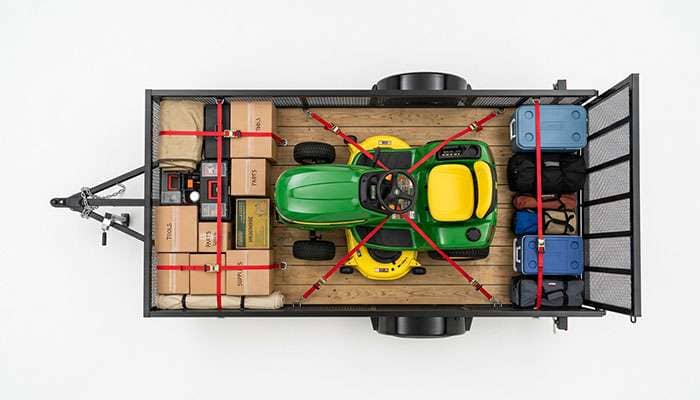
Here's the sequence I give every customer who buys trailer tires from us:
Step 1: Park on level ground and chock the wheels. If the trailer is on a slope, your loading will be off. Level ground, wheels chocked, jack supporting the tongue.
Step 2: Identify your axle centerline. Stand beside the trailer and note where the axle is (or on tandem axles, the midpoint between the two axles). Visualize this as the pivot line. Everything forward of this line is the 60% zone. Everything behind is the 40% zone.
Step 3: Load the heaviest items first, positioned just forward of the axle. This is counterintuitive — most people want to push heavy stuff to the back to make loading easier. Wrong. The heaviest single items should sit over or just forward of the axle centerline. That's the sweet spot where weight minimally affects tongue weight while maximizing stability.
Step 4: Fill in with lighter items distributed forward. Smaller, lighter items go forward of the heavy items. This builds up the 60% concentration in front of the axle.
Step 5: Place lightest items behind the axle. Whatever's left — low-weight bulk items, flexible cargo, soft goods — goes in the rear 40% zone.
Step 6: Distribute weight side-to-side evenly. Look at the trailer from behind. It should sit level, not leaning to one side. Tires should appear equally compressed.
Step 7: Secure everything with tie-down straps. Ratchet straps with proper working load limit (WLL) ratings. Every item secured to the D-rings or anchor points. Test by shoving hard on each item — it shouldn't move.
Step 8: Verify tongue weight before you drive. This is the step most people skip and it's the most important one. Measure it. Make sure you're in the 10-15% range. If you're outside that range, adjust the load.
Browse our full trailer tire and trailer wheel selection. Running trailer tires that are more than 5-6 years old? Replace them regardless of tread depth — age-related sidewall failure is the #1 cause of trailer tire blowouts. Check the DOT date code on your sidewall to confirm tire age. Call us at 888-926-2689 for help sizing the right tires for your trailer.
Yes. The 60/40 rule applies to both single-axle and tandem-axle trailers. For tandem-axle setups, use the midpoint between the two axles as your reference line — 60% of cargo weight should go forward of that midpoint, 40% behind. Tandem axles provide more overall stability than single axles, but they don't change the loading rule. Rear-biased loading on a tandem-axle trailer is still dangerous at highway speeds.
If tongue weight falls below 10% of total trailer weight, the trailer loses its anchor to the tow vehicle and becomes prone to sway. Sway is a side-to-side oscillation that amplifies with each swing — it can start as a small shimmy and escalate to a full loss of control in 3-5 seconds. Low tongue weight is the leading cause of trailer accidents on highways. If you notice the trailer feels "loose" behind the truck, or if it starts swaying in response to wind or passing trucks, stop immediately and redistribute cargo forward until tongue weight is back in the 10-15% range.
The most accurate method is a dedicated tongue weight scale ($75-$250) that sits under the coupler and measures downward force directly. Alternatively, drive to a CAT scale at any truck stop, weigh truck plus trailer together, then weigh just the truck. The weight difference at the rear axle position is your tongue weight. For small trailers with under 300 pounds of tongue weight, a bathroom scale with a 2x4 support beam across it works in a pinch. Your target is 10-15% of the total loaded trailer weight.
No. A weight distribution hitch redistributes tongue weight across both the tow vehicle's rear and front axles, which prevents squatting and improves handling — but it doesn't fix an improperly balanced trailer. If your cargo is loaded 40/60 (too much behind the axle), you still have inadequate tongue weight and the trailer will still want to sway. Weight distribution hitches are excellent tools for managing already-correct tongue weight on heavy trailers. They are not a substitute for loading the trailer correctly in the first place. Load to 60/40, then use a weight distribution hitch if your tongue weight exceeds what your tow vehicle can comfortably handle.
The 60/40 rule is specifically for bumper-pull trailers where the hitch point is behind the tow vehicle's rear axle. Fifth-wheel and gooseneck trailers have their hitch point directly over the tow vehicle's rear axle, which fundamentally changes the physics. Fifth-wheels typically target 20-25% of total trailer weight on the hitch instead of 10-15%. They're also much more resistant to sway because the pivot point is in a more stable location. Follow the manufacturer's loading guidelines for your specific fifth-wheel or gooseneck — they often include specific weight distribution instructions.
If you're loaded correctly but the trailer still feels unstable, check these common issues: tire pressure (underinflated trailer tires cause wobble and sway), tire age (trailer tires older than 5-6 years are prone to sidewall failure regardless of tread depth), hitch ball tightness (a loose hitch ball creates play that mimics sway), and tow vehicle capacity (exceeding your truck's tow rating causes instability regardless of trailer loading). Also check that your load is fully secured — a shifting load can turn a stable trailer into a swaying one in seconds. Replace trailer tires at the first sign of sidewall cracking, and never exceed the tow vehicle's rated capacity.