
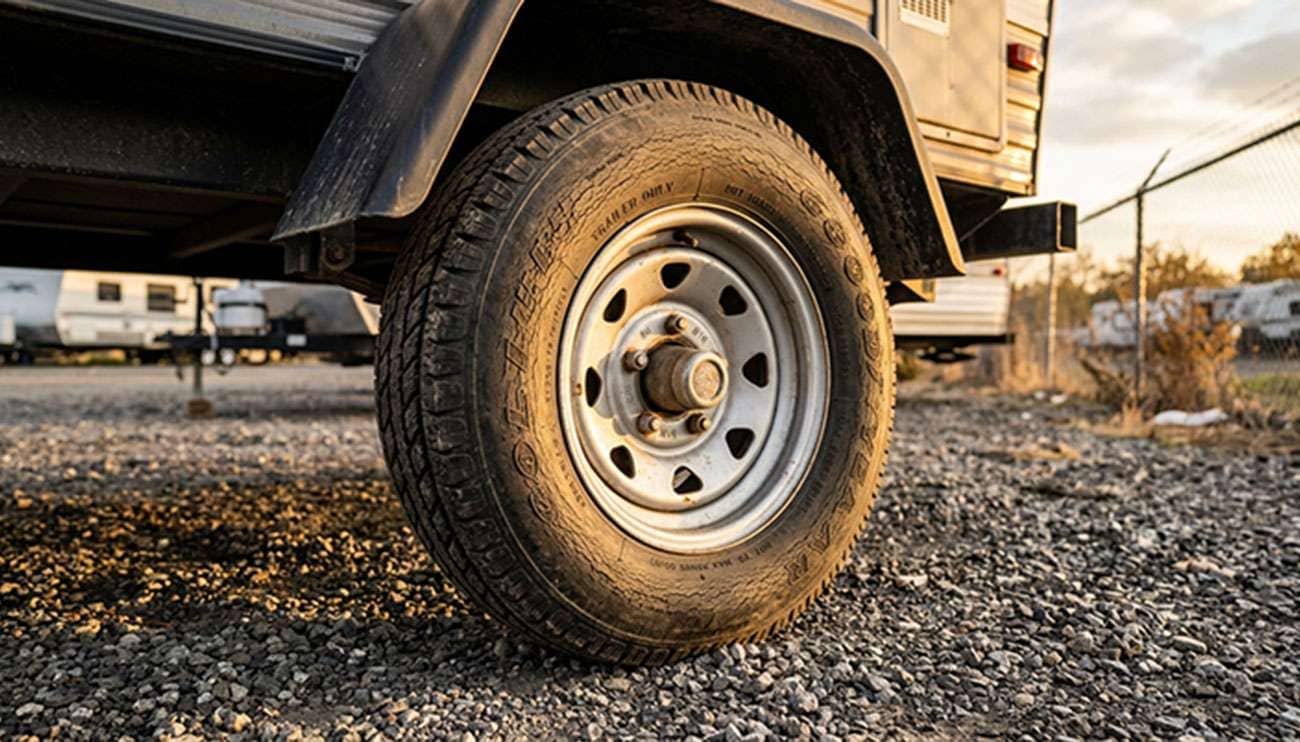
Plan on replacing trailer tires at about five years old, no matter how much tread is left. Many trailer tire makers put the range somewhere between three and six years, and I tell folks five because it splits the difference on the safe side. Most people expect a "the tread looks fine" answer. The variable that actually matters is how your trailer lives. A trailer that sits in the sun 50 weeks a year ages its tires faster than one that runs every weekend. Read the four-digit date code on the sidewall, not the tread, and shorten the clock if the trailer sits outdoors uncovered.
I have been around tires since my family opened the shop in Long Beach in 1971, and trailer tires are the ones that fool people most. Every spring somebody pulls in with a boat trailer on tires that look nearly new. Deep tread, shiny sidewalls, maybe 3,000 miles on them total. Then you flip the tire over to the date code and it is nine years old, and the sidewall has fine cracks you can see once you know to look. Those tires never wore out. They just got old. Here is how to tell where yours stand.
How Your Trailer Lives |
What Usually Ends the Tire |
Replace By |
|---|---|---|
Sits outdoors uncovered, used a few times a year (boat, camper, utility) |
Age, sun, and ozone |
3 to 5 years, even with full tread |
Stored covered or indoors, used a few times a year |
Age |
About 5 years; inspect closely after that |
Towed often, every month or more (car hauler, landscaper, horse trailer) |
Tread wear, usually before the age limit |
When tread hits 4/32 inch or at 5 years, whichever comes first |
Full-time RV or travel trailer, long trips at highway speed |
Heat from load and speed, plus age |
About 5 years, sooner if run near max load |
Spare tire mounted on the trailer |
Age; it rarely touches the road |
Same date as the road tires |
Here is the same idea keyed to the number on the sidewall, so you can decide what to do the minute you read it.
Tire Age From Date Code |
Condition |
What to Do |
|---|---|---|
Under 3 years |
No cracks, bulges, or uneven wear |
Keep running; check pressure before every trip |
3 to 5 years |
Fine surface cracking only |
Plan replacement before your next long trip |
5 years or more |
Any condition, even full tread |
Replace |
Any age |
Deep cracks, bulge, exposed cords, or tread separation |
Replace before towing again |
Rubber does not just wear. It ages, the same way a garden hose left in the yard gets stiff and cracks. Oxygen, ozone in the air, sunlight, and heat all break down the rubber compounds over time. Every tire on every vehicle goes through that. Trailer tires just get hit harder, for three reasons.
Tire makers blend protective chemicals called antiozonants and waxes into the rubber. Those chemicals work their way to the surface and form a thin shield against ozone. Here is the part most people never hear: the tire has to flex for that to happen. Every time a tire rolls, it flexes, and that flexing keeps bringing fresh protection to the surface.
A car tire rolls nearly every day. A boat trailer tire might roll 20 days a year and sit the other 345. When the tire sits, the surface protection gets used up and does not get replaced. That is when you start seeing weather checking, those fine little cracks in the sidewall. I have seen low-mileage trailer tires crack worse than high-mileage ones for exactly this reason.
ST (Special Trailer) tires are built to carry a lot of weight on a relatively small tire. That is what they are for. Our article on the difference between car and trailer tires gets into the construction. The short version: an ST tire is designed with stiffer sidewalls and higher load capacity than a passenger tire of the same size, and it usually runs close to its limit.
Load creates heat, and heat speeds up aging inside the tire, where you cannot see it. On a tandem-axle trailer, the tires also scrub sideways in every tight turn, because both axles cannot follow the same arc. That twisting load is hard on the internal belts.
Most trailers do not get a garage. They sit in a side yard, a storage lot, or a driveway, often parked in the same spot with the same side facing the afternoon sun for months. Ultraviolet light breaks down the rubber surface directly. The side of the tire that faces south or west often shows cracking first.
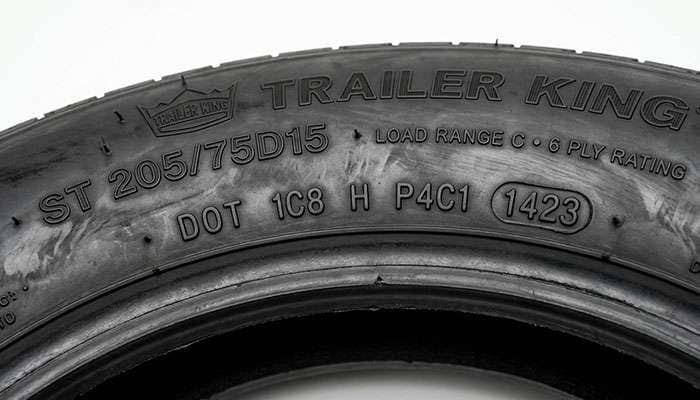
Every tire sold in the United States carries a DOT code on the sidewall. The last four digits of that code tell you the week and year the tire was made. A code ending in 2321 means the 23rd week of 2021. A code ending in 0819 means the 8th week of 2019.
Two things trip people up. First, the full date code is often only molded on one side of the tire. If you do not see a four-digit number at the end of the DOT code, check the other sidewall, which on a trailer may be facing the frame. Second, the date is when the tire was made, not when you bought it. A tire can sit in a warehouse before it ever reaches you. If you want more detail on reading the whole code, we have a full guide on how to read DOT tire date codes.
There is no federal expiration date on tires. The National Highway Traffic Safety Administration (NHTSA) leaves age guidance to tire and vehicle manufacturers. That is why you see different numbers from different sources, and why I give folks one simple number they can remember: five years.
While you are checking the date, read the size too. Make sure you are actually running ST tires, and note the load range letter. If you need help decoding what you are looking at, our breakdown of the ST225/75R15 tire code walks through every part of a common trailer size.
It does, but less than most people think, and it is usually not the thing that ends a trailer tire's life.
Trailer tires do not steer and do not drive. They are mostly along for the ride, carrying weight. So they do not wear the tread down the way a truck's front tires do. A trailer used a handful of times a year might take ten years or more to wear out its tread. The rubber will be done long before that.
That is why "plenty of tread left" is the most dangerous thing a trailer owner can say. Deep tread on an old tire means nothing about what is going on inside. The belts and the bond between the layers of rubber weaken with age, and that is what lets go. When a trailer tire throws its tread on the highway, the tread is often still deep.
For trailers that do see heavy use, tread still matters. The legal minimum is 2/32 inch, but I replace at 4/32 inch, because shallow tread on wet roads makes a trailer harder to control behind you. Whichever comes first, age or tread, is your replacement date.
About five years is the honest answer for most trailers. But the type of trailer you have changes how you get there, so let's walk through the common ones.
Boat trailers have it worst. They sit most of the year, often outdoors, and when they do get used, the tires get dunked. Fresh water is not too bad, but salt water is hard on wheels, bearings, and brakes, and the tires sit wet in the sun afterward. Boat trailer tires often show cracking at three to four years. Check them every spring before the first launch.
Travel trailers combine the worst of both worlds: heavy loads at highway speed during the season, then months of sitting in storage. Heat builds fast in a loaded RV tire on a hot summer highway. Five years is a firm limit here. If you run close to the trailer's maximum weight, think about replacing sooner.
A landscaper's trailer that runs every day may wear through its tread in two or three years, so age is rarely the problem. A homeowner's utility trailer that hauls brush twice a year is the opposite. It will age out long before the tread goes, and it is usually the one nobody checks.
These carry valuable cargo, and in the case of horse trailers, living cargo. They also tend to run heavy. My advice is simple: stick with five years, check the pressure before every trip, and do not let a cracked tire talk you into "one more season."
Yes, more than anything else you control. How the trailer sits between trips can add or take away years.
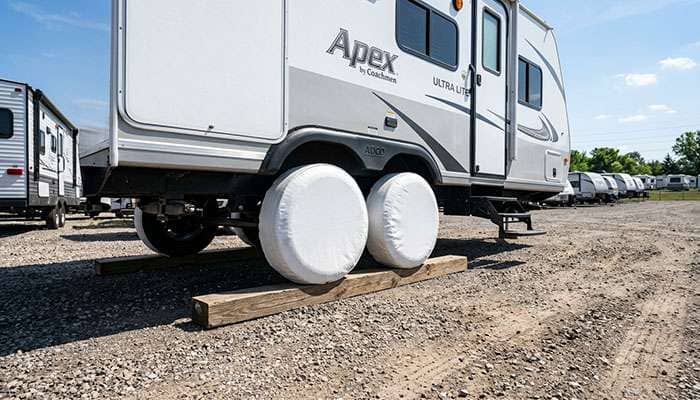
Simple vinyl tire covers block sunlight, and sunlight is one of the biggest causes of sidewall cracking. They cost very little next to a set of tires. If your trailer lives outside, put covers on.
A tire that sits loaded in one spot develops a flat spot where it meets the ground, and the rubber at that spot is under constant stress. If the trailer will sit for months, either put it on jack stands to take the weight off the tires or roll it a few feet every few weeks so a different part of the tire carries the load. We cover more about this in our article on tire flat spots from sitting.
Sitting on dirt or grass holds moisture against the tire. Sitting on hot blacktop in summer cooks it. A board or a piece of plywood under each tire is an easy improvement for a trailer parked in the yard.
Electric motors produce ozone. A trailer parked in a shop next to a running compressor or a freezer is aging its tires faster than you would think. Keep tire dressings and petroleum-based cleaners off the sidewalls too; some of them can dry out the rubber.
Indoor storage helps a great deal, but it does not stop the clock. Tires age even in a garage. If you have tires that have been stored for a long time, our article on 10-year-old garage-stored tires explains why they still are not safe to run.
Sometimes there are no warning signs. That is the real reason the age rule exists. But here is what to look for every time you hook up.
Weather checking or cracks. Fine cracks in the sidewall or between the tread blocks. Shallow surface cracks are the first sign of age. Cracks deep enough to catch a fingernail mean the tire is done. Our guide to tire dry rot has pictures of what these stages look like.
Bulges or bubbles. A bulge on the sidewall or the tread means the inside of the tire has separated. Do not tow on it, not even to the shop.
Uneven or odd wear. Wear on one edge, cupping, or a flat spot can point to a bent axle, bad bearings, or a tire that is coming apart inside.
A wobble or thump. If the trailer starts to sway or thump at speed and it did not before, pull over and look. A tire separating inside often changes shape before it fails.
Cuts, gouges, or exposed cords. Curbs, boat ramps, and rocks all damage sidewalls. If you are unsure whether a sidewall injury is safe, read our guide to tire sidewall damage. On a trailer, my rule is simple: when in doubt, replace it.
Probably, if you have never checked. The spare is the most forgotten tire on any trailer. It came with the trailer, it hangs on the tongue or the side, and it never touches the road. So it looks perfect, and it is often the oldest tire on the rig.
A spare ages the same way the road tires do. It sits in the sun, it never flexes, and it is usually under-inflated because nobody checks it. If your road tires are five years old, your spare is too. When you replace the set, replace the spare with them, or at least check its date code and its pressure. A blowout on the highway is a bad time to find out your spare is cracked.
An old trailer tire rarely gives up quietly. Here is what it can cost you, from least to most.
1. Your trip. A flat or a blowout on the shoulder means hours waiting, and often a spare that is just as old.
2. The other tire on that side. On a tandem trailer, when one tire fails, the tire next to it suddenly carries the full load of both. That overloads it and can damage it, even if it does not fail right then. Many shops will tell you to replace both.
3. Your fender and wiring. When the tread lets go at highway speed, it whips around inside the wheel well. It can tear up the fender, rip out light wiring, and damage brake lines on trailers with brakes.
4. Your axle, hub, and wheel. Running on a shredded tire for even a short distance can damage the wheel and the hub.
5. Your cargo. A boat, a car, horses, or everything you packed in the camper.
6. A crash. A trailer that suddenly loses a tire can sway and pull the tow vehicle with it. That is the one that really matters.
A new set of trailer tires costs much less than any of those. The cheapest point on the list is replacing them on schedule.
Here is the way I would do it, start to finish, in about 15 minutes in your driveway.
Step 1: Find the date code on every tire, including the spare. Read the last four digits of the DOT code and write down the week and year for each one.
Step 2: Do the math. If any tire is five years or older, replace it. If it is three to five years old and the trailer lives outside, plan to replace it soon.
Step 3: Inspect both sidewalls. Look for cracks, bulges, cuts, and exposed cords. Check the inside sidewall too; that is where damage hides.
Step 4: Check the tread. Use a tread depth gauge. Replace at 4/32 inch, even if the tire is young.
Step 5: Check the pressure cold. Use the pressure on the trailer's placard or the tire sidewall as your guide, and check before every trip. Low pressure builds heat, and heat kills trailer tires.
Step 6: Check the speed rating. Many trailer tires have historically been rated for 65 mph. Many newer ST tires carry a higher speed symbol, such as L (75 mph) or M (81 mph). Read your sidewall and tow at or below the rating.
Step 7: Replace as a set. Put the same size, load range, and type on every wheel, including the spare. Mixing old and new tires on a tandem axle means the old tire is still your weak link.
When you are ready, you can shop our trailer tires by size and load range.
Trailer tires rarely wear out. They age out. They sit in the sun, they do not roll enough to keep their protection up, and they work hard when they do roll. That is why the date code on the sidewall tells you more than the tread does.
Five years is my rule, and three to four if the trailer sits outside uncovered. Cover them, get the weight off them during long storage, check the pressure before every trip, and do not forget the spare. A new set of tires is a small price next to a blowout on the freeway with your boat or your family behind you.
Most trailer tire makers recommend replacement somewhere between three and six years. Five years is a good rule for most trailers, and sooner if the trailer is stored outdoors without tire covers.
Yes, if they are past about five years old. Trailer tires usually age out before they wear out, and the rubber and internal belts weaken with age even when the tread is deep.
Look for the DOT code on the sidewall. The last four digits are the week and year the tire was made. A code ending in 2321 means the 23rd week of 2021. Check both sides if you do not see it.
Trailer tires spend most of their life sitting still and outdoors. Tires need to flex to bring their protective antiozonants to the surface, so a parked tire loses that protection while sunlight and ozone crack the rubber.
Yes. A spare ages just like the road tires even though it never touches the road. Check its date code and replace it on the same schedule as the rest of the set.
Yes. Covers block sunlight, one of the main causes of sidewall cracking. They are one of the cheapest ways to slow aging on a trailer that is stored outdoors.



