
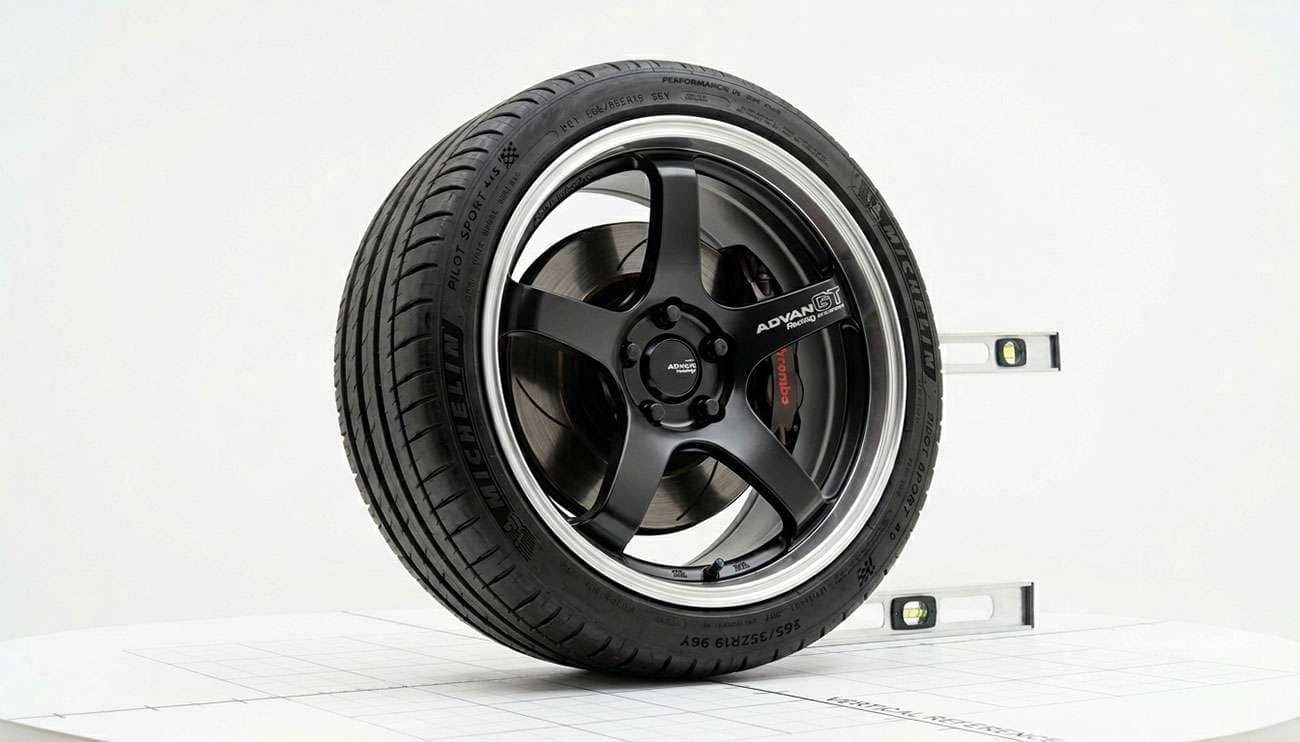
Camber, caster, and toe are the three alignment angles that decide how your car tracks down the road, how it behaves in a corner, and how evenly your tires wear. People tend to lump them together as "the alignment," but each one is measured on a different plane and does a completely different job. Mix them up and you'll chase the wrong symptom. So let's separate them cleanly, the way a tech reads them off the alignment rack.
If you only remember one thing from each, make it this:
Here's how they line up side by side:
Angle |
Viewed From |
What It Controls |
Main Symptom When Off |
|---|---|---|---|
Camber |
The front |
Cornering grip and how flat the contact patch sits |
Wear on the inside or outside tread edge |
Caster |
The side |
Steering stability, self-centering, and steering effort |
Wandering, pulling, or a steering wheel that won't return |
Toe |
Above |
Straight-line stability vs. turn-in response |
Rapid feathered wear across the tread |
All three are measured in degrees (toe is sometimes also expressed in inches or millimeters). Now the detail.
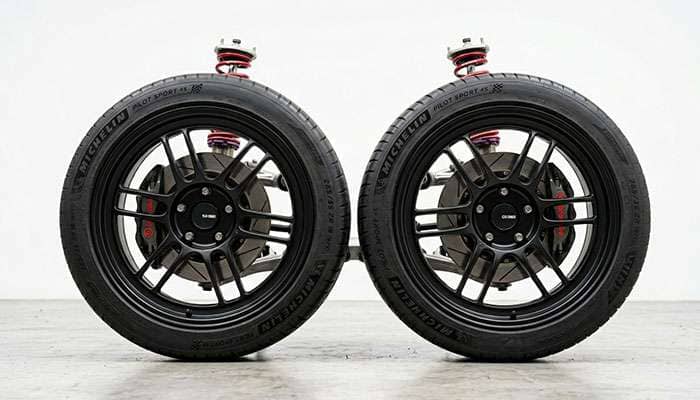
Stand in front of the car and look at a tire straight on. If the top of the wheel leans inward, toward the center of the car, that's negative camber. If the top leans outward, away from the car, that's positive camber. Perfectly vertical is zero.
Camber is about the contact patch, the section of tread actually touching the road. Under hard cornering the body rolls and the suspension compresses, which tends to lift the inside edge of the tread off the pavement. A little negative camber pre-tilts the wheel so that when the car loads up in a turn, the tread flattens out and grips. That's why most performance street setups run a mild amount of negative camber, often in the neighborhood of half a degree to a degree and a half, depending on the car.
The trade-off is wear and straight-line behavior. Too much negative camber rides on the inside edge of the tire during everyday straight driving and wears it prematurely, and it can make the car feel nervous. Positive camber, on the other hand, tends to wear the outside edge and is generally undesirable for handling, though some heavier or older vehicles used a touch of it for low-speed stability. If you want the full breakdown on this one angle alone, I went deep in our guide to wheel camber explained.
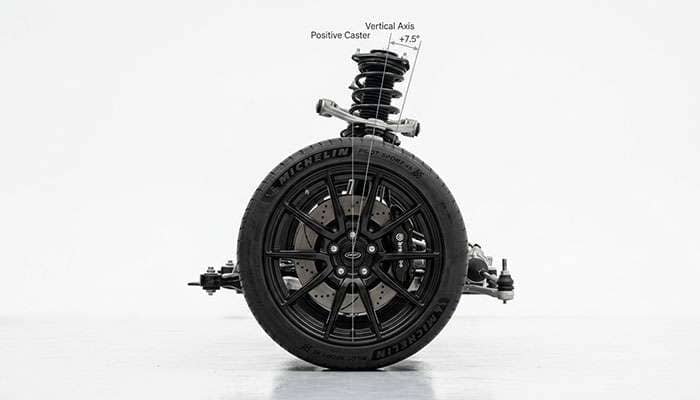
Caster is the one most people can't picture, because you have to look at the car from the side. It's the tilt of the steering axis, the imaginary line the wheel pivots around when you steer. If that line tilts rearward at the top, toward the driver, you have positive caster. If it tilts forward, that's negative caster.
The easiest way to feel caster is to picture the front fork of a bicycle, which is raked back. That rake is what lets you ride no-hands: the wheel naturally wants to track straight and recenter itself. Positive caster does the same thing for your car. It gives strong straight-line stability at speed and that self-centering effort you feel when the wheel returns to center after a turn. The cost is heavier steering, which is exactly why negative caster was more common on older cars before power steering made effort a non-issue.
Two things set caster apart from the other two angles. First, it's a steering-geometry setting, so it only applies to the wheels that steer, which on nearly every car means the front. Second, caster has very little direct effect on tire wear. When caster is off you feel it in the steering, wandering, pulling to one side, or a wheel that won't snap back to center, rather than seeing it on the tread.
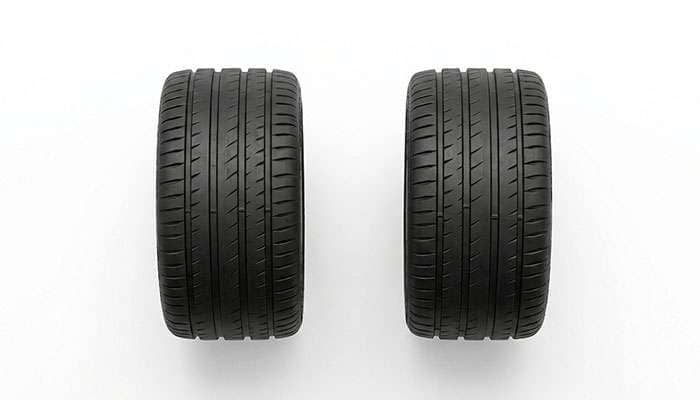
Now look straight down from above. Toe describes whether the front edges of the tires on an axle point toward each other or away. Toe-in means the front edges are closer together than the rears. Toe-out is the opposite, front edges farther apart. It's measured as the difference between those two distances, in degrees or as a fraction of an inch.
Toe is the stability-versus-response knob. A small amount of toe-in promotes straight-line stability and calms the car down, which is why most street vehicles run a bit of it. Toe-out sharpens turn-in and makes the car feel more eager to change direction, but it also makes it darty and twitchy, which is why you mostly see it on track-focused setups rather than daily drivers.
Here's the part that matters most: of the three angles, toe is the one that punishes your tires hardest. Even a small toe error means the tire is being dragged slightly sideways every foot you drive, and that scrubbing chews through tread fast, leaving a feathered, sawtooth pattern across the face. If you've ever wondered what tire feathering is, misadjusted toe is the usual culprit.
None of these angles operates in a vacuum. A good alignment balances all three to match how you actually drive. A street car prioritizes stability and even wear: modest negative camber, healthy positive caster, and a touch of toe-in. A track car leans the other way, more aggressive negative camber for cornering grip, more caster for steering feel, and sometimes toe-out up front for sharper response, accepting the faster tire wear that comes with it.
They also interact. More positive caster, for example, adds negative camber to the outside wheel as you turn the steering, which helps grip in corners without forcing you to run as much static negative camber everywhere else. That's the kind of trade-off a good alignment shop dials in on purpose, which is why "just set it to factory spec" and "set it up for autocross" produce very different numbers on the same car.
Because each angle lives on a different plane, the symptoms point in different directions:
The tread itself is the cheapest diagnostic tool you own. Reading it tells you which angle drifted, and our guide on how to read tire wear patterns walks through exactly what each pattern is telling you.
Get the angles checked if you notice any of the symptoms above, after you hit a serious pothole or curb, anytime you replace suspension or steering components, and as a matter of course when you mount a fresh set of tires so they start life wearing evenly. On that last point, see whether you need an alignment with new tires.
One clarification worth making, since the terms get blurred: alignment, rotation, and balancing are three separate services. Alignment sets these angles, rotation moves tires around to even out wear, and balancing corrects weight distribution to kill vibration. Our breakdown of alignment vs. rotation vs. balancing sorts out which one your car actually needs, and you can size up the bill in our look at wheel alignment cost.
The simplest way to keep them straight is by the view: front for camber, side for caster, top for toe. From there it's about what each one does for you. Camber buys you grip, caster buys you stability and steering feel, and toe is the balance point between calm and quick, while also being the angle that eats tires fastest when it's wrong. Get all three set to the right spec for how you drive, and your car tracks straight, turns the way you expect, and wears its tires evenly. That's the whole point of an alignment, and now you know which number is responsible for what.
They are three separate alignment angles measured on different planes. Camber is the inward or outward tilt of the wheel viewed from the front, caster is the forward or rearward tilt of the steering axis viewed from the side, and toe is whether the tires point in or out viewed from above. Camber affects cornering grip, caster affects steering stability, and toe affects straight-line stability and tire wear.
Toe is usually the worst offender. When toe is off, the tire is dragged slightly sideways with every rotation, scrubbing the tread and producing a feathered, sawtooth wear pattern. Even a small toe error can wear a tire out quickly. Camber causes wear too, but it shows up on one edge rather than across the whole tread.
For handling, a mild amount of negative camber is generally preferred because it keeps the contact patch flat during cornering and improves grip. Too much negative camber wears the inside edge and can make the car feel twitchy in a straight line. Positive camber tends to wear the outside edge and is usually undesirable for performance.
Caster controls steering stability and self-centering. Positive caster, where the steering axis tilts rearward at the top, gives strong straight-line stability and makes the steering wheel return to center after a turn, similar to the raked front fork of a bicycle. The trade-off is heavier steering effort. Caster applies to the steered (front) wheels and has little direct effect on tire wear.
It depends on the vehicle's suspension design. Toe is adjustable on virtually every car. Camber and caster are adjustable on many vehicles but are fixed by design on some, which may require aftermarket adjustable components to change. An alignment shop can tell you what your specific car allows.



