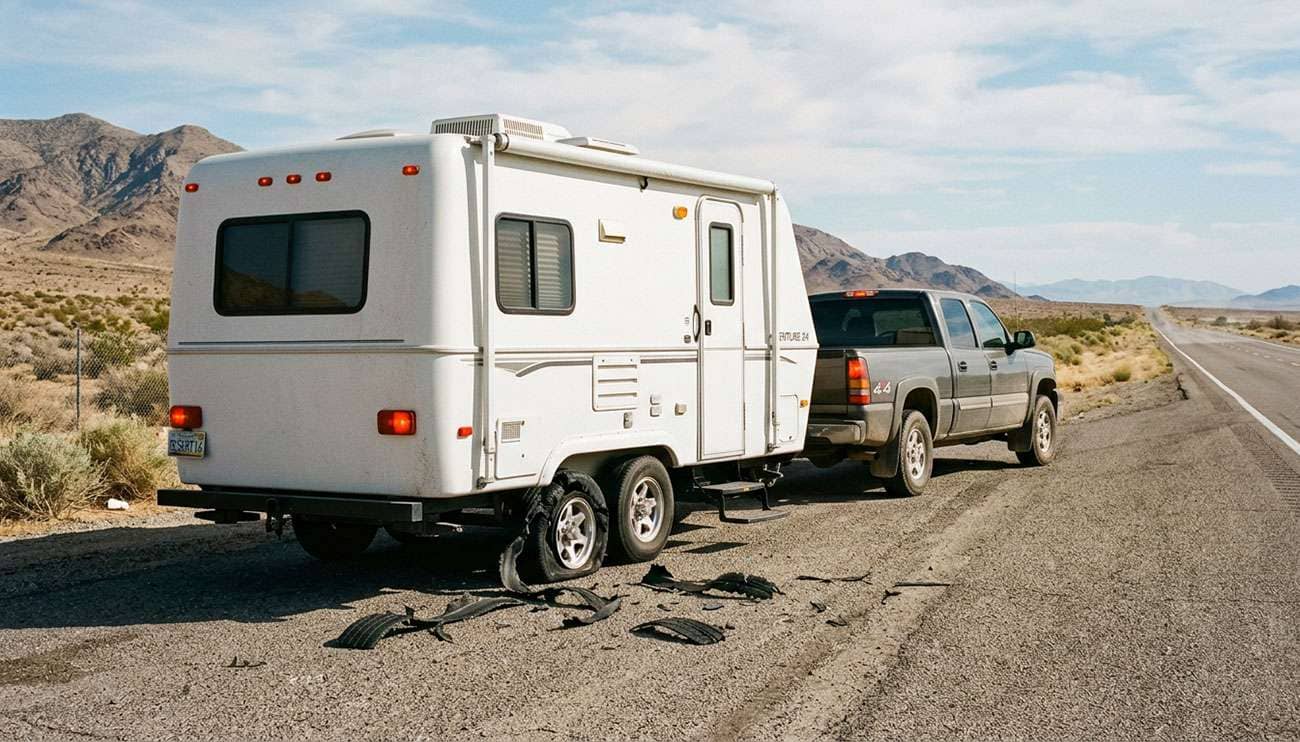
Trailer tires keep blowing out because three things stack up on them at once: they're run faster than their ST speed rating allows, they're sized with almost no load reserve, and they're carried at less air than their load range needs. Any one of those builds heat. All three together cook the belts loose. Most advice tells you to "check your pressure and don't overload it" and leaves it there. The part nobody puts in front of you is that the failed tire itself tells you which of the three got you, and the fix is different for each.
I'm Hank Feldman. I've been selling and mounting tires in Long Beach since 1971, and I've seen trailer tires come back in every condition you can picture: tread peeled off like an orange, sidewalls split clean around, two tires on the same side cooked while the other side looked brand new. Every one of those failures left evidence. Here's how to read it.
What the Failed Tire Shows |
Most Likely Cause |
What to Fix |
|---|---|---|
Tread separated from the casing, belts exposed, casing still mostly round |
Heat from speed above the ST rating |
Slow down or buy a higher speed rating |
Sidewall split or blown out around its circumference, dark rub marks inside |
Underinflation, the tire ran flexed and hot |
Run full sidewall pressure, add trailer TPMS |
Both tires on one side failing, other side fine |
Side-to-side load imbalance |
Re-balance cargo, weigh each side |
Rear axle tires failing on a tandem |
Trailer riding nose-high, rear axle overloaded |
Level the trailer at the hitch |
Fine cracks in sidewall and tread grooves, tread depth still good |
Age and UV damage |
Check the DOT date, replace aged tires |
Scuffed or feathered shoulders, uneven wear across the tread |
Alignment, bent axle, or tandem scrub |
Have the axles checked before new tires go on |
Once you know the cause, the next question is what to put back on. That depends on how fast you tow and how close to capacity you load.
How You Tow |
Minimum ST Speed Rating |
Load Range Target |
|---|---|---|
Under 65 mph, light load, short trips |
Any ST rating |
At least 15% capacity over axle load |
Interstate travel at 65 to 75 mph |
L (75 mph) |
One load range above factory, 20% reserve |
Long hauls with stretches over 75 mph |
M (81 mph) or N (87 mph) |
20% reserve or more |
Heavy fifth wheel, toy hauler, or equipment trailer near GVWR |
L or M |
Load Range E or higher, wheels rated to match |
Start with what an ST tire is. ST stands for Special Trailer, and it's built for a different job than the tire on your truck. It has a stiffer sidewall to resist sway and to handle the side-scrub of a tandem axle in a tight turn. It carries more load than a passenger tire of the same size. And it is not built for traction, steering, or braking, because a trailer tire doesn't do any of those things. If you want the full side-by-side, we covered it in trailer tires vs. car tires.
That stiff, heavy construction is exactly why heat is the enemy. A tire makes heat every time its sidewall flexes. Load, speed, and low pressure all increase that flexing. On a car, you'd feel the tire getting soft. On a trailer, you feel nothing. The tire can run hot and underinflated for 200 miles behind you and the first sign is a bang in the mirror.
There's one more thing working against you, and it starts at the factory. Federal Motor Vehicle Safety Standard 120, administered by NHTSA, requires that the combined load rating of a trailer's tires meet or exceed the axle's Gross Axle Weight Rating. Meet or exceed. Many trailer builders meet it and stop. That means the tires on a brand-new trailer are often sized to carry the trailer's full rated weight with very little margin left over. Load it to the limit, run it a little low on air, tow it a little fast, and you've used up a margin that was thin to begin with.
So when folks tell me their trailer "eats tires," I tell them the trailer isn't eating anything. The tires are being asked to work at 100% every mile, and a tire at 100% doesn't forgive anything.
This is the question that catches more people than any other, and the answer is printed on the tire if you know where to look. For years, ST tires carried a standard maximum speed of 65 mph under Tire and Rim Association standards. A lot of ST tires on the road today still carry no speed letter at all. If yours has no letter, treat 65 mph as the limit.
Newer ST tires usually carry a speed symbol right after the load index. Across the market, most ST radials are rated L or M, with a smaller group rated N. Here's what each letter means:
Speed Marking on an ST Tire |
Maximum Speed |
What It Means for Towing |
|---|---|---|
No letter |
65 mph |
Below most interstate speed limits. Slow down or replace. |
J |
62 mph |
Found on some bias-ply and specialty trailer tires. Local use. |
L |
75 mph |
The practical minimum for interstate towing. |
M |
81 mph |
Good margin for long highway runs. |
N |
87 mph |
Top of the ST range. Most headroom for heat. |
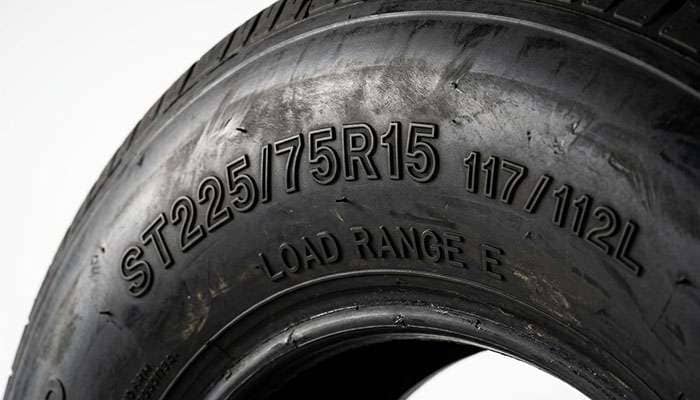
To find the marking, look for the load index and speed letter after the size, something like 117/112L or 120/116M. Our guide to the ST225/75R15 tire code breaks down every character in that string.
A speed rating isn't a promise that the tire stays round up to that speed and then falls apart. It's the speed the tire can sustain, at full rated load and full rated pressure, without building more heat than its construction can shed. Every mile per hour above that rating pushes the internal temperature up, and heat is what breaks down the bond between the rubber and the steel belts.
Run a 65 mph tire at 72 mph on a 95-degree afternoon, loaded to the limit, and you're stacking three heat sources at once. Summer is when we see the most trailer failures come through the door, and we explained why in how tires can blow out in high temperatures.
Some ST tire makers publish guidance for running an unmarked tire above 65 mph, usually adding pressure with no added load. That's their call for their tire, and you'll find it in their data book. My call is simpler: if you tow at 70, buy a tire rated for 75 or better and stop doing arithmetic on the shoulder.
Load reserve is the gap between what your tires are rated to carry and what they actually carry. That gap is your safety margin, and on most factory trailers it's thinner than people think.
Take a common setup: a tandem axle trailer with two 5,200-pound axles, for a 10,400-pound combined GAWR, riding on four ST225/75R15 Load Range E tires. Each tire is rated for 2,830 pounds at 80 psi.
Setup |
Total Tire Capacity |
Combined GAWR |
Reserve |
|---|---|---|---|
4 x ST225/75R15 Load Range E at 80 psi |
11,320 lb |
10,400 lb |
8.8% |
Same tires at 65 psi |
About 10,160 lb |
10,400 lb |
Negative. Overloaded at full GAWR. |
4 x ST235/80R16 Load Range E at 80 psi |
13,680 lb |
10,400 lb |
31.5% |
That first row is legal. It meets FMVSS 120. It also leaves less than 9% margin, and that's before you account for the fact that no trailer loads perfectly even. If one side of that trailer carries 55% of the weight, the tires on that side are already past their rating at full GAWR.
Here's my rule, and it's the one we use at the counter: aim for 15 to 20% more tire capacity than the weight on the axles. If your factory tires don't get you there, go up a load range in the same size, or go up a size if your wheels and fender clearance allow it. The bigger tire in that third row costs a little more and buys you a margin that actually forgives a hot day or a heavy load.
If load range and load index get tangled up in your head, read load range vs. load index. On a trailer tire, the load index is the weight number, and the load range tells you how much air it takes to reach it.
Your wheel has its own load rating and its own maximum pressure, usually stamped on the inside or printed on a label. A Load Range E tire needs 80 psi to carry its rated load. If your wheel is only rated for 65 psi, you can't legally run the tire at the pressure its capacity depends on. Upgrade the tires without checking the wheels and you've only moved the weak link. The Tire Industry Association's mounting guidance is clear on this: never inflate past the lower of the tire's or the wheel's maximum rating.
Run the maximum cold pressure molded on the sidewall, unless the tire manufacturer's load/inflation table tells you a lower pressure covers your actual weight. For most trailer owners, the simple answer is the right one: full sidewall pressure, checked cold, every trip.
Here's why that matters more on a trailer than on a car. A trailer tire's rated load is tied to its rated pressure. The load ranges share the same capacity tables up to each range's own pressure limit. So a Load Range E tire at 65 psi carries about what a Load Range D tire carries at 65 psi. You paid for an E, but at D pressure you get D capacity. In the table above, that 15 psi shortfall is the difference between a thin margin and an overloaded trailer.
A tire loses roughly 1 to 2 psi a month just sitting, and trailers sit a lot. Pressure also drops about 1 psi for every 10 degrees Fahrenheit the temperature falls. A trailer aired to 80 psi in August and hitched up in November can easily be sitting in the high 60s before it moves an inch.
Always check cold, before the trip, with the trailer sitting in the shade. A tire checked after an hour on the highway will read high from heat, and bleeding it down to the sidewall number leaves it underinflated once it cools. Never let air out of a hot tire.
Your truck has a TPMS. Your trailer almost certainly doesn't, unless you added one. An aftermarket trailer TPMS with valve-cap or internal sensors is the single best investment I know of for catching a slow leak before it becomes a blowout. It turns "I didn't feel a thing" into a warning on the dash.
When customers bring in a trailer that keeps losing tires on the same side or the same axle, I stop looking at the tires and start looking at the trailer. Repeat failures in one position almost always mean that position is carrying more than its share.
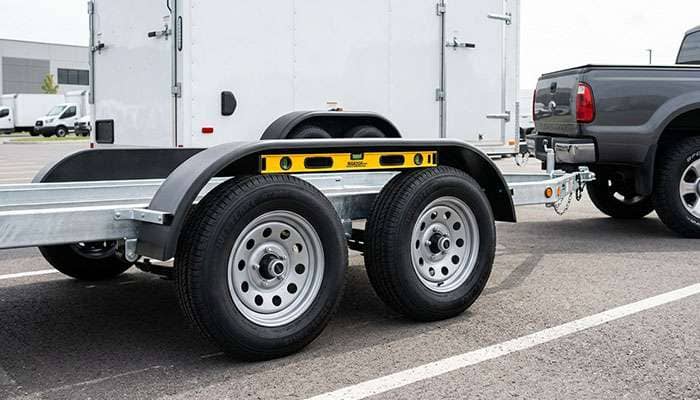
A tandem axle trailer is designed to sit level, with weight split evenly between the axles. Hitch it so the nose points up and the rear axle takes more of the load. Hitch it nose-down and the front axle gets it. A few inches of hitch height is all it takes to shift hundreds of pounds from one axle to the other. Put a level on the frame rail with the trailer hitched and loaded. If it isn't level, adjust the hitch drop or rise until it is.
Water tanks, generators, slide-outs, and kitchen cabinets on RVs are rarely centered. On cargo and equipment trailers, the heavy stuff tends to end up wherever it was easiest to strap down. Front-to-back balance matters too, and the 60/40 rule for trailers covers how to set it. The only way to know your side-to-side split for sure is to weigh each wheel position at a scale that offers it. Do it once with the trailer loaded the way you actually travel.
When a tandem trailer makes a tight turn, the tires can't roll around the corner the way steering wheels do. They drag sideways. That side-scrub twists the tread and loads the sidewall, which is part of why ST tires have stiff sidewalls in the first place. Repeated tight turns at fuel stations and campgrounds add up. If you see scuffed or feathered shoulders, have the axle alignment checked. A bent axle from a curb strike will chew through tires on that position no matter what you buy.
Trailer tires usually age out before they wear out. A trailer that covers 3,000 miles a year can sit on tires with plenty of tread for a decade, and that's where a lot of blowouts come from. Rubber breaks down from ozone, UV light, and heat cycles whether the tire is rolling or not. NHTSA has said plainly that tires degrade over time even when they're barely used.
Many ST tire manufacturers recommend replacing trailer tires every three to five years regardless of tread depth. To find your tires' age, read the last four digits of the DOT code on the sidewall. The first two are the week, the last two are the year. A tire stamped 2321 was built in the 23rd week of 2021. Our guide on how old trailer tires can be goes deeper on reading the code and what to look for.
Storage makes a difference. Tires sitting on the ground in the sun, carrying weight for months without moving, develop flat spots and crack faster. Tire covers, keeping the trailer on blocks or a hard surface instead of dirt, and moving it every few weeks all help. None of them stops the clock.
A trailer tire doesn't go from fine to failed in one step. It goes down a ladder, and the bill gets bigger on every rung.
Underinflation wears both shoulders. Overload on one side wears that side's tires faster. You lose tread life first, and you usually don't notice because nobody looks at trailer tires closely until something goes wrong.
Every tow in that condition builds heat inside the tire. The rubber that bonds the steel belts to the casing gets weaker every time it overheats. From the outside, the tire still looks fine.
Eventually the weakened structure starts to show. A bulge in the tread or sidewall, a wobble you can see from the truck mirror, or cracks near the bead. Any of those means the tire is done. Our guide on whether tire sidewall damage is safe to drive on walks through what each type of damage means.
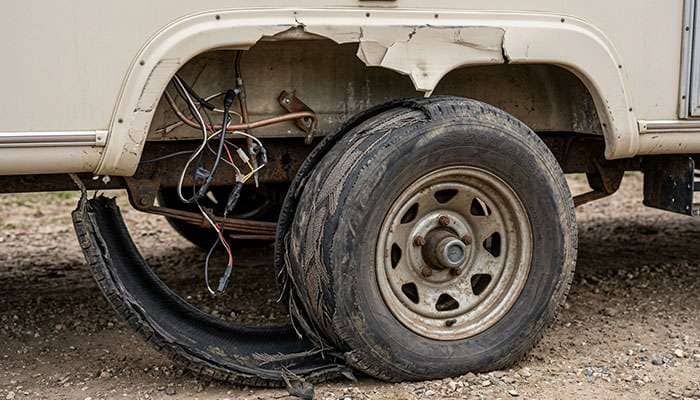
The tread lets go of the casing and starts flapping. A loose tread spinning at highway speed hits everything in the wheel well. On a travel trailer or fifth wheel, that means fender skirts, wiring for the brakes and lights, propane lines, fresh and gray water plumbing, and the underbelly. I've seen a single thrown tread do more damage to an RV than the tire, the wheel, and a set of four replacements cost combined.
When one tire on a tandem fails, the other tire on that side picks up its load instantly. If you keep towing to the next exit, you're running that remaining tire at roughly double its load. That's how one blowout becomes two. Pull over as soon as it's safe, every time.
At the bottom of the ladder, you're buying a set of four tires anyway. The only question is whether you buy them before the damage or after it.
This is the routine I give customers at the counter. Do it in this order and you'll stop the cycle.
When it's time to replace them, our trailer tires section lets you sort by load range and speed rating, so you can match the tire to the way you actually tow.
Trailer tires don't blow out because they're cursed or because trailers are hard on rubber. They blow out because they're asked to work at the edge of their speed rating, their load rating, and their pressure rating all at once, with no driver feel to warn you when one of those slips. Speed, load reserve, and inflation are the three dials. Turn any one of them the wrong way and you get heat. Turn all three and you get the bang in the mirror.
Read the tire that failed. It tells you which dial got you. Fix the trailer, buy the speed rating you actually need, size the tires with real margin, and keep them aired up cold. Do that and your next trip ends at the campground instead of on the shoulder.
Most repeat trailer tire blowouts come from heat caused by three things: towing faster than the ST tire's speed rating, carrying loads that leave little or no capacity reserve, and running less air than the tire's load range needs. If failures keep happening in the same position, check whether the trailer is level, evenly loaded, and free of axle damage.
ST tires with no speed letter on the sidewall are limited to 65 mph. Newer ST tires carry a speed symbol after the load index: L means 75 mph, M means 81 mph, and N means 87 mph. For interstate towing, choose L or higher.
For most trailers, yes. Trailer tire load capacity is tied to pressure, so running the maximum cold pressure on the sidewall gives you the full rated capacity. Check pressure cold, before driving, and never exceed the maximum pressure rating of your wheels.
Aim for 15 to 20% more total tire capacity than the weight on your trailer's axles. Federal rules only require tire capacity to equal the axle rating, so many factory trailers leave less than 10% reserve. Going up one load range or one tire size usually closes the gap.
Many ST tire manufacturers recommend replacing trailer tires every three to five years, even if the tread still looks good. Rubber breaks down from UV, ozone, and heat over time. Check the last four digits of the DOT code to find the week and year the tire was built.
Hot pavement and high air temperatures add to the heat a tire already builds from load, speed, and sidewall flex. Summer is also peak towing season, with heavier loads and longer highway runs. A tire that was barely within its limits in cool weather can cross the line on a 100-degree day.