
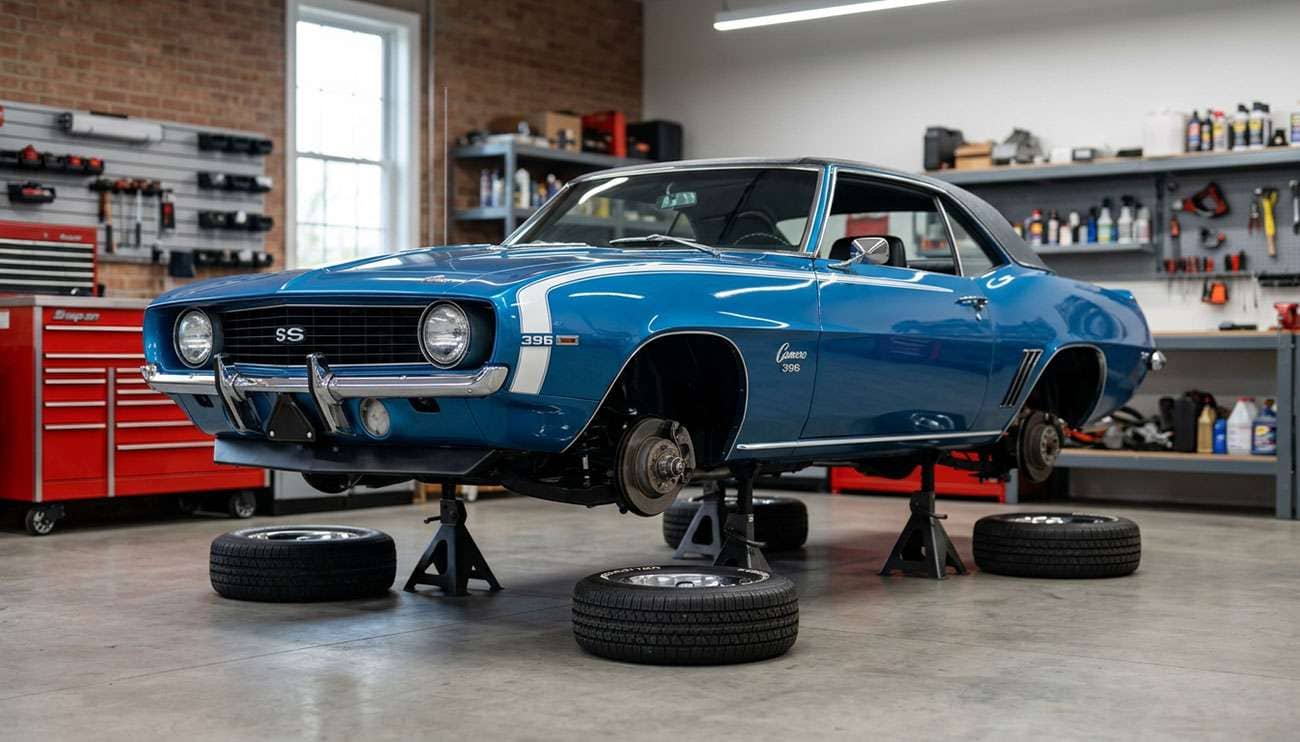
A fellow rolled his '69 Camaro into the shop a few springs back, face like a thundercloud. He'd tucked the car away all winter, pulled it out on the first warm weekend, got a quarter-mile down the road and thought the driveshaft had come apart. Thump, thump, thump, like somebody was hammering on the floorboards from underneath. Steering wheel shaking bad enough to blur his reflection in the mirror. He was convinced something major had let go.
Nothing had let go. His tires had flat spotted. The car had sat on the same four patches of rubber for four months in an unheated garage, and when he finally got her rolling again, the tires remembered exactly where they'd been. Happens every spring around here. Happens to brand-new tires and it happens to old ones, and most folks never see it coming.
I've been dealing with flat spots since the disco era, and the good news is they're preventable, and the better news is most of them aren't even permanent if you catch them early. The bad news is that if you ignore them — or store your car wrong year after year — you'll be buying new rubber you didn't need to buy. Let me walk you through what's happening inside that tire, why it happens, and the seven things I tell every customer with a weekend car or a seasonal driver.
Here's the simple version. A tire isn't a solid piece of rubber. It's a layered sandwich — rubber compounds on the outside, steel belts for shape, and underneath the tread on most modern tires, a thin nylon cap layer that holds the whole thing round at highway speeds. When you're driving, each tire rotates through a loaded state and a relaxed state roughly 480 times per kilometer. All that flexing generates heat, and that heat keeps the rubber and the nylon supple and cooperative.
Park the car, though, and the picture changes fast. Gravity doesn't take time off. The weight of the vehicle pushes down on whatever patch of tire happens to be touching the ground, and that patch flattens a little — same way the soles of your feet flatten when you stand in one place too long. Drive away five minutes later and you'd never know. But leave it there overnight in forty-degree weather? Leave it there a month? Leave it there all winter on a cold concrete slab? The nylon cap remembers. The rubber compound takes a set. And when you finally roll the car, it's no longer a perfect circle — it's a circle with a little flat patch in four different places, hitting the ground sixty or seventy times a mile.
That's a flat spot. It's not a wear pattern, it's not a balance problem, and it's not something a tire shop did wrong. It's geometry and rubber chemistry, and every tire on every car is subject to it.
This is the question I get most, and the honest answer is it depends. Here's the rule of thumb I've been giving folks for decades.
Performance tires, summer compounds, and low-profile rubber can develop temporary flat spots overnight if the temperature drops hard enough. A Porsche or a Corvette parked outside a hotel on a cold February night might thump for the first ten minutes of the drive home the next morning. By the time the tires heat up at highway speed, the ride smooths right out.
Regular all-season tires on a typical daily driver are a lot more forgiving. A week of vacation in the airport parking lot won't hurt them. Two or three weeks of sitting, you might feel a shimmy for the first few miles. The trouble starts around the thirty-day mark — that's when the industry says severe flat spotting can set in. A month of immobility is enough to cause real problems if the other conditions line up against you.
What other conditions? Cold temperatures. Low tire pressure. Heavy vehicles. Concrete floors instead of asphalt or dirt. High-performance rubber compounds. Any one of those stacks the deck. Two or three of them together, and you're looking at flat spots that won't simply drive out.
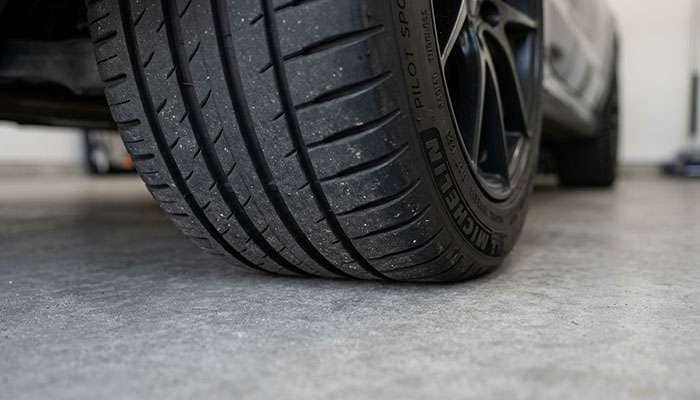
Not all flat spots are created equal. I sort them into three buckets, and the bucket a tire lands in decides whether you keep it or replace it.
These are the common ones. A car sits a few days to a few weeks, the rubber takes a mild set, and the first few miles feel bumpy or shimmy at certain speeds. Twenty minutes at highway speed usually brings the tires back around — the rotation generates heat, the heat softens the rubber, the centrifugal force pulls them back to round. If the thump is gone by the time you hit the second stoplight, you had a temporary flat spot and you don't owe anybody a dime.
These come from longer sits — a month or more under vehicle load, especially in cold or wet storage. The rubber compound has taken a deeper set. Normal driving will usually work them out, but it takes hours of highway time, not minutes. You might notice the ride improves after a road trip, or you might find you're chasing a vibration for weeks. A shop can check whether the tires are out of round by spinning them on a balancer — if the runout is bad, you're looking at semi-permanent.
These are the ones that send you tire shopping. Permanent flat spotting happens when tires sit loaded, underinflated, and in high heat for months — or when they're bias-ply tires that sat all winter on a cold slab, or when someone locked up the brakes at speed and ground the tread flat in one spot. Once the internal cords or the nylon cap layer have physically deformed past the point of recovery, no amount of driving is going to straighten them out. If I've got a customer still feeling a vibration after 25 highway miles, I'm telling him to start looking at new rubber.
If you daily a sedan you don't need to read this section too closely. But if you've got a weekend cruiser, a show car, a vintage pickup, or anything that spends more time sitting than rolling — this is the part that matters most.
Most American cars built before 1976 rolled off the line on bias-ply tires. Bias-ply construction uses cords that run at an angle across the tire, which gives it strength and that classic period-correct sidewall profile. It also makes bias-ply tires far more prone to flat spotting than modern radials. The cord angle means the sidewall doesn't flex independently of the tread — the whole tire takes a set as one unit. If you want the deep dive on that construction difference, we covered it in our bias-ply vs. radial tires for classic cars breakdown.
Stack that construction reality on top of the way classic cars actually live their lives — tucked away six months a year, parked on cold concrete, period-correct tires that cost three times what a modern all-season costs — and you've got the perfect recipe for flat spots. I've seen '68 Mustangs with fifty original miles on their Redlines come out of storage with flat spots so bad the tires had to be tossed. Heart-breaker when you paid $400 a corner for the right look.
Modern radial classic-style tires solve a lot of this. The American Classic Bias Look Radial line, for instance, gives you the period-correct narrow whitewall profile and the authentic vintage sidewall, but with modern radial construction underneath. They still flat spot if you abuse the storage, but nowhere near as aggressively as true bias-ply. For most classic owners who actually drive their cars a few thousand miles a year, a radial with the right look is the smart compromise.
You don't need a tire gauge or a technician to spot the signs. Your car will tell you within the first mile.
The rhythmic thump. This is the dead giveaway. A flat spot hits the pavement once per rotation, so you feel a steady thump-thump-thump that speeds up as you accelerate and slows down as you brake. It doesn't sound like a cupped tire (that's more of a hum) and it doesn't sound like a bent wheel (that's faster and higher-pitched). It sounds like somebody tapping on the underside of your car in 4/4 time.
Steering wheel shimmy. Flat spots on the front tires will show up in the wheel, usually worst between 35 and 55 mph. Flat spots on the rears will show up in the seat. If both ends are flat-spotted, welcome to a vibration that'll rattle your molars until the rubber warms up. There are plenty of other reasons for a shimmy — bent rims, bad balance, worn tie rod ends — so if the thumping doesn't fade after 20 highway minutes, read through our guide on steering wheel vibration to narrow down what's actually going on.
Visible deformation. If the car's been sitting long enough and the flat spot is severe enough, you can see it. Get down on your knees and look across the tread. A normal tire curves evenly around the rim. A flat-spotted tire has a distinct flat patch on the section that was touching the floor. Bias-ply flat spots are often visible. Modern radial flat spots usually aren't — they're felt more than seen.
Pulling or drift. Bad flat spotting can throw the whole balance of the vehicle off enough that the car pulls gently to one side. Usually this is the front tire with the worst flat spot dragging you that direction. Pulls usually fade with the thumping.
Here's what I tell every customer who parks a car for more than a couple of weeks. Work through this list top to bottom — most folks need three or four of these, not all seven.
Simplest and cheapest solution there is. If you can get the car out of the garage every two weeks for a 20-minute drive at highway speeds, you'll never see a flat spot. You're rotating the load point, warming the rubber, and redistributing the compounds. This is the old-timer's answer and it still works. Won't help you if you're deployed, snowed in, or the car is in long-term storage, but for seasonal weekenders it's the best medicine.
This one surprises people. Before you park the car for the winter or a long trip, bump the cold pressure up 5 to 10 PSI above your normal setting. Higher pressure means less sidewall flex at the contact patch, which means a smaller flat area bearing the car's weight. The rubber compound resists setting when it's not being squished as hard. Just don't exceed the max cold inflation pressure stamped on the sidewall — that's a hard ceiling, not a suggestion. Not sure what you normally run? Look at the door jamb placard or check our write-up on how to find your recommended tire pressure.
Tire cradles — FlatStoppers and Race Ramps are the name brands — are contoured pads that hold the contact patch in a curve instead of a flat. You drive the car onto them, shut it off, and the tire's load is distributed across the whole curved face of the cradle instead of pressing flat against the floor. They're my second-favorite solution after driving the car, and for a garage queen that sits all winter, they're worth every penny. Figure around $150-$200 for a set of four good ones. Buy them once, use them forever.
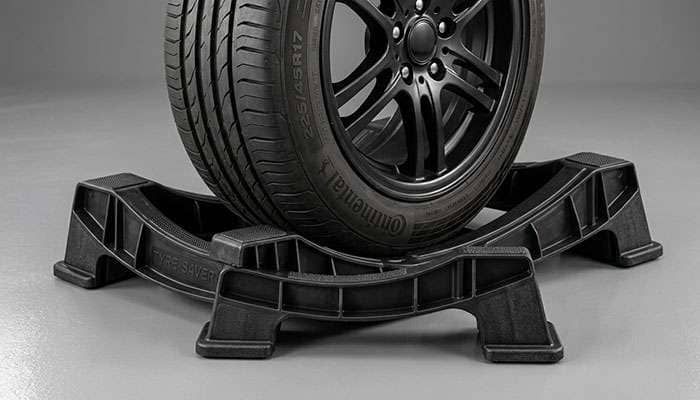
The budget version of tire cradles. Head to a flooring store and ask for carpet sample squares — the thick, dense stuff. Stack two or three under each tire. Alternatively, 2-inch rigid foam insulation board from the home improvement store, cut to fit, gives you roughly the same cushioning effect. You're not getting the contoured-cradle benefit, but you're putting soft, compressible material between the tire and the cold concrete slab, which buys you some protection. Works fine for tires that aren't your forever-tires.
Putting the car on jack stands takes all the weight off the tires, which completely prevents flat spots. Sounds perfect, right? There's a catch. Suspensions aren't designed to hang at full droop for months on end. You can stretch shocks, tear CV boots, damage leaf spring shackles, and put weird stress on the frame at the jack points. If you're going to go this route, use four jack stands, one under each suspension point (not the pinch welds), and put a few wooden shims under the control arms to keep the suspension close to its normal ride height. And be extremely careful — a car on jack stands is less stable than a car on its tires, and you do not want that thing coming down on you or anyone else.
Cold is enemy number one for flat spotting. If you can store the car in a climate-controlled space — even just a heated garage that keeps above 45 degrees — you're doing the rubber a huge favor. If climate control isn't in the budget, at least keep the car off a cold slab. A couple of layers of plywood, or the carpet/foam trick from step 4, insulates the tires from the ground temperature. Keep the car out of direct sunlight through a window, too, because UV exposure speeds up rubber aging, which is a whole other problem — one we break down in our tire dry rot guide.
Even in storage, tires lose a little air. Cold weather drops pressure by about 1 PSI per 10 degrees of temperature drop. An underinflated tire flat-spots way faster than a properly inflated one, so if you set your tires at +10 PSI in October and don't check them again until April, you might find they've drifted back down to normal — or worse, below normal — right when you needed the cushion. Put a reminder on your calendar for the first of every month during storage season. Takes two minutes per tire.
So the damage is already done. Now what?
First, just drive. Most flat spots, especially on modern radials, will work themselves out with 20 to 30 minutes of highway driving. The friction and rotation heat up the rubber, the nylon cap softens, and the compound returns to round. If the thumping is fading as you drive, you're in good shape. Keep going.
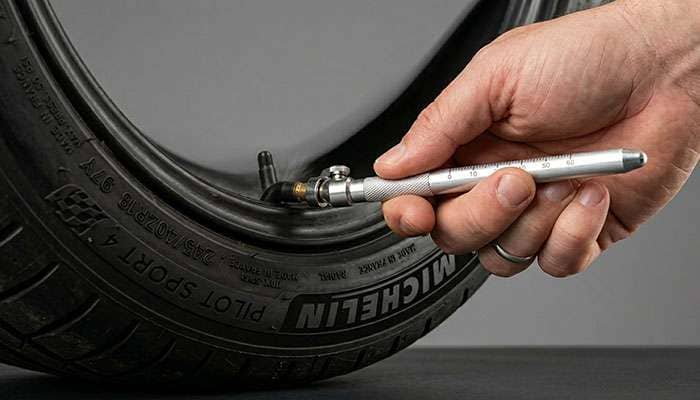
Second, goose the pressure temporarily. If you know the tires are flat-spotted and you want to help them along, bump the pressure up 5 PSI above placard (not above the max sidewall pressure) and take a long highway run. The extra pressure and the heat work together to pull the tire back round. Drop the pressure back to spec when you get home.
Third, get them balanced. If the thump is gone but a subtle vibration remains, chances are one or more tires came out of the ordeal slightly out of round. A good tire shop with a road-force balancer can identify which tire is the problem and, often, correct for it by rotating the tire on the wheel or by fine-tuning the balance weights.
Fourth, if 25 miles of highway didn't fix it — replace. I know nobody wants to hear this, especially if you've got $1,600 worth of period-correct rubber on a classic. But a permanently flat-spotted tire will vibrate forever, it'll wear unevenly, and eventually the cord damage can lead to a belt separation or a blowout. For a classic car daily driver that's aging out anyway, use this as the excuse to check the date codes and think about fresh rubber. Our guide on how to read DOT tire date codes walks you through reading the manufacturing date off the sidewall, and if you're driving a classic, our checklist on when classic car tires should be replaced covers the full decision tree.
If your car is a weekend-only or seasonal driver, you want rubber that's engineered to take abuse from sitting. Here's what I recommend at the shop:
Tire |
Best For |
Why It Works for Sitting Cars |
|---|---|---|
Classic muscle, hot rods, restomods |
Period-correct vintage look with modern radial construction that resists flat spotting far better than true bias-ply rubber |
|
1940s-1960s cruisers, show cars |
Authentic whitewall styling without the bias-ply flat-spotting penalty that plagues true vintage rubber |
|
Modern daily drivers that sit weeks at a time |
Long-life compound designed for durability over miles and calendar years alike — handles extended parking with minimal setting |
|
Budget-conscious weekend drivers |
Stout construction and proven compound at a friendlier price point — solid pick for a second car that spends weeks in the garage |
Lifespan matters too when you're buying tires for a car that sits. Rubber ages whether you're driving or not, and there's no point in spending big on rubber that's going to dry-rot before you wear it out. Our breakdown on the lifespan of a tire covers the six-to-ten-year window most tire makers recommend — worth reading before you drop money on a fresh set.
Flat spots are one of those problems that looks terrifying the first time it happens and turns out to be an easy fix most of the time. The thump-thump-thump of a freshly unparked classic is one of the most common calls I get every spring, and nine times out of ten the customer is back on the road by lunchtime with nothing but a gas bill to show for it.
The key is staying ahead of it. Drive the car every couple of weeks if you can. Bump the pressure before long storage. Get some cradles or some carpet under those tires if the car's going to sleep through winter. And don't cheap out on tires for a car that sits — radial construction, fresh rubber, and decent compounds buy you a whole lot of peace of mind. That fella with the '69 Camaro I mentioned at the start? He's got cradles now. Haven't had a complaint out of him in five seasons.
If you're shopping for rubber that'll handle the storage life, come see us at Performance Plus Tire. We stock the classic car radials, the modern daily-driver options, and everything in between, and we'll point you toward the right compound for how you actually use the car — not how a catalog says you should.
Performance tires in cold temperatures can flat spot overnight. Most all-season tires handle a week or two of parking without issue but start showing noticeable flat spots around the 30-day mark. A full month of immobility on cold concrete is typically when severe flat spotting sets in, especially on underinflated tires or bias-ply construction.
Most flat spots are temporary and disappear after 15 to 30 minutes of highway driving, as tire rotation generates heat that softens the rubber and pulls it back to round. Semi-permanent flat spots may need hours of driving or a tire shop road-force balance. Permanent flat spots cannot be repaired and require tire replacement.
Over-inflate the tires by 5 to 10 PSI above normal cold pressure before parking, never exceeding the max sidewall pressure. Use tire cradles, carpet squares, or rigid foam insulation between the tires and the floor. Drive the car for 20 minutes every two weeks if possible. Check pressure monthly during storage.
Yes. American cars built before 1976 typically used bias-ply tires, whose angled cord construction makes them far more prone to flat spotting than modern radials. Combined with long winter storage on cold concrete slabs and period-correct tire compounds, classic cars face the perfect storm for flat spots. Modern radial classic-style tires solve most of the problem while preserving the vintage look.
Temporary flat spots are safe to drive on — the vibration will fade as the tires warm up. Semi-permanent flat spots are generally safe but uncomfortable and can stress suspension components. Permanent flat spots are a safety concern because the internal cord damage can lead to belt separation or blowouts, and they should be replaced rather than driven on long-term.
Jack stands prevent flat spots entirely by removing weight from the tires, but letting the suspension hang at full droop for months can damage shocks, CV boots, and leaf spring shackles. If you use this method, place jack stands under the suspension points and add wooden shims under the control arms to keep the suspension near ride height. Tire cradles are safer for most owners.



