
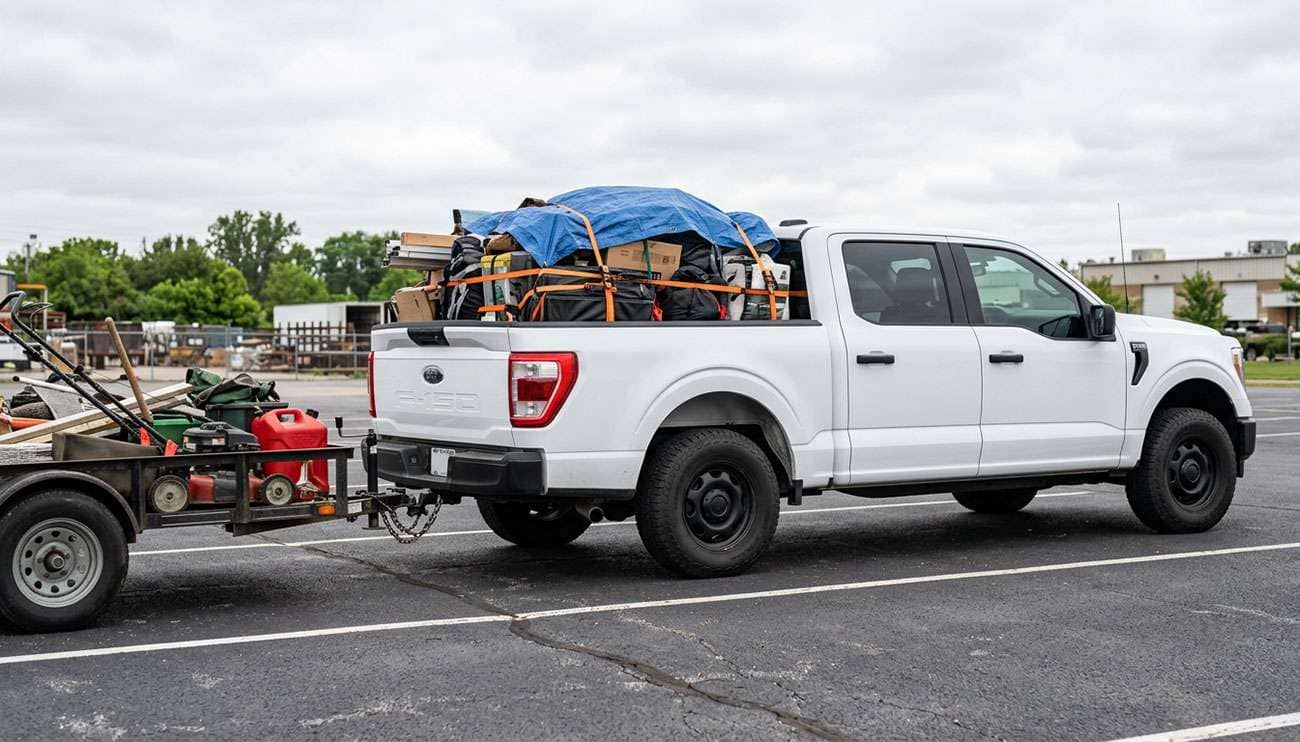
Nearly every driver who worries about overloading checks the wrong number. They find the Gross Vehicle Weight Rating on the door jamb, add up what they think is in the truck, come in a few hundred pounds under, and stop worrying. The math is fine. The number is wrong.
GVWR is a total. It says nothing about where that total sits. A three-quarter-ton pickup can run 900 pounds under GVWR and still be 600 pounds over its rear Gross Axle Weight Rating, because a fifth-wheel pin, a slide-in camper, or a bed full of gravel does not distribute itself politely across both axles. It lands almost entirely behind the cab. Meanwhile the front axle sits thousands of pounds under its own rating, quietly making the total look healthy.
The rear axle is where trucks actually run out of capacity, and the rear tires are the component that fails first when it happens. This guide works through the six load configurations that put a truck over the rear limit, shows you which of three separate ratings binds first in each one, and gives you the scale procedure to confirm it. The decision table below is the short version.
Load Configuration |
Where the Weight Lands |
Which Limit Usually Binds First |
|---|---|---|
Empty truck, heavy accessories |
Split, often front-biased |
Front GAWR |
Cargo in the bed |
Rear, some ahead of axle |
Rear GAWR |
Bumper-pull trailer |
Behind rear axle, leveraged |
Rear GAWR |
Weight-distributing hitch |
Shifted partly forward |
Varies, often GVWR |
Fifth-wheel or gooseneck |
Directly over rear axle |
Rear GAWR |
Slide-in truck camper |
Rear, much behind axle |
Rear tire capacity |
Your truck does not have one rear capacity. It has three, and your real ceiling is whichever of them is lowest.
The rear Gross Axle Weight Rating. This is the manufacturer's limit for the entire rear corner of the vehicle, assigned under the certification requirements in 49 CFR Part 567 and printed on the label inside the driver's door frame. It is not the strength of the axle shaft alone. It reflects the weakest link in the whole assembly, including the springs, the bearings, the brakes, the wheels, and the tires the truck was delivered on. That last point catches people out. Changing one component does not raise the rating.
Twice your rear tire's load capacity. Each tire carries a load index, and that index converts to a specific weight. A load index of 121 means 3,197 pounds per tire. An index of 126 means 3,748 pounds. Two of those tires under the rear axle give you a combined figure, and if that figure is lower than your rear GAWR, the tires are your limit rather than the axle. If you are unclear on how the index relates to the letter on the sidewall, our breakdown of load range vs load index separates the two properly.
Your wheel's load rating. Wheels carry their own stamped maximum, and aftermarket wheels frequently carry a lower one than the factory steel or aluminum they replaced. A wheel rated at 2,500 pounds under a tire rated at 3,858 pounds means your real per-corner ceiling is 2,500. This gets overlooked constantly on lifted trucks running large-diameter aftermarket wheels. Our wheel load rating guide covers where to find the stamp and what it means.
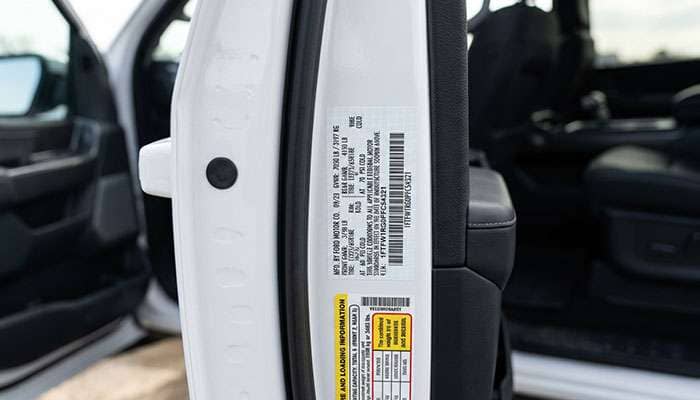
Write all three down before you load anything. The lowest number is the one that matters, and for a surprising number of trucks it is not the one on the door jamb.
An unloaded truck is the one case where the front axle usually binds first. A steel replacement bumper, a winch and mounting plate, and a skid plate package can add 300 pounds or more entirely ahead of the front axle centerline, and the front GAWR on a half-ton pickup is often only a few hundred pounds above its curb weight at that corner.
The rear axle in this configuration is typically running at forty to fifty percent of its rating. A bed cover, a bed rack, and a toolbox add weight behind the cab but rarely enough to matter on their own.
What this case does is set your starting point. Every pound of accessory weight is a pound you cannot use for cargo later, and most people never subtract it. They quote the payload figure from the window sticker of a base-trim truck and forget that their own truck left the lot 400 pounds heavier. Weigh the truck empty, fueled, with the accessories installed and the gear you always carry. That is your real curb weight, and every calculation from here starts there.
Bed cargo is the most forgiving of the loaded cases, because a pickup bed straddles the rear axle. Roughly the front third of the bed sits ahead of the axle centerline, which means weight placed against the bulkhead transfers a meaningful share to the front axle instead of piling onto the rear.
The distribution is not even, though. A load centered in the middle of the bed puts something like eighty percent of its weight on the rear axle and twenty percent on the front. Push that same load to the tailgate and the rear share climbs past one hundred percent, because the load is now levering weight off the front axle. That is the light-steering sensation people describe when a truck feels vague and floaty with a heavy load in the back.
Dense materials are where this bites. A yard of wet gravel runs roughly 3,000 pounds and occupies a fraction of the bed. Bagged concrete, roofing bundles, and firewood all reach the rear GAWR long before they reach the top of the bed rails. Available space is not available capacity.
Load heavy items forward and low, against the bulkhead, and secure them so they cannot shift rearward under braking.
A conventional receiver hitch places the trailer's tongue weight behind the rear axle, and that position turns it into a lever. Ten to fifteen percent of the trailer's loaded weight lands on the ball, which is the range the industry recommends for stability. On a 7,000 pound trailer that is 700 to 1,050 pounds of tongue weight.
But the rear axle does not receive only that tongue weight. Because the ball sits two to four feet behind the axle centerline, the load pivots the truck. The rear axle picks up more than the tongue weight while the front axle loses several hundred pounds. A 900 pound tongue can easily add 1,100 pounds or more to the rear axle and remove 200 pounds from the front.
This is the case where people are most often surprised by a scale ticket. The trailer is within tow rating, the truck is under GVWR, and the rear axle is over. Reducing tongue weight below the recommended range is not the fix, because too little tongue weight causes trailer sway. The fix is either less total trailer weight, better trailer load distribution over its own axles, or the equipment in the next section.
A weight-distributing hitch uses spring bars under tension to apply a counteracting moment through the hitch head, transferring part of the tongue load forward to the truck's front axle and back to the trailer's axles. Properly set up, it restores most or all of the front axle weight the trailer removed and reduces the rear axle load.
The important thing to understand is that it moves weight; it does not delete it. The total is unchanged, so your GVWR figure does not improve at all. What changes is the distribution, which is exactly what you want when the rear axle is your binding constraint and the front has room.
Setup matters more than the hardware. An under-tensioned bar transfers almost nothing. An over-tensioned bar unloads the rear axle too far, which reduces rear traction and can make the truck feel unsettled. The standard method is to measure the front fender height unhitched, then adjust bar tension until the hitched front fender height returns to within a fraction of an inch of that unhitched measurement. Verify the result on a scale rather than by eye.
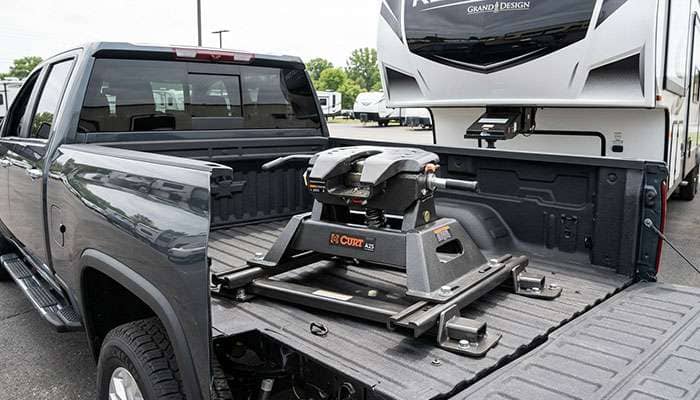
Fifth-wheel and gooseneck couplings place the load in the bed, ahead of or directly over the rear axle. That position is far more stable than a bumper pull, and it eliminates the leverage problem, because the load is not hanging off the back of the truck.
The tradeoff is magnitude. Pin weight on a fifth-wheel typically runs fifteen to twenty-five percent of the loaded trailer weight, against ten to fifteen for a bumper pull. On a 14,000 pound fifth-wheel that is 2,100 to 3,500 pounds landing on the truck, essentially all of it on the rear axle. Add the hitch hardware itself, which runs 150 to 250 pounds, and passengers, and a truck that started with 3,000 pounds of rear capacity headroom does not have much left.
There is no weight-distributing equivalent here. You cannot redistribute a fifth-wheel pin load forward, because it is already sitting where it needs to be for stability. If the rear axle is over, the only remedies are a lighter trailer, less cargo in the trailer's forward compartments, or a truck with a higher rating. This is the single most common reason people move from a three-quarter-ton to a one-ton, and dual rear wheels exist specifically to raise the rear tire capacity component of the three-number stack.
A slide-in camper is the case where the tires, not the axle, usually run out first, and it is the configuration most likely to be dangerously over without the driver knowing.
Campers are heavy, they sit high, and a substantial portion of the mass sits behind the rear axle in the overhang. A dry camper weight of 2,800 pounds becomes 3,600 pounds or more once you add water, propane, batteries, and gear. Because of the rearward center of gravity, the rear axle can receive more than the camper's total weight while the front axle sheds several hundred pounds.
The high center of gravity also introduces lateral load transfer that a bed full of gravel never does. In a crosswind or an emergency lane change, the outside rear tire momentarily carries considerably more than half the axle load. A tire that is at ninety-five percent of its rated capacity on a static scale can exceed that rating during a dynamic event, which is why campers are so hard on rear tires and why sidewall failures on camper rigs are disproportionately common.
If you run a slide-in camper, treat your rear tire capacity as the governing number and build in real margin. Ninety percent of the rating on a static scale is not conservative for this application.
Here is the detail that almost no capacity discussion mentions, and it changes the arithmetic for most trucks on the road.
A tire's load index describes what it can carry at a specific inflation pressure, and that pressure is the maximum stamped on the sidewall. A load range E light-truck tire earning 3,197 pounds at load index 121 earns that figure at 80 PSI. It does not carry 3,197 pounds at 55 PSI. Load-carrying capacity is a function of the air inside the tire, not the letter on the sidewall, and it falls off substantially as pressure drops.
The Tire and Rim Association publishes the load-inflation tables that define this relationship, and every major manufacturer publishes its own version for its light-truck lines. Run the pressure down and you walk down the table. A tire operating well below its maximum pressure can be carrying meaningfully less than its headline number, which means a truck that looks fine against a load index chart can be over its actual tire capacity while every sticker and spec sheet says otherwise.
This matters most for people who lowered their pressures for ride comfort. An empty three-quarter-ton on 80 PSI rear tires rides harshly, so drivers drop to 50 or 55 PSI and forget to raise it before loading. The tire is then asked to carry a heavy load at a pressure that does not support it. Our guide to tire E load rating and what it means for your weight limit covers the sidewall side of this in more depth.
There is a related trap in tire selection. If your truck came with LT-metric tires and you replaced them with P-metric passenger tires in the same size, the capacity does not carry over one for one. When a P-metric tire is fitted to a truck, van, or SUV, its rated capacity is reduced by a divisor to account for the different service conditions. The number on the sidewall is not the number you get. The differences are laid out in our comparison of P-metric vs LT tires.
The practical rule: find the load-inflation table for your specific tire, locate your actual cold pressure, and use the capacity listed at that pressure. Then double it for the axle. That is your real rear tire number, and it belongs in the three-number stack instead of the headline figure.
The most honest thing to say about a modest overload is that nothing happens immediately. That is precisely the problem. There is no warning light for exceeding rear GAWR, and a truck ten percent over feels heavy rather than broken. The damage is cumulative, and it proceeds in a predictable order.
Heat, first and always. An overloaded tire deflects more than it was designed to on every revolution. That extra flexing converts to heat in the sidewall and belt package. Heat is what degrades the adhesion between a tire's internal components, and the process is cumulative rather than self-correcting. A tire does not recover from a hot afternoon towing over a mountain pass; it simply has less life left.
Accelerated and irregular wear. Overloaded rear tires wear faster and often unevenly, because the contact patch distorts under a load the construction was not designed to support. Shoulder wear is the common pattern.
Sidewall degradation. Repeated over-deflection works the sidewall, and sidewall damage on a load-carrying tire is the failure mode that ends in a blowout rather than a slow leak. If you are running heavy and see any deformation, bulging, or cracking in the sidewall, our guide on tire sidewall damage and whether it is safe to drive covers what is repairable and what means the tire comes off the truck now.
Bearings, springs, and brakes. Wheel bearings are sized to the axle rating and wear faster beyond it. Leaf springs lose arch and eventually sag permanently, which changes ride height and geometry. Brakes are the underrated one: stopping distance grows with mass, and a rear brake system asked to manage more energy than it was rated for fades sooner and wears through pads and rotors faster.
Then the blowout. A rear tire failure on a heavily loaded truck, particularly one towing, is not the manageable event a front failure usually is. It arrives with the vehicle already at the edge of its handling envelope. This is the outcome the entire rating system exists to prevent, and it is why NHTSA requires manufacturers to assign both GVWR and GAWR based on how the braking, tire, suspension, steering, and drivetrain systems respond together.
Worth stating plainly: no suspension modification raises any of these ratings. Air bags, helper springs, and heavier leaf packs improve how a truck manages a load within its limits, and they are genuinely useful for controlling sag and stabilizing the rear. They do not change the rear GAWR, because the rating was never set by the springs alone.
Everything above is theory until you have a ticket. A certified scale gives you axle-by-axle numbers in about five minutes, and most truck stops have one.
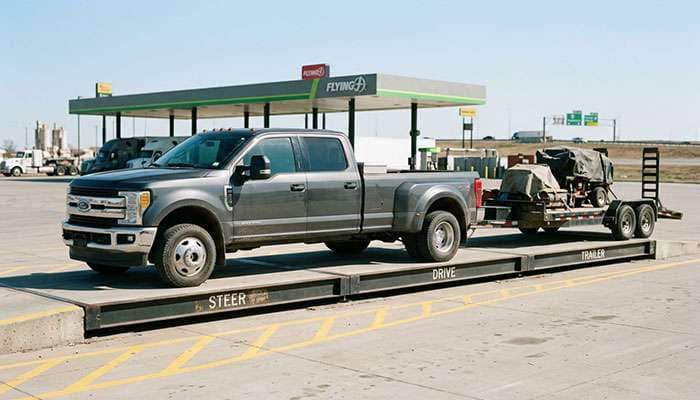
Any single line over its limit means the truck is over, no matter how much room the other lines show. If the rear axle is the line that fails, work through the remedies in order: move cargo forward, remove cargo, adjust the trailer's internal load distribution, add or correct a weight-distributing hitch, or increase capacity at the tire and wheel.
If your scale ticket shows the tires are your binding constraint, the fix is straightforward. Note that raising tire capacity does not raise your GAWR; it removes the tires as the limiting factor so the axle rating becomes your ceiling instead.
Load range E light-truck tires cover most three-quarter and one-ton applications, with per-tire capacities in the 3,197 to 3,968 pound range depending on size and index. Load range F adds another step for heavy towing. The distinction between them is explained in our comparison of 10-ply vs 12-ply tires.
Four options worth considering, all with meaningful load capacity and deep size coverage:
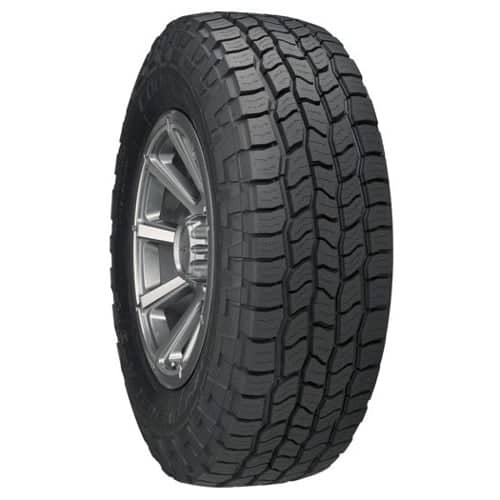
Cooper Discoverer AT3 XLT. A well-balanced all-terrain with a load range E offering in LT295/60R20 at load index 126, giving 3,748 pounds per tire. Around $523 in that size, with load range F available in some fitments for heavier applications.
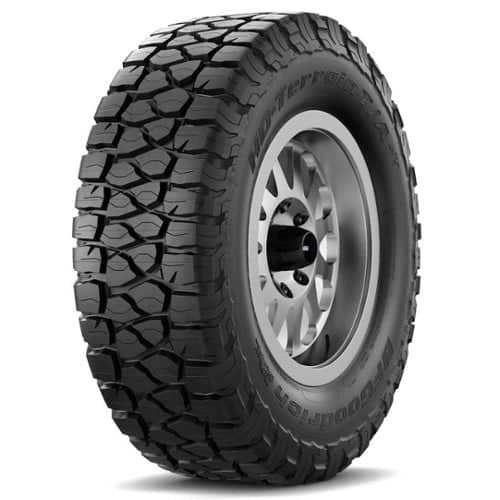
BFGoodrich HD-Terrain T/A KT. Built specifically for work and tow duty. Load range F fitments reach load index 128 at 3,968 pounds per tire, the highest per-tire capacity in this group. Expect around $792 in the largest sizes.
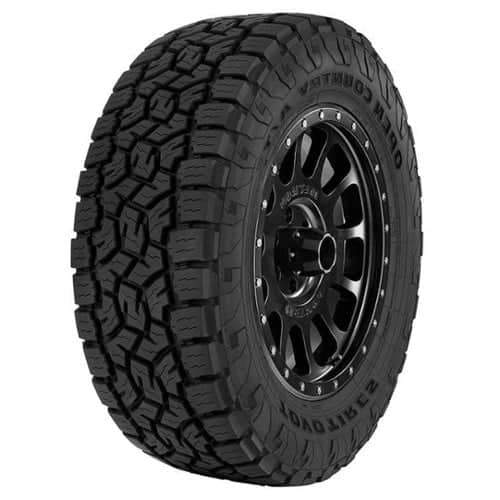
Toyo Open Country A/T III. The deepest fitment coverage of the four, with 74 load range E and F sizes in stock, which matters if you run a less common size. Load range F options reach load index 127 at 3,858 pounds.
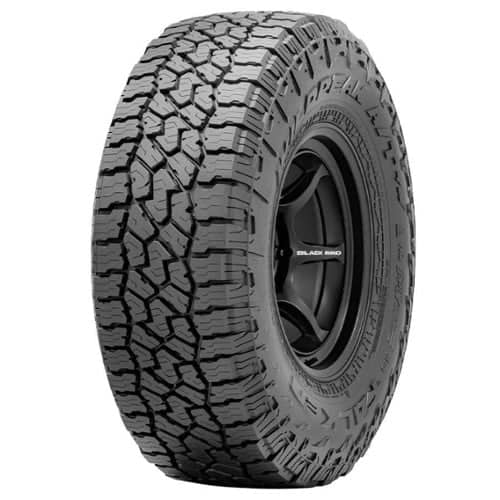
Falken Wildpeak A/T4W. Strong all-weather capability alongside its load ratings, with load range F fitments at load index 127 and 3,858 pounds per tire, from around $609.
Whichever you choose, confirm two things: that the load index at your intended operating pressure supports your measured axle weight, and that your wheels are rated for both the load and the inflation pressure the tire requires. A tire needing 80 PSI on a wheel rated for 65 PSI is not a valid combination. For a broader look at the category, see our roundup of the best pickup truck tires, and you can browse current inventory in one of the most common heavy-duty fitments at LT265/70R17 tires.
The GVWR check is the easiest one to pass and the least informative one to run. It tells you about a total, and totals hide distribution. The rear axle carries the pin weight, the tongue weight, the camper overhang, and the gravel, and it reaches its limit while the front axle still has a thousand pounds of headroom making the arithmetic look comfortable.
Find your three rear numbers, take the lowest, and measure against it on a certified scale with the truck loaded the way you actually drive it. It costs a few dollars and five minutes, and it replaces an estimate with a fact. If the tires turn out to be your limiting number, that is the cheapest of the three problems to solve.
Yes, and it is common. GVWR is the total weight limit for the whole vehicle, while GAWR is a separate limit for each axle. Loads that concentrate behind the cab, such as fifth-wheel pin weight or a slide-in camper, can push the rear axle past its rating while the front axle remains thousands of pounds under its own and keeps the total looking acceptable. Both axles must be within their individual ratings regardless of the total.
Nothing dramatic on any single trip, which is why the practice persists. The effects are cumulative. Tires run hotter and degrade internally, wheel bearings and leaf springs wear faster, brake components manage more energy than they were rated for and fade sooner, and stopping distances increase. The risk is not that one overloaded trip fails, but that repeated trips consume component life invisibly until something fails at highway speed under load.
No. Air springs, helper springs, and heavier leaf packs control sag and improve how the truck handles a load within its ratings, which is worthwhile. They do not change GVWR or GAWR, because those ratings account for the entire system including brakes, bearings, wheels, tires, and frame. Upgrading one component does not raise the limits of the others.
They do not raise the GAWR assigned by the manufacturer. What they can do is remove the tires as your binding constraint. If twice your rear tire capacity is lower than your rear GAWR, the tires are setting your real ceiling, and higher-capacity tires move that ceiling up to the axle rating. Beyond that point the axle rating governs and additional tire capacity adds margin rather than usable payload.
No. The load index figure applies at the tire's maximum stamped inflation pressure. Load capacity is a function of inflation pressure, and it decreases as pressure decreases according to the load-inflation tables published by the Tire and Rim Association and by individual manufacturers. A tire run well below its maximum pressure carries meaningfully less than its headline rating, so use the capacity listed for your actual cold pressure when calculating axle loads.
Weigh the fully loaded truck and trailer together on a certified scale, recording each axle separately. Then unhitch the trailer, leave it parked, and weigh the truck alone. The difference between the two rear axle readings is your measured hitch or pin load. This is far more reliable than percentage estimates, which vary considerably with how the trailer itself is loaded.



