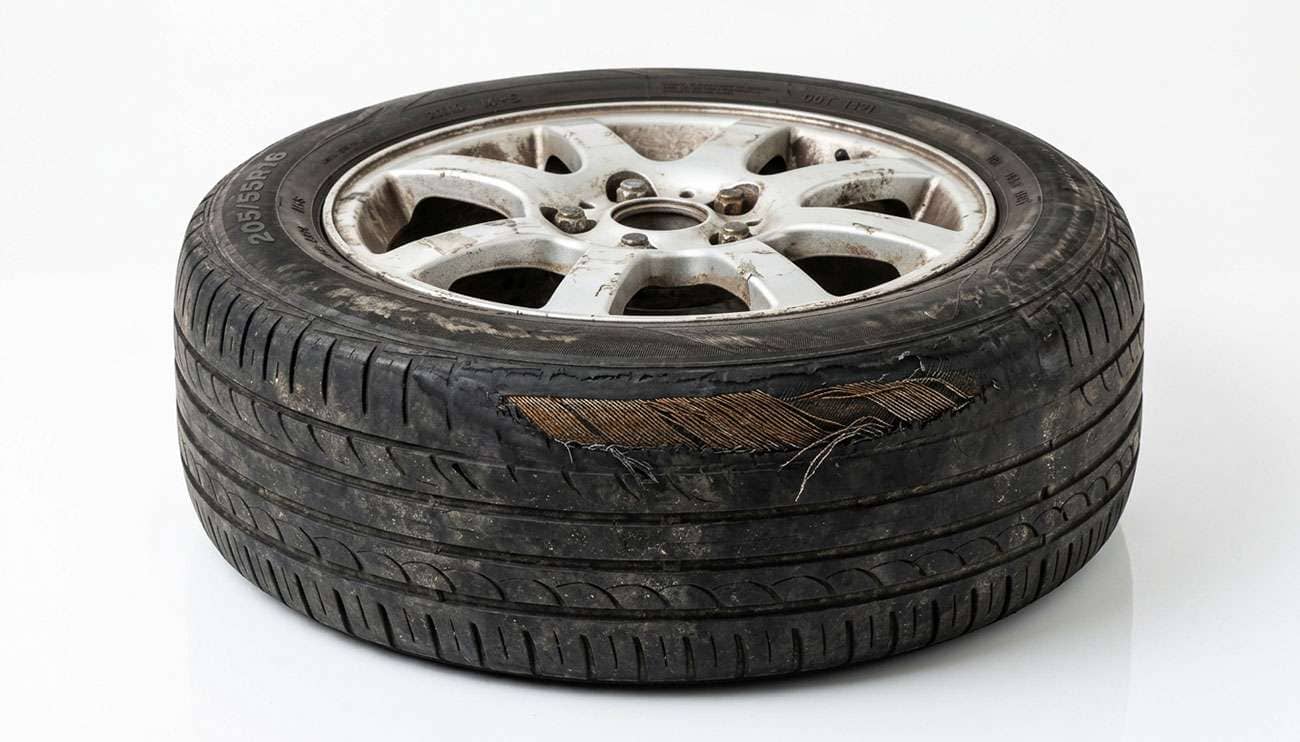
Only as far as the nearest tire shop, and only if the cords are in the tread. If they show in the sidewall, the tire comes off where it sits. Most answers stop at "replace it now," and that part is right. What they leave out is where on the tire the cords are showing. The location tells you what wore the tire out, how close it is to failing, and whether the next set will end up the same way. A tire worn through on the inner shoulder is a different problem from one worn through down the center, and a new tire only fixes half of it.
A worn-through tire is a record of every pressure, alignment and suspension problem the car has had. Read it before you replace it.
Find the row that matches what you see, then read the last column before you buy anything.
Where the Cords Show |
Most Likely Cause |
Can You Drive It? |
Fix Before New Tires |
|---|---|---|---|
A band down the center, all the way around |
Over-inflation, or the tire simply wore out |
Slowly, straight to a tire shop |
Set pressure to the door placard, not the sidewall maximum |
Both shoulders, center still has tread |
Under-inflation or overloading |
Slowly, straight to a tire shop |
Monthly pressure checks; a load index that covers what you carry |
Inner shoulder only |
Toe-out or negative camber, worn front-end parts, a lowered or leveled vehicle |
Slowly, straight to a tire shop |
Replace worn parts, then a full alignment |
Outer shoulder only |
Toe-in, positive camber, hard cornering |
Slowly, straight to a tire shop |
Full alignment; ask for the camber readings |
One patch or a row of scallops |
Locked-wheel skid, worn shocks, imbalance, a bent wheel |
Slowly, straight to a tire shop |
Shocks or struts, balance, check the wheel for runout |
Sidewall |
Cut, curb scuff, impact, or driving on it low |
No. Spare or tow |
Usually nothing, unless it was run low |
Inside the tire, seen with it off the wheel |
Driven while low or flat |
No. The tire is scrap |
Find the leak; confirm the TPMS works |
One short wire poking out of tread that still has depth |
Road debris, not your tire's belt |
To a shop to be checked; it may be repairable |
Nothing |
"How many miles do I have left" is not a column, because for every row except the last the answer is none. What differs is whether the replacement tire lasts its full life or wears through in the same spot.
It means the rubber is gone and you are looking at the tire's structure. From the outside in, a typical passenger radial has:
You do not have to guess which layers yours has. FMVSS 139, the federal standard for passenger and light truck radials, requires every tire to be marked with its ply count and cord materials in the tread and sidewall. Look near the bead for a line like "TREAD: 2 POLYESTER + 2 STEEL + 1 NYLON, SIDEWALL: 2 POLYESTER." That tells you what you will see as the tire wears through.
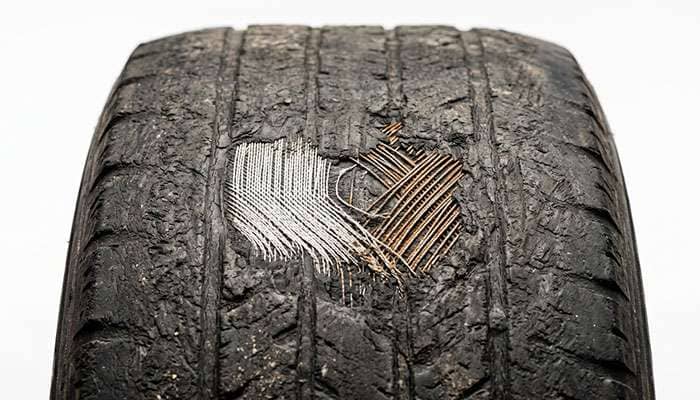
If your tire has a nylon cap ply, it shows first, as white, tan or gold threads running around the tire. It is easy to dismiss because it does not look like metal. Do not. The cap ply is thin, and the steel belts sit directly underneath it. Without a cap ply, the first thing through is steel: fine wires laid at an angle, which rust within days of meeting water.
Every passenger tire has at least six treadwear indicators, raised bars across the main grooves molded in at 2/32 inch. NHTSA picked that depth because traction falls off rapidly once tread gets that shallow. Below the bars there is only a thin layer of base rubber before the belts. Cords showing means the tire went past every warning it was designed to give. We cover when to replace well before that point in our guide to tread depth and when to replace tires.
Here is how close you are, based on what you can see.
What You Can See |
Layer Reached |
Can It Be Repaired? |
How to Move the Car |
|---|---|---|---|
Wear bars flush with the tread |
2/32 inch, the end of the tread's life |
No; replace soon |
Normally, but book the replacement |
Smooth band, no grooves left |
Base rubber over the belts |
No |
Short trip to a shop, dry roads only |
White, tan or gold threads in the tread |
Nylon cap ply, one layer above the steel |
No |
Slowly, off the highway, straight to a shop |
Shiny or rusty steel wire in the tread |
Steel belts |
No |
Mount the spare if you can |
Frayed wire ends or a lump near the worn spot |
Broken belt, separation starting |
No |
Spare or tow only |
Fabric in the sidewall |
Body ply, the air-holding carcass |
No |
Spare or tow only |
Only to get it replaced, and only if the cords are in the tread, not the sidewall. If you have a usable spare, put it on. If you have to drive on the worn tire, keep the trip short, stay off the highway, keep your speed down, and do not carry a load or tow.
The reason is how the belts work. They hold the tread flat against the road and keep the tire from growing at speed, and their bond to the surrounding rubber is what keeps the tread attached. Once the cords are exposed, three things happen at once:
Together, those produce a belt that separates, the failure that throws a tread at highway speed. We explain the separation modes in whether it is safe to drive with a broken tire belt.
The other risk shows up before anything breaks. With no groove depth left to move water, the tire hydroplanes at ordinary speeds and takes much longer to stop in the rain.
There is no number you can safely plan around. The failure does not come from running out of rubber. It comes from a weakened belt letting go, and that depends on speed, heat, load and pressure on the day it happens. A worn-through tire can survive a slow week around town and fail on the first hot freeway drive. Highway speed, hot weather, low pressure and a heavy load all push it closer, and wet roads are the biggest crash risk on a tire with no tread.
If the metal is visible, treat the tire as already failed and the drive to the shop as borrowed time.
A band of cords down the middle, with some tread left on the shoulders, means the tire was carried on its center. The usual cause is too much air. An over-inflated tire bulges at the crown, so the middle carries most of the weight and wears first.
The most common way this happens is filling to the number molded on the sidewall. That is the tire's maximum pressure, not what your vehicle calls for. Your pressure is on the placard in the driver's door jamb, and it is almost always well below the sidewall maximum. A tire on a rim narrower than its approved range, or a lot of wheelspin on a powerful rear-drive car, wears the center the same way.
If the tire is worn evenly across the whole width, nothing caused it. It simply ran past its wear bars. Our guide to reading tire wear patterns shows each pattern side by side.
People mean two different things by this, and both matter.
This is the most common worn-through tire we see, and the most dangerous, because it hides. The outer tread has plenty of depth, and the inner two inches are down to the steel. Often nobody knows until the car is on a lift.
Inner shoulder wear comes from the wheel's angle to the road:
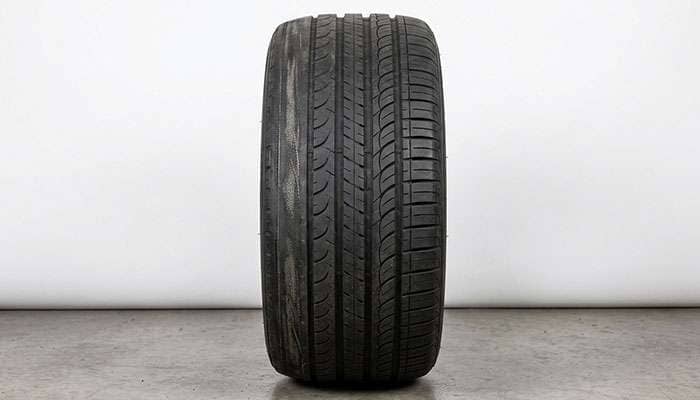
This is where replacing the tire is not enough. An alignment stops the wear, but it does not put tread back, and a new tire on the same settings will wear through the same edge. Worn parts have to be replaced first, or the alignment will not hold. We cover why the new set needs its own check in whether you need an alignment with new tires. Ask for the before-and-after printout; it is the only proof the camber and toe were brought back into spec.
If a shop dismounts the tire and finds cords showing through the inner liner, the tire was driven while low or flat. The sidewall folded over and ground the liner away, often leaving a band of rubber dust inside. This damage can be invisible from the outside, which is why a proper flat repair includes inspecting the inside. The tire is scrap even if the tread looks new. Find out why it went low: a slow leak, a bad valve stem or an ignored TPMS warning.
This is the opposite of center wear. An under-inflated tire sags, the middle of the tread lifts slightly, and the shoulders carry the load. The sidewalls flex more with every revolution, and that flexing makes the heat that weakens the belts.
Overloading does the same thing. The load index on the sidewall tells you how much weight the tire carries at its rated pressure. If you haul, tow, or run passenger tires on a working truck, check that the load index covers what you actually carry. An overloaded tire behaves like an under-inflated one, even at the correct pressure.
Outer-edge wear points to the angles the other way: toe-in, or positive camber with the top of the tire leaning out. It also shows up on cars driven hard through corners, and on trucks whose leveling kit tilted the tops of the front tires outward. The fix is the same: replace worn parts, then a full alignment with camber checked, not just a toe adjustment.
When the rest of the tread has depth and the cords show in a single patch, something happened to that one spot.
Stop driving on it. The sidewall has no steel belts. The only thing holding the air pressure there is the body ply, the fabric you are looking at. If it is exposed, it is damaged, and a sidewall can let go with no warning.
Sidewall cords almost never come from wear. They come from a cut, a curb scrape, a pothole or road debris, or from driving the tire very low. Illinois' inspection rules make a useful test: if you can part the edge of a cut and see cord, the cord counts as exposed. Industry repair standards do not allow sidewall repairs at all, so mount the spare or call a tow. Our guide to tire sidewall damage shows which marks are cosmetic and which are not.
Wires sticking out of a tire come from one of two places, and they mean very different things.
On a tire worn to the steel, broken belt filaments fray out of the worn area like whiskers. They are sharp, so wear gloves. If your own belt wire is sticking out, the belt is breaking up, and the tire should go no farther than it takes to put the spare on.
Sometimes a single short wire pokes out of tread that still has good depth. That is usually not your tire. Highways are scattered with fine steel wire shed by failed truck tires, and a piece can stick into your tread like a tiny nail and cause a slow leak that is hard to find. You can tell the two apart in your driveway:
A debris wire in the main tread can usually be repaired with a plug-patch from the inside, like a nail. If the tire is holding air, leave the wire in and let the shop pull it and inspect the inside.
In most places, yes. That spelling usually comes from UK drivers, so here are both sides of the Atlantic.
United States. There is no federal tread minimum for passenger cars. NHTSA requires the wear bars at 2/32 inch and leaves enforcement to the states, most of which set 2/32 inch. Exposed cord is its own failure in inspection states, regardless of tread depth. Pennsylvania rejects a tire with any part of the ply or cord exposed. Virginia rejects one worn so the fabric or steel cord is visible, and Illinois counts cord as exposed if any of it can be seen.
Commercial vehicles. FMCSA's rule, 49 CFR 393.75, bars any tire with body ply or belt material exposed through the tread or sidewall. It also sets 4/32 inch on the front tires of trucks and buses and 2/32 inch elsewhere.
United Kingdom. Any exposed ply or cord makes a tyre illegal, as does less than 1.6 mm across the central three-quarters of the tread. Fines run up to 2,500 pounds per tyre, plus penalty points.
We go through every condition that makes a tire illegal, state by state, in what makes a tire illegal.
A tire with cords showing feels like it is still working. Here is what it costs, in the order it usually happens.
The one-time fix is to find the cause, correct it, and put a fresh set on. Once the pressure, parts and alignment are sorted, shop our tires by your vehicle and size, and match the load index to the weight you actually carry.
A tire with wires showing is not safe to drive except to get it replaced, and not even that far if the cords are in the sidewall. What changes from tire to tire is the reason, and the reason is written on the tread. Center points to too much air, both shoulders to too little air or too much load, one edge to alignment and worn parts, one spot to a skid, a bent wheel or worn shocks.
Replace the tire, but read it first. Fix the cause before the new set goes on, or the new set will tell you the same story.
Only as far as a tire shop, slowly and off the highway, and only if the wires are in the tread. If they show in the sidewall, do not drive on it at all. Exposed steel belts can separate or blow out, and a tire with no tread hydroplanes in the rain.
The rubber has worn or been cut away and the tire's structure is exposed. White or gold threads are usually the nylon cap ply over the steel belts. Steel wire means the belts themselves. Fabric in the sidewall is the body ply that holds the air. In every case, replace the tire.
Cords on the inner edge of the tread usually mean toe-out, negative camber or worn front-end parts, which must be fixed before new tires go on. Cords on the inside of the tire itself, seen with it off the wheel, mean it was driven low or flat, and the tire is scrap.
There is no safe number of miles. Exposed steel belts wear, corrode and break, and the tire can separate or blow out at any time, more likely with heat, highway speed, low pressure and load. Treat it as already failed.
On a worn-out tire, the steel belt breaks up and its filaments fray out of the worn area. A single short wire in tread that still has good depth is often road debris from a failed truck tire, and it may be repairable like a nail.
Yes, in most places. In the UK, any exposed ply or cord makes a tyre illegal. In the US, inspection states reject tires with exposed cord regardless of tread depth, and federal rules bar commercial vehicles from running them.