
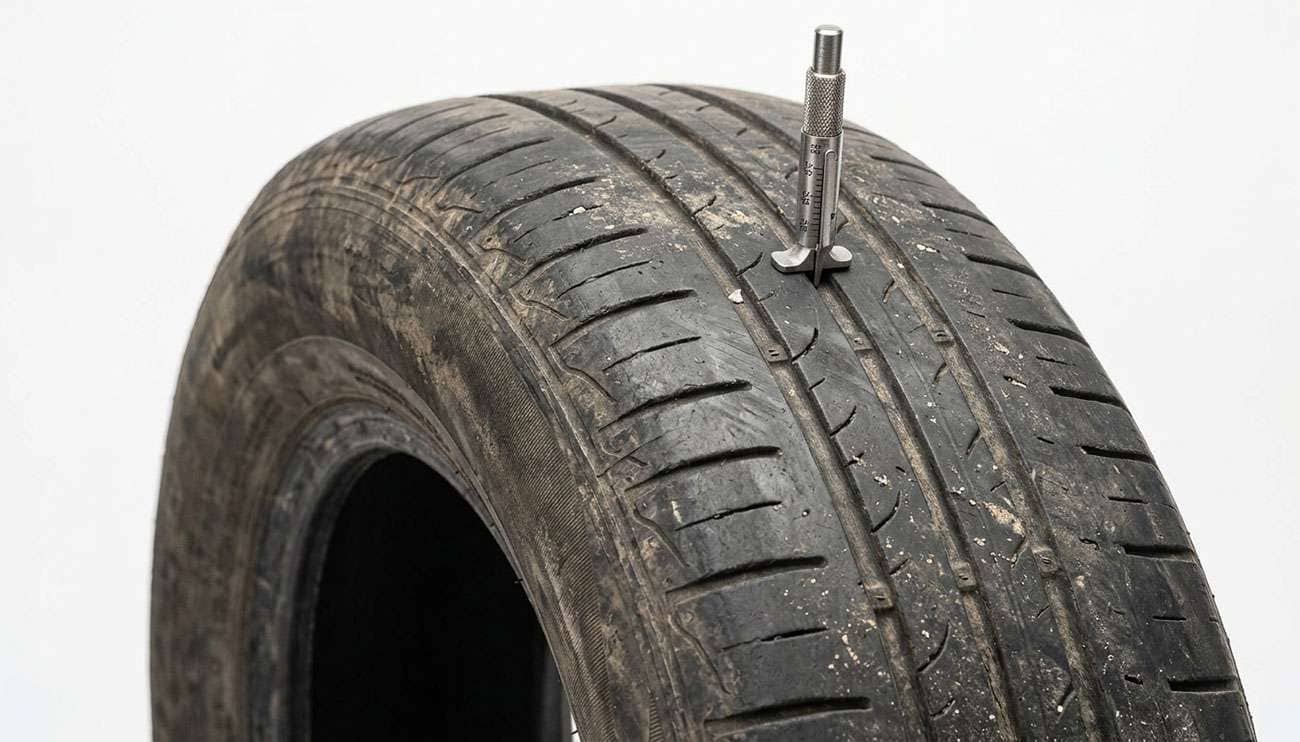
Six separate things can make a tire illegal in the United States, and tread depth is only one of them. Any single one is enough on its own. And here is the part that trips people up at my counter: the tread number everybody quotes, 2/32 of an inch, is the law in about 42 states but not in California or Idaho, where the statute reads 1/32. In a handful of states there is no tread minimum written into the vehicle code at all. The same set of tires can be legal in one state and a citation in the next one.
Now, before we get into it, I want to explain why you have probably already read three articles about this that were useless to you.
Go ahead and search this question. Almost everything on the first page is British. You will get garage chains and motoring sites talking about 1.6 millimeters of tread, MOT test failures, three penalty points on your license, and fines up to 2,500 pounds per tire. Every bit of that is real law. None of it is your law. We do not have an MOT here. There is no annual roadworthiness test in most of this country. A bald tire in California does not put a single point on your license. If you took that advice and went looking for your MOT certificate, you were chasing something that does not exist.
So let me give you the American version, the way I would tell it to somebody standing in the shop with a tire in his hand.
Six ways to fail. You do not need all six. One is plenty.
What Makes It Illegal |
Where the Rule Comes From |
How You Check It |
|---|---|---|
Tread below your state's minimum |
State vehicle code, varies by state |
Tread gauge, or look at the wear bars |
Exposed cord, belt, or ply |
State unsafe tire statutes |
Look at it, then run a hand over it |
Bulge, knot, or ply separation |
State unsafe tire statutes |
Hand around the whole sidewall, inside and out |
No DOT mark, or marked not for highway use |
Federal standards on sale, state rules on use |
Read the sidewall |
Load or speed rating below the placard |
State equipment rules, and your insurer |
Doorjamb sticker against the sidewall |
Studs outside your state's season |
State studded tire statutes |
A calendar, and a look at where you are driving |
Notice that four of those six do not require anybody to measure anything. That matters more than people realize, and I will come back to it.
Everybody knows 2/32. It is on every blog and every shop wall including mine. Here is where it actually comes from and why it is not universal.
The federal government sets 2/32 of an inch as the tread standard in its vehicle-in-use inspection criteria, 49 CFR 570.9. For commercial trucks and buses, the Federal Motor Carrier Safety Administration goes further under 49 CFR 393.75: steer axle tires need at least 4/32, and every other position needs 2/32. Those commercial numbers apply everywhere in the country.
Passenger cars are different, because passenger car equipment law is written by the states. Most of them adopted the federal 2/32 figure and left it there. Some did not.
Where You Are |
Passenger Minimum |
Worth Knowing |
|---|---|---|
Roughly 42 states |
2/32 inch in the major grooves |
Matches the height of the molded wear bars |
California |
1/32 inch in any two adjacent grooves |
CVC 27465(b). Snow tires used in place of chains need 6/32 |
Idaho |
1/32 inch |
Same lower threshold as California |
About half a dozen states |
No statutory minimum |
You can still be cited under general unsafe equipment law |
Commercial, nationwide |
4/32 steer, 2/32 all other positions |
49 CFR 393.75, enforced at every scale house |
I want to be straight with you about that fourth row, because I could have written a tidy list and you would never have known the difference. The published lists of no-minimum states do not agree with each other. Arkansas, Montana, North Dakota, South Carolina, and West Virginia turn up on almost every list. Massachusetts, Mississippi, and New Mexico show up on some and not others. I am not going to print a clean list I cannot stand behind. If you live in one of those states, pull up your own vehicle code and read the equipment section. It takes ten minutes and it is the only version that counts.
And do not read a missing tread statute as permission. Every state has a general unsafe equipment provision. No specific number just means the officer gets more discretion, not less.
California is the one that surprises people, especially the folks who walk into our Long Beach store. Our state allows a thinner tire than most of the country. That is a legal fact, and it is a terrible thing to aim for. Here is why.
The 2/32 figure traces back to a commercial standard written in the late 1960s. It was chosen because it matches the height of the tread wear indicator bars molded into the grooves, which made it easy to write into law and easy for an inspector to eyeball. It was not chosen because somebody studied hydroplaning and concluded that 2/32 was where the water stops. Research summarized in the medical and safety literature points the other way: below about 4/32, a tire can lose roughly half its available friction on a merely wet road, well before true hydroplaning even starts.
So the legal floor and the safe floor are two different numbers, and in California they are four times apart. Our own guide to tread depth and when to replace tires walks through where to actually draw the line, and if you want the thirty-second driveway version, the penny rule gets you close enough to know whether to worry. A penny reads 2/32. A quarter reads 4/32. I keep both in the drawer by the register.
This is the category that catches people who have plenty of tread, and it is the one I see most often.
California actually defines an unsafe tire in the Health and Safety Code, section 39945: a tire is unsafe when it shows an exposed ply or cord, a sidewall crack, a bulge, a knot, or a ply separation. Most states have language that lands in the same place. Read that list again and notice what is missing. There is no measurement in it. No gauge, no penny, no argument about whether the groove was 2/32 or 3/32 on a cold morning. An officer looks at your tire, sees cord, and that is the end of the conversation.
Understanding what those defects actually are will keep you from talking yourself into ignoring one.
Exposed cord or belt means the rubber that was covering the tire's structure is gone and the carcass is open. Once that happens, water and road salt reach the steel. Steel corrodes, corrosion travels along the belt away from the hole, and the bond between rubber and steel lets go progressively where you cannot see it. A tire with cord showing in one small patch is not damaged in one small patch.
A bulge or knot is not a cosmetic blemish. It is air. The plies inside have separated and air has pushed into the gap between layers, which is why it sticks out. That tire is not going to fail someday. It is failing right now, and it announced itself. We go through what is repairable and what is not in our piece on tire sidewall damage and whether it is safe to drive, and if you have got a rounded lump you are trying to identify, tire sidewall bubbles explained will tell you what you are looking at.
One habit worth building. When you check tires, reach around and run your palm over the inside sidewall too. That is where curb damage hides, and that is the side nobody ever looks at until it is on a lift.
Every tire built for highway use in this country carries the letters DOT molded into the sidewall. That mark is the manufacturer certifying that the tire meets the applicable federal motor vehicle safety standards, and it sits alongside the tire identification number that gives you the build date.
Here is the nuance that most articles get wrong, and I would rather give it to you accurately than simply.
The federal standards govern how tires are made and sold. NHTSA has said in writing, more than once, that federal law does not prohibit a vehicle owner from mounting off-road tires and driving on public roads. That surprises people. Federal law goes after the manufacturer and the dealer, not you in your driveway.
Where you get caught is the state. A great many state equipment codes specifically exclude tires that are marked as not intended for highway use, and that is the level where a traffic stop happens. There is also a long-standing federal mechanism where tires that failed to meet the passenger tire performance standard could be relabeled for off-highway use and sold for farm wagons and the like. A dealer who sells those for passenger car use, or who grinds off that legend, is looking at a civil penalty. When a manufacturer marks a tire for farm or non-highway use, it is required to remove the DOT symbol.
What this means in practice. If the sidewall says competition only, racing use only, not for highway use, or has no DOT mark at all, that tire has a legitimate purpose and a public road is not it. Track compounds fall here. So do plenty of imported and specialty tires. And there is one more consequence that has nothing to do with a citation: after a collision, an adjuster who finds competition-only rubber on a street car has been handed a coverage argument. That is a bad day that starts long after the traffic stop would have ended.
A tire can be brand new, fully DOT marked, and still wrong enough to be a problem.
Load rating below the placard. Open your driver's door and look at the sticker on the jamb. It lists the original tire size and the load rating your vehicle was certified with. Fit something rated below that and you have put a tire under the truck that is not built to carry what the truck weighs. This is the single most common mistake I see on lifted trucks and on vans that got a cheap set thrown at them. If load range and ply ratings are not something you have had explained properly, our guide on how to read tire load range and ply ratings covers it in plain language.
Speed rating below the original. Less likely to earn you a ticket, more likely to matter in a claim, and a real problem on heavy vehicles that cruise loaded at highway speed.
Size far enough off to matter. Change overall diameter significantly and your speedometer lies, which is its own citation if the number it lies about is over the limit. Some states also have fender coverage rules, where tire sticking out past the bodywork is an equipment violation.
Mixing construction on the same axle. Radial and bias-ply tires on the same axle handle load and slip so differently that many states prohibit it outright. Same goes for wildly mismatched sizes side to side.
This is the one that turns law-abiding people into violators purely by crossing a state line, and it catches snowbirds and road trippers every single spring.
Studs chew up pavement. Every state has taken a position on them, and the positions are all over the map.
Category |
States |
Detail |
|---|---|---|
Banned year round |
Hawaii, Louisiana, Mississippi, Texas, Florida, Michigan, Minnesota |
Michigan MCL 257.710 bars any tire with metal contacting the road, with exceptions only for law enforcement, ambulances, and rural mail carriers |
Effectively banned |
Wisconsin |
Statute 347.45 permits studs only for emergency vehicles, school buses, and mail delivery, plus out of state vehicles passing through for up to 30 days |
Seasonal window |
About 30 states including California, Oregon, Washington, Virginia, Ohio, Tennessee |
Oregon and Washington run November 1 to March 31. Virginia is October 15 to April 15. Ohio runs to April 15, Tennessee to April 1 |
No seasonal limit |
Colorado, Kentucky, New Hampshire, New Mexico, North Carolina, Vermont, Wyoming |
Legal at the state level year round, general equipment law still applies |
Two California specifics for the folks close to home. Studs are permitted here from November 1 through April 30. And studded tires do not count as an alternative traction device in this state, which means they will not get you through a chain control checkpoint. People find that out at the worst possible moment, halfway up a mountain with a line of cars behind them.
The fines are not symbolic either. Oregon's presumptive fine for running studs past April 1 sits at 165 dollars and lands closer to 200 once surcharges are added.
A tire can be made illegal by what somebody did to it, and this one is worth knowing because the person who did it was often trying to help.
A sidewall repair is never acceptable. Not a plug, not a patch, not a boot. The sidewall flexes through its entire life and no repair survives that. Any tire with a sidewall repair in it is condemned, and any shop that put one there did you harm.
Rope plugs installed from the outside without dismounting the tire are the other one. The tire never came off the wheel, so nobody inspected the inner liner, and nobody knows what that nail did on its way through. The repairable area is the crown only, not the shoulder, and a proper repair is a patch-plug combination done from the inside. If a shop has ever turned you down and you left annoyed, our article on why a shop will not patch your tire explains what they saw that you did not.
Regrooving is the last one. Cutting new grooves into worn tread is a legitimate practice on certain commercial tires that are specifically built and marked for it, with extra rubber under the tread for exactly that purpose. Doing it to a passenger car tire is carving into the belt package. I have seen it. It is not a shortcut, it is a countdown.
Here is the part I most want you to walk away with, because it is the part that costs real money and almost nobody talks about it.
In California, a bald tire violation under CVC 27465(b) is an infraction. The base fine is 25 dollars per bald tire. It puts zero points on your license. Court assessments push the real total higher depending on the county, but the headline number is small enough that plenty of people read it, shrug, and keep driving.
That is the trap. The citation is not the exposure. The citation is the evidence.
There is a doctrine called negligence per se. Put plainly: when you violate a safety statute and that violation causes the kind of harm the statute was written to prevent, you are presumed negligent. You do not get to argue about whether a reasonable person would have replaced those tires. The legislature already decided that.
So run the situation out. You are down to the cords on a rainy Tuesday. Somebody stops short, you cannot, and you hit them. Now there is a collision report that documents your tire condition, and possibly a citation attached to it. The other side's attorney does not have to build a liability case anymore. It was built for him, by you, for 25 dollars.
That is the actual cost ladder on worn tires, and it runs one direction:
A set of tires is cheaper than any rung on that ladder past the first one. Our piece on the consequences of bald tires goes further into what worn rubber does to stopping distance.
Five minutes, no tools you do not already have. Do all four tires and the spare.
If any one of those six comes back bad, the tire is finished. There is no partial credit here.
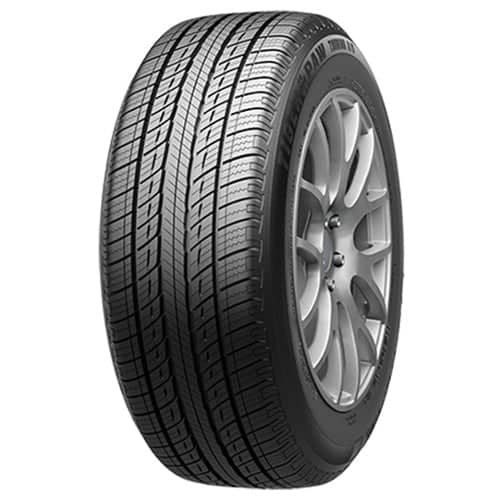
For a car that just needs to be legal and safe again without a lot of drama, the Uniroyal Tiger Paw Touring A/S is what I hand most people. It runs about 96.70 in 215/60R16, 110.95 in 205/55R16, and 131.49 in 225/65R17. It is an honest touring all-season, and four of them cost less than one bad afternoon.
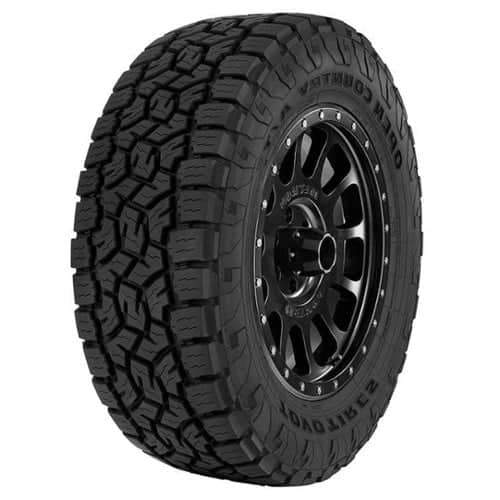
If it is a truck, and especially if the last set was under-rated for the load, the Toyo Open Country A/T III is the one I trust. Around 254.39 in 265/70R17 and 298.35 in LT265/70R17. Pay attention to that LT designation and match it to your doorjamb, because that is exactly the load rating trap from earlier in this article.
Shop tires at Performance Plus Tire and match the load rating on your placard while you are at it. If you are not sure what that sticker is telling you, call us. We have been doing this a long time and nobody here is going to make you feel dumb for asking.
What makes a tire illegal is not one thing. It is six things, any one of which stands on its own, and only one of them involves a number that anybody measures.
If you take two things from all this, take these. First, look up your own state's tread minimum instead of trusting the 2/32 everybody repeats, because in California and Idaho the statute reads 1/32 and in a few states there is no number at all. Second, understand that four of the six failures are visual. Cord, bulges, sidewall markings, and the wrong load rating do not require a gauge or an argument. They require somebody to look.
And keep the 25 dollar figure in perspective. The fine was never the point. The fine is a receipt showing you knew.
There is no single national number for passenger cars, because passenger equipment law is written by the states. Roughly 42 states use 2/32 of an inch, matching the federal in-use inspection standard at 49 CFR 570.9. California and Idaho set the threshold at 1/32 of an inch, and about half a dozen states have no statutory minimum written into the code. Commercial vehicles are the exception and are federally regulated nationwide at 4/32 on steer tires and 2/32 elsewhere.
Yes. Tread depth is only one of six ways a tire fails. State unsafe tire provisions cover exposed ply or cord, sidewall cracks, bulges, knots, and ply separation, none of which involve measuring anything. A tire with 8/32 of tread and a bulge in the sidewall is illegal, and an officer does not need a gauge to write it.
In California a violation of CVC 27465(b) is an infraction with a 25 dollar base fine per bald tire and no DMV points, though county court assessments raise the real total. The bigger exposure is civil rather than criminal. Violating a safety statute can make you negligent per se in an accident claim, which means the citation itself becomes evidence of liability.
Federal law regulates how tires are manufactured and sold rather than how owners use them, and NHTSA has stated that federal law does not prohibit an owner from mounting off-road tires and driving on public roads. However, many state equipment codes specifically exclude tires marked as not for highway use, so the citation risk is real at the state level. There is also an insurance dimension, since competition-only rubber found on a street car after a collision gives an adjuster a coverage argument.
It depends entirely on where you are. Hawaii, Louisiana, Mississippi, Texas, Florida, Michigan, and Minnesota ban them year round, and Wisconsin restricts them to emergency vehicles, school buses, and mail delivery. About 30 states allow a seasonal window, commonly running from late fall into spring. California permits studs from November 1 through April 30 but does not accept them as an alternative traction device at chain control. Colorado, Kentucky, New Hampshire, New Mexico, North Carolina, Vermont, and Wyoming impose no seasonal limit.
British garage chains and motoring sites publish heavily on tire legality because the UK has an annual MOT roadworthiness test, which gives drivers a fixed yearly reason to search for it. Their figures are real but they are not applicable here. The UK minimum is 1.6 millimeters across the central three quarters of the tread, enforced through MOT failures, penalty points, and fines assessed per tire. The United States has no equivalent national test, and tread minimums are set state by state.



