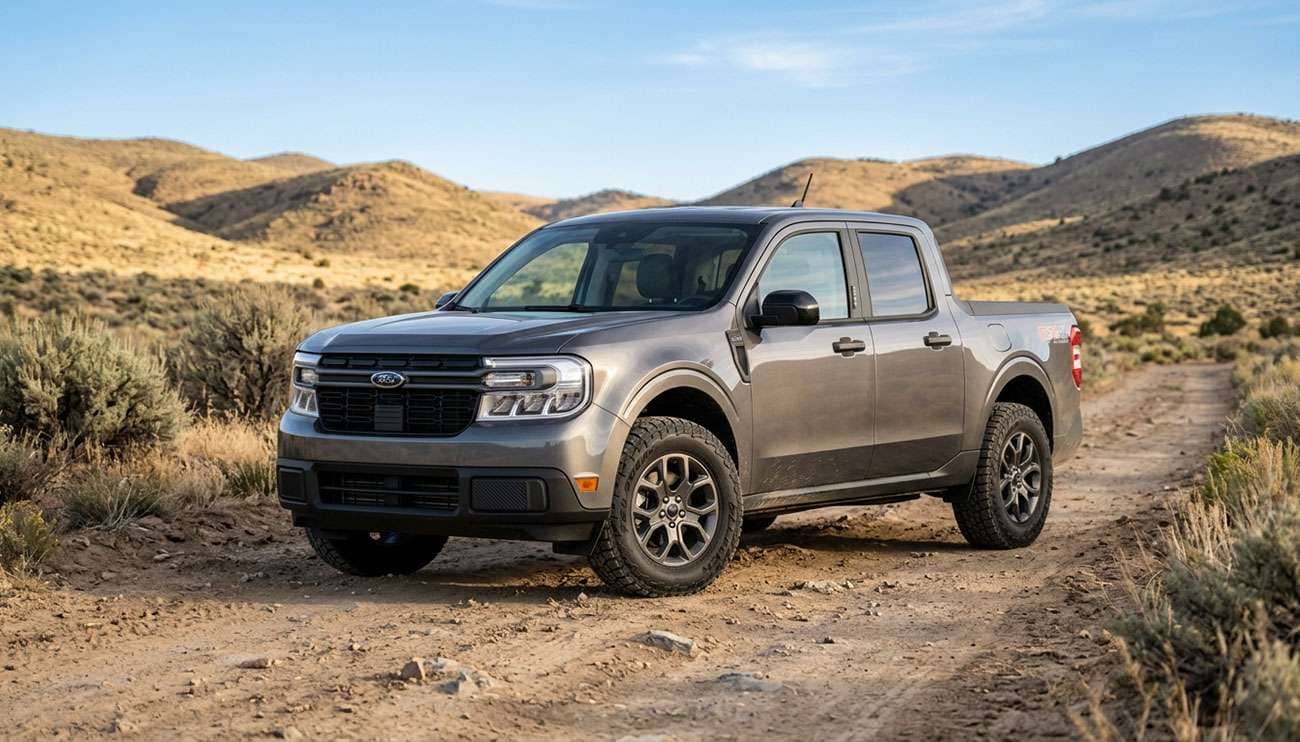
Short answer: about 30 inches. On the factory 17-inch wheels and stock suspension, owners report 235/70R17 (30.0 in.), 255/65R17 (30.1 in.), and 225/75R17 (30.3 in.) clearing without rubbing. Sizes around 30.5 inches start touching the front fender liner and pinch weld at full lock, and a 235/75R17 (30.9 in.) rubs. Most answers stop at a size. They skip the catch: the tallest size that clears, 225/75R17, is sold almost entirely as a Load Range E light truck tire. That is a tire built for 80 psi and a three-quarter-ton, not a 5,300-lb hybrid that runs 35 psi.
I'm Dennis Feldman, and I handle fitment questions for Performance Plus Tire. The Maverick is a truck people want to make look tougher without spending money on a lift, which makes the stock-suspension ceiling the number that matters. The ceiling is real, but it isn't one tire size. It's a height, a width, and a construction, and the best choice is usually not the tallest one.
This chart is for 17-inch wheels at stock height, keyed to the size you would actually order. Diameters are calculated from the size. The fit results come from Maverick owners who have run them.
Tire Size |
Diameter |
Stock-Suspension Result |
How It's Usually Built |
|---|---|---|---|
225/65R17 |
28.5 in. |
Factory size (XL, XLT) |
Passenger, load index 102 |
235/65R17 |
29.0 in. |
Fits; 2025 Tremor factory size |
Passenger |
245/65R17 |
29.5 in. |
Fits, no rub reported |
Passenger |
235/70R17 |
30.0 in. |
Fits, no rub reported |
Passenger, mostly XL |
255/65R17 |
30.1 in. |
Fits; best-documented 30-inch size |
Passenger, mostly standard load |
225/75R17 |
30.3 in. |
Fits, no rub reported |
LT Load Range E only |
265/65R17 |
30.6 in. |
Borderline; reports split |
Mostly passenger, some LT |
245/70R17 |
30.5 in. |
Rub reported |
About half LT Load Range E |
235/75R17 |
30.9 in. |
Rubs; needs trimming or a lift |
Passenger |
The second chart starts from your trim instead. Factory wheel size changes which 30-inch size you can reach.
Trim and Wheel |
Factory Tire |
About 30 Inches on That Wheel |
Note |
|---|---|---|---|
XL, XLT (17 in.) |
225/65R17, 28.5 in. |
235/70R17 or 255/65R17 |
The most room and the most size choices |
Tremor (17 in.) |
235/65R17 A/T, 29.0 in. (2025) |
235/70R17 or 255/65R17 |
More ground clearance, same full-lock limits |
18-inch wheels (2022-2024 Lariat, 4K Tow) |
225/60R18, 28.6 in. |
235/65R18 |
Owner reports no rub |
19-inch wheels (2025 Lariat, Lobo, Black Appearance) |
225/55R19, 28.7 in. |
235/60R19 (calculated) |
Few owner reports; Lobo sits lower, so stay closer to stock |
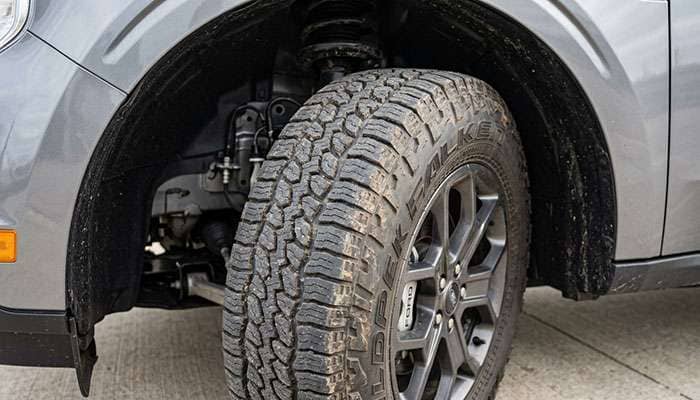
Because the Maverick is a unibody truck built on a crossover platform, and its wheel wells were drawn around a 28.5-inch tire. There's no separate frame to lift away from the body and no torsion bar to crank. The front suspension is a MacPherson strut, which puts the spring and strut right next to the inside of the tire.
That gives a bigger tire three places to hit. On the inside, the tire's inner shoulder gets close to the strut and spring perch, especially on wider tires or wheels with more offset. On the outside, at full steering lock, the front of the tire sweeps toward the plastic fender liner and the pinch weld, the folded seam of sheet metal where the inner fender joins the body. And at full compression, with a load in the bed or a hard dip, the tire moves up into the liner.
Maverick owners who have tested sizes on stock suspension name the liner and the pinch weld as the contact points. They also note two things that don't show up in a size chart. Mud and a loaded bed, which make the truck sag, can turn a size that clears on the street into one that rubs at the trailhead. And tire shape matters as much as diameter: a square-shouldered all-terrain or mud-terrain touches sooner than a rounded highway tire of the same size.
That is why the line sits at about 30 inches rather than at a single size. A 255/65R17 at 30.1 inches is a full inch wider than stock and clears. A 245/70R17, slightly taller at 30.5 inches, is where owners start reporting rub. Height and width trade against each other.
Some, and in ways people don't expect.
The Tremor rides on unique springs. Ford's 2025 spec sheet lists 9.1 inches of ground clearance against 8.3 for the standard 2.0L AWD truck, and a 235/65R17 all-terrain from the factory. That extra height helps over rocks and ruts. It does nothing at full steering lock, where the tire swings toward the liner and pinch weld regardless of ride height. Plan on the same 30-inch range. Tremor owners usually gain the most by choosing a 30-inch tire with a rounded shoulder rather than chasing an extra half-inch.
The Lobo is the street truck of the family: tuned suspension, a lower stance, and 19-inch wheels. Less ride height means less room at full compression. I'd keep a Lobo within a size of stock.
The rear suspension changes with the drivetrain. Front-wheel-drive hybrids use a twist-beam rear axle, and all-wheel-drive trucks use an independent multi-link rear. The owner reports I found put the limit at the front wheel well on both drivetrains, not the rear. Where the drivetrain matters is in what bigger tires do to the truck, which we cover below.
The rule is height, not wheel size. On 18s, one owner runs 235/65R18 at 30.0 inches on Bronco Sport wheels with no rub. On 19s, the same height works out to a 235/60R19 at 30.1 inches. I have fewer owner reports on 19s, so test-fit before you commit, and remember that a 19-inch wheel leaves less sidewall to absorb impacts off-road.
Then you're out of stock territory, and the work grows faster than the tire does. The Maverick's lift kits are mostly strut and spring spacers in the 1.5 to 2 inch range. Owners pair a 2-inch lift with 235/75R17s, about 31 inches, and warn that a 245-wide tire may still rub the fenders in that setup. Fitment guides put the low 30s within reach of a small lift and some liner trimming, while a 32 or 33 calls for a real lift, liner and pinch weld work, and different wheels.
Remember the full-lock problem from earlier. A spacer lift raises the body at ride height, but the tire still swings toward the liner and pinch weld when you turn, so lift alone rarely buys a full size. And on a unibody truck with independent suspension at both ends, lifting changes the angles of the front axle shafts, and on AWD trucks the rear shafts too. Steeper CV joint angles wear boots and joints faster, and the alignment needs resetting afterward.
None of that makes a lifted Maverick a bad idea. It just means a 31-inch tire is a project, not a tire swap. If what you want is the look and a little more ground clearance, a 30-inch passenger all-terrain on stock suspension gets you most of the way for the price of four tires.
Usually not, and this is the part of the size question nobody talks about. An LT (light truck) tire is built with heavier plies and stiffer sidewalls to carry a lot of weight at high pressure. A Load Range E is rated at 80 psi. That's what a three-quarter-ton needs. A Maverick doesn't.
Look at what's available. In the tire market, 225/75R17, the tallest size that clears a stock Maverick, is sold almost entirely as LT Load Range E. About half of the 245/70R17s on the market are LT, too. A typical LT225/75R17 weighs around 41 lbs, compared to about 25 lbs for a passenger 225/65R17. That's 16 extra pounds at every corner, all of it unsprung and rotating, on a truck whose selling point is efficiency.
Then there's pressure. The Maverick's door placard calls for 35 psi on the 17-inch trims. At 35 psi, an LT tire carries a fraction of its sidewall rating, rides stiff, and wears in odd patterns. Inflate it to its rating and the truck rides like a buckboard. The tire is the wrong tool for the job either way.
The good news is that the next sizes down don't have this problem. 235/70R17 and 255/65R17 are sold mainly as passenger tires, including all-terrains, at about 32 to 35 lbs each. They reach the same 30-inch height without the LT penalty. Our guide to P-metric vs. LT tires explains the construction difference in more detail.
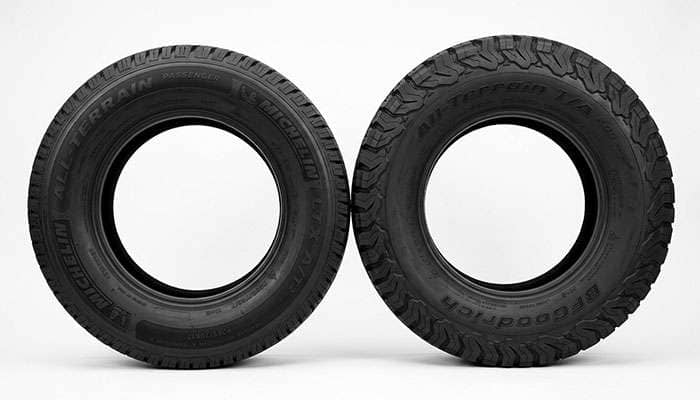
At least the load index on your door placard. Every bigger passenger size in the chart beats it.
Ford's 2025 spec sheet lists a gross vehicle weight rating (GVWR) of 5,320 lbs for the FWD hybrid, 5,240 lbs for the 2.0L AWD, and 5,090 lbs for the Tremor, with payloads from 1,140 to 1,500 lbs. The most common load index for a 225/65R17 is 102, which means 1,874 lbs per tire. The 30-inch passenger sizes run higher: 235/70R17 is commonly 108 or 109 (up to 2,271 lbs), and 255/65R17 is commonly 110 (2,337 lbs). Upsizing within passenger tires adds capacity, not risk.
One thing to know about XL, or extra load, passenger tires: the extra capacity only shows up at higher pressure. Under the standard load and inflation tables, an XL tire at 35 psi carries about what a standard-load tire of the same size carries. If you buy an XL 235/70R17 for the higher number on the sidewall, you only get it by running more air, which firms up the ride. For a Maverick that tows near its 4,000-lb max or carries a full bed, that's a fair trade. For a daily driver, a standard-load tire is fine. Our guide to load range vs. load index breaks down both numbers.
No, the sizes in the chart are run on the factory wheels. The factory 17-inch wheel is a 7-inch-wide 5x10⁸ wheel at about +37.5 mm offset, and a 255/65R17 is within the range tire makers approve for that width.
If you do change wheels, two numbers matter. The first is offset. Nearly all 5x10⁸ aftermarket wheels run between +35 and +45 mm, and most 17-inch versions are 7.5 to 8 inches wide. That's a close match to stock, and a wider wheel with a bit less offset can move the tire's inner shoulder away from the strut. Go much lower and you move the outer shoulder into the liner and fender lip at full lock instead.
The second is the center bore. The Maverick's hub is 63.4 mm, and most 5x10⁸ aftermarket wheels are bored 72 mm or larger to fit a range of cars. They need a hub-centric ring to center on the Maverick's hub. Our 5x10⁸ bolt pattern guide lists the vehicles that share the pattern, which is useful when you're shopping used wheels.
They change the speedometer, the fuel economy readout, and a little bit of everything that depends on wheel speed.
Speedometer. A 255/65R17 is about 5.4 percent taller than the factory 225/65R17. At an indicated 65 mph, you're doing about 68.5. A 235/70R17 is about 5 percent taller, so 65 indicated is about 68.3. The odometer runs short by the same amount, which pushes your oil-change and warranty mileage later than it really is. A Ford dealer, or diagnostic software such as FORScan, can update the tire size. Our guide to bigger tires and your speedometer covers the fix.
Fuel economy. One owner who put 245/65R17 all-terrains on an EcoBoost Maverick measured a drop of 1.2 to 1.4 mpg. Part of that is real: the tires are heavier, wider, and more aggressive. Part of it is the odometer undercounting miles, which makes the mpg math look worse than it is. On a hybrid, tire weight and rolling resistance matter more, because so much of its efficiency comes from low-speed electric driving and regenerative braking.
Braking and stability systems. ABS, traction control, and stability control all use wheel speed, so recalibrating the tire size keeps them working from accurate numbers. Heavier tires also take more braking effort, which is one more reason to avoid LT construction.
Yes. On an all-wheel-drive Maverick, all four tires need to be the same size, and ideally the same make, model, and tread depth. The AWD system connects the front and rear axles, and it expects all four tires to turn at the same speed. A size mismatch makes it think a wheel is slipping, which puts constant load on the coupling. Upsizing means four new tires at once, and keeping a full-size spare that matches if you can. Our guide to AWD tire requirements explains how much difference the system tolerates.
On a front-wheel-drive hybrid, the drivetrain is more forgiving, but mixed sizes still change the handling balance. Replace all four when you upsize.
A tire that's too big rarely fails right away. It costs you in stages.
Stage 1: Liner rub. You hear it at full lock in parking lots. The plastic liner gets scuffed, then torn, then starts hanging. Cheap to fix, but it's telling you something.
Stage 2: Pinch weld contact. Once the liner wears through, the tire meets sheet metal. The pinch weld's edge is sharp, and it scrapes the paint, which invites rust on a truck you plan to keep.
Stage 3: Tire damage. The shoulder lugs that keep hitting metal get cut. A cut on the shoulder or sidewall is a tire you can't trust at highway speed. If you see one, read our guide on tire sidewall damage and whether it's safe to drive.
Stage 4: The wrong tire, every mile. An overbuilt LT tire won't rub, but it costs you on every drive: harsher ride, longer stops, and lower mileage, on a truck you probably bought for efficiency. That's still a cost, just slower.
The fix at every stage is the same: a passenger-construction tire close to 30 inches, in a size owners have already proven on the truck.
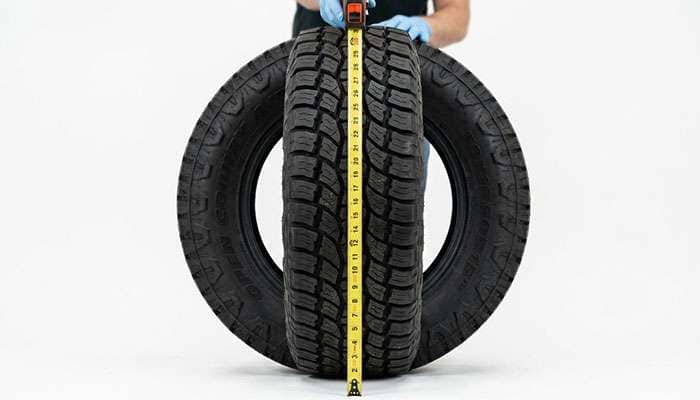
Step 1: Know your trim and wheel. 17-inch, 18-inch, or 19-inch, and whether it's a Tremor or a Lobo.
Step 2: Read your door placard. Note the factory size, the load index, and the recommended pressure.
Step 3: Pick a height, not just a size. Aim for about 30 inches. On 17s, that's 235/70R17 or 255/65R17.
Step 4: Choose passenger construction. Pick a passenger or XL tire with a load index at or above your placard number. Skip LT unless you have a specific heavy-duty reason.
Step 5: Match the tread to the shoulder. If you want an aggressive all-terrain, favor sizes on the shorter end of the range. A square shoulder hits sooner.
Step 6: Buy four. Especially on AWD.
Step 7: Check clearance. After mounting, turn lock to lock and look at the liner and pinch weld. Check again with a load in the bed.
Step 8: Recalibrate. Update the tire size so the speedometer, odometer, and service intervals are accurate.
When you're ready, start with the Ford Maverick wheels and tires that fit your truck.
The biggest tire on a stock Maverick is about 30 inches. On the factory 17-inch wheels, 235/70R17 and 255/65R17 are the sizes owners have proven, and 225/75R17 is reported to clear too. Past about 30.5 inches, the tire meets the liner and pinch weld at full lock, and a lift or trimming comes into play.
The tallest size that clears isn't automatically the best one. 225/75R17 is sold almost only as a Load Range E light truck tire, which is heavier, stiffer, and built for far more pressure than a Maverick runs. A passenger 235/70R17 or 255/65R17 gets you the same height and the look you want without giving up the ride, mileage, and braking that made you buy the truck in the first place.
Thinking about the Maverick's bigger sibling? Our breakdown of the biggest tire on a stock Ford Ranger covers a body-on-frame truck with very different limits.
About 30 inches. On the factory 17-inch wheels, owners report 235/70R17, 255/65R17, and 225/75R17 clearing without rubbing. Sizes around 30.5 inches and up start to rub the fender liner and pinch weld at full lock.
Yes. A 245/65R17 is about 29.5 inches tall, roughly an inch taller than stock, and owners run it on stock suspension and factory wheels without rubbing.
Yes. The 255/65R17 is about 30.1 inches tall and is the best-documented 30-inch size on a stock Maverick, with owners reporting no rub on and off road.
Not for about 30-inch tires. Larger sizes, such as 245/70R17 and 235/75R17, rub at full lock on stock suspension and generally need trimming, a lift, or both.
Usually not. LT tires are heavier and built for high pressure and heavy loads. At the Maverick's 35 psi placard pressure, they ride stiffly and add unsprung weight. Passenger or XL tires in the same height carry more than the factory load index.
XL and XLT trucks use 225/65R17. The 2025 Tremor uses 235/65R17 all-terrains. 2022-2024 Lariats and 4K Tow trucks used 225/60R18, and 2025 Lariat, Lobo, and Black Appearance trucks use 225/55R19.