
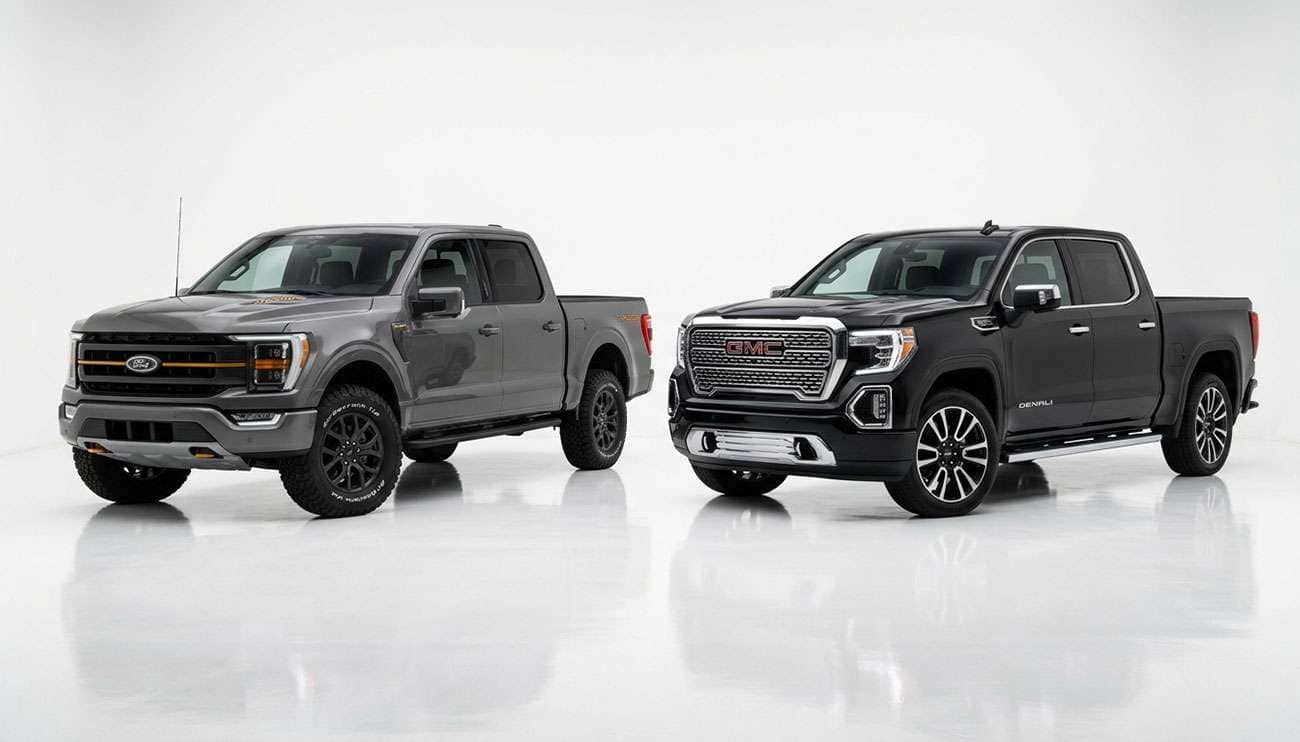
The 2025 GMC Sierra 1500 leaves the factory on sizes from 255/70R17 on a Pro up to 275/50R22 on a Denali Ultimate, with the AT4X on LT275/70R18. Here's the part most size charts leave out: the overall height barely moves, only 31.1 to 33.2 inches across the whole lineup. What moves is everything else. The sidewall runs from 5.4 to 7.6 inches. The AT4X is the only trim on light truck construction, and its Load Range C mud-terrain is rated for 99 mph. The Denali's 22-inch size comes in both Standard Load and Extra Load versions. Pick a replacement by size alone and you can lose capacity or speed rating without knowing it.
I'm Hank Feldman. We've been putting tires on trucks in Long Beach since 1971, and the Sierra is a truck where two owners with the "same" pickup can need completely different tires. This guide sorts it out trim by trim, then shows you what each size really carries.
Sierra 1500 Trim |
Factory Tire Sizes |
Wheel |
What Sets It Apart |
|---|---|---|---|
Pro |
255/70R17, 265/70R17, 275/60R20 |
17 or 20 in. |
Work truck; tallest sidewalls on the street-tire trims |
Pro 4x4 with X31 Off-Road Package |
275/65R18, 275/70R18 |
18 in. |
Off-road sizes on the base truck |
SLE |
255/70R17, 265/70R17, 265/65R18, 275/60R20 |
17, 18, or 20 in. |
Widest range of sizes of any trim |
Elevation |
275/60R20 |
20 in. |
One size, street-focused |
SLT |
265/65R18, 275/60R20, 275/50R22 |
18, 20, or 22 in. |
Same trim, sidewalls from 6.8 to 5.4 in. |
AT4 |
275/65R18, 275/70R18, 265/60R20, 275/60R20 |
18 or 20 in. |
Factory lift; all-terrain tread on most configurations |
AT4X and AT4X AEV Edition |
LT275/70R18 |
18 in. |
Only light truck tire in the lineup; Load Range C, Q speed rating |
Denali |
275/60R20, 275/50R22 |
20 or 22 in. |
Luxury trim on street tires |
Denali Ultimate |
275/50R22 |
22 in. |
Shortest sidewall in the lineup, 5.4 in. |
Sizes are the factory fitments listed for the 2025 model year in tire makers' vehicle databases. Your exact size depends on your wheel package, so the door placard is the final word. The second table shows what each of those sizes actually is: the height, the sidewall, and the load and speed rating you'll most often find in that size.
Tire Size |
Height (in.) |
Sidewall (in.) |
Most Common Rating |
Max Load per Tire (lb) |
|---|---|---|---|---|
255/70R17 |
31.1 |
7.0 |
112T SL |
2,469 |
265/70R17 |
31.6 |
7.3 |
115T SL |
2,679 |
265/65R18 |
31.6 |
6.8 |
114T SL |
2,601 |
275/65R18 |
32.1 |
7.0 |
116T SL |
2,756 |
LT275/70R18 (AT4X) |
33.2 |
7.6 |
115/112Q Load Range C on the factory mud-terrain; 125S Load Range E in the replacement market |
2,679 (C) / 3,638 (E) |
265/60R20 |
32.5 |
6.3 |
112H SL or 115H XL |
2,469 / 2,679 |
275/60R20 |
33.0 |
6.5 |
115T or 115H SL |
2,679 |
275/50R22 |
32.8 |
5.4 |
111H SL or 115H XL |
2,403 / 2,679 |
Load and speed ratings in that table are what the replacement market most commonly offers in each size, not a promise of what's on your truck. Your factory tire's exact rating is molded on the sidewall. That's the number to match.
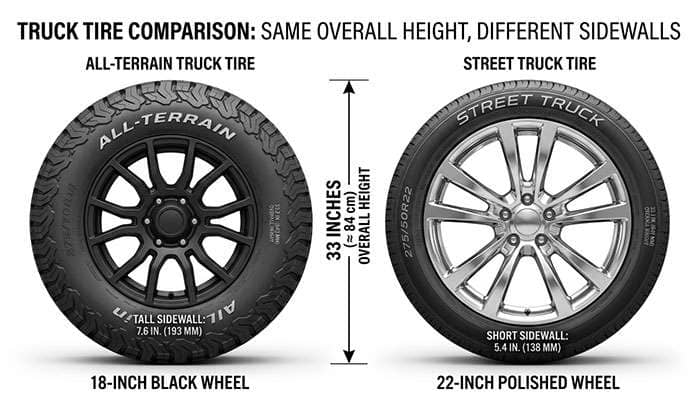
Eight sizes, across 17-, 18-, 20-, and 22-inch wheels. GMC keeps the overall tire height in a tight band, roughly 31 to 33 inches, so the speedometer, gearing, and fender clearance all stay in the range the truck was engineered for. The wheel diameter is what changes, and when the wheel gets bigger, the sidewall gets shorter to keep the height the same.
That trade matters more than most owners realize. A 7-inch sidewall is a cushion. It soaks up potholes, protects the wheel lip on rocks, and lets you air down on sand. A 5.4-inch sidewall is a stiffer spring and a smaller buffer between a pothole edge and a 22-inch wheel. Neither is wrong. They're built for different jobs, and GMC matches them to each trim's job.
This guide covers the 2025 model year of the current-generation Sierra 1500, the truck GMC has built since 2019. GMC has announced an all-new 2027 Sierra 1500 due at dealers before the end of 2026, and its AT4X moves up to 35-inch mud-terrain tires on a 2-inch lift. If you're shopping tires for a truck already in your driveway, everything below applies.
The AT4 is offered on four sizes: 275/65R18 and 275/70R18 on 18-inch wheels, and 265/60R20 and 275/60R20 on 20-inch wheels. It's the off-road trim that still lives on passenger-construction tires, with a factory lift and all-terrain tread on most configurations.
If you're choosing between AT4 wheel packages, or replacing tires on one, the 18-inch is the working choice. The 275/65R18 has a 7.0-inch sidewall and typically carries load index 116, 2,756 lb per tire. The 265/60R20 has a 6.3-inch sidewall, and in Standard Load it's typically load index 112, 2,469 lb. That's almost 300 lb less per tire on the narrower 20-inch size. The 20-inch setups look sharper and ride a little quieter on pavement. The 18s air down better, protect the wheel better on rocks, and carry more.
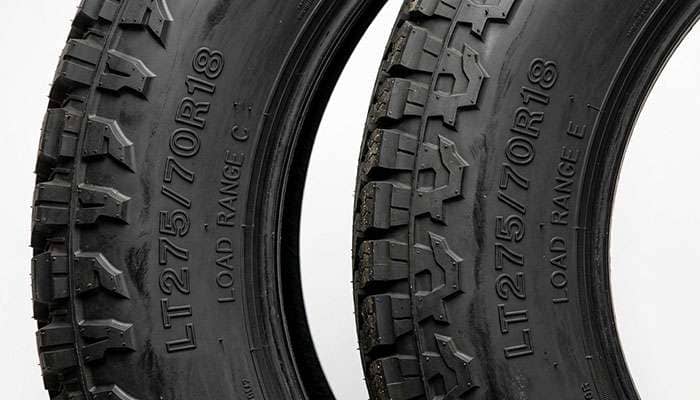
The AT4X is the outlier in the lineup. It rides on LT275/70R18, about 33.2 inches tall, and the factory Goodyear Wrangler Territory MT in that size is a light truck tire in Load Range C, rated 115/112Q. That's the only light truck construction in the Sierra 1500 lineup, and it's a deliberate choice for off-road work.
A Load Range C light truck tire has a lighter casing than the Load Range E tires most people picture on a truck. It's built for up to 50 psi instead of 80. For crawling and airing down on the trail, that's the point: a more flexible casing wraps around rocks and puts more rubber on the ground at low pressure. It still carries 2,679 lb per tire at its maximum pressure, on par with the 20-inch passenger tires elsewhere in the lineup.
Replacing it is where owners go wrong. Most LT275/70R18 tires on the market are Load Range E, rated 125, about 3,638 lb per tire. That sounds like an upgrade, and on paper it is. In practice, at the AT4X's placard pressure, a Load Range E tire carries about what the Load Range C does, because light truck load tables follow the same curve up to the lower range's maximum pressure. What you do get is a heavier, stiffer tire. That's a fine trade if you tow heavy. It's the wrong one if the AT4X spends its weekends aired down on a trail.
Q means 99 mph. It's normal for a mud-terrain. Many replacement LT275/70R18 all-terrains carry S (112 mph) or R (106 mph) ratings, so a switch from the mud-terrain to an all-terrain usually raises the speed rating, not lowers it. Just don't put a Q-rated tire on a Sierra whose placard calls for a higher rating. To see how the two light truck constructions compare, read P-metric vs. LT tires.
The Denali comes on 275/60R20 or 275/50R22. The Denali Ultimate is 275/50R22 only. Both 275/50R22 and 275/60R20 are about 33 inches tall, but the 22-inch tire's sidewall is only 5.4 inches, the shortest on any Sierra 1500.
The 275/50R22 size is sold in two load constructions. Standard Load (SL) is typically load index 111, 2,403 lb per tire. Extra Load (XL) is typically 115, 2,679 lb. The XL carries more only when it's inflated to its higher maximum pressure. At the same pressure, SL and XL tires of the same size carry about the same load. So an XL doesn't hurt. But an SL replacement on a truck that came with XL is a real step down in capacity, and that's easy to miss because the size on the sidewall is identical.
A 22-inch wheel with a 5.4-inch sidewall rides firmer, and it's more exposed to pothole damage than any other Sierra setup. When a pothole edge compresses a short sidewall all the way, the wheel lip takes the hit, and that's how bent 22s and pinched sidewalls happen. If your Denali lives on rough roads, a 20-inch Denali wheel and 275/60R20 tire keeps the same height with an extra inch of sidewall. For more on that wheel-size trade, read our Sierra 1500 wheel guide.
These are the working trims, and their sizes show it.
The 275/65R18 is the quiet winner in this group. At about 32.1 inches, it's typically load index 116, 2,756 lb per tire, the highest capacity of any passenger-construction size in the Sierra lineup. The 255/70R17 is the lightest-duty size at 112, 2,469 lb. That's a 287-lb difference per tire, over 1,100 lb across four tires, between two trims of the same truck.
If you own an SLT, look closely at which wheel you have. The same trim can wear 18s, 20s, or 22s, and each one takes a different tire with a different load index. Two SLT owners at the same counter can need completely different tires.
The wheels will bolt on. Every current Sierra 1500 uses the same 6x139.7 bolt pattern, 78.1mm hub bore, and M14x1.5 studs, so an 18-inch AT4 or AT4X wheel fits the hub of a Denali, SLT, or Elevation. For more on the pattern, read the 6x139.7 bolt pattern guide.
The tire is the harder question. The AT4X's 33.2-inch LT275/70R18 is the tallest tire in the lineup, and the AT4X has its own factory lift and off-road suspension to clear it. On a street-trim Sierra at stock height, a 33-inch tire is at the edge of what the front end was built around. Test-fit, check full steering lock, and plan on a leveling kit if it touches. Our guide to 35s on a leveled Silverado covers the same GM truck under a Chevy badge if you want to go bigger than that.
GM calibrates the speedometer to the factory tire size. Put a 33.2-inch tire on a truck built for the 31.6-inch 265/65R18 and the tire is 5 percent taller: at an indicated 65 mph, you're doing about 68. A dealer or a quality programmer can correct it.
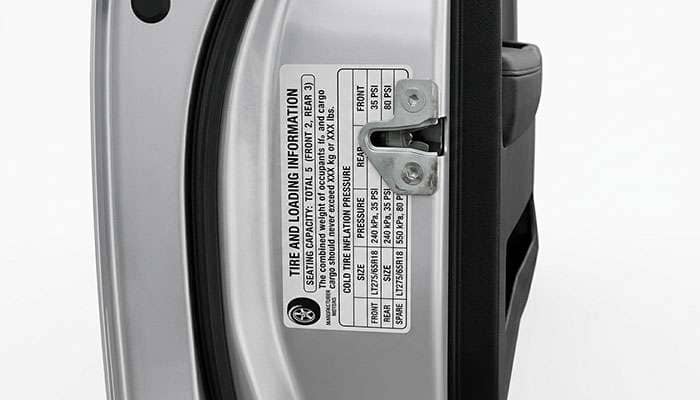
The tire doesn't set your towing rating; GMC does, per configuration. But the tire has to support it. Under FMVSS No. 110, the tire and loading placard on your door jamb lists the factory tire size and pressure the truck's rated loads depend on, and NHTSA's guidance for replacement tires is to match or exceed the original tire's load capacity. The Tire Industry Association trains technicians to the same rule.
That's where the trim spread bites. A Denali Ultimate on 275/50R22 SL tires carries 2,403 lb per tire. An SLE on 275/65R18s carries 2,756. If you tow, the load index on the replacement tire should never be lower than the factory tire's. It's even better if it has some margin. For the numbers behind that, read towing tire load range for half-ton trucks and load range vs. load index.
The industry's load tables credit passenger tires and light truck tires differently, and at the same pressure, a light truck tire generally carries less than a passenger tire of the same size. So if you move an LT tire onto a truck that came with passenger tires, run it at the pressure that matches the original tire's load, not the pressure on the placard. That usually means more air and a firmer ride.
A tire that matches the size but misses the spec doesn't fail in the driveway. It costs you a little at a time, and each step costs more than the last.
Every step on that list is avoidable by matching your trim's size, load index, and speed rating. Start with the 2025 GMC Sierra 1500 tire and wheel fitment page to see sizes matched to your trim.
If you're cross-shopping trucks, our F-150 tire size by trim guide lays out the Ford lineup the same way.
The 2025 GMC Sierra 1500 runs eight factory tire sizes from 255/70R17 to 275/50R22, all between 31.1 and 33.2 inches tall. The height is the easy part. What changes between trims is the sidewall, from 7.6 inches on the AT4X to 5.4 on the Denali Ultimate; the construction, with the AT4X alone on a Load Range C light truck tire; and the load index, from 111 on an SL 22-inch tire to 116 on a 275/65R18. Match all three when you buy replacements, not just the numbers in the size, and your Sierra will carry, tow, and ride the way GMC built it to.
The 2025 Sierra 1500 uses 255/70R17, 265/70R17, 265/65R18, 275/65R18, LT275/70R18, 265/60R20, 275/60R20, and 275/50R22, depending on trim and wheel package. Your exact size is on the driver's door jamb placard.
The 2025 Sierra AT4 is offered on 275/65R18 or 275/70R18 on 18-inch wheels, or 265/60R20 or 275/60R20 on 20-inch wheels, mostly with all-terrain tread.
The AT4X uses LT275/70R18, about 33.2 inches tall. The factory mud-terrain in that size is a Load Range C light truck tire rated 115/112Q, built to flex when aired down off-road.
The Denali comes on 275/60R20 or 275/50R22, and the Denali Ultimate on 275/50R22. The 22-inch size is sold as Standard Load (111) and Extra Load (115), so match the load construction on your factory tire.
Moving up to a factory size from another trim, such as 275/65R18 or 275/60R20, is usually fine. The AT4X's 33.2-inch LT275/70R18 is at the limit for a stock-height street trim, so test-fit at full steering lock and plan on a leveling kit if it rubs. Any taller size needs a speedometer recalibration.
They share the same platform, bolt pattern, and most tire sizes, but trims differ. For example, the Sierra AT4X and the Silverado ZR2 both use LT275/70R18. Always confirm with your own truck's door placard.



