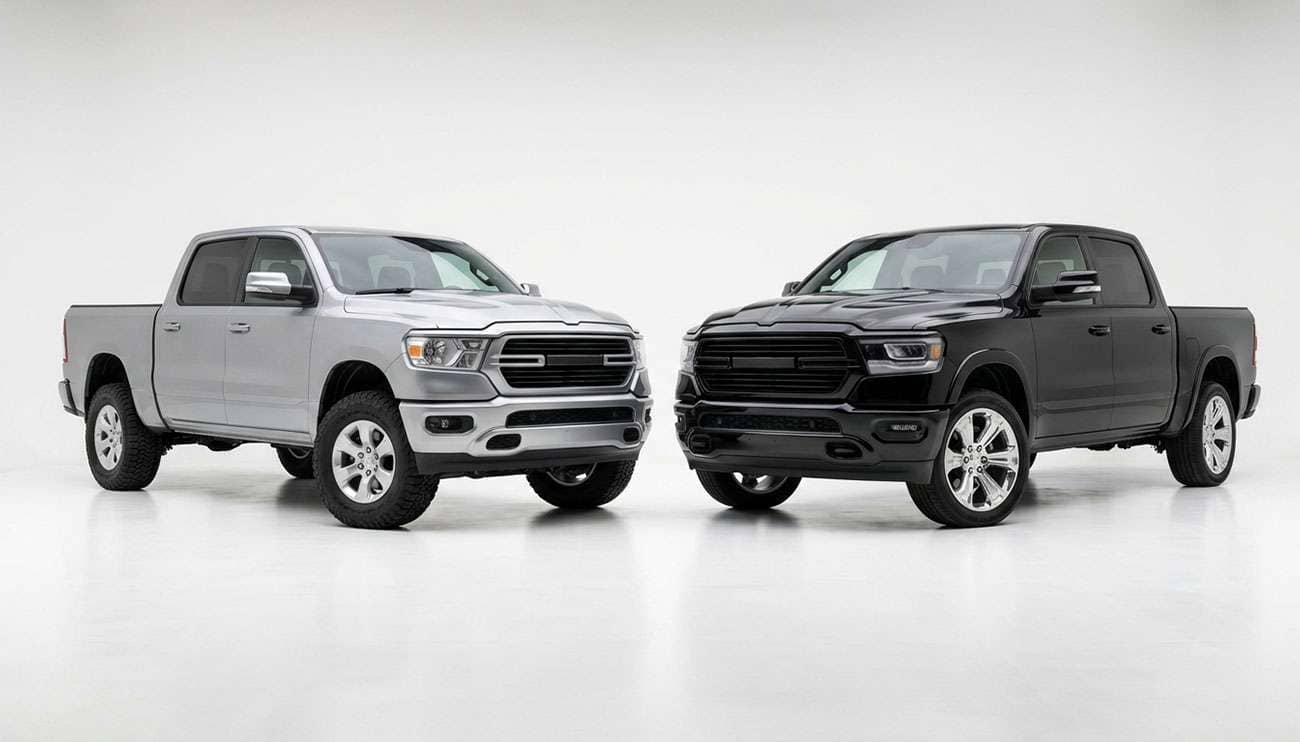
For 2026, Ford fits five standard-line F-150 sizes: 245/70R17, 265/70R17, 265/60R18, 275/65R18, and 275/60R20. The Tremor, the Raptor, two C-rated LT options, and a 22-inch package add more. The variable most size charts skip is load. The standard-load versions of those five sizes run from a 110 to a 116 load index, which works out to 2,125 to 2,505 pounds per tire once a passenger tire is counted for truck duty. Your neighbor's size is only right for your truck if it carries what your placard requires.
If you've searched this before and gotten a list of sizes with "check your door jamb" at the bottom, that list isn't wrong. It's just half the answer. The part nobody puts in front of you is the load number attached to each size, and how much it moves from one F-150 to the next. I spend most of my week matching load tables to trucks, so here's the full picture, size and capacity together.
Ford's 2026 F-150 technical specifications list every factory tire fitment by trim and drivetrain. The table below pairs each one with its overall diameter and the load rating that usually comes with it.
Trim and Drivetrain |
Factory Size |
Diameter |
Typical Load Rating |
Rated Load per Tire |
Counted on an F-150 |
|---|---|---|---|---|---|
XL, XLT 4x2 (all-season) |
245/70R17 |
30.5 in |
110, standard load |
2,337 lb |
2,125 lb |
XL 4x4 (all-terrain) |
265/70R17 |
31.6 in |
115, standard load |
2,679 lb |
2,435 lb |
STX, Lariat 4x2; optional on XLT 4x2 (all-season) |
265/60R18 |
30.5 in |
110, standard load |
2,337 lb |
2,125 lb |
STX, XLT, Lariat 4x4 (all-terrain) |
275/65R18 |
32.1 in |
116, standard load |
2,756 lb |
2,505 lb |
King Ranch, Platinum; optional on STX, Lariat |
275/60R20 |
33.0 in |
115, standard load |
2,679 lb |
2,435 lb |
Tremor (all-terrain) |
275/70R18 |
33.2 in |
116, standard load |
2,756 lb |
2,505 lb |
Optional on XL Fleet and FX4 Package |
LT265/70R17 C |
31.6 in |
112, Load Range C |
2,469 lb |
2,469 lb |
Optional on XLT 4x4 |
LT265/70R18 C |
32.6 in |
113, Load Range C |
2,535 lb |
2,535 lb |
Optional on STX Lobo Package, King Ranch, Platinum |
275/50R22 |
32.8 in |
111, standard load |
2,403 lb |
2,185 lb |
Raptor |
LT315/70R17 |
34.4 in |
Light truck; check placard |
Varies by load range |
Full rated load |
Raptor 37 Package |
37x12.50R17 |
37 in |
Check placard |
Varies |
Varies |
"Typical load rating" is the rating most common for that size and construction across the tire market; your door placard lists the exact requirement for your truck. "Counted on an F-150" divides passenger-tire ratings by 1.10, explained below. Diameters are nominal.
Line up the five standard-line fitments and the counted capacity runs from 2,125 pounds (245/70R17 and 265/60R18) to 2,505 pounds (275/65R18). That's a 380-pound gap per tire and 1,520 pounds across four tires, all on trucks wearing the same badge. Two of those sizes even share the same 30.5-inch diameter on different wheels, which is why "it's the same height" tells you nothing about load.
Tremor gets its own 33-inch all-terrain. Ford lists two C-rated light truck options: LT265/70R17 C with the FX4 Package or on XL Fleet trucks, and LT265/70R18 C on the XLT 4x4. The 22-inch 275/50R22 is optional on the STX Lobo Package, King Ranch, and Platinum. The Raptor rides on LT315/70R17, with a 37-inch package on top of that.
Most 2021 to 2025 F-150s share much of this lineup, but packages changed along the way. The 2021 to 2023 Heavy-Duty Payload Package, for example, paired 18-inch wheels with LT265/70R18 C all-terrains, and dealer-published 2023 specs listed a maximum F-150 payload of 3,315 pounds, well above the 2026 ceiling. If your truck is a few years old, the placard on the door is the only reference that counts.
Because "F-150 XLT" describes a trim, not a tire. Drivetrain, packages, and engine all change what Ford bolts on at the factory, and two trucks with the same badge on the tailgate can leave the plant on completely different rubber.
The 2026 XLT is the cleanest example. The 4x2 comes on 245/70R17 all-seasons. The 4x4 comes on 275/65R18 all-terrains. That's a 1.57-inch difference in diameter and a 419-pound difference in rated load per tire. Park those two XLTs in the same driveway and the owners are shopping for two different tires.
Order the FX4 Package and your truck may carry LT265/70R17 C instead of a passenger tire. Tick the Lobo Package and you're on 22s. Add the optional 20-inch wheels to a Lariat and you're shopping 275/60R20. The window sticker and the build sheet tell you which packages your truck actually has.
Ford's own 2026 spec sheet puts maximum payload anywhere from 1,405 pounds on the Raptor to 2,440 pounds on a properly equipped 3.5L EcoBoost 4x2, and notes that the label on the doorjamb shows the carrying capacity of a specific truck. Different payloads call for different tire capacities. That's the whole reason the sizes and load ratings differ.
At minimum, whatever your truck's placard specifies. More if you regularly load it near its limits. There's no single F-150 answer, and anyone who gives you one is guessing about your configuration.
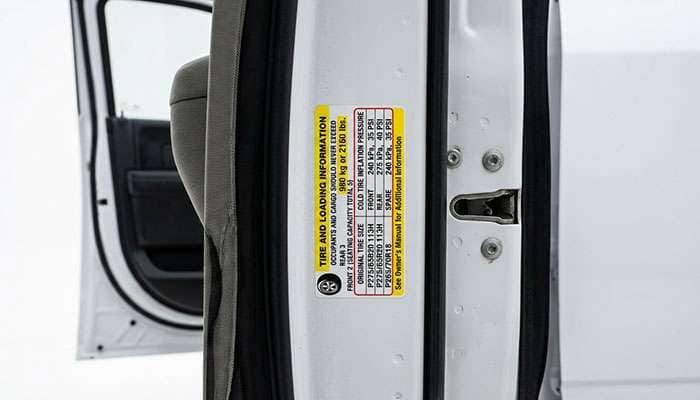
The tire and loading information placard, required under Federal Motor Vehicle Safety Standard No. 110, sits in the driver's door opening. It lists the original tire size, the recommended cold inflation pressure, and the combined weight of occupants and cargo the truck should never exceed. The certification label nearby adds the gross vehicle weight rating (GVWR) and the gross axle weight ratings (GAWR).
When a passenger tire goes on a light truck, its rated load is divided by 1.10. Tire makers including Toyo and Nitto trace that factor to Federal Motor Vehicle Safety Standard No. 120 and the Tire and Rim Association Yearbook. It applies to P-metric and metric (no-prefix) passenger tires alike, standard load or extra load. LT tires take no derate. Our P-metric vs. LT tire guide walks through the full math.
Here's how that plays out, using a hypothetical rear GAWR of 4,000 pounds. Split across two tires, each rear tire has to carry 2,000 pounds, and a 5 percent cushion raises the target to 2,100. A metric 245/70R17 at 110 counts as 2,125 pounds on the truck, so it clears. A P245/70R17 at 108 counts as 2,005 pounds. It technically covers the axle rating, but it misses the cushion by 95 pounds per tire. Same size on the sidewall, different answer at the scale. Run the same math with the real numbers from your own certification label before you buy.
Four tires' worth of counted capacity should comfortably exceed your GVWR, and each axle's pair should exceed that axle's GAWR. A common shop check builds in a 5 percent cushion on top, which we break down in the 105 percent rule for tires.
Same size, often a different load. Ford's 2026 spec sheet lists F-150 sizes without a "P" prefix, and in these sizes the P-metric version of a tire usually carries a lower load index than the metric version. That's the most common way a neighbor's "same size" ends up short on your truck.
Size |
P-Metric Standard Load |
Metric Standard Load |
Extra Load |
LT Load Range E |
|---|---|---|---|---|
245/70R17 |
108 (2,205 lb) |
110 (2,337 lb) |
114 (2,601 lb) |
119 (3,042 lb) |
265/70R17 |
113 (2,535 lb) |
115 (2,679 lb) |
116 (2,756 lb) |
121 (3,197 lb) |
265/60R18 |
109 (2,271 lb) |
110 (2,337 lb) |
114 (2,601 lb) |
119 (3,042 lb) |
275/65R18 |
114 (2,601 lb) |
116 (2,756 lb) |
116 (2,756 lb) |
123 (3,415 lb) |
275/60R20 |
114 (2,601 lb) |
115 (2,679 lb) |
116 (2,756 lb) |
123 (3,415 lb) |
275/50R22 |
111 (2,403 lb) |
111 (2,403 lb) |
115 (2,679 lb) |
119 (3,042 lb) |
Values show the most common rating in each column across the tire market; individual tires vary. Passenger columns still take the 1.10 factor on a truck. The LT column does not.
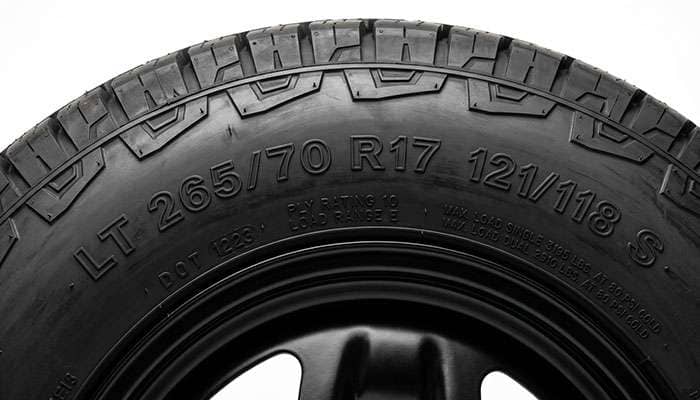
In 275/65R18, the size on most 2026 STX, XLT, and Lariat 4x4 trucks, P-metric versions most often carry a 114 while the metric versions carry a 116. That's 155 pounds of rated capacity per tire, or 140 pounds counted on the truck. Across four tires, a set that "matches the size" can come up 560 pounds short of what the truck left the factory with.
An Extra Load tire reaches a higher rating at a higher pressure. In 245/70R17 and 265/60R18, it jumps four points over metric standard load. In 275/65R18, it often matches the standard-load 116 exactly. Our guide to what XL means on a tire covers the pressure side of that trade.
Load range tells you the casing's pressure class. Load index tells you pounds. You need both to compare two tires honestly, and our breakdown of load range vs. load index shows how they fit together on the sidewall.
In construction, yes. In capacity, barely. The C-rated options on the FX4 and XLT 4x4 give you a light truck casing, but their load numbers land very close to a passenger tire of similar size once that passenger tire is derated.
An LT265/70R17 C typically carries a 112, or 2,469 pounds, with no derate. The standard-load 265/70R17 it replaces carries a 115, which counts as 2,435 pounds on the truck. The difference is 34 pounds per tire. The LT265/70R18 C, typically a 113, carries 2,535 pounds, a hair more than the 2,505 counted for a standard-load 275/65R18.
A tougher casing that resists punctures, bruising, and sidewall cuts on gravel and rock, plus a load rating that isn't discounted on a truck. That's worth having if your truck sees dirt roads or job sites. It just isn't a big capacity jump.
If your placard lists an LT tire, the pressure on that placard was set for that LT tire. Keep LT construction at the same or higher load rating. If you load the truck hard, an LT Load Range E in the same size adds real reserve. In LT265/70R18, the E version commonly carries a 124, about 3,527 pounds per tire.
Ford offers both on the same platform, so the swap is common. The catch is load. The neighbor's 20s or 22s were chosen for the neighbor's truck, and the lower-profile sizes often carry less than your 18s.
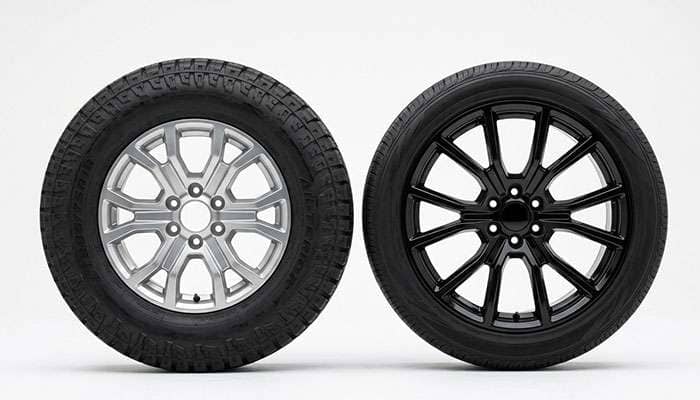
The 20-inch size is 33.0 inches tall versus 32.1, about 2.9 percent larger, near the edge of the 3 percent range most shops use for size changes. A standard-load 275/60R20 typically carries a 115, counted as 2,435 pounds, versus 2,505 for the 18-inch 116. That's 70 pounds less per tire. An Extra Load 275/60R20 at 116 or 119 closes it.
This is where the neighbor's size really bites. A standard-load 275/50R22 typically carries a 111, counted as 2,185 pounds. That's 320 pounds less per tire than the 275/65R18 it replaces, or 1,280 pounds across the truck. The Extra Load version at 115 counts as 2,435 pounds and gets you most of the way back. On a 4x4 truck that came on 18s, choose the XL.
Width, offset, and the wheel's own load rating all matter before the tire does. If you're shopping a wheel swap along with the tires, our F-150 aftermarket wheel guide covers what to check.
Not as a like-for-like swap. Both trims carry hardware the rest of the lineup doesn't, and their tires were sized around it.
The Tremor's 275/70R18 stands 33.2 inches tall, about 3.4 percent taller than the 275/65R18 on an XLT 4x4. Ford's spec sheet shows the Tremor with monotube shocks, a different transfer case than the XL, STX, and XLT, and a wider front track than a standard SuperCrew 4x4. Load isn't the issue, since both sizes typically carry a 116. Clearance and calibration are.
The Raptor's LT315/70R17 stands about 34.4 inches, roughly 7 percent taller than a 275/65R18, and rides on a Raptor-only chassis: cast aluminum lower control arms, FOX dampers, a five-link coil rear suspension, and a front track about 6 inches wider than a standard F-150. Raptor owners report Load Range C versions of this tire from the factory, so bigger here doesn't automatically mean more capacity. For taller aftermarket sizes on a standard truck, start with our F-150 aftermarket tire guide.
A size that mounts isn't the same as a size that works. When the diameter or the load rating misses your truck's spec, the costs stack up in a predictable order.
Ten minutes at the truck saves you from buying your neighbor's tires. Work through it in this order.
The F-150 lineup uses five standard-line sizes, a Tremor size, two C-rated LT options, a 22-inch option, and two Raptor sizes. Across the five standard sizes alone, counted capacity swings 380 pounds per tire. Add P-metric versions that trail their metric twins by a couple of load index points, and a "same size" tire can fall short of your truck's spec without looking any different.
So skip the neighbor's receipt and start with your own placard. Match the size, match or beat the load rating after the 1.10 factor, and keep LT construction where Ford specified it. When you're ready, shop truck tires by size and load rating and buy for the truck you actually own.
Here's what decides the right tire for your F-150.
Standard sizes are 245/70R17, 265/70R17, 265/60R18, 275/65R18, and 275/60R20, depending on trim and drivetrain. Tremor uses 275/70R18, Raptor uses LT315/70R17, and options include LT265/70R17 C, LT265/70R18 C, 275/50R22, and a 37-inch Raptor package.
Whatever your door placard specifies, at minimum. Common factory ratings run from 110 to 116 on standard-load sizes. Divide a passenger tire's rated load by 1.10 when comparing it for truck use.
Trim, drivetrain, and packages all change the factory tire. A 2026 XLT 4x2 uses 245/70R17 while an XLT 4x4 uses 275/65R18, and those sizes differ by 419 pounds of rated load per tire.
No. The 275/60R20 is about 2.9 percent taller, and its standard-load version typically carries a 115 instead of a 116. An Extra Load 275/60R20 matches or beats the 18-inch rating.
Only where Ford specified them, such as the C-rated options and the Raptor. Most trims use passenger-construction tires. If your placard lists an LT tire, keep LT construction at the same or higher rating.
Yes, if the load index still meets your placard after dividing by 1.10. In common F-150 sizes, P-metric versions often carry one or two load index points less than the metric tire Ford lists.