
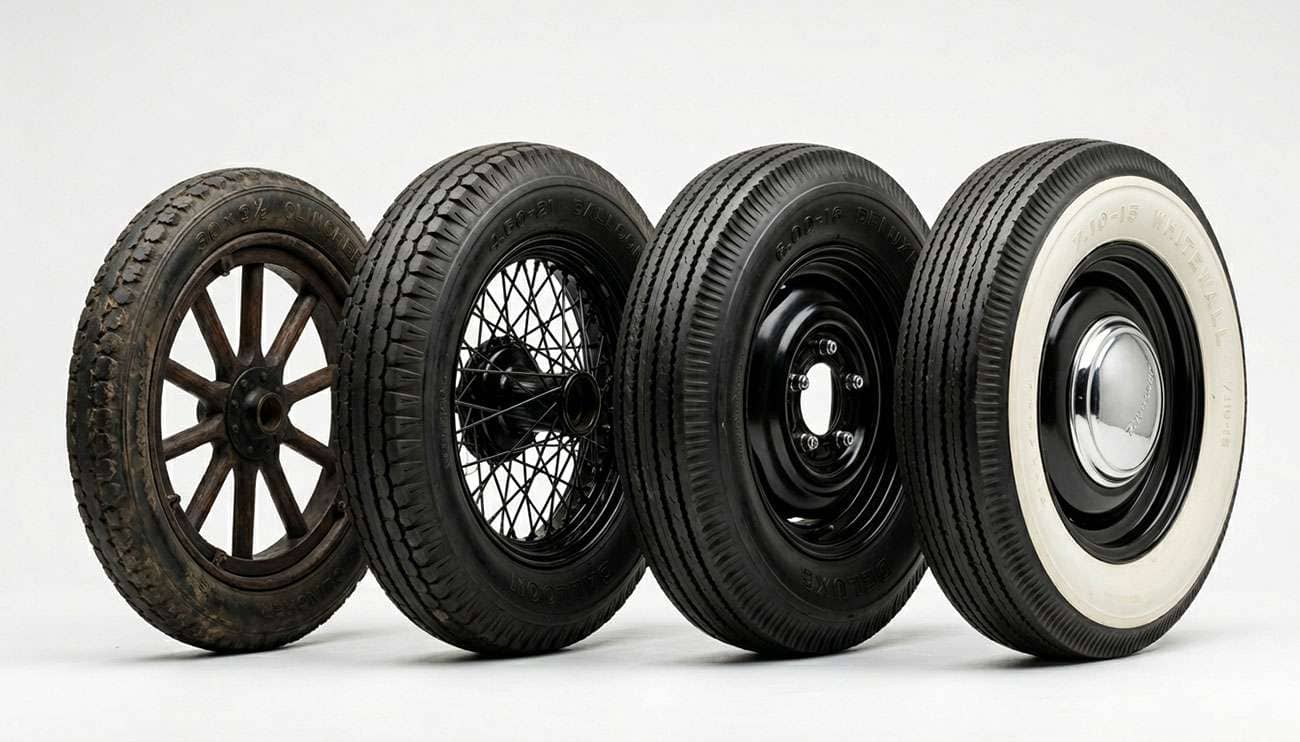
I take calls every week from guys who've just bought their first antique car and have no idea what tires it needs. They look at the sidewall of the old tire — if there even is one still on the car — and the numbers look like they're from another planet. 30x3½. 475/500-19. 6.00-16. G78-15. None of it matches anything at the local tire shop. The kid behind the counter shrugs. Google gives them fourteen different answers. And they end up calling me, which honestly is the right move because this stuff isn't as complicated as it looks once somebody explains it in plain English.
That's what I'm going to do right here. I've been decoding vintage tire sizes since before the internet existed, and I can tell you that every sizing system — no matter how alien it looks — follows a logic. Once you understand the logic, you can figure out what your car needs, find the right modern replacement, and stop guessing. Let me walk you through every system your antique car might use.
The short answer is that the tire industry changed its sizing conventions four separate times over the last century. Each new system made sense at the time, but nobody bothered to create a universal translator between them. So a tire that was called a 6.00-16 in 1940 became a 7.75-15 in 1960 became a G78-15 in 1970 became a 225/75R15 in 1980 — and they're all roughly the same physical tire. Four completely different numbers. Same rubber.
The other problem is that many original tire sizes have been discontinued. Nobody makes a 5.25-18 anymore. But somebody makes a tire that's the same dimensions under a different size designation, or a close-enough equivalent that fits the same wheel and fills the same fender opening. Knowing how to cross-reference between systems is the key to finding tires for any antique car.
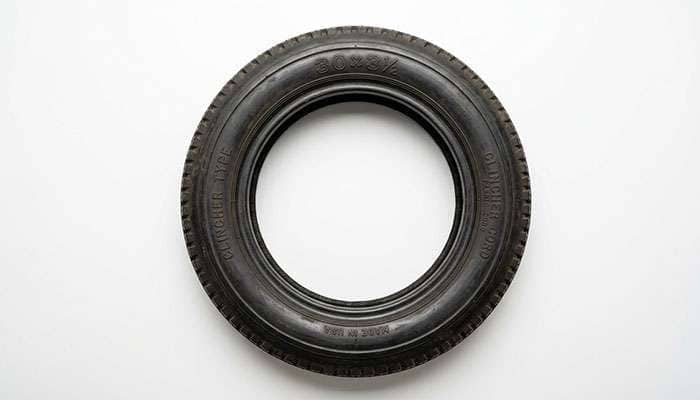
The oldest tire sizing system is also the simplest. Clincher tires — the ones that hook onto the rim rather than seating with air pressure — use a straightforward inches format: overall diameter × section width.
A tire marked 30x3½ is 30 inches in overall diameter and 3½ inches across. That's it. No aspect ratios, no speed ratings, no load indexes. Just two measurements in inches. These tires ran at high pressure (60-80 PSI) and were standard equipment on Ford Model T's through the early 1920s and virtually every other car of the brass era.
Common clincher sizes you'll encounter: 28x3, 30x3, 30x3½, 32x3½, 32x4, 33x4, 34x4, 36x4. The first number is always the overall diameter. The second is always the width. If your antique car has clincher rims — look for an inward-curving hook at the rim edge — you need clincher-specific tires. Excelsior makes beaded edge tires for these early vehicles, and Firestone produces clincher reproductions in the most popular Model T sizes.
One thing that trips people up: you can't put a modern wired-on tire on a clincher rim. The bead shapes are completely different. If your car has clincher rims, you're buying clincher tires. Period.
When balloon tires replaced clinchers in the mid-1920s, the sizing system changed. The new format was section width – rim diameter, both in inches. A tire marked 4.50-21 has a 4.50-inch section width and fits a 21-inch rim. Notice what's missing: the overall diameter. You have to calculate it (or just look it up) because the sizing system assumes an aspect ratio of roughly 90-100% — meaning the sidewall height is about 90-100% of the section width.
This system covered the vast majority of antique cars from the mid-1920s through the mid-1960s. Here are the sizes you'll encounter most:
1920s–early 1930s (19-21 inch wheels): 4.40-21, 4.50-21, 4.75-19, 5.00-19, 5.00-20, 5.25-18, 5.50-18. These fit Ford Model A's, Chevrolet Eagles, and most other American cars of the era.
Mid-1930s–1940s (16 inch wheels): 5.50-16, 5.50-17, 6.00-16, 6.50-16. The 6.00-16 became the single most common tire size in America during this period — it fit everything from Fords to Cadillacs.
Post-war 1950s–early 1960s (15 inch wheels): 6.70-15, 7.10-15, 7.60-15, 8.00-15, 8.20-15. As American cars got bigger and heavier after WWII, tire widths increased and wheel diameters shrank from 16 to 15 inches. Every number ending in zero (6.70, 7.10, etc.) indicates a tire with approximately a 90% aspect ratio — a tall, narrow profile by modern standards.
Here's one that catches people off guard. Many tire catalogs list sizes like 475/500-19 or 440/450-21. That slash between two numbers isn't a fraction or a width/aspect ratio — it means the tire fits rims that originally took either size. A 475/500-19 replaces both the 4.75-19 and the 5.00-19 because the actual dimensions are close enough that one tire covers both applications.
This combined sizing is most common in 1920s and 1930s tires where the manufacturing economics of producing two nearly identical sizes didn't make sense. Universal lists their Model A tires this way — you'll see 440/450-21 for the 1928-1929 Model A and 475/500-19 for the 1930-1931 Model A. Don't let the slash confuse you. It just means the tire covers two original sizes.
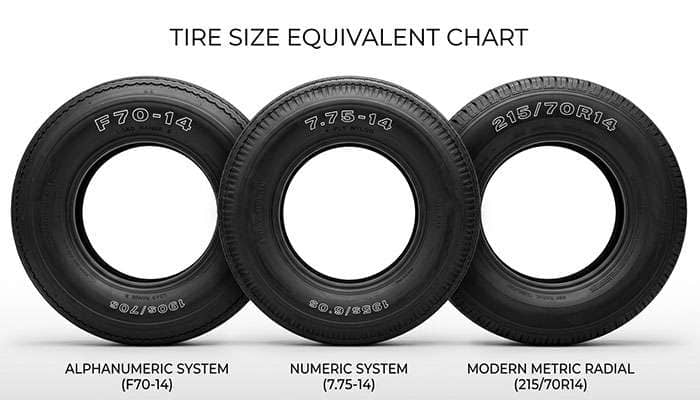
Just when you thought you had numeric sizing figured out, the industry threw a curveball in 1968. The new alphanumeric system used a letter to indicate load capacity, followed by the aspect ratio and rim diameter: G78-15 means the tire has a G load rating, a 78% aspect ratio, and fits a 15-inch rim. The letter "G" told you approximately how much weight the tire could carry — A was the lightest, N was the heaviest.
This system lasted only about eight years before being replaced by the modern P-metric system, but it covers some of the most popular collector cars ever made — late-1960s and early-1970s muscle cars, pony cars, and full-size sedans. If you're restoring a 1969 Camaro, a 1970 Chevelle, or a 1971 Plymouth Barracuda, there's a good chance the original tires were alphanumeric.
Common alphanumeric sizes and their approximate numeric and metric equivalents:
Alphanumeric |
Replaces Numeric |
Metric Equivalent |
Common Vehicles |
|---|---|---|---|
E70-14 |
7.35-14 |
205/70R14 |
Compacts, early pony cars |
F70-14 |
7.75-14 |
215/70R14 |
Mustang, Camaro, Nova |
G70-15 |
8.25-15 |
225/70R15 |
Chevelle, GTO, Road Runner |
G78-15 |
8.25-15 |
225/75R15 |
Full-size sedans, wagons |
H78-15 |
8.55-15 |
235/75R15 |
Full-size Buick, Olds, Chrysler |
L78-15 |
9.15-15 |
235/75R15 |
Cadillac, Lincoln, Imperial |
The "70" in the first column indicates a 70-series tire (70% aspect ratio) — these were the Wide Oval and Wide Tread performance tires of the muscle car era. The "78" indicates a standard 78-series tire with a taller sidewall for passenger cars. If you see a 60-series number (like F60-15), that's an even lower-profile performance tire — rare for the era and typically found only on high-performance factory options.
Here's the part everyone actually needs — how to take an old size and find a modern tire that fits. The principle is simple: match the overall diameter and the rim diameter. The width can vary slightly without causing problems, but the overall diameter must stay within 3% of the original or your speedometer will be off and the tire may not clear the fender.
For post-war numeric sizes, the conversion to modern metric is fairly direct. A 7.10-15 has roughly the same dimensions as a 205/75R15 radial. A 6.70-15 converts to approximately 205/75R15 as well (they overlap because the originals weren't precisely standardized). An 8.20-15 converts to approximately 235/75R15.
For pre-war sizes, the conversions are less direct because modern metric tires aren't made for 16-21 inch wheels in the narrow widths antique cars need. That's where specialty manufacturers come in — Kontio Tyre, Universal, Firestone, and Coker Classic all produce tires in the original antique sizing designations so you don't have to convert at all. A 6.00-16 is still available as a 6.00-16 — you just order it in that size.
Use our Antique Tire Size Conversion tool for a quick cross-reference, or call us at 888-926-2689 and I'll look up your car's original tire size in about 30 seconds.
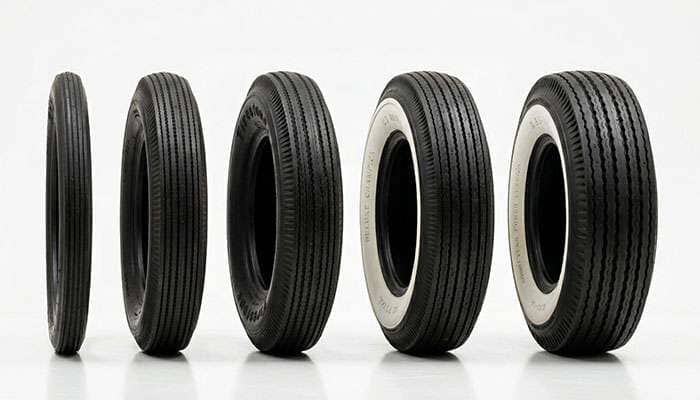
After decades of fielding calls, these are the sizes I sell most often. If your car is on this list, ordering just got easy:
Vehicle |
Years |
Original Tire Size |
Available As |
|---|---|---|---|
Ford Model T |
1909–1927 |
30x3½ (clincher) |
30x3½ clincher — Firestone, Universal |
Ford Model A (early) |
1928–1929 |
4.50-21 |
440/450-21 — Universal, Firestone |
Ford Model A (late) |
1930–1931 |
4.75-19 |
475/500-19 — Universal, American Classic |
1930s Fords / Chevrolets |
1932–1940 |
5.50-17 / 6.00-16 |
5.50-17, 6.00-16 — Firestone, Coker, Excelsior |
VW Beetle / Karmann Ghia |
1950s–1970s |
5.60-15 |
560R15 — Autobahn Bias Look Radial |
1950s American sedans |
1949–1960 |
7.10-15 / 7.60-15 |
205/75R15 or 225/75R15 radial — Kontio WhitePaw |
1957 Chevy Bel Air |
1957 |
7.50-14 / 8.00-14 |
215/75R14 or 225/75R14 — Kontio, American Classic |
Don't see your car? Browse our full classic tire selection or check the Whitewall Tires Guide for help matching sidewall styles. We carry tires for virtually every antique vehicle manufactured from 1900 through the 1970s.
Check three places: the old tire sidewall (if one exists on the car), the owner's manual or factory documentation, and the data plate on the vehicle (often on the door jamb or firewall). If none of those are available, Performance Plus Tire maintains a database of original equipment tire specifications for virtually every antique vehicle. Call us at 888-926-2689 with your year, make, and model and we'll look it up in about 30 seconds. You can also use our Antique Tire Size Conversion tool online to cross-reference between sizing systems.
The dash separates the tire's section width (in inches) from the rim diameter (also in inches). A 6.00-16 tire has a 6.00-inch section width and fits a 16-inch wheel. The overall diameter is not explicitly stated — it's determined by the aspect ratio, which for tires of this era was approximately 90-100%. So a 6.00-16 has an overall diameter of roughly 28 inches. This numeric sizing convention was used from the mid-1920s through the mid-1960s.
Yes. A 7.10-15 converts to approximately 205/75R15 in modern metric sizing. Both tires have roughly the same overall diameter (about 27.1 inches) and fit a 15-inch wheel. The radial construction of the modern tire will change the ride and handling characteristics — the steering will feel lighter and more responsive, and the car will track straighter on the highway. If you want to maintain the vintage appearance with radial performance, Kontio Tyre WhitePaw offers a 205/75R15 with genuine wide whitewall construction that looks period-correct.
The letter indicates the tire's load-carrying capacity — essentially how much weight the tire can support. The scale runs from A (lightest) through N (heaviest), with each letter corresponding to a progressively wider, heavier-duty tire. In practical terms, an E-rated tire is narrower and lighter than a G-rated tire, which is narrower than an L-rated tire. The 78 indicates the aspect ratio (78% sidewall height relative to width), and 15 is the rim diameter. So G78-15 means a mid-range load capacity tire with a 78-series profile on a 15-inch wheel.
The slash indicates that the tire is a combined size — it fits wheels that originally took either a 4.75-19 or a 5.00-19 tire. Manufacturers combined these similar sizes into a single production run because the dimensional differences were small enough that one tire could safely serve both applications. This is most common in 1920s and 1930s tire sizes. When you see a slash in an antique tire listing, just confirm that one of the two sizes matches your car's original specification.
Yes — and the selection is better today than it's been in decades. Brands like Universal, Firestone, Coker Classic, and Excelsior produce new tires in original antique sizing designations (30x3½, 4.50-21, 6.00-16, etc.) using modern rubber compounds that are safer and more durable than the originals. For post-war sizes, Kontio Tyre WhitePaw and American Classic produce tires in both original numeric and modern metric equivalents with period-correct whitewall styling. You rarely need to "convert" to a modern size unless you specifically want a modern radial — the original sizes are still available as new production tires.



