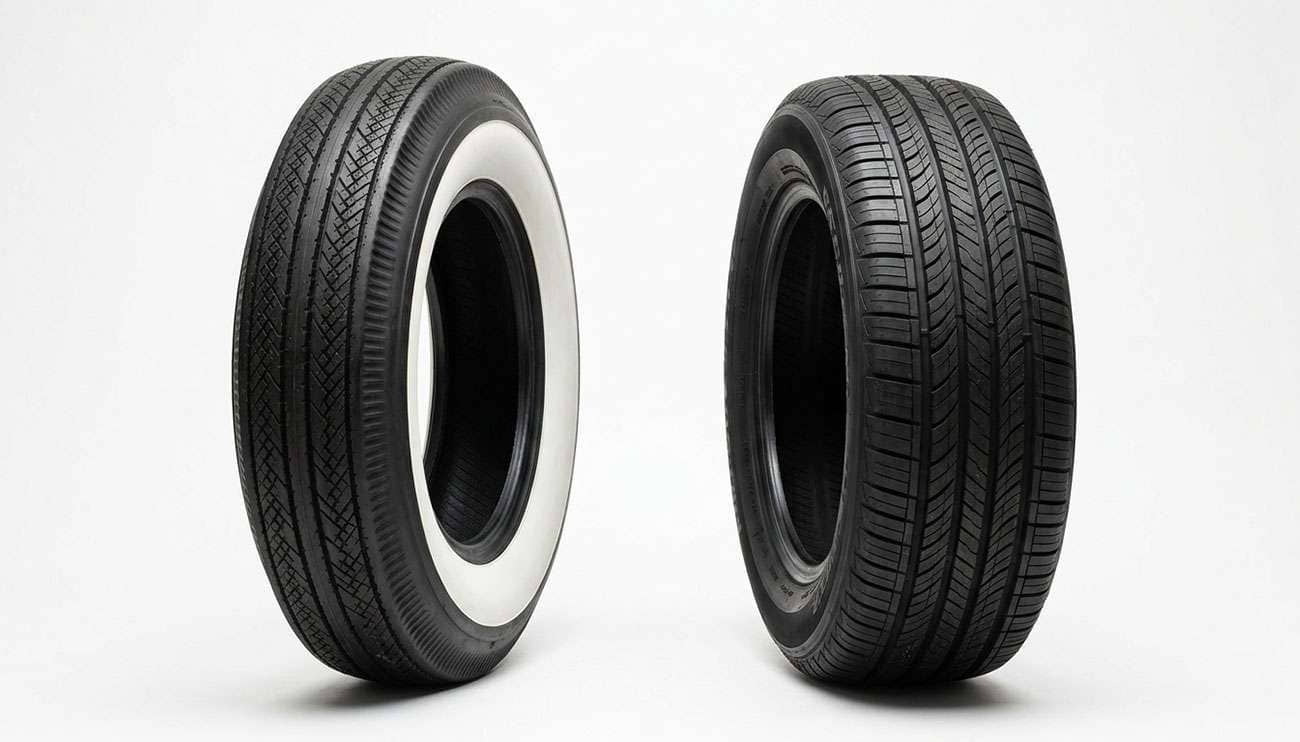
Never on the same axle. Front to rear, you can if you have to, but only one way around: bias-ply on the front, radials on the rear. Most answers stop at "don't mix them" and never explain why one split is tolerated and the other is the one that spins cars. The variable is which axle grips first. Radials build cornering grip at a smaller slip angle than bias-ply tires, so whichever end wears the bias tires is the end that lets go first.
I opened this shop in Long Beach in 1971, right as radials were taking over American cars, and I watched a decade of people bolt a pair of new radials onto whatever axle needed tires and keep the old bias tires on the other end. Some of those cars drove fine. Some of them came back on a hook. The difference was almost always which end got the radials. Today the question mostly comes from classic car owners who want period bias-ply tires up front, and the answer for them is better than "never," as long as they know the rules.
Setup |
Verdict |
What It Does to Handling |
At Inspection |
|---|---|---|---|
All four the same construction |
Correct |
Handles the way the car was set up to handle |
Passes |
Bias on one side, radial on the other, same axle |
Never |
Unequal grip side to side; pulls under braking and in turns |
Rejected in states that inspect tires |
Bias-ply front, radial rear |
Acceptable if you must mix |
Understeer: the front lets go first and the car pushes wide |
Generally passes |
Radial front, bias-ply rear |
Avoid |
Oversteer: the rear lets go first and the car tries to spin |
Rejected in Virginia; against tire industry guidance everywhere |
One bias-ply spare on a radial car |
Emergency only |
Creates a same-axle mix wherever it goes |
Slow, short trip to a replacement |
Dually or vehicle with dual rear wheels |
Either construction on either axle |
Four rear tires out-grip two fronts either way; never mix within a dual set or an axle |
Rules carve out duals |
"Acceptable if you must" is doing real work in that third row. It is the tire industry's fallback, not a recommendation. Every tire maker and most owner's manuals would rather see four tires of the same construction, the same as they would rather see matched brands, which our guide on whether you can mix tire brands covers.
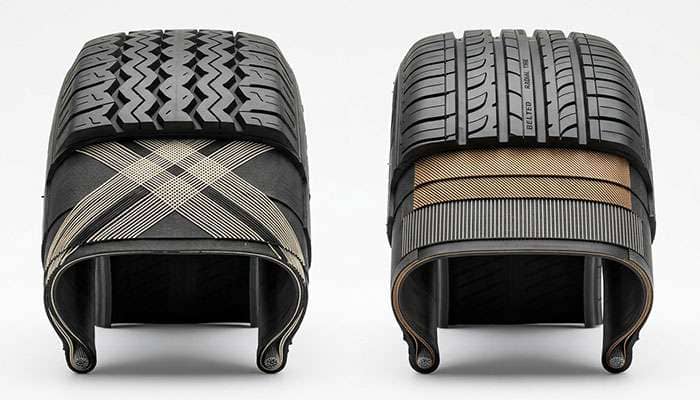
A bias-ply tire builds its carcass from layers of cord laid diagonally, typically 30 to 40 degrees off the centerline, each layer crossing the one below it. The sidewall and tread are one structure, so when the sidewall flexes, the tread squirms with it. A radial runs its body cords straight across from bead to bead and puts a stiff belt package under the tread. The sidewall flexes on its own and the tread stays flat on the road.
That difference shows up in slip angle, the small gap between where a tire points and where it actually travels in a turn. Every tire needs some slip angle to make cornering force. A radial makes a given amount of cornering force at a smaller slip angle than a bias-ply tire. Engineers call that higher cornering stiffness, and it is the whole story.
The research on this goes back to the years radials took over. A 1975 SAE paper from the University of Michigan's Highway Safety Research Institute analyzed the cornering properties of roughly 160 passenger tires. Radials stood clearly apart from bias and bias-belted tires on slip angle, and the authors found that mixing produced large departures from matched handling, particularly in radial and bias-ply combinations. A 1974 SAE study found the same thing from the vehicle side: the biggest handling changes came when the front and rear tires had different cornering stiffness.
Here is the mechanism in plain terms. In a turn, the axle with the lower cornering stiffness has to run a bigger slip angle to hold the car on its line. If that is the front axle, the nose drifts wide and you add steering. That is understeer, and every driver knows what to do about it. If that is the rear axle, the tail drifts out, the car turns tighter than you asked, and the faster you go the worse it gets. That is oversteer, and most drivers do not know what to do about it.
No, and this is the one part of the question with no gray area. Put a radial on one end of an axle and a bias-ply on the other, and the two tires make different amounts of cornering and braking force at the same steering input. The car pulls under braking, steers differently left than right, and the two tires do not even roll the same distance per revolution, so they scrub against each other down every straight.
Tire makers say never. Goodyear's dealer guidance states it flatly, and the industry's replacement guidelines from the old Rubber Manufacturers Association, now the U.S. Tire Manufacturers Association, call for matched construction. So does government. NHTSA's vehicle-in-use inspection standard for state inspection programs, 49 CFR Part 570, treats a major mismatch in tire size, construction or profile on the same axle as a cause for rejection. State inspection rules in Pennsylvania, Virginia, New Hampshire, Maryland, Missouri, Hawaii and Utah all reject a radial and a bias-ply tire sharing an axle. New Hampshire applies the same rule to street rods specifically.
Pennsylvania's code includes one useful phrase: different tire types may not share an axle "except in an emergency." That is the right way to think about it. A same-axle mix is a way to get home, slowly, not a way to drive.
Yes, if you have to mix. This is the combination the tire industry tolerates. The RMA replacement guidelines say that if two radial tires and two non-radial tires must be used on a vehicle, the radials go on the rear axle. Goodyear's guidance says the same thing in stronger words: when radials are used with bias or bias-belted tires on the same vehicle, the radials must always be on the rear.
The reason follows straight from the mechanism. With bias-ply tires up front and radials in back, the front reaches its limit first. The car understeers. In a corner taken too fast, or on a wet off-ramp, the nose pushes wide and lifting off the throttle usually brings it back. It is not the handling the car had on four matched tires, but it is the safe kind of wrong.
Two cautions. First, understeer is still a handling change, and it is biggest exactly when you need grip most: emergency lane changes and wet curves. Drive a mixed car with that in mind. Second, some modern owner's manuals go further than the tire industry and say not to mix bias-ply and radial tires on the vehicle at all. If your car's manual says that, follow it. Front-bias, rear-radial is a classic-car compromise, not a modern-car option.
The rear lets go first. With radials up front and bias-ply tires in back, the rear axle has the lower cornering stiffness, so in a hard turn or a sudden swerve it runs out of grip before the front does. The tail steps out. An inexperienced driver's instinct, lifting off or braking, shifts weight forward and makes it worse.
Virginia's inspection regulations reject a vehicle with bias-ply or bias-belted tires on the rear axle when radials are on the front. Goodyear's guidance goes as far as warning dealers never to mount non-radial snow tires on the rear when radials are on the front, unless the vehicle has dual rear wheels.
There is old military evidence for how unforgiving this can be on a light vehicle. A U.S. Army test program in the 1970s tried mixes of radial and bias-ply tires on several vehicles, from the M151 quarter-ton utility vehicle up to heavier trucks and a school bus. The testers concluded the M151 could not safely tolerate any mixture of bias and radial tires, while the heavier, more stable vehicles were less sensitive. A light, short-wheelbase car is the M151 end of that range. A lot of hot rods and roadsters are exactly that.
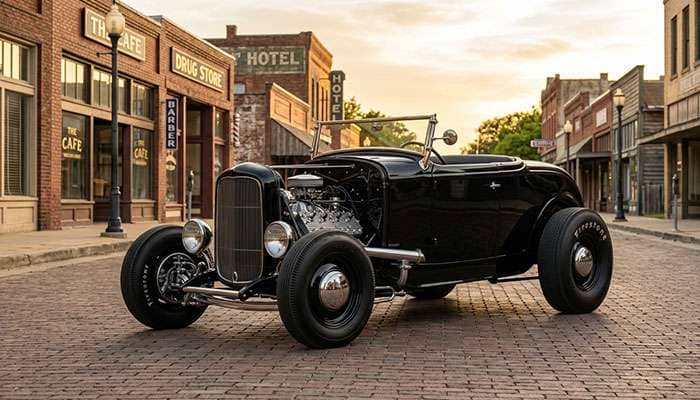
This is where the question comes from today, and there are good reasons for it.
Bias-ply fronts with radial rears is the tolerated direction, so a classic set up that way is inside the industry's rules. The setup to watch for is the reverse, and it is common in the nostalgia drag look: radial front runners with big bias-ply cheater slicks in the back. That puts the lower-grip tire on the rear axle, which is the oversteer combination, on a car that usually has plenty of torque to break the rear loose. If you want that look, run bias up front too, or go to radial rears.
Here is how the common classic setups sort out:
Your Car and How You Use It |
Front |
Rear |
Why |
|---|---|---|---|
Judged or period-correct show car, short drives |
Bias-ply |
Bias-ply |
Correct look, matched handling, low miles |
Traditional hot rod with skinny front runners |
Bias-ply or bias-look radial |
Match the fronts, or radial if the fronts are bias |
Never radial fronts over bias rears on a light car |
Nostalgia drag look with cheater slicks |
Bias-ply |
Bias-ply cheaters, or drag radials with radial fronts |
Keeps the lower-grip tire off the rear by itself |
1950s and 1960s cruiser driven regularly |
Bias-look radial |
Bias-look radial |
Period look with matched radial handling |
Muscle car, original-look driver |
Radial in a period-style size |
Radial in a period-style size |
Raised-letter and redline radials exist in many period sizes |
Restomod or daily-driven classic |
Radial |
Radial |
Modern grip, matched, no compromise |
One more thing when you split construction front to rear: set each tire to the pressure its maker specifies for that size and construction. The number in a 1960s owner's manual was written for the tires that car left the factory on. Our guide to classic car tire pressure walks through how to get it right. And if you are still deciding between the two constructions altogether, our comparison of radial vs. bias-ply tires for classic cars lays out the trade-offs.
To get off the road and to a replacement, yes. Beyond that, no. A single bias-ply spare on a radial car creates a same-axle mix wherever you mount it, which is exactly the emergency use Pennsylvania's code allows and nothing more. Drive slowly, avoid the highway if you can, and replace it with a matching radial as soon as possible.
Plenty of classic cars still carry their original bias-ply spare, sometimes a tire that has never touched pavement. Before you count on it, read the DOT date and look hard at the sidewall for cracking. A decades-old spare can be unsafe at any speed. Our checklist on when classic car tires should be replaced covers what to look for, and if you find cracks deep enough to show cords, our guide to tire sidewall damage explains why that tire is done.
Not on the same axle. Trailer rules follow the same logic, and the stakes are different: a trailer has no driver correcting it. A bias-ply and a radial ST tire on one axle carry load differently because the bias tire's stiffer sidewall deflects less, so the two tires never share the load evenly. On a tandem trailer, keep every tire the same construction. Mixing construction axle to axle makes the axles fight each other, with uneven wear and extra heat as the result.
If your trailer is already a mix, that is worth fixing before your next long pull, especially if it has been eating tires. Our piece on why trailer tires keep blowing out covers the other usual suspects.
A mixed set does not announce itself on a calm drive. It sends the bill later.
For most classic owners, the cleanest answer is to stop choosing. A bias-look radial is a true radial under the skin, with a sidewall, tread pattern and profile built to look like the original bias-ply tire. You get period looks and matched radial handling on all four corners, and the front and rear question goes away.
That is a big part of why we keep our own Autobahn bias-look radials in the lineup, and why bringing Lucas Classic Tires into the family this year mattered to me. A classic owner should not have to pick between how the car looks and how it stops. Our guide to bias-look radial tires explains how they are built and what they change, and you can browse period sizes in both constructions in our classic tires collection.
Radial and bias-ply tires make cornering grip differently, and that one fact sets every rule. On the same axle, they fight each other, which is why tire makers, NHTSA's inspection standard and a long list of states all say no. Front to rear, the rule is about which end lets go first: bias-ply fronts with radial rears give you understeer, the forgiving kind of wrong, while radial fronts with bias-ply rears give you oversteer.
For a classic on bias-ply fronts, that means you are inside the rules as long as the radials are in the back and you drive with a little understeer in mind. If you want the look and the handling without any compromise, a set of four bias-look radials gets you there.
Never on the same axle. If you must mix front to rear, tire industry guidance puts the radials on the rear axle and the bias-ply tires on the front. Four tires of the same construction is always the better setup, and some modern owner's manuals say not to mix at all.
Yes, if you have to mix. This is the combination tire makers tolerate, because the front reaches its grip limit first and the car understeers instead of spinning. Expect the car to push wider in hard or wet corners than it would on four matched tires.
The two tires make different amounts of cornering and braking force, so the car pulls under braking and steers differently in each direction. The tires also roll slightly different distances and scrub as a result. It should only ever happen as a short emergency setup.
In many states with vehicle inspections, a radial and a bias-ply tire on the same axle is a rejection, including Pennsylvania, Virginia, New Hampshire, Maryland, Missouri, Hawaii and Utah. Virginia also rejects bias-ply tires on the rear axle when radials are on the front. Check your own state's inspection rules.
Only as an emergency, to get to a replacement at low speed. A single bias-ply spare creates a same-axle mix wherever it is mounted. On a classic car, check the spare's DOT date and sidewall condition before relying on it at all.
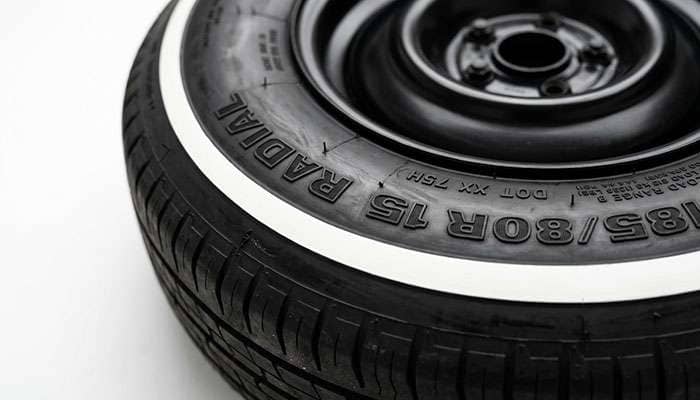
Read the size on the sidewall. An R in the size, such as 670R15 or 205/75R14, means radial. A dash or a D, such as 6.70-15 or ST205/75D14, means bias-ply. Most radials are also marked with the word Radial on the sidewall.