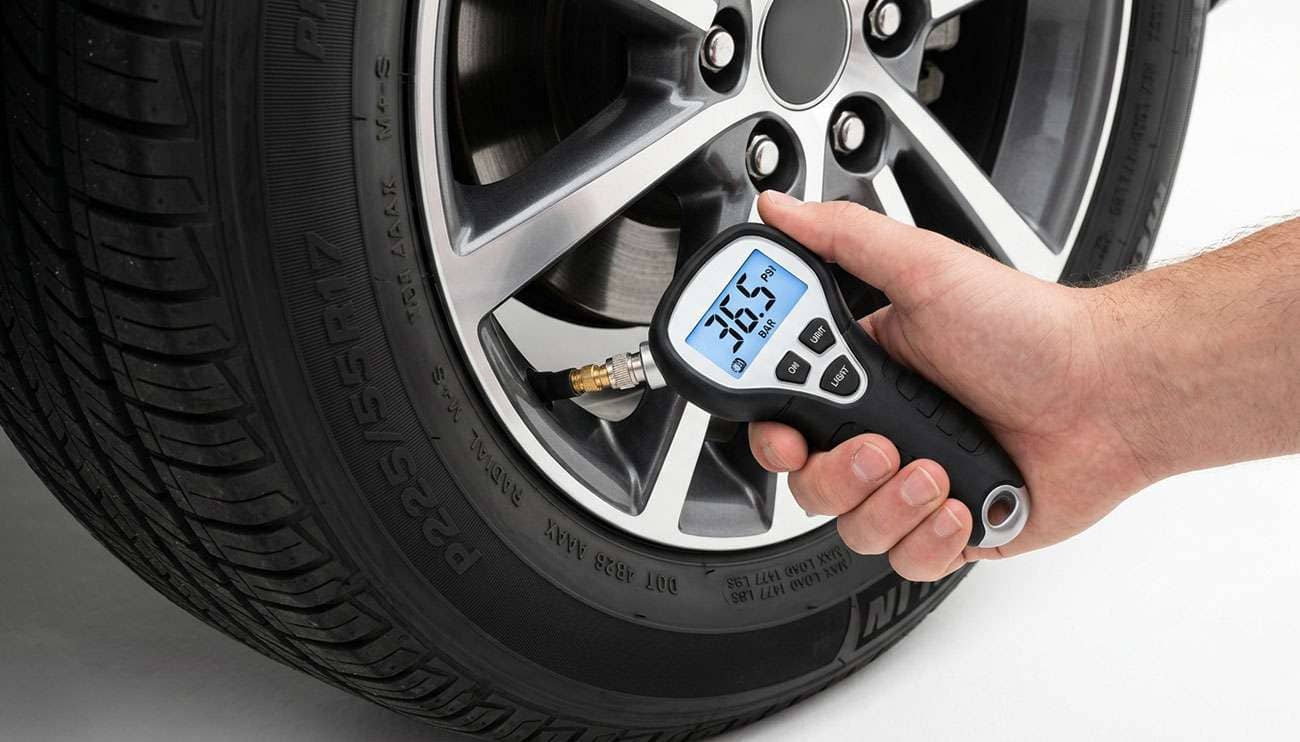
There is no single number of safe extra PSI, and that is exactly why every article you have read on this question hedges. The honest answer depends on why you are adding the air. Three PSI added to offset a cold morning is a completely different act from three PSI added to keep a warning light off, even though your gauge reads the same in both cases. One is correcting back to spec. The other is hiding a problem. Below is the ceiling for each reason people actually reach for the air hose.
I run fitment numbers at Performance Plus Tire every day, and this question comes in constantly with the reason attached: I tow, I autocross, my light keeps flickering, I want better mileage. The reason changes the answer completely. So let us take them one at a time instead of pretending a single figure covers all of them.
Find your reason in the left column. The safe range is measured against the cold inflation pressure printed on your driver door jamb placard, not the number molded into your tire sidewall.
Why You Are Adding Air |
Safe Range Over Placard |
Hard Ceiling |
What It Costs You |
Verdict |
|---|---|---|---|---|
Topping up after a cold snap |
0 PSI over |
Placard number |
Nothing |
Correct. You are restoring spec, not exceeding it |
Chasing better fuel economy |
0 to 2 PSI |
3 PSI over |
More tread than the fuel is worth |
Not worth it. The math does not close |
Keeping the TPMS light off |
0 PSI |
None. Wrong tool |
Masks a leak or a failing sensor |
Do not. Diagnose the cause instead |
Towing or hauling a load |
Follow the placard loaded column, often 3 to 8 PSI on the rear |
Max cold inflation on the sidewall |
Nothing when done correctly |
Correct. This is the case the extra air was designed for |
Prepping for a track day |
Negative. Set cold pressure lower |
Hot target, commonly 36 to 40 PSI |
Greasy, overheated tire on lap three |
Backwards. Adding cold PSI hurts you here |
Switched to XL tires or plus sized |
Recalculate from load tables, often 2 to 5 PSI |
Max cold inflation on the sidewall |
Nothing when calculated properly |
Correct. Your placard number expired when the tire changed |
Most drivers treat the placard figure as a suggestion. It is not. Under Federal Motor Vehicle Safety Standard 110, every passenger vehicle sold in the United States carries a placard listing the recommended cold inflation pressure, the vehicle capacity weight, the seating capacity, and the original tire size. Those four items are one package. The pressure figure is derived from the other three.
Here is what that means practically. The automaker weighed the vehicle, established the maximum load it could legally carry, looked up the load index of the original equipment tire, and then found the inflation pressure at which that tire carries that load with a margin built in. That margin is the part nobody mentions. Your placard number is not the minimum pressure at which the tire survives. It already includes reserve capacity above what the fully loaded vehicle demands.
So when someone tells you to add a few PSI for safety, ask what specifically they think is unsafe about the engineered number. Usually there is no answer, because the reserve is already there.
The second half of that package matters just as much. The pressure was calculated for a specific tire, with a specific load index, at a specific size. Change the tire and the calculation changes with it. That is the entire reason two of the six rows in the table above land on the correct side of the ledger. Fitment changes create legitimate reasons to run more pressure. Vibes do not.
For a stock daily driver on original equipment sizing, a touring tire like the Michelin Defender 2 is engineered around exactly the pressure your placard specifies. Nothing about running it 4 PSI high improves anything the engineers left on the table. If you are unsure where to find your figure or which of the several numbers on your car is the right one, our walkthrough on how to find your recommended tire pressure sorts out the placard, the manual, and the sidewall in a couple of minutes.
One clarification before we go further, because it derails more conversations than any other point. The number molded into your sidewall, usually something like Max Press 44 PSI or 51 PSI, is the maximum pressure the tire structure is rated to hold cold. It is a limit, not a target. Filling to it is the single most common way drivers end up genuinely overinflated, and we covered the full consequences of that in our piece on overinflated tires. Everything in this article measures from the placard.
This is the most popular reason and the weakest one, and it fails on arithmetic rather than on safety.
The mechanism is real. A harder tire deflects less as it rolls, less deflection means less energy lost to hysteresis in the rubber, and less energy lost means marginally better mileage. The U.S. Department of Energy quantifies the underinflation side of this: mileage drops roughly 0.2 percent for every 1 PSI of average pressure lost across all four tires. People run that relationship backwards and assume adding pressure buys the same 0.2 percent per PSI in the other direction.
Run the numbers on that assumption at its most generous. Say you drive 12,000 miles a year at 30 MPG. That is 400 gallons. At 4 dollars a gallon you are spending 1,600 dollars on fuel. Add 5 PSI and grant yourself the full 1 percent improvement. You have saved 16 dollars over the year.
Now the other side of the ledger. Running consistently above placard concentrates load on the center of the tread, and center wear does not stop when you have collected your 16 dollars. On a 60,000 mile treadwear warranty set, losing even 15 percent of usable tread life costs you 9,000 miles. On a set of four tires at 200 dollars each, that is roughly 120 dollars of rubber. You spent 120 to save 16, and you gave up contact patch the entire time.
The relationship also flattens out. The efficiency gain per additional PSI shrinks the further above placard you go, while the wear penalty does not shrink at all. There is no pressure at which this trade turns profitable. Our deeper breakdown of the fuel side lives in does tire pressure affect gas mileage, and the short version is that the money is in never being underinflated, not in being overinflated.
If fuel economy is genuinely your goal, the lever is tire selection, not the air hose. A low rolling resistance compound at the correct pressure beats a standard compound at 5 PSI over, and it does it without costing you tread or wet grip.
This one deserves its own section because the reasoning behind it is built on a misunderstanding of how the system works, and correcting that misunderstanding usually solves the actual problem.
Under Federal Motor Vehicle Safety Standard 138, the TPMS warning lamp is required to illuminate when pressure in a tire falls to 25 percent or more below the manufacturer recommended cold inflation pressure. Twenty five percent. That is not a hair trigger. If your placard says 35 PSI, the light is not designed to come on until you are down around 26 PSI.
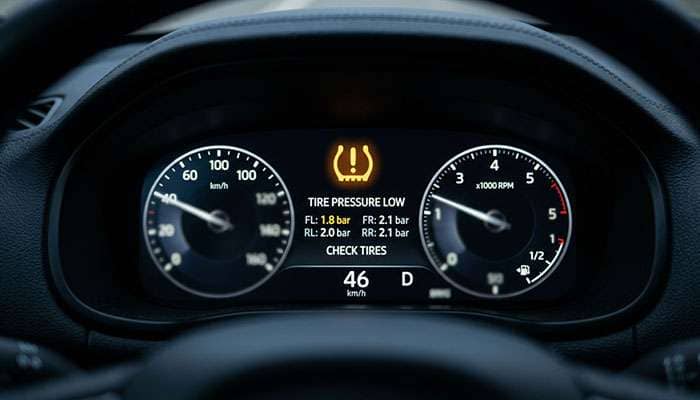
Sit with that for a moment. If your light is coming on, or flickering on cold mornings and clearing later in the day, you are not sitting 2 PSI low. You are sitting roughly 9 PSI low on a 35 PSI vehicle. Adding 3 or 4 PSI above placard to buy yourself headroom above that threshold does not fix anything. It just moves you further from the warning while the underlying cause continues.
And there is almost always an underlying cause. In our experience the flickering TPMS light traces back to one of four things:
None of those are solved by extra air. Three of them get worse while you drive around masking them. If your light is part of the picture, our guide on whether you can still drive with the TPMS light on walks through triage before you touch the pressure.
The correct move is to set all four tires to placard cold, note the exact figures, and check again in seven days. A tire that has dropped more than 1 to 2 PSI in a week has a leak. That is diagnosis. Padding the number is avoidance.
Here is where the answer flips. When you load a vehicle, running more pressure is not a shortcut or a risk. It is the specification.
The reason goes back to the load and inflation relationship that underpins the whole system. A tire's load carrying capacity is a direct function of its inflation pressure. Tire and Rim Association load and inflation tables map this out in detail, and the anchor points are worth memorizing. A P-metric standard load tire reaches its branded maximum load at 35 PSI. A P-metric extra load tire reaches its maximum load at 41 PSI. On the light truck side, Load Range C reaches maximum load at 50 PSI, Load Range D at 65 PSI, and Load Range E at 80 PSI.
Read those numbers as a ladder rather than as limits. Below the anchor pressure, the tire carries proportionally less. So when you hitch up a trailer and shift several hundred pounds of tongue weight onto the rear axle, the rear tires need to climb that ladder to carry it. Leaving them at the unloaded placard figure means asking a tire to carry a load it is not currently inflated to support, and that is the condition that produces excessive sidewall flex, heat buildup, and eventually failure.
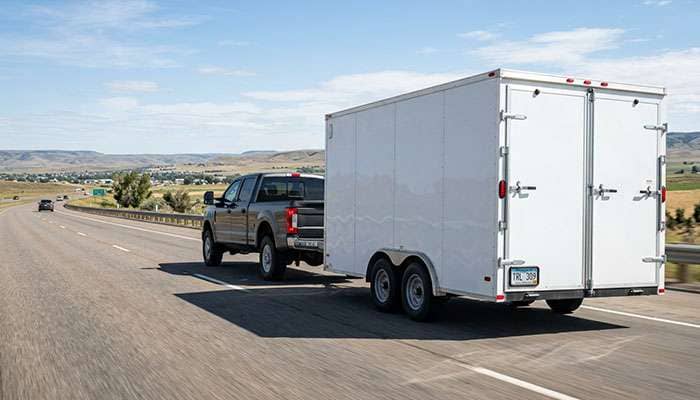
Check your placard before you assume you need to calculate anything. Most trucks and many SUVs list two pressure sets, one for normal operation and one for maximum load, and the loaded figure is commonly 3 to 8 PSI higher on the rear. If your placard has that column, follow it. You are not exceeding spec. You are using the part of the spec most drivers never read.
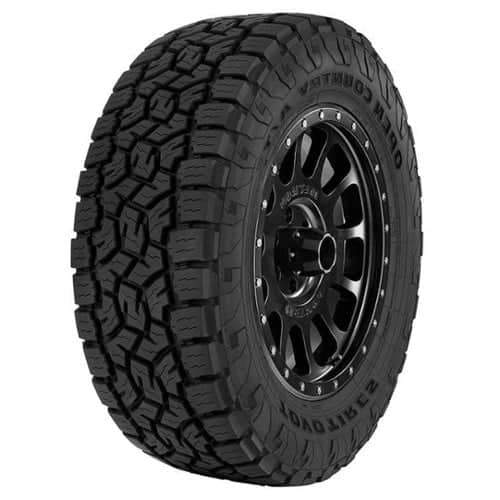
If you are running a light truck tire like the Toyo Open Country A/T III in an LT size with a load range rating, this matters even more, because LT tires are far more sensitive to inflation than P-metrics are. An LT tire at unloaded pressure carrying a loaded axle is working well outside its design window.
Two boundaries to respect. First, add pressure to the axle that is actually carrying the load. Adding it to the front when the weight is on the rear gives you a nose that skates and a rear that is still overloaded. Second, never exceed the maximum cold inflation pressure molded into the sidewall, no matter what a table suggests. That figure is a structural limit on the tire itself.
When you are done towing, take the pressure back out. Loaded pressure on an empty truck is just overinflation with a good excuse.
Run your numbers through our inflation pressure vs load calculator to see exactly what pressure your size and load range needs for the weight you are actually carrying.
Track day pressure is where the instinct to add air does the most damage, because the correct procedure runs in the opposite direction from what most drivers expect.
A tire on track gains pressure dramatically. Street driving might add 2 to 4 PSI from cold to operating temperature. Twenty minutes of hard lapping routinely adds 6 to 10 PSI or more, depending on ambient temperature, surface, and how much load you are putting through the tire. That gain is not a problem to be prevented. It is the expected behavior, and the entire setup process is built around it.
Which means you do not set your track pressure cold. You set a cold pressure that arrives at your target once hot. If your hot target is 38 PSI and your tires gain 8 PSI on track, you start at 30 PSI cold. Start at 38 cold and you will be at 46 by the end of your first session, which is well past the point where the contact patch has crowned, the shoulders have lifted, and the car has gone loose and greasy on you.
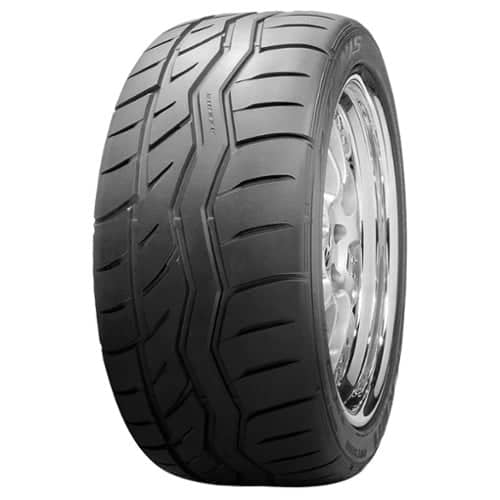
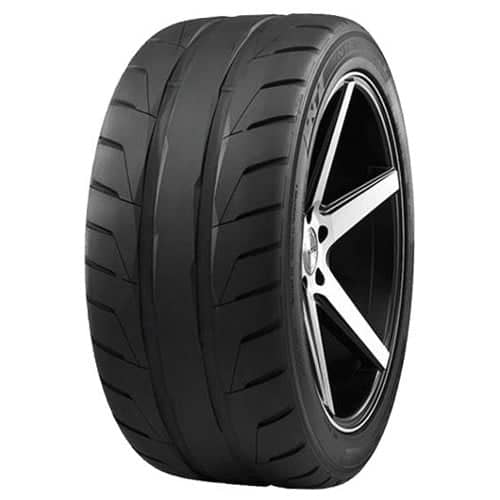
Dedicated track and autocross tires like the Falken Azenis RT615K+ and the Nitto NT05 have narrower optimal pressure windows than street touring tires, which makes the cold offset more important rather than less. These compounds reward precision. A couple of PSI either side of the window is the difference between a tire that turns in cleanly and one that pushes.
The procedure is straightforward. Set cold pressures in the paddock before your first session and write them down. Come in after the session and check pressures immediately, while the tires are still hot, because they start bleeding heat the moment you stop. Note the hot reading, bleed down to your hot target, and record how much you removed. That number is your gain. Next session, subtract it from your target and set that cold. After two sessions you will know your car and your tires well enough to set cold pressure once and forget about it.
Tire pyrometer readings across the tread will tell you whether you have it right. Even temperatures across inside, middle, and outside mean the contact patch is flat. A hot middle relative to the shoulders means you are still carrying too much pressure.
Cold weather is the one situation where drivers reach for the air hose for a legitimate reason and then commonly overshoot the fix.
The physics is simple. Air pressure in a sealed volume falls as temperature falls, at a rate of roughly 1 PSI for every 10 degrees F of drop. A car set to 35 PSI on a 75 degree afternoon in October is sitting near 30 PSI on a 25 degree January morning without a molecule having escaped. That is a real loss of load capacity and it is worth correcting.
The correction is topping back up to placard, measured cold. It is not adding a cushion above placard to preempt the next cold snap. The placard figure is itself a cold inflation specification, which means it already assumes the tire is at ambient temperature and has not been driven. Add a buffer on top and you are overinflated on every day that is not the coldest day of the year.
Cold measured properly means the vehicle has sat at least three hours, or has been driven less than about a mile. Checking at a gas station after a twenty minute highway run gives you a warm reading that can sit 4 to 6 PSI above the cold figure, and setting to placard on a warm reading leaves you genuinely underinflated once everything cools. This is the single most common way people end up low in winter while believing they just filled up.
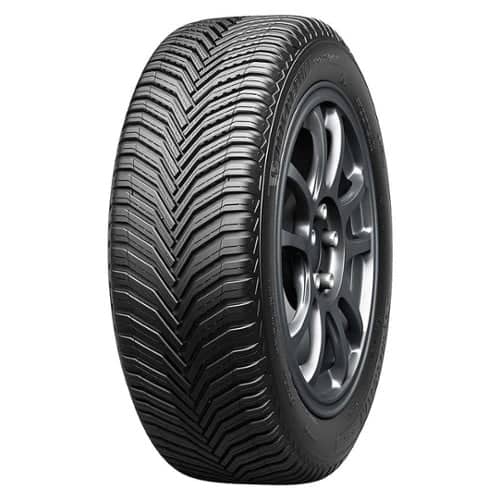
An all weather tire such as the Michelin CrossClimate2 does not change any of this. Compound flexibility helps traction in the cold. It does not exempt the tire from gas laws. For the full seasonal routine, see our breakdown of tire pressure in cold weather.
This is the case almost nobody talks about, and it is the one where the placard number can genuinely leave you underinflated even though your gauge says you are perfect.
Remember the package from FMVSS 110. Your placard pressure was calculated for the original equipment tire at its original size and load index. Change any of those inputs and the output changes.
The clearest example is a standard load to extra load swap. An SL tire hits its rated maximum load at 35 PSI. An XL tire in the same nominal size hits its rated maximum load at 41 PSI, because the reinforced construction is designed to work at higher pressure. Put XL tires on a car whose placard says 33 PSI and inflate to 33, and you have a tire operating well below the pressure its load rating assumes. The construction that was supposed to give you more capacity is not being asked to do its job.
Plus sizing creates the same problem through a different door. A shorter sidewall on a wider wheel changes the air volume inside the tire, and volume is what actually carries load. Two tires at identical pressure with different internal volumes do not carry identical weight. Match the pressure and you have not matched the capacity.
The fix is not a rule of thumb. It is looking up the load and inflation table for your new size and load range, finding the pressure at which it carries the same weight your original setup carried at placard pressure, and setting that. In practice this lands somewhere in the 2 to 5 PSI range above placard for most swaps, but do not treat that as the answer. Look it up for your specific case. Our comparison of SL vs XL tires covers which construction you should be running before you get to the pressure question.
If you bought a wheel and tire package from us, this calculation was part of the fitment work. If you assembled it yourself from parts, it is worth checking.
Everything above is about whether to add pressure. This section is about what is quietly happening if you already have and left it there. The damage runs in a ladder, and each rung makes the next one more likely.
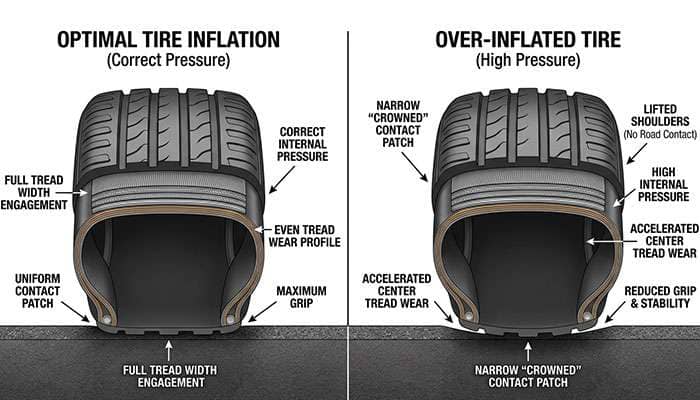
Rung one: the contact patch shrinks and crowns. Excess pressure pushes the center of the tread outward and lifts the shoulders. Your footprint gets narrower and the load per square inch on the remaining rubber goes up. Everything downstream follows from this single change.
Rung two: wet performance degrades first. Dry grip holds up reasonably well under mild overinflation, which is why people get away with it and conclude it is harmless. Wet grip is different. Water evacuation depends on the tread pattern working across the full footprint, and a crowned tire cannot use its outer grooves effectively. The shoulders are the part of the tread doing the most work in a wet corner, and they are precisely the part you have lifted off the road.
Rung three: your electronic safety systems lose their assumptions. ABS, traction control, and stability control are calibrated around the grip characteristics of the vehicle on its specified tire at its specified pressure. These systems make decisions based on wheel speed differentials and expected slip behavior. Change the contact patch and you change the inputs those calibrations were built around. Nothing fails outright. The margins just get thinner in exactly the situations where you need them.
Rung four: impact absorption drops. A tire is the first suspension component your car has. An overinflated tire is a stiffer spring with less travel, so more of any pothole or expansion joint impact passes through to the wheel and the sidewall instead of being absorbed. This is how a pressure habit becomes a bent rim or a sidewall bubble. If you have taken a hard hit and are unsure what you are looking at, our guide on tire sidewall damage and whether it is safe to drive covers what is repairable and what ends the tire.
Rung five: center wear cashes in the tread you paid for. Concentrated center loading wears the middle of the tread faster than the shoulders. You reach the wear bars in the center while the outer tread still has usable depth, and the tire is finished regardless. You bought 60,000 miles and used 48,000 of them.
Rung six: you buy tires early, and the warranty may not help. Tire manufacturer limited warranties, including treadwear mileage warranties, commonly exclude damage and irregular wear resulting from improper inflation. A tire that shows a clean center wear signature is documenting the cause of its own failure. Whether a specific claim gets paid depends on the individual manufacturer's terms, but the exclusion language is standard across the industry and worth reading before you assume you are covered.
If you have been running high and want to correct it, the procedure takes about ten minutes and the only thing that matters is doing it cold.
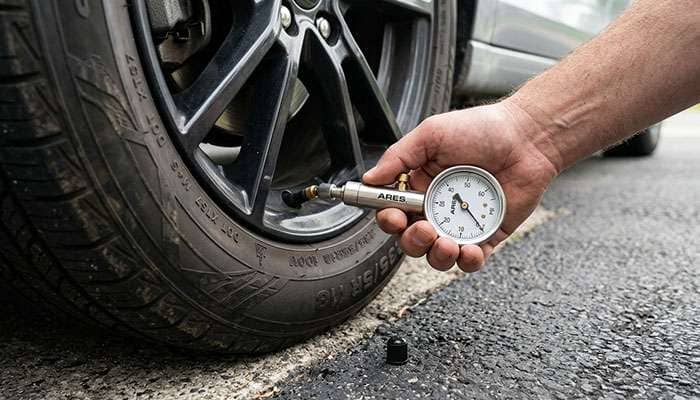
One equipment note. A dial or digital gauge you keep in the glove box will outperform the gauge on a gas station air hose by a wide margin. Public hose gauges take physical abuse and drift badly, and a gauge reading 3 PSI low will have you overinflating every single time while you believe you are following spec exactly.
The reason every article on this subject hedges is that the question has no single answer, and the honest version requires knowing why you are asking. A few extra PSI is genuinely fine, and genuinely pointless, when you are chasing fuel economy. It is a mistake when you are chasing a warning light, because the light is telling you about a 25 percent deficit that extra air cannot fix. It is backwards on a track day, where the whole discipline is setting cold low so hot lands right. And it is simply correct when you are towing, or when you have changed to a tire whose load rating assumes a different pressure than your placard was written for.
Find your reason in the table near the top of this page and follow that row. If your reason is not on it, that is worth paying attention to, because it usually means the answer is to leave the pressure at placard and look at something else.
If your fitment has changed, or you are working out what your loaded axle actually needs, our inflation pressure vs load calculator gives you the number for your specific size and load range. And if the center of your tread is already telling the story, browse our full tire selection and fitment resources or call the shop and we will work out what happened before you buy the replacements.
It depends entirely on what your placard says, which is why the number alone cannot answer the question. If your door jamb specifies 40 PSI, as many trucks and larger SUVs do, then 40 is correct. If it specifies 32, then 40 is 25 percent over and you will see center wear and reduced wet grip. Check the placard first. The only universal rule is that 40 PSI is safe from a structural standpoint on essentially any modern passenger tire, since sidewall maximums are typically 44 to 51 PSI.
Two PSI over placard will not create a safety problem and falls within the range your tires already swing through from normal temperature changes across a single day. That said, it also does not buy you anything measurable. The fuel savings at 2 PSI are within rounding error and the handling difference is not something you will feel. If your gauge reads 2 PSI high after filling, it is not worth a second trip. If you are adding 2 PSI on purpose, it is worth asking what you expect it to do.
Tire manufacturer limited warranties, including treadwear mileage coverage, commonly exclude damage and irregular wear caused by improper inflation, and that exclusion covers overinflation as well as underinflation. Whether a specific claim is denied depends on the individual manufacturer's terms and on what the tire shows when it is inspected, but a clean center wear pattern is fairly clear evidence of sustained overinflation. Read your warranty documentation for the brand you are running rather than assuming coverage.
No. The sidewall figure is the maximum cold inflation pressure the tire structure is rated to hold, and it is a ceiling rather than a recommendation. It says nothing about your vehicle, because the same tire fits many vehicles with very different weights. Your correct pressure comes from the placard on your driver door jamb, which was calculated for your specific vehicle weight, load capacity, and original tire specification. Filling to sidewall maximum is the most common route to genuine overinflation.
It improves one specific sensation and degrades actual grip. Higher pressure reduces sidewall flex, which makes steering feel sharper and more immediate on turn in, and that is why the change is often described as better handling. But the crowned contact patch that comes with it reduces the rubber actually touching the road, particularly at the shoulders where a cornering tire does its work. You get a car that feels more responsive and has less to give when you ask for it. On track, where handling is measured with a stopwatch rather than a feeling, the setup direction is lower cold pressure, not higher.
Normal street driving typically adds 2 to 4 PSI from cold to operating temperature, and a sustained highway run on a hot day can add 4 to 6. Hard track lapping commonly adds 6 to 10 PSI or more. Ambient temperature drives a separate change of roughly 1 PSI for every 10 degrees F. This is exactly why all pressure specifications are cold specifications, meaning the vehicle has sat at least three hours or been driven under a mile. Setting to placard on warm tires leaves you underinflated once they cool.