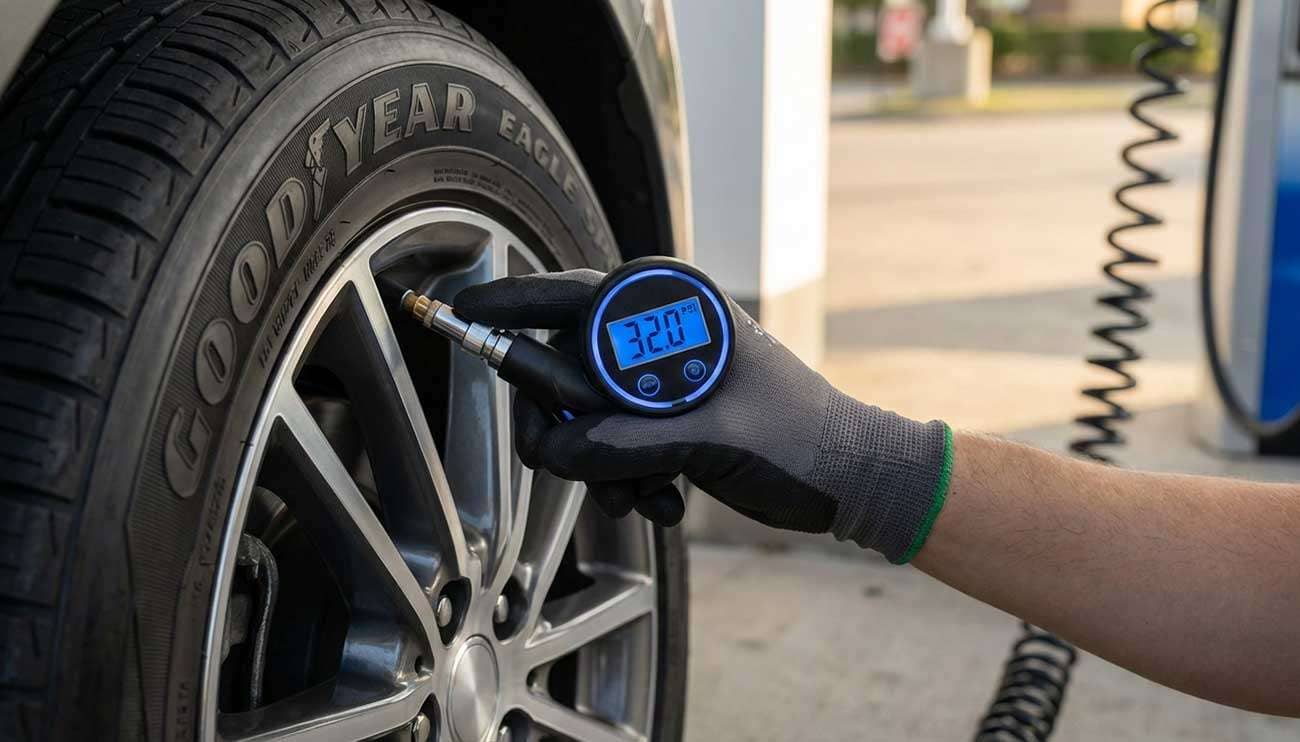
Driving with underinflated tires costs you more at the pump than you think. Tire pressure affects gas mileage significantly, with studies showing that maintaining proper tire pressure can improve fuel efficiency by up to 3%.
Here's what the numbers tell us: For every 1 PSI drop in pressure across all four tires, your gas mileage decreases by 0.2%. This adds up fast. When your vehicle's tires are underinflated by 10 PSI, you're losing up to 2% in gas mileage – equivalent to paying an extra 6 cents per gallon! The impact varies with speed too. At 40 miles per hour, driving with all four tires at 50% of their recommended pressure can reduce fuel economy by about 10%, while at higher speeds of 80 miles per hour, the reduction drops to approximately 5%.
At Performance Plus Tire, we know that understanding tire pressure's effect on fuel consumption is essential for every driver. Tires naturally lose about 1 PSI of pressure per month, creating more rolling resistance and making your engine work harder. We'll guide you through the relationship between tire pressure and gas mileage, backed by research and practical advice to help you maximize your fuel efficiency.
Tire pressure plays a crucial role in vehicle performance and fuel consumption, yet many drivers overlook this simple maintenance factor. Understanding these concepts helps you make better decisions about your vehicle's care.
Tire pressure refers to the amount of air compressed inside your tires, measured in pounds per square inch (PSI), bar, or kilopascals (kPa). This measurement indicates the force exerted by air against the tire's inner walls, creating necessary support for your vehicle's weight. To measure tire pressure accurately, you'll need a tire pressure gage that attaches to the valve stem of your tire. When checking pressure, the tires should be "cold" – meaning the vehicle has been parked for at least three hours or driven less than a mile at moderate speed.
Digital gages typically provide more accurate readings, though analog gages with dial indicators also work effectively. For precise results, press the gage firmly onto the valve stem until no air hisses out around the edges.
The recommended tire pressure is established by your vehicle's manufacturer as the optimal air pressure for your specific vehicle, generally falling between 28 and 36 PSI. You can find this information on the driver's side door jamb, in your owner's manual, or sometimes on the glove box door.
The maximum PSI, printed on the tire's sidewall, represents the maximum pressure the tire can safely withstand. This number, set by the tire manufacturer, almost always exceeds the recommended pressure. Running at maximum PSI is not advisable for everyday driving as it can impair handling, braking, and potentially lead to dangerous blowouts.
Properly inflated tires ensure optimal contact between the tire and road surface. When tires lack sufficient pressure, more of the tire's surface area contacts the road, increasing rolling resistance. Underinflated tires become softer and deform when rolling, forcing your engine to work harder and burn more fuel.
Research shows the clear connection:
For every 1 PSI drop in pressure across all four tires, gas mileage decreases by 0.2%
Properly inflated tires can improve fuel economy by up to 3%
Underinflated tires at 50% of recommended pressure can reduce fuel economy by 10% at lower speeds
Maintaining proper tire pressure creates optimal performance and efficiency – neither too much nor too little air gives you the best results.
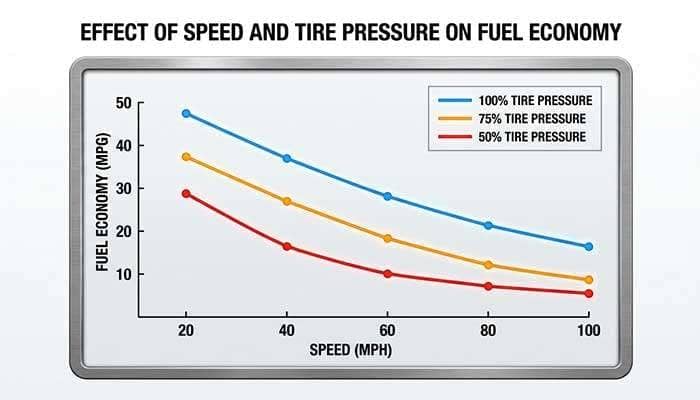
Scientific research provides solid proof of tire pressure's impact on gas mileage. Several landmark studies have measured this relationship with remarkable precision.
Oak Ridge National Laboratory conducted detailed testing to measure exactly how tire pressure affects fuel economy. Their methodology was thorough: vehicles went through a warm-up phase to reach target oil temperature, followed by a 50 mph cruise for five minutes, then steady speeds from 40 to 80 mph in 5 mph increments. Each speed was maintained for at least 5.5 minutes to ensure accurate measurements. The researchers used a 2009 Toyota Corolla with a 1.8-liter four-cylinder engine as their primary test vehicle, representing what most consumers drive.
The study results were clear. With all four tires at 75% of the recommended pressure, vehicles experienced a consistent 2-3% decrease in fuel economy across various speeds. When tires dropped to just 50% of the recommended pressure, the consequences became much worse. Vehicles suffered a 5-10% decrease in fuel economy depending on speed[84].
Speed plays a significant role in how tire pressure affects fuel economy. At 40 mph, the 2009 Toyota Corolla achieved 57.5 mpg with properly inflated tires but only 51.7 mpg with tires at 50% pressure—a 10% reduction. As speed increases, the percentage penalty from underinflation decreases. At 80 mph, the same vehicle achieved 30.9 mpg with properly inflated tires versus 29.2 mpg with tires at 50% pressure—approximately a 5% reduction.
These findings show that maintaining proper tire pressure becomes especially important for city driving and lower-speed commutes where the fuel economy penalties from underinflation hit hardest.
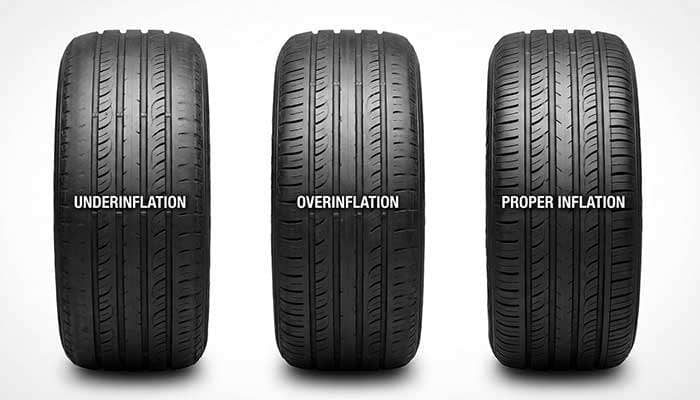
Incorrect tire pressure creates problems that extend well beyond your fuel bill. These issues compound over time, hitting both your wallet and your safety on the road.
Chronically underinflated tires drain your finances in multiple ways. You'll pay more for fuel consistently—studies show four out of five consumers waste money due to underinflation. Worse, continuous driving on underinflated tires accelerates tread wear, forcing you to replace tires sooner than necessary and adding unexpected maintenance costs.
Underinflated tires force your engine to work overtime. The excessive rolling resistance requires more energy to maintain your speed, burning extra fuel with every mile. The U.S. Department of Energy reports that proper tire inflation can save up to 11 cents per gallon on fuel costs.
Different pressure problems create distinct wear patterns. Underinflated tires wear heavily on the outer edges, while overinflated tires show excessive center tread wear. This happens because improper pressure changes how weight distributes across the tire surface. Underinflation makes sidewalls flex too much, generating heat that breaks down the rubber faster.
Incorrect tire pressure puts you at serious risk. Underinflated tires overheat and increase blowout danger, reduce your vehicle's handling response, and make it take longer to stop. The stakes are real—tire-related crashes killed 646 people in 2023 alone.
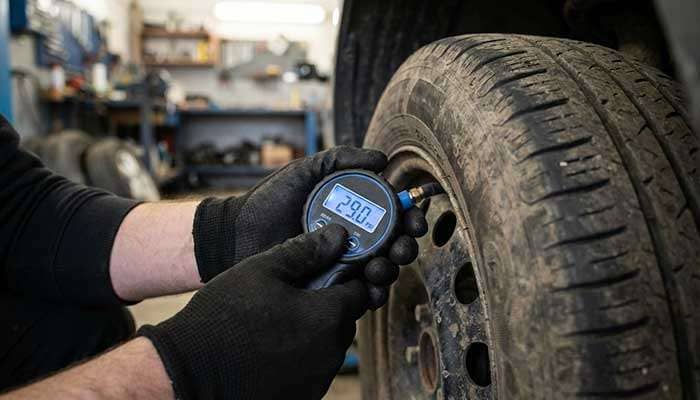
Proper tire pressure maintenance is essential for maximizing your fuel economy. We recommend regular monitoring and adjustment to help you achieve the best possible gas mileage throughout changing conditions.
Follow these simple steps for accurate pressure readings:
Remove the valve cap and place it somewhere secure
Press the gage firmly onto the valve stem until the hissing sound stops
Read the measurement and compare it to your vehicle's recommended PSI
Replace the valve cap securely
Check pressure when tires are "cold" - before driving or after the vehicle has been parked for at least three hours. Driving heats tires, causing pressure readings to be 4-6 PSI higher than actual cold pressure. Check in the morning before your first trip for the most accurate results.
Digital gages offer precise readings with clear displays, but require batteries. Analog dial gages provide reliable readings without batteries and typically handle rough treatment better. Choose a quality gage rather than relying on gas station equipment, which may be inaccurate from weather exposure.
Temperature changes affect pressure significantly. For every 10°F temperature change, tire pressure fluctuates approximately 1 PSI. Check pressure weekly during winter months since cold temperatures decrease pressure. Never deflate warm tires that read high after driving in hot conditions.
Modern TPMS continuously monitors pressure in real-time, alerting you when pressure drops below safe thresholds. Don't rely solely on TPMS warnings - they typically activate only when pressure falls 25% below recommendations. Combine TPMS with monthly manual checks for optimal performance.
Proper tire pressure plays a vital role in maximizing your vehicle's fuel efficiency. We've shown how underinflated tires create increased rolling resistance, forcing your engine to work harder and consume more fuel. The research is clear - maintaining recommended pressure levels delivers measurable fuel economy improvements.
Speed matters too. City driving sees the biggest impact from underinflation, making proper pressure especially important for daily commuters and urban drivers.
Correctly inflated tires provide benefits beyond fuel savings. Your tires will wear more evenly, extending their lifespan and reducing replacement costs. The safety improvements deliver peace of mind through better handling, shorter stopping distances, and reduced blowout risks.
Checking your tire pressure takes just minutes but yields substantial rewards. Armed with a quality pressure gage and your vehicle's recommended PSI, you can easily maintain optimal pressure through seasonal temperature changes. This simple maintenance habit saves money at the pump while protecting your vehicle investment and enhancing road safety.
Ready to start saving at the pump? Take a moment to check those tires the next time you fill up. Your wallet - and your safety - will thank you.
Understanding the relationship between tire pressure and fuel efficiency can lead to significant savings and improved vehicle performance.
• Proper tire pressure improves fuel economy by up to 3% - For every 1 PSI drop across all tires, gas mileage decreases by 0.2%
• Underinflated tires at 50% pressure reduce fuel economy by 5-10% depending on speed, with greater impact at lower speeds
• Check tire pressure monthly when tires are "cold" - before driving or after 3+ hours parked for accurate readings
• Temperature affects pressure significantly - tire pressure changes about 1 PSI for every 10°F temperature change
• Beyond fuel savings, proper inflation extends tire life and improves safety by preventing blowouts and ensuring better handling
The simple act of maintaining recommended tire pressure (found on your driver's side door jamb) can save you money at the pump while protecting your investment in tires and enhancing road safety. This basic maintenance takes just minutes but delivers lasting benefits for your wallet and peace of mind.
Maintaining the correct tire pressure can improve fuel efficiency by up to 3%. For every 1 PSI drop in pressure across all four tires, gas mileage decreases by approximately 0.2%.
The best time to check tire pressure is when the tires are "cold," meaning before driving or after the vehicle has been parked for at least three hours. This provides the most accurate reading of the tire's true pressure.
Underinflated tires wear prematurely on the outer edges and can lead to increased blowout risk due to overheating. They also negatively impact handling responsiveness and extend braking distances, compromising overall vehicle safety.
Yes, the impact of tire pressure on fuel economy varies with speed. At lower speeds around 40 mph, underinflated tires can reduce fuel economy by about 10%, while at higher speeds of 80 mph, the reduction is approximately 5%.
It's recommended to check your tire pressure at least once a month and before long trips. Additionally, tire pressure should be checked more frequently during significant temperature changes, as pressure fluctuates about 1 PSI for every 10°F change in temperature.