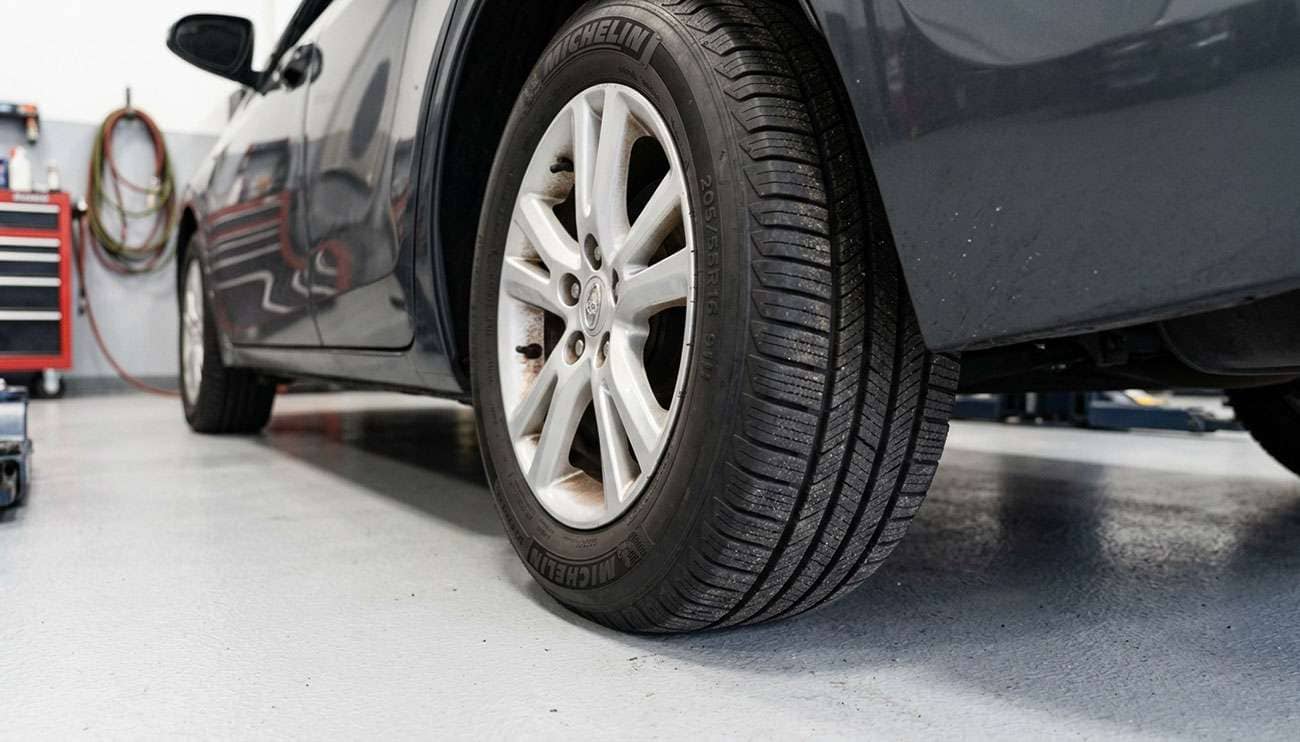
I've been in the tire business for decades, and I still see it every single week — someone pulls up with tires inflated to 50 PSI because "that's what it says on the sidewall." Their ride is harsh, their center tread is cooked, and they have no idea they've been slowly destroying a $600 set of tires. Overinflated tires are one of the most common — and most preventable — problems I deal with at Performance Plus Tire.
Here's the thing: a little too much air won't make your tire explode on the spot. But it absolutely changes how your tire contacts the road, how it wears, and how your car handles. Over time, those changes cost you money and put you at risk. Let me walk you through exactly what happens, why it happens, and what to do about it.
Most people don't overinflate their tires on purpose. It happens for a few predictable reasons, and once you know them, you can avoid all of them.
Those coin-operated air machines at the gas station are notoriously inaccurate. Some have preset PSI dials that are off by 5 or more pounds. Others don't shut off automatically. You're standing there in the heat or the cold, rushing through it, and you end up with 45 PSI in a tire that should be at 33. I've seen it a thousand times.
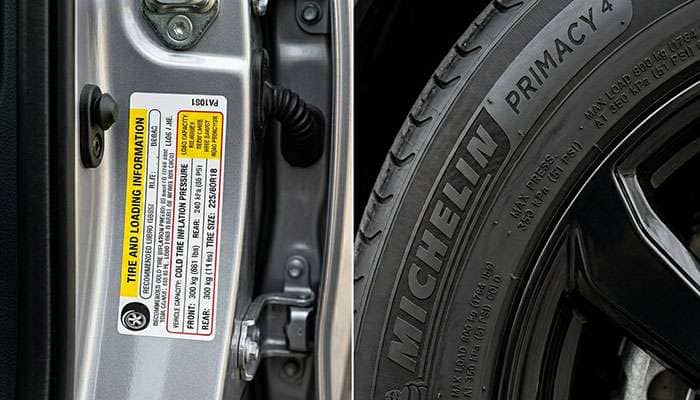
This is the big one. Your tire has a number stamped on the sidewall — something like "Max Press 51 PSI." Your driver's door jamb has a sticker that says "33 PSI front / 35 PSI rear." Those are two completely different numbers, and mixing them up is the single most common cause of overinflation I see.
You fill your tires on a cool morning. By afternoon, the sun has heated the pavement to 130°F and your tires are rolling on it. The air inside expands, and your 35 PSI becomes 39 PSI without you touching a thing. In summer states like Arizona or Texas, this swing can push properly filled tires into overinflation territory every single afternoon.
Some folks deliberately overinflate because they read somewhere that harder tires roll easier and save fuel. I'll bust that myth wide open in a minute.
This distinction saves tires. It saves money. And I wish every driver understood it before they picked up an air hose.
Recommended PSI is the pressure your vehicle manufacturer determined gives you the best balance of ride comfort, traction, fuel economy, and tire life for your specific car. You find it on the sticker inside your driver's door jamb or in your owner's manual. It's calculated based on your vehicle's weight, suspension design, and intended tire size. Most passenger cars fall between 30 and 36 PSI. Trucks and SUVs are typically 35-44 PSI depending on load.
Maximum PSI is the highest pressure the tire itself can safely hold. It's stamped on the sidewall by the tire manufacturer. For most passenger tires, this number is somewhere between 44 and 51 PSI. It exists for situations like mounting and seating the tire bead — not for daily driving.
Running your tires at max PSI is like redlining your engine constantly. Can the engine handle that RPM? Technically, yes. Should you drive that way every day? Absolutely not.
PSI Detail |
Recommended PSI |
Maximum PSI |
|---|---|---|
Where to find it |
Driver's door sticker / owner's manual |
Tire sidewall |
Who sets it |
Vehicle manufacturer |
Tire manufacturer |
Typical range (passenger car) |
30–36 PSI |
44–51 PSI |
Typical range (truck/SUV) |
35–44 PSI |
50–80 PSI (load range dependent) |
Purpose |
Optimal daily driving performance |
Tire's structural limit (not for daily use) |
Safe to exceed? |
Slightly (up to ~10%) |
Never |
The takeaway is simple: always inflate to the number on your door, not the number on your tire.
Overinflation doesn't just feel different — it changes the physics of how your tire works. Here's what's actually happening under your car.
When a tire has too much air, the center of the tread bulges outward. Instead of your full tread width sitting flat on the road, only the middle strip carries the weight. That strip wears down faster than the shoulders, and you end up with a tire that looks bald in the center but brand new on the edges. I've seen tires with 50% tread on the outside and bare cords in the middle — all because someone ran 8 PSI over recommended for six months.
An overinflated tire is stretched tight. The rubber and internal cords are under more stress than they were designed for during normal driving. Hit a pothole at highway speed and there's less flex to absorb the impact. Instead of the tire deforming around the obstacle, the force transfers straight through — and the weakest point in the sidewall or tread gives out. That's a blowout. On the highway at 70 mph, that's a life-threatening event.
A properly inflated tire puts a full, flat contact patch on the road. Overinflation shrinks that contact patch dramatically — sometimes by 20-30%. Less rubber on the pavement means less grip in corners, longer braking distances, and a higher chance of losing control on wet roads. Your tire's traction rating was tested at the correct PSI. Overinflate it, and that rating doesn't apply anymore.
Your tires are the first line of defense between your car and the road. They're supposed to absorb small bumps, expansion joints, and imperfections before that energy reaches your suspension. An overinflated tire can't flex enough to do this job. Every crack in the pavement becomes a jolt through your steering wheel and your spine. Your suspension components — struts, shocks, bushings — absorb impacts they weren't designed to handle, which leads to premature wear.
Your car's anti-lock braking system, traction control, and electronic stability control are all calibrated for tires running at the correct pressure. Change the contact patch and the grip characteristics, and those systems receive inputs they weren't programmed for. Your ABS might activate too early or too late. Your stability control might intervene when it shouldn't — or not intervene when it should.
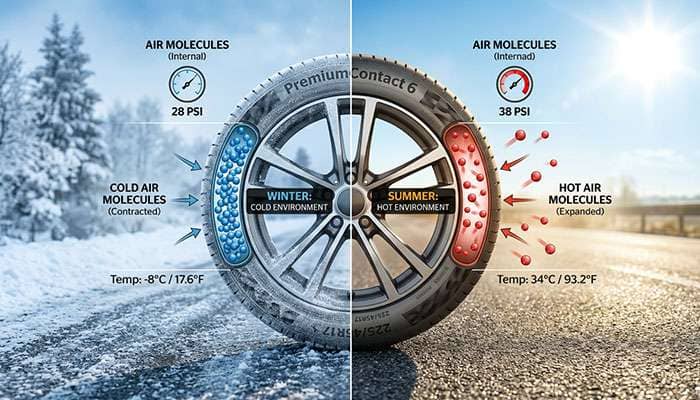
This is basic physics, but it catches people off guard every season. Air expands when it heats up and contracts when it cools down. Inside your tire, that means:
For every 10°F change in temperature, your tire pressure shifts about 1-2 PSI.
That might not sound like much, but do the math. You fill your tires to 35 PSI on a 70°F fall afternoon. A cold snap drops overnight temperatures to 30°F — a 40-degree swing. You just lost 4-6 PSI overnight. Your TPMS light comes on. You add air to get back to 35 PSI while the tires are cold. Then the temperature climbs back to 70°F, and suddenly you're sitting at 39-41 PSI. Now you're overinflated.
This seasonal seesaw is why I tell every customer the same thing: check your pressure with a handheld gauge at least once a month, and always when the tires are cold — meaning the car hasn't been driven for at least three hours. Don't just react to the TPMS light. That light only triggers when pressure drops about 25% below recommended. It doesn't warn you about overinflation at all on most vehicles.
I hear this one at least once a week. "Hank, I run my tires at 40 because it saves gas." Let me tell you what the actual numbers say.
The U.S. Department of Energy reports that underinflated tires can reduce fuel economy by about 0.2% for every 1 PSI below recommended. That's real. But the inverse doesn't hold the way people think it does. Overinflating from 33 PSI to 40 PSI might — might — net you a fraction of a percent in fuel savings from reduced rolling resistance. On a 15-gallon tank at $3.50 per gallon, we're talking about pennies per fill-up.
Meanwhile, the center wear from that overinflation can chew through your tire tread 25-30% faster than normal. If a $150 tire that should last 50,000 miles only lasts 35,000 miles because you overinflated it, you just spent $150 to save maybe $8 in gas over the tire's lifetime. That's not savings. That's an expensive mistake.
This takes five minutes and costs nothing. Here's how I do it, and how you should too.
Open your driver's door. Look at the sticker on the door jamb or the pillar. It lists the recommended cold tire pressure for front and rear tires. If you can't find it, check your owner's manual. Do not use the number on the tire sidewall.
First thing in the morning is best. The car hasn't moved, the tires haven't heated up. If you've driven more than a mile or two, wait three hours before checking. Hot readings run 3-5 PSI higher than cold and will mislead you.
A decent digital tire gauge costs $10-15 and lasts for years. The pencil-style ones work in a pinch but digital is more accurate. Don't trust the gauge on the gas station air pump — they're beaten up and rarely calibrated.
If you're over, press the small pin in the center of the valve stem to release air in short bursts. Check after each burst. If you're under, add air in short bursts and recheck. Get within 1 PSI of your recommended number.
Your spare tire loses pressure too. If you ever need it and it's flat, you've got two problems instead of one. Check it every time you check your other four.
Correcting your PSI fixes the problem going forward. But if you've been running overinflated for months, the damage might already be done. Here's how to tell.
Run your hand across the tread. If the center feels noticeably smoother than the shoulder edges, you've got center wear. Now check the tread depth with a gauge or the penny test — stick a penny into the center tread groove with Lincoln's head pointing down. If you can see the top of his head, you're at or below 2/32" and the tire needs to be replaced regardless of how the shoulders look.
Also look for any cracking, bulging, or damage in the sidewalls. Overinflation puts extra stress on the sidewall rubber, and that stress can cause micro-cracks that compromise the tire's structural integrity. If you see sidewall damage, don't drive on it.
When it's time for replacements, invest in quality tires that match your driving needs. For everyday driving, I recommend the Michelin CrossClimate 2 — it handles everything from dry summer roads to light snow and has excellent tread life when properly inflated. For drivers on a tighter budget, the BFGoodrich Advantage Control delivers solid all-season grip and quiet ride at a lower price point. If you're running an SUV or crossover, the Bridgestone Alenza AS Ultra is built for that segment and wears like iron.
Check out our Purchase New Tires Guide if you need help narrowing down the right tire type for your vehicle. And don't make the same mistake twice — once the new rubber is on, keep a gauge in your glovebox and check every month.
It depends on your vehicle. Most passenger cars have a recommended tire pressure between 30 and 36 PSI. If your door sticker says 33 PSI and you're running 40, you're about 7 PSI overinflated — enough to cause noticeable center wear and reduced traction. However, some trucks and SUVs recommend 40 PSI or higher, especially under load. Always go by your vehicle manufacturer's recommendation, not a universal number.
Yes. Overinflated tires are stiffer and less able to absorb impacts from potholes, curbs, and road debris. The increased internal pressure also puts more stress on the tire's sidewalls and internal cords. A sudden impact that a properly inflated tire could absorb might cause an overinflated tire to rupture, especially at highway speeds. This risk increases significantly in hot weather when air expansion pushes pressure even higher.
Most TPMS systems only alert you when tire pressure drops below a threshold — typically 25% below the recommended PSI. They do not warn you about overinflation. Some newer sensor-based systems can detect overinflation, but the vast majority of vehicles on the road will not give you a warning if your tires have too much air. That's why manual pressure checks with a handheld gauge are essential.
A general guideline is that up to 10% above the recommended PSI is unlikely to cause immediate problems. For a tire recommended at 33 PSI, that means up to about 36 PSI is within a reasonable tolerance. Beyond that, you start to see measurable effects on tread wear, contact patch size, and ride quality. Never exceed the maximum PSI stamped on the tire's sidewall under any circumstances.
It can. Most tire manufacturers require that tires be maintained at the vehicle manufacturer's recommended pressure to keep the treadwear warranty valid. If a warranty claim is filed and the tire shows signs of overinflation damage — specifically center tread wear — the manufacturer can deny the claim. Always check the warranty terms for your specific tires and keep your pressure at the recommended level.
No. While it's true that cold temperatures reduce tire pressure by about 1-2 PSI for every 10°F drop, the correct approach is to check your pressure when tires are cold and inflate to the recommended PSI — not above it. Overinflating to "pre-compensate" for temperature drops will leave your tires overinflated during warmer daytime driving and reduce traction on cold, slippery roads when you need grip the most.