
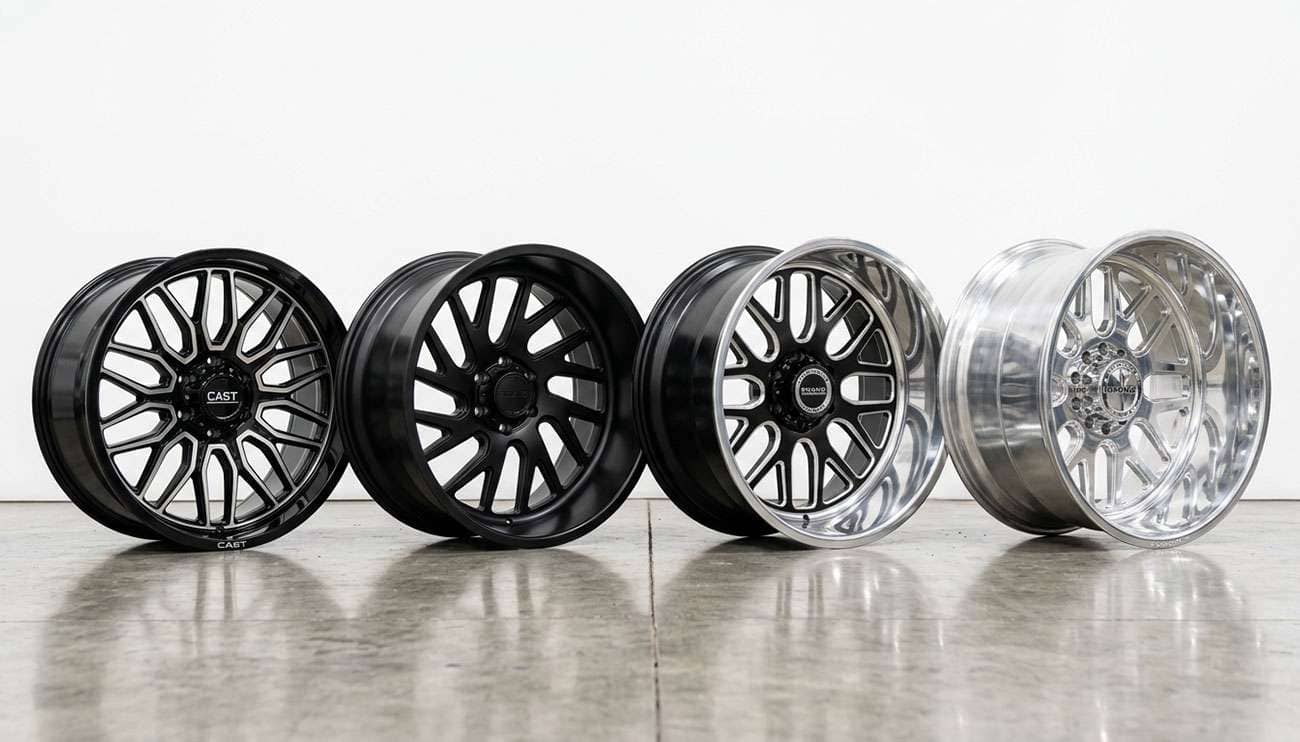
A 30 inch rim runs from about $629 to $4,549 per wheel, so a set of four lands between roughly $2,500 and $18,200 before tires. The number that decides where you land is not brand and it is not cast versus forged. It is width. A 30x10 starts around $629. A 30x11 starts at $3,300. That one inch is a five-times price jump, and almost nobody tells you why before they quote you.
I have been writing these quotes at the counter for a long time, and the conversation always goes the same way. A guy calls, asks what 30s cost, hears a number, and then hears a completely different number two weeks later when he comes back with the actual wheel he wants. Nothing shady happened. He just changed the width by an inch and walked out of one manufacturing category into another one. That is the whole story of 30 inch pricing, and the rest of this article is me laying it out with real numbers.
Here is the table I wish somebody had handed me the first time I priced a set of 30s. Find your width, read across.
Wheel Width |
Price Per Wheel |
Set of Four |
What You Can Buy at This Width |
|---|---|---|---|
30x9.5 |
$646 to $1,878 |
$2,585 to $7,512 |
One-piece cast street wheels only |
30x10 |
$629 to $3,300 |
$2,516 to $13,200 |
Cast, replica, and three-piece forged |
30x11 |
$3,300 |
$13,200 |
Three-piece forged only |
30x12 |
$4,381 |
$17,525 |
Billet and custom-machined only |
30x16 |
$2,532 to $4,549 |
$10,128 to $18,196 |
One-piece forged super-wide truck wheels |
Look at what happens between 30x10 and 30x11. The cheap option does not get more expensive. The cheap option disappears. At 30x10 you can still buy a one-piece cast wheel that came out of a mold, and molds are cheap once they exist because the tooling cost gets spread across every wheel that ever comes out of them. At 30x11 and above, nobody makes a cast wheel. There is not enough volume to justify the mold. So the only wheels that exist at that width are forged or multi-piece, and forging means starting with a solid aluminum billet and machining most of it into chips on the floor.
That is not a markup. That is a different product built a different way, and the price reflects it honestly.
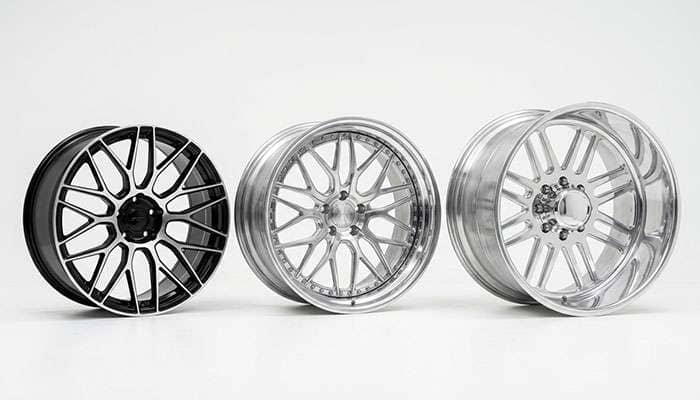
Most pricing guides sort 30 inch wheels by brand tier. Entry brand, mid brand, luxury brand. That framing works fine at 20 inches, where every brand offers every width and the brand name really is the variable. It falls apart at 30, because at this diameter the market is not one market. It is three markets that happen to share a number.
This is 30x9.5 and 30x10. It bolts to a lifted half-ton, a Tahoe, an Escalade, a Silverado on a moderate lift. It is a low-offset one-piece cast aluminum wheel, usually in the +15 to +31 range, running a 255 or 265 series low-profile street tire. Entry is around $629 to $650 per wheel. This is the only place at 30 inches where you can build a set for under four grand with tires.
This is 30x11 and 30x12, and it lives in deeply negative offset territory, often -80 to -127. These are three-piece forged and billet wheels with the lip bolted to the face, custom drilled to your bolt pattern rather than pulled off a shelf. Three-piece construction lets a builder dial exact width and offset per corner, which is why show cars use it and why it costs $3,300 to $4,381 a corner.
This is 30x16, and it is a completely different animal. Sixteen inches of width at a -101 to -112 offset, carrying a 42 or 44 inch off-road tire on a heavily lifted truck. One-piece forged, load ratings up to 3,640 lbs per wheel. Entry is $2,532 and it runs to $4,549 at the top.
When somebody quotes you "$550 to $3,000 for a 30 inch rim," they are not making it up. They are averaging across three markets that have almost nothing to do with each other. Tell me the width and I can tell you the price inside about eighty bucks. That is the part nobody puts in front of you.
Yes, and they have for about twenty years now. Thirty is a production size with real manufacturer support, not a one-off show piece. What is worth understanding is who makes them, because the roster is short compared to what you see at 22 or 24.
Brand |
Construction |
Widths Offered at 30 Inch |
Price Range Per Wheel |
|---|---|---|---|
One-piece cast |
30x9.5 |
$646 to $1,878 |
|
One-piece cast |
30x10 |
$629 to $1,750 |
|
One-piece cast |
30x10 |
$894 to $1,300 |
|
One-piece cast |
30x10 |
$919 to $1,179 |
|
One-piece cast |
30x10 |
$1,016 to $1,463 |
|
One-piece forged |
30x16 |
$2,532 to $2,890 |
|
One-piece forged |
30x16 |
$2,646 to $3,039 |
|
Three-piece forged |
30x10, 30x11 |
$3,300 |
|
One-piece forged |
30x16 |
$3,541 to $4,549 |
|
Billet |
30x12 |
$4,381 |
Notice something about that list. Every brand offers exactly one or two widths at 30 inches. Nobody offers the full spread. That is why "which brand is cheapest" is the wrong question. Pick your width first and the brand list picks itself.
One more thing worth saying out loud. Many of these come drilled blank, which means the bolt circle gets machined for your vehicle after you order. Blank drilling is why the same wheel can fit a 5x115 Charger and a 6x139.7 Silverado, and it is also why these are not returnable once cut. Get the bolt pattern right before you commit.
Yes, but this question means two different things and the answer changes depending on which one you are asking. This trips people up constantly, so let me split it.
If you mean a tire that mounts on a 30 inch wheel: yes, those exist and you have real choices. The sizes in production are 255/30R30, 265/30R30, 275/25R30, 315/20R30, and 315/30R30 on the street side, plus LT42x16.50R30 and LT44x16.50R30 for the super-wide forged truck wheels. Street tires in this group run $220 to $654 each. The flotation off-road sizes run $1,326 to $2,711 each, which is a number that catches people completely off guard.
If you mean a tire that stands 30 inches tall: also yes, but that is an entirely different tire on an entirely different wheel. A 30x9.50R15 mounts on a 15 inch wheel and stands 30 inches tall. A 265/70R17 is close to 30 inches tall. Neither has anything to do with a 30 inch rim.
Tire |
Size |
Load Index / Speed |
Price Each |
|---|---|---|---|
275/25ZR30 XL |
101W |
$220.51 |
|
255/30ZR30 XL |
103W |
$248.26 |
|
P315/30ZR30 |
114V |
$270.27 |
|
265/30ZR30 XL |
105W |
$287.68 |
|
265/30ZR30 XL |
105W |
$353.69 |
|
315/30ZR30 XL |
111Y |
$493.03 |
|
315/30ZR30 XL |
114V |
$653.52 |
|
LT42x16.50R30 |
126Q |
$1,325.99 |
|
LT44x16.50R30 |
126P |
$2,710.59 |
That bottom pair is the line item that blows up budgets. A guy prices a set of 30x16 forged wheels at $2,532 each, does the math on $10,128, and figures he is close. Then he finds out the only tires that fit are $1,326 to $2,711 apiece and the real number is closer to $21,000. Price the tire before you fall in love with the wheel.
Two answers again, and both are correct depending on what you are measuring.
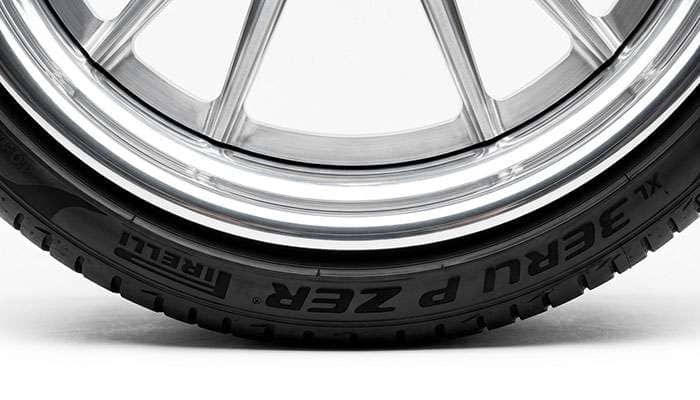
If you are measuring the wheel: the tire size ends in R30 or ZR30. That trailing number is the rim diameter the tire is built to seal against, and it has to match your wheel exactly. There is no rounding, no close enough, no adapter.
If you are measuring overall tire height: a tire that stands 30 inches tall is usually something like a 30x9.50R15 or a 265/70R17. Both of those go on small wheels.
Here is what your rolling diameter actually becomes when you mount common sizes on a 30 inch wheel. This matters because it drives your speedometer, your gearing, and whether the thing rubs.
Tire Size |
Sidewall Height |
Overall Diameter |
Section Width |
|---|---|---|---|
315/20R30 |
2.48 in |
34.96 in |
12.4 in |
275/25R30 |
2.71 in |
35.41 in |
10.8 in |
255/30R30 |
3.01 in |
36.02 in |
10.0 in |
265/30R30 |
3.13 in |
36.26 in |
10.4 in |
315/30R30 |
3.72 in |
37.44 in |
12.4 in |
LT42x16.50R30 |
6.0 in |
42.0 in |
16.5 in |
LT44x16.50R30 |
7.0 in |
44.0 in |
16.5 in |
Run those numbers against your factory tire and you will see how far off your speedometer is going to be. A truck that came with a 33 inch tire and now wears a 37.44 inch tire is reading about twelve percent slow. At an indicated 60 you are doing 67. That is a real ticket, and it is also a real transmission shift-point problem if you do not recalibrate. Most shops can flash the module. Budget for it.
If you are talking about the aspect ratio, yes. The middle number in a size like 265/30R30 is the aspect ratio, and it means the sidewall height equals thirty percent of the section width. Anything at 50 or below gets called low profile. Thirty is deep into that territory, and 25 and 20 are more extreme still.
Here is what that means in the real world instead of in the numbers. A 265/30R30 has 3.13 inches of sidewall between the rim lip and the pavement. Your factory tire probably had six or seven. That sidewall is the only suspension component between your $3,300 wheel and a pothole on Cherry Avenue, and three inches of rubber does not absorb much.
Three things follow from that, and I tell every customer all three before they sign:
None of that is a reason not to run 30s. It is a reason to know what you are buying. If you are weighing the tradeoff more broadly, we walked through it in do big rims damage transmission, which covers the driveline side of large-diameter builds.
Enough theory. Here are four builds I have actually quoted, with the wheel, the tire, and the number at the bottom. Wheels and tires only, no mounting, no lift, no gearing.
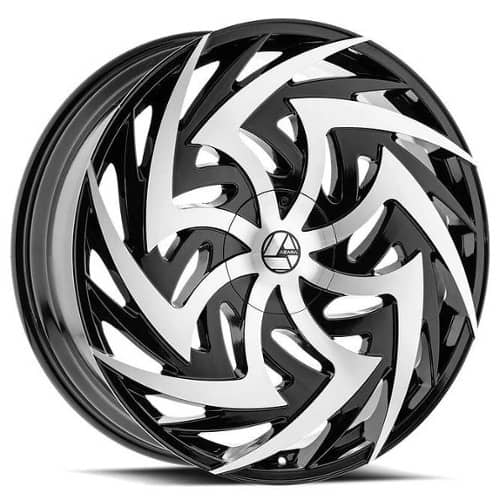
Four Azara AZA 520 in 30x9.5, +15 offset, gloss black machined, rated 2,100 lbs each, at $646.36 apiece comes to $2,585.44. Add four Lionhart LH-Ten in 255/30ZR30 XL at $248.26 each for $993.04. Total $3,578.48.
This is the entry point. It is a real set of 30s on a lifted SUV and it costs less than a mid-tier set of 24s from a name brand. The compromise is that you are in cast construction with a modest load rating, which is fine for a street truck and not fine for towing.
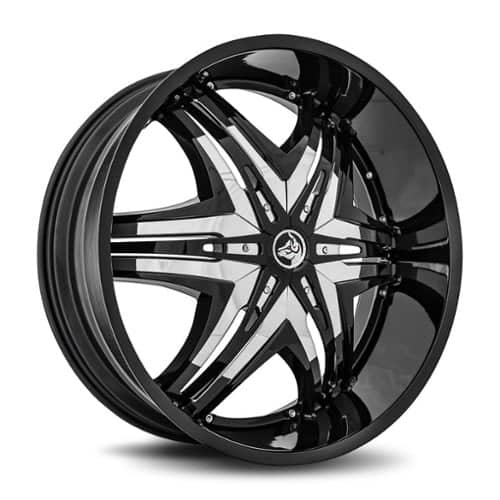
Four Diablo Elite in 30x10, +30 offset, black with chrome inserts, at $1,016.00 each is $4,064.00. Four Venom Power Ragnarok One in 265/30ZR30 XL at $353.69 each is $1,414.76. Total $5,478.76.
The extra $1,900 over build one buys you a wider wheel, a nicer finish, and a tire with a bit more section width to fill the fender. This is where most street builds actually land.
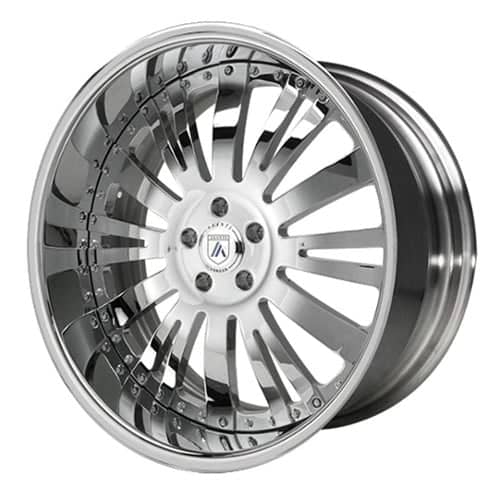
Four Asanti AF150 in 30x11, three-piece forged, offset made to order anywhere from -127 to +86, at $3,300.00 each is $13,200.00. Four Pirelli Scorpion Zero Asimmetrico in 315/30ZR30 XL at $653.52 each is $2,614.08. Total $15,814.08.
The jump from build two to build three is not brand snobbery. Three-piece construction is what makes a custom offset possible in the first place. If your build needs a specific lip depth to sit right in the fender, this is the only way to get it, and you pay for the machining. Watch the load rating here. Some three-piece wheels at this width carry a 1,900 lb rating per wheel, which is plenty for an Escalade and not enough for a loaded three-quarter ton.
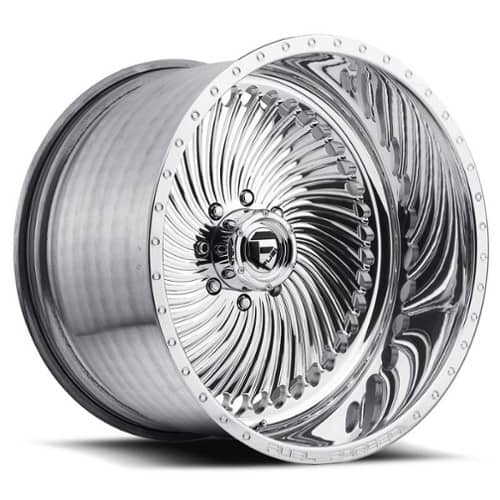
Four Fuel FF01 in 30x16, -112 offset, one-piece forged, rated 3,640 lbs each, at $2,532.11 apiece is $10,128.44. Four Venom Power Swampthing M/T in LT42x16.50R30 at $1,325.99 each is $5,303.96. Total $15,432.40.
Step up to the 44 inch Fuel Gripper X/T at $2,710.59 each and the tire bill alone becomes $10,842.36, pushing the total to $20,970.80. Move to American Force CK01 Assault forged wheels at $3,541.00 each and you are north of $25,000.
Build |
Wheels (Set of 4) |
Tires (Set of 4) |
Total |
|---|---|---|---|
Street SUV, 30x9.5 |
$2,585.44 |
$993.04 |
$3,578.48 |
Finished street truck, 30x10 |
$4,064.00 |
$1,414.76 |
$5,478.76 |
Show and luxury, 30x11 |
$13,200.00 |
$2,614.08 |
$15,814.08 |
Super-wide forged, 30x16 |
$10,128.44 |
$5,303.96 |
$15,432.40 |
The wheel and tire number is the number people shop. It is not the number they pay. Here is everything else that shows up, roughly in the order it hits you.
Mounting and balancing. A 30 inch assembly does not go on a standard passenger tire machine. It needs a large-capacity machine and usually a road-force balancer, because a wheel and tire package that heavy will telegraph any imbalance straight into the steering wheel. Expect a premium over standard car rates, and expect some shops to decline the job entirely.
Lift and clearance work. Almost nothing rolls 30s from the factory. You are looking at a lift kit, and often fender trimming or a bulge on top of that. On a truck running 42s at 30x16, you are also looking at cutting and possibly relocating hardware. This is frequently the largest single line item in the whole project and it never appears in a wheel price.
Regearing. Go from a 33 inch tire to a 42 and your effective final drive ratio changes dramatically. The truck will feel gutless, the transmission will hunt, and highway rpm will drop out of the powerband. Ring and pinion swaps front and rear are common on these builds.
Speedometer and module calibration. Covered above, and it is not optional if you want the truck to shift correctly.
TPMS. Federal rules require a functioning tire pressure monitoring system on passenger vehicles, and your existing sensors have to be transferred, replaced, or reprogrammed. Budget per wheel.
Hub-centric rings and correct lug hardware. These wheels commonly ship with a center bore larger than your hub, which means centering rings are required to carry the load on the hub instead of on the studs. Wrong lug seat type, wrong thread pitch, or missing rings is how wheels come loose. SAE J2530 covers aftermarket wheel performance requirements and it exists because this stuff matters.
Re-torque. Torque to the manufacturer spec and then re-torque after twenty-five to fifty miles. Every time. This is basic Tire Industry Association practice and it is the single cheapest insurance in the entire build.
Everybody asks this and it is a fair question. Here is my honest read after decades of watching people get it right and get it wrong.
Online specialty retailers generally beat brick-and-mortar on price at 30 inches, because a local shop cannot afford to floor-stock a size this slow-moving. The tradeoff is that you need to be right about fitment before it ships, and blank-drilled wheels are not returnable once they are machined for your pattern.
Marketplace listings and auction sites will show you lower numbers. Some are legitimate. Many are replicas of forged designs sold without load ratings, JWL or VIA certification marks, or any warranty. At 20 inches a bad wheel is a headache. At 30 inches, on a heavy truck, with three inches of sidewall and a wheel carrying a couple thousand pounds, a bad wheel is a different category of problem. If a listing will not tell you the load rating, that is your answer.
Used and take-offs are genuinely cheap and genuinely risky. A 30 inch wheel that has taken a pothole hit can have a hairline crack at the lip that a quick look will not show. If you go used, get them off the vehicle and inspect the barrel and the back side of the face under good light.
Financing rather than chasing the lowest sticker is what I actually recommend to most people at this size. The gap between a $3,578 build and a $5,479 build is about $1,900, and stretching that over payments usually gets someone into the wheel they actually wanted instead of the one they settled for and replaced eighteen months later. We lay out the options on the financing page.
The cheapest place to buy rims is the place where you buy the right ones once. I have watched too many people save four hundred dollars up front and spend twelve hundred fixing it. If you want the broader version of that argument, we made it in should I buy cheap rims.
Six steps, in this order. Do not skip ahead, because every step narrows the ones after it.
Thirty inch rims cost between $629 and $4,549 per wheel, and the honest answer to "how much" is that it depends on one thing more than all the others put together: how wide you go. Stay at 30x9.5 or 30x10 and you are shopping one-piece cast wheels with a real entry point around $2,585 for a set. Move to 30x11 or wider and the cast option ceases to exist, because nobody tools a mold for that volume, and you are in forged and billet territory at $13,200 to $17,525 a set.
The tire is the other half of the bill and it does not scale the way people expect. Street sizes are reasonable. The flotation sizes that fit 30x16 forged wheels can cost more than the wheels on a budget build. And underneath all of it sits the lift, the gearing, and the calibration work that turns a wheel purchase into a project.
None of that should scare you off. I have built plenty of these and a well-sorted set of 30s on the right truck is a genuinely spectacular thing. Just go in with the real number instead of the averaged one. Pick the width, price the tire, verify the fitment, and budget the install. Do those four things and there are no surprises left.
When you are ready to look at what actually fits your vehicle, start with our 30 inch wheels selection, or call the shop and we will verify bolt pattern, bore, offset, and load rating against your year, make, and model before anything ships.
A single 30 inch rim costs between $629 and $4,549, putting a set of four at roughly $2,516 to $18,196 before tires. Width is the main driver. A 30x10 one-piece cast wheel starts around $629, while 30x11 and 30x12 exist only in forged and billet construction starting at $3,300 and $4,381 respectively.
Yes. Tires built for a 30 inch wheel include 255/30R30, 265/30R30, 275/25R30, 315/20R30, and 315/30R30 on the street side, plus LT42x16.50R30 and LT44x16.50R30 for wide forged truck wheels. Street sizes run $220 to $654 each and the flotation off-road sizes run $1,326 to $2,711 each.
If you mean a tire for a 30 inch wheel, the size ends in R30 or ZR30. If you mean a tire that stands 30 inches tall, that is a size like 30x9.50R15 or 265/70R17, both of which mount on much smaller wheels. Mounted on a 30 inch wheel, a 265/30R30 stands 36.26 inches tall and a 315/30R30 stands 37.44 inches tall.
Yes. An aspect ratio of 30 means the sidewall height is thirty percent of the section width, and anything at 50 or below is considered low profile. On a 265/30R30 that works out to about 3.13 inches of sidewall, roughly half of what a typical factory truck tire provides. Expect a firmer ride and a higher risk of rim damage from potholes.
Online specialty retailers generally price better than local shops at 30 inches because the size moves too slowly to floor-stock. Marketplace and auction listings show lower numbers but often omit load ratings and certification marks. At this diameter and weight, buy from a seller who will publish the load rating and verify fitment against your specific vehicle before shipping.
Yes, from established manufacturers including Azara, Dub, Diablo, Performance Replicas, O.E. Revolution, Fuel, RBP, Asanti, American Force, and Intro Custom. Each brand typically offers only one or two widths at 30 inches, so choosing your width first narrows the brand list automatically.
Almost never. Nearly every 30 inch application requires a lift kit and frequently fender trimming as well, and builds running 42 inch tires on 30x16 wheels need substantial clearance work. Confirm bolt pattern, hub bore, offset, brake clearance, and tire diameter against your specific vehicle before ordering.
If you are still working out whether 30 is the right jump, these help: can you get 28 inch wheels covers the step just below, 26 inch truck wheels looks at the most common large-diameter truck size, upgrading from 22 to 24 or 26 inch wheels walks the ladder, are forged wheels worth the price explains what you get for the machining, and how much do custom wheels cost gives the picture across every diameter.



