
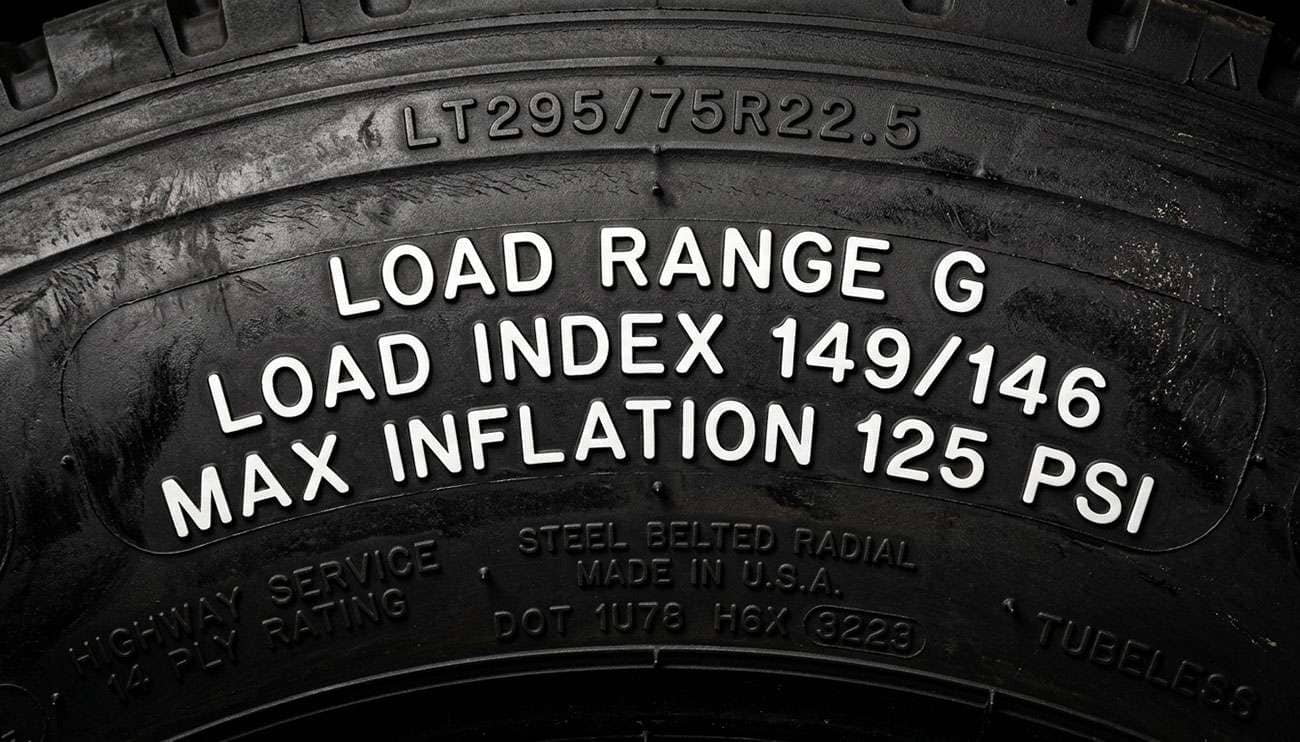
Most tire buyers look at three things: size, price, and brand. Load rating barely registers — until something goes wrong. An overloaded tire doesn't fail politely. It fails fast, usually at the worst possible time, and the consequences range from a blowout on the highway to a complete loss of vehicle control. The 105% rule exists specifically to prevent that scenario. It's a practical safety standard that tells you exactly how much load capacity your replacement tires need to have — not just enough, but enough with a margin built in. Once you understand it, you'll never buy tires the same way again.
The 105% rule is a tire selection guideline used by engineers, fleet managers, and tire professionals when specifying replacement tires. The rule states that the load carrying capacity of each replacement tire should be at least equal to — and ideally at least 105% of — the load that tire will be required to carry based on the vehicle's Gross Vehicle Weight Rating (GVWR).
In plain English: don't buy a tire that's rated to carry exactly what it needs to carry. Buy a tire rated to carry slightly more. The 5% buffer exists because real-world driving isn't a controlled laboratory. Weight shifts during cornering. Load distribution isn't perfectly even across four tires. Roads aren't flat. That 5% isn't padding — it's the difference between a tire operating within its design envelope and a tire being pushed to its absolute limit on every drive.
The 105% standard is referenced in tire industry guidelines and is used extensively in commercial vehicle tire selection — where getting load ratings wrong has immediate, serious consequences. The logic is straightforward: tire load ratings are established under controlled test conditions with precisely measured loads, consistent speeds, and ideal inflation pressures. Real-world conditions deviate from all of those parameters simultaneously. The 5% buffer accounts for that deviation without requiring a completely different tire size or load range.
For everyday passenger cars with factory tire specs and typical use, the OEM tires already incorporate this kind of margin — manufacturers spec tires with load capacity beyond what they strictly need. The 105% rule becomes critical when you're replacing tires with a different size, switching from P-metric to LT designation (or vice versa), running a vehicle near its maximum load capacity, or operating a light truck or SUV with significant payload or towing loads.
Here's the calculation. Take your vehicle's GVWR from the door jamb sticker or owner's manual. Divide by 4 (assuming equal load distribution across all four tires — more on why this is an assumption shortly). Multiply by 1.05. The result is the minimum load capacity, in pounds or kilograms, that each tire should be rated for.
Example: A truck with a GVWR of 6,800 lbs.
6,800 ÷ 4 = 1,700 lbs per corner
1,700 × 1.05 = 1,785 lbs minimum load capacity per tire
You'd then cross-reference that number against the tire load index chart to find the load index your tires need to meet or exceed. A load index of 108 supports 2,205 lbs per tire — well clear of that 1,785 lb minimum. A load index of 100 supports 1,764 lbs — technically below threshold for this vehicle. That's the kind of distinction the 105% rule helps you make correctly before you buy, not after a failure on the highway.
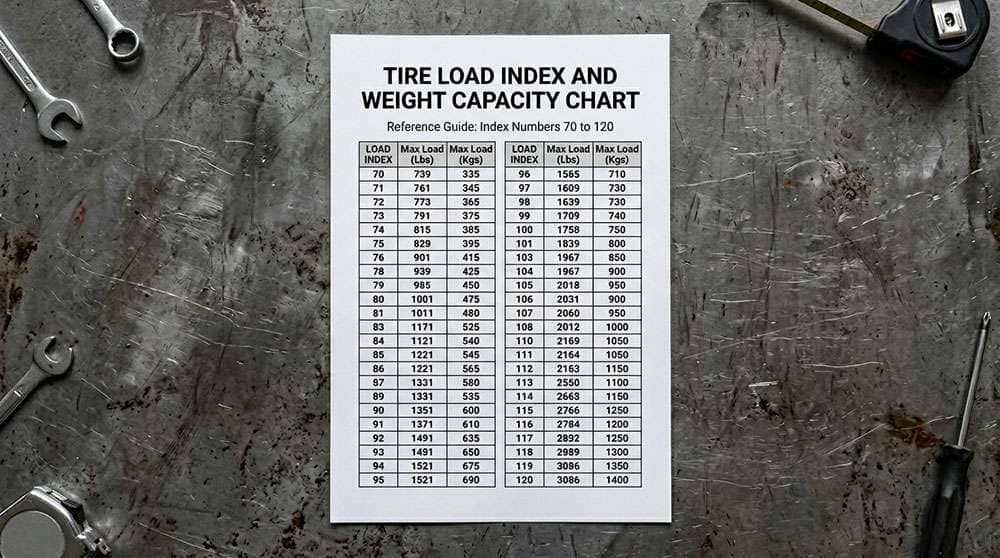
You can't apply the 105% rule without understanding load index, because load index is the number that tells you how much weight each tire can support. It's stamped on every tire sidewall right after the size code — the two or three digits before the speed rating letter in a designation like 265/70R17 121S.
Load index is a standardized numerical code — not a direct weight measurement — that corresponds to a specific maximum load capacity. The scale runs from around 70 (671 lbs per tire) up to 126 and beyond for heavy commercial applications. For passenger and light truck tires, you'll most commonly see load indices between 95 and 125. Each number represents a specific weight, and those weights are defined by international tire standards — the same chart is used by every tire manufacturer worldwide.
Load Index | Max Load (lbs) | Max Load (kg) | Typical Application |
|---|---|---|---|
95 |
1,521 |
690 |
Compact and mid-size sedans |
100 |
1,764 |
800 |
Mid-size sedans, small SUVs |
105 |
2,039 |
925 |
Large sedans, crossovers |
110 |
2,337 |
1,060 |
SUVs, light trucks |
115 |
2,679 |
1,215 |
Full-size trucks, heavy SUVs |
120 |
3,086 |
1,400 |
Heavy-duty trucks, work vehicles |
125 |
3,638 |
1,650 |
Heavy-duty trucks, commercial light |
Use the tire load index calculator to look up any load index value and see the corresponding weight capacity — you don't need to memorize the chart, but you do need to check it before buying tires for a vehicle that carries real loads.
Here's a critical detail that most tire buyers miss entirely: the load index rating on the sidewall is only valid when the tire is inflated to its maximum rated pressure. Drop the inflation pressure below that maximum, and the tire's actual load-carrying capacity drops too. This isn't a subtle effect — running a tire at 10 PSI below its max pressure can reduce effective load capacity by 10% or more. That's why the 105% rule and proper inflation management go hand in hand. You can select the right tire and still undermine it with improper inflation. The inflation pressure vs. load calculator shows exactly how capacity changes with pressure — worth running through for any vehicle you're loading heavily.
Here's where the 105% rule becomes genuinely urgent for a large segment of drivers: anyone running P-metric tires on a light truck, SUV, or pickup. This scenario is far more common than most people realize, and it creates a load capacity problem that the 105% rule is specifically designed to address.
P-metric tires (designated with a "P" prefix, like P265/70R17) are designed and load-rated for passenger vehicle use. LT-metric tires (designated "LT", like LT265/70R17) are built for light truck use — they have heavier construction, higher load ratings, and are rated at higher inflation pressures. The physical size of a P265/70R17 and an LT265/70R17 is essentially identical. The load capacity is not.
When you run P-metric tires on a light truck application — a pickup, an SUV, or a van — industry standards require that you derate (reduce) the tire's load capacity. For single rear wheel applications, you divide the P-metric load capacity by 1.10. That means a P-metric tire is only considered to carry approximately 91% of its sidewall-rated load when used on a truck. If that P-metric tire was already marginal for your vehicle's weight, that 9% reduction can push it below safe limits.
This is where the two concepts collide directly. If you're buying P-metric tires for a truck, you need to:
1. Calculate the per-tire load requirement using your GVWR ÷ 4 × 1.05 (the 105% rule)
2. Apply the P-metric derating factor — multiply the required load by 1.10 to find what the tire's rated load index needs to be before derating
3. Confirm the tire you're selecting has a load index that meets or exceeds that adjusted requirement
In practical terms, this means P-metric tires on a truck need a meaningfully higher load index than you might initially assume — often 10–15 load index points higher than the theoretical minimum. That's a real difference in tire selection, and it's one that tire shops sometimes miss when a customer comes in just looking for a size match.
For truck tires specifically, understanding whether you need LT or P-metric — and what load index is appropriate for your GVWR and payload — is one of the most important decisions you'll make when buying tires. Getting it wrong doesn't show up immediately. It shows up as premature tire failure, overheating sidewalls, and accelerated wear — all signs the tire was operating beyond its design capacity.
Load capacity and inflation pressure are inseparable. This is the physics behind the 105% rule, and understanding it makes everything else click into place.
A tire carries load through the air pressure inside it. The tire structure — the casing, the belts, the sidewalls — provides the containment. But it's the air that actually supports the weight. When you inflate a tire to its maximum rated pressure, the air column inside can support the maximum rated load. When you reduce pressure, you reduce the air's ability to support load, even though the tire looks fine from the outside and the tread shows no wear.
Most drivers think of underinflation as a fuel economy issue or a tire wear issue. Both are true. But the more serious consequence is load capacity degradation. A tire running 6 PSI low isn't just wearing unevenly — it's carrying less weight than its load index rating promises. On a heavily loaded truck or SUV, that gap between rated capacity and actual capacity can be the margin between a tire that holds up and one that fails.
This is why the 105% rule matters even when you've selected tires with sufficient load index. You can select the right tire and still violate the rule's intent by running it underinflated. The rule's 5% margin partially compensates for minor pressure variations, but it doesn't account for chronic underinflation. Check and maintain inflation pressure at the vehicle manufacturer's recommended levels — not the maximum pressure on the sidewall, which is the tire's structural limit, not the vehicle's recommended operating pressure. Those are two different numbers for a reason.
Tire load ratings are based on cold inflation pressure — meaning the pressure in the tire before it's been driven on and heat has built up. Tires warm up as you drive, and that heat increases internal pressure by 4–6 PSI under normal driving conditions. That increase is normal and expected — it's built into the design. Don't bleed air from a tire that's hot to bring it down to the recommended pressure. Check inflation when the tires are cold (driven less than a mile, or not driven in the last three hours), and set to the vehicle manufacturer's recommended pressure. The pressure will rise appropriately once you start driving.
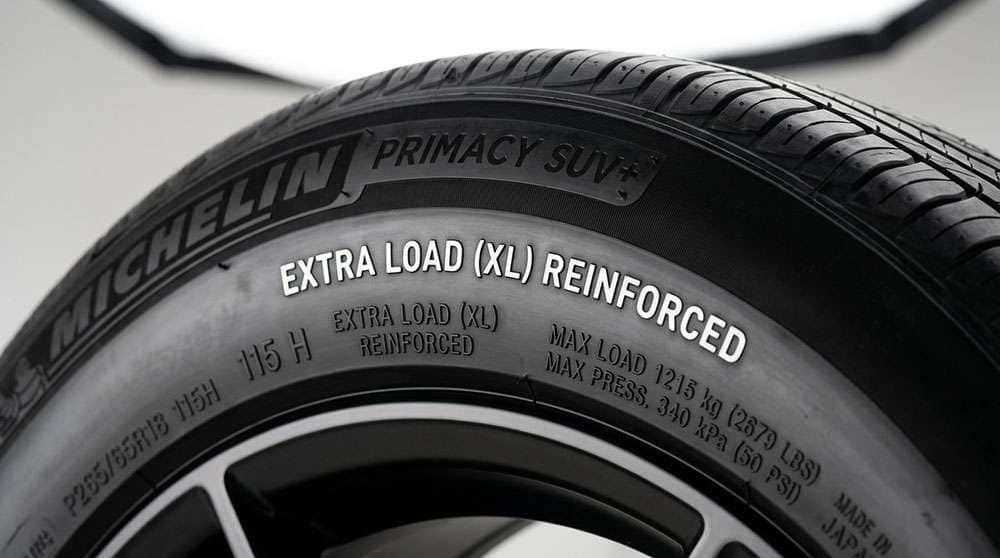
The 105% rule intersects with one more common scenario: the choice between Standard Load (SL) and Extra Load (XL) tires in the same size. Understanding this distinction can mean the difference between a tire that meets your load requirements and one that falls short — even though both have the same size code.
A Standard Load tire achieves its maximum rated load at a maximum inflation pressure of 35 PSI (for most passenger tires). An Extra Load (also called Reinforced or XL) tire of the same size achieves its maximum rated load at 41 PSI — and that maximum rated load is higher than the SL version of the same size, because the XL construction allows for higher inflation pressure and therefore higher load capacity.
On the sidewall, you'll see the designation clearly: "Standard Load," "SL," "Extra Load," "XL," or "Reinforced." The tire that follows the 105% rule for a given vehicle might be satisfied by an SL tire in one size but require an XL tire in another. This is particularly common when drivers go to a slightly smaller section width or lower aspect ratio without changing rim diameter — the new size might have a lower maximum load capacity at SL than the original, making XL a requirement rather than an option.
You can read the full breakdown of load range ratings and what they mean in practice at the Tire Load and Speed Ratings guide — it covers everything from SL and XL to the load range letters (C, D, E) used on LT tires.
If the OEM tire spec for your vehicle calls for XL tires, always replace with XL. The manufacturer determined that SL load capacity was insufficient for the vehicle's GVWR at that tire size. Replacing an XL requirement with SL is a safety compromise, regardless of whether the SL tire looks identical or fits the same rim.
If your vehicle came with SL tires and you're considering XL as an upgrade, run the 105% calculation first. If SL tires already provide more than 105% of your required per-corner load capacity, XL offers no safety benefit for load — though XL tires often have slightly stiffer sidewalls that some drivers prefer for handling feel. Make the choice based on actual data, not assumption.
Here's the practical step-by-step process. Use this every time you're buying replacement tires, especially if you're changing size, switching from LT to P-metric or vice versa, or putting tires on a vehicle that carries real payload.
GVWR — Gross Vehicle Weight Rating — is the maximum total weight your vehicle is designed to carry, including the vehicle itself, all passengers, cargo, fuel, and tongue weight from any trailer. You'll find it on the sticker inside the driver's door jamb, in the owner's manual, and often on the B-pillar. Don't confuse GVWR with curb weight (the vehicle empty) or payload capacity (what you can add). GVWR is the total.
Divide GVWR by 4 to get the theoretical per-tire load. Then multiply by 1.05 to apply the 105% rule. This gives you the minimum load capacity each tire must support.
Example: GVWR of 7,716 lbs (a common figure for a half-ton pickup)
7,716 ÷ 4 = 1,929 lbs
1,929 × 1.05 = 2,025 lbs minimum per tire
If you're selecting P-metric tires for a truck or SUV: multiply your minimum per-tire requirement by 1.10 to get the rated capacity the P-metric tire needs to have before derating.
2,025 × 1.10 = 2,228 lbs required load index rating for P-metric tires on this truck
Look up what load index corresponds to your required capacity. For 2,228 lbs, that's a load index of approximately 111 (which supports 2,403 lbs — the next index that meets your requirement). That's your minimum load index. Any tire you select must have a load index of 111 or higher. Use the tire size calculator alongside the load index data to confirm size and load compatibility simultaneously.
Confirm the specific tire you're selecting — size, load index, speed rating, SL or XL designation — matches your requirements. Then browse tires at Performance Plus Tire filtering by size and confirming the load index on each option. If you're unsure whether a specific tire meets your 105% requirement, the load index is right in the product specs — you don't have to guess.
The 105% rule sounds straightforward, but there are several points where drivers consistently go wrong. Knowing the failure modes in advance keeps you from repeating them.
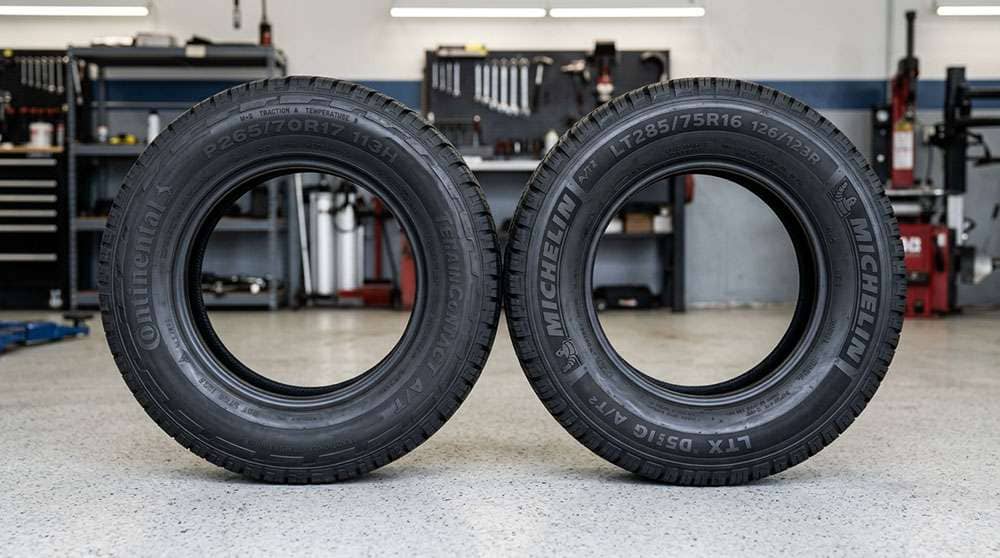
The most common mistake is buying a replacement tire in the correct size without verifying the load index matches or exceeds the original. Two tires in the same size code — say, 265/70R17 — can have different load indices depending on construction, brand, and load range. If your original tire was a 265/70R17 120S and you replace it with a 265/70R17 115S, you've reduced load capacity by more than 400 lbs per tire. On a lightly loaded car that's irrelevant. On a fully loaded truck it's a safety issue.
The 105% rule uses GVWR — the maximum — not your typical driving load. Some drivers argue they never load their truck to GVWR, so a lower load index is fine. This reasoning has two problems. First, you may carry more than you think, especially with passengers plus cargo plus a trailer tongue weight adding up simultaneously. Second, the load rating exists for a reason — if the vehicle is rated to carry that weight, the tires should be able to handle it safely when it does. Don't optimize for your best-case scenario. Optimize for your worst-case scenario, which is what the GVWR represents.
Truck owners who switch from LT to P-metric tires to save money or get a smoother ride often don't account for the derating. A P-metric tire that looks like an equivalent replacement for an LT tire of the same size is carrying less effective load. If the original LT tires were correctly specified for the truck's GVWR, the P-metric replacements may not pass the 105% rule after derating — even though they're the same size and the sidewall load index matches on paper.
Dividing GVWR by 4 assumes perfectly equal load distribution. Real vehicles don't work that way. A rear-loaded truck puts significantly more weight on the rear axle than the front. A vehicle towing a trailer has tongue weight biasing rear tire load. For most passenger vehicles, dividing by 4 is an acceptable approximation. For trucks operating near GVWR or with significant towing, it's worth checking the actual axle weight ratings to determine front vs. rear load distribution and specifying tires accordingly. The tire load ratings reference page covers axle-specific load considerations in detail.
The 105% rule isn't complicated once you break it down — it's just a 5% safety margin applied to the most important structural specification on your tires. But it's a margin that most drivers never check, and ignoring it is how you end up with tires that are technically the right size and technically in spec but functionally inadequate for the vehicle they're on. That gap is where tire failures happen.
Take 10 minutes before your next tire purchase to run the calculation. Find your GVWR on the door jamb sticker. Divide by 4. Multiply by 1.05. Apply the P-metric derating factor if relevant. Cross-reference against the load index chart. Then buy tires that meet or beat that number — not just tires that match your size. The difference in cost between a correctly specified tire and a marginally under-specified one is usually negligible. The difference in safety is anything but. Performance Plus Tire lists load index for every tire in its catalog, making it easy to verify you're buying right the first time.
Here's the 105% rule and everything around it, distilled.
• The 105% rule requires tires rated for more than the math suggests: Each tire's load capacity should support at least 105% of the per-corner weight derived from your vehicle's GVWR. The 5% buffer accounts for real-world load variation, uneven weight distribution, and road conditions.
• Load index is the number that makes the rule work: Load index is a standardized code on every tire sidewall corresponding to a specific maximum weight capacity at maximum inflation pressure. Never replace tires with a lower load index than the original without running the 105% calculation first.
• P-metric tires on trucks require an additional derating: P-metric load capacity must be divided by 1.10 for truck applications, meaning P-metric tires need a meaningfully higher rated load index than equivalent LT tires to meet the same effective load requirement.
• Inflation pressure directly affects load capacity: A tire's load index rating only holds at its maximum rated inflation pressure. Underinflated tires carry less than their rated load — and chronically underinflated tires on heavily loaded vehicles are a failure risk regardless of their rated load index.
• XL vs. SL matters when load capacity is close to the limit: If OEM specs call for XL tires, always replace with XL. If SL tires already provide more than 105% of required capacity, XL is optional. Check before you assume either way.
Running tires with an insufficient load index puts you at genuine risk of tire failure. An overloaded tire generates excess heat — heat is the primary cause of tire failure — and the structural components of the tire degrade faster than designed when routinely operated beyond their rated capacity. The danger isn't always immediate; an underrated tire might perform fine for months of light use and then fail catastrophically when the vehicle is fully loaded. Always meet or exceed the load index requirement, especially on trucks and SUVs that carry real payload.
The 105% rule applies to all vehicles, but it's most critical for trucks, SUVs, vans, and any vehicle that regularly operates near its maximum load capacity. For a standard passenger car that rarely carries more than a driver and one passenger, the OEM tire spec already incorporates more than adequate load margin, and the 105% calculation will confirm that comfortably. For a truck used for payload, towing, or carrying multiple passengers plus cargo, the calculation becomes genuinely important and can determine whether a seemingly adequate tire is actually safe for the application.
Yes, but you must account for the P-metric derating factor. For single rear wheel truck applications, divide the P-metric tire's rated load capacity by 1.10 to get the effective load capacity for truck use. If the derated capacity still meets or exceeds your 105% per-corner requirement, P-metric tires are technically acceptable. In practice, this often means you need a significantly higher load index on P-metric tires than on equivalent LT tires to carry the same effective load on a truck, which can make LT tires the better practical choice for heavily loaded vehicles.
Your vehicle's GVWR is printed on the certification label inside the driver's door jamb — the same sticker that shows recommended tire size and inflation pressure. It's also in the owner's manual under specifications. GVWR is the maximum total weight the vehicle is designed to handle including its own weight, all passengers, all cargo, fuel, and any tongue weight from a trailer. Don't confuse it with curb weight (vehicle empty) or payload rating (what you can add). GVWR is the total that matters for the 105% load calculation.
No — these are two completely different rules addressing different concerns. The 105% rule is about load capacity: replacement tires should be rated to carry at least 105% of the per-corner load derived from GVWR. The 3% rule (sometimes called the 3% diameter rule) is about tire size changes: when changing tire sizes, the overall diameter of the new tire should stay within approximately 3% of the original to avoid speedometer error, clearance issues, and gear ratio changes that affect transmission behavior. Both rules matter when buying tires, but they're measuring completely different things.



