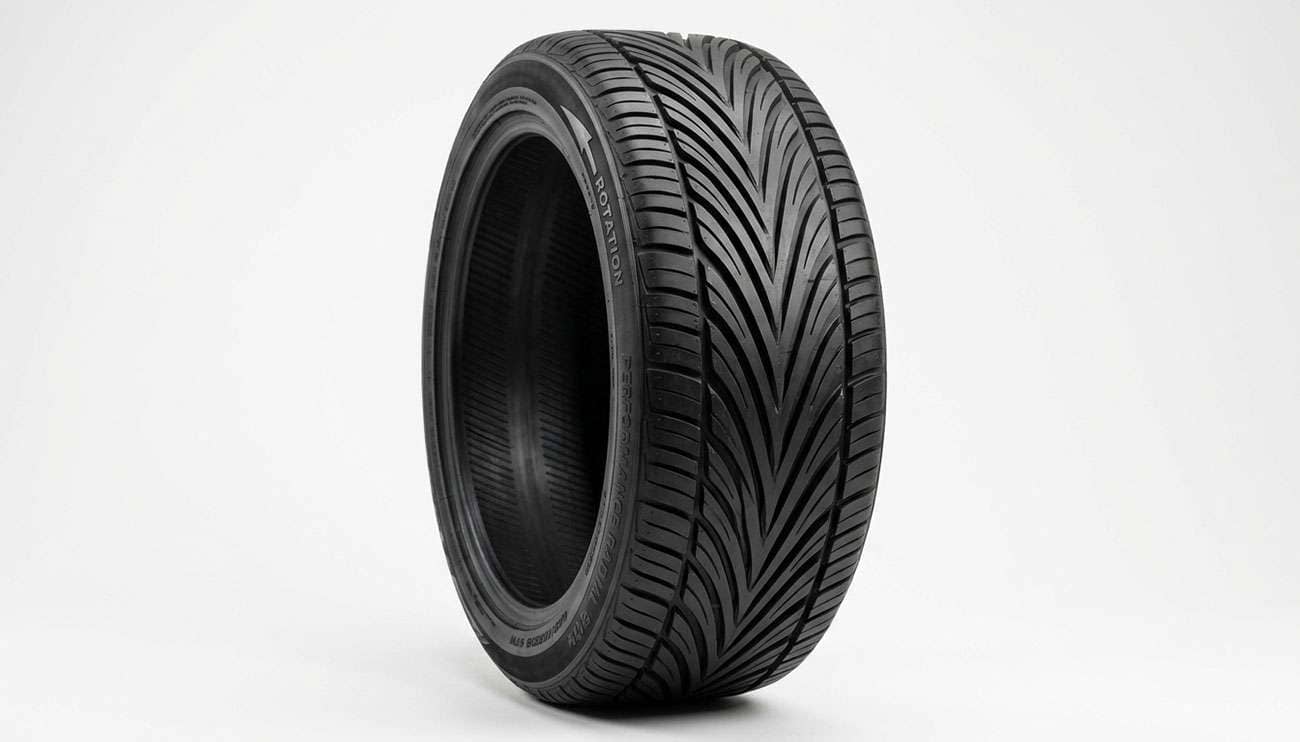
A directional tire mounted backwards still holds air, steers, and stops on dry pavement close to the way it should. The trouble shows up in standing water. Its V-shaped grooves are built to sweep water out from under the tire. Run backwards, they sweep it toward the center, and the tire starts to hydroplane sooner. Whether you fix it by swapping wheels side to side or by remounting depends on something most answers skip: how many arrows point the wrong way, and which side of the car they're on.
I've been mounting tires since 1971, and I still see this every month. Most of the time the owner has no idea, because on a dry day the car feels fine. That's exactly what makes it worth checking. And "backwards" means something different depending on which of the three tread designs you're running, so let's sort that out first.
Tread Type |
How to Spot It |
What "Backwards" Means |
What You Lose |
The Fix |
|---|---|---|---|---|
Directional |
Rotation arrow on the sidewall; V-shaped tread |
Tire turns against its arrow |
Water and slush clearing; some extra noise |
Swap sides if the wrong tires split evenly left and right; otherwise remount |
Asymmetric |
"OUTSIDE" and "INSIDE" on the sidewalls; bigger blocks on one shoulder |
Inside sidewall facing out |
Cornering grip and wet grooves end up on the wrong shoulders |
Dismount, flip on the wheel, remount |
Directional-asymmetric |
Arrow plus an outside marking; often sold as left and right tires |
On the wrong side of the car, or flipped on the wheel |
Both of the above |
Move it to its marked side, or remount |
Symmetric |
No arrow, no outside marking; tread mirrors across the center |
Nothing; it can't be backwards |
Nothing |
None needed |
Two different mistakes hide under one word. A directional tire is "backwards" when it spins the wrong way. An asymmetric tire is "backwards" when the wrong sidewall faces out. They feel the same to the driver, which is to say not much, but they get fixed differently, and the directional one is the one that bites in the rain.
Look at the sidewall. A directional tire carries an arrow, usually next to the word ROTATION or DIRECTION. There's no industry-standard symbol, so each tire maker picks its own wording and arrow style, but they all mean the same thing: this is the way the tire turns when the car rolls forward. If you're new to the design itself, what directional tires and wheels are covers the basics.
Here's the simple check. Stand beside the car and find the arrow. If it's on the top half of the tire, it should point toward the front bumper. If it's on the bottom half, it should point toward the rear. The top of a tire moves forward as you drive, and the bottom moves back.
You can also read the tread itself. On a correctly mounted directional tire, the point of the V hits the road first. Standing in front of the car looking at the face of the tread, the V should point down at the ground. If it points up, the tire is turning backwards. Tread styles vary, so when the V is hard to read, trust the arrow.
Check all four corners, not just one. As you'll see further down, the number of wrong arrows and where they sit tells you how the mistake happened and how to fix it.
Yes, and that's the whole reason the arrow is there. Here's the mechanism, condition by condition.
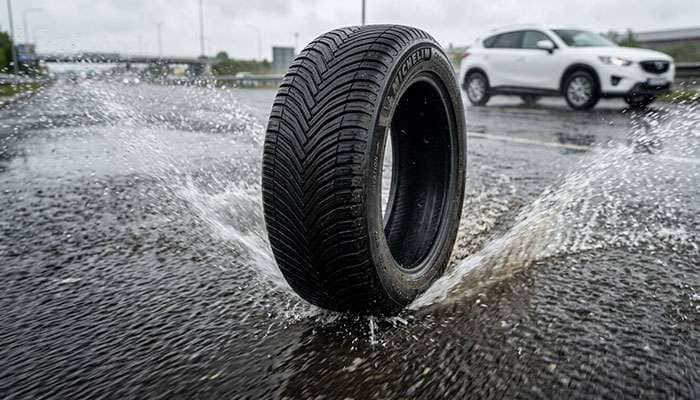
A directional tread is a water pump. As each V-shaped groove rolls into the contact patch, the point goes down first and the arms follow, so water gets squeezed from the center of the footprint out toward the shoulders and thrown off the sides. That's how the tire keeps rubber on the road when there's water on it.
Mount it backwards and the arms hit the water first. Now the grooves funnel water in toward the center of the footprint instead of out. The tire can't clear as much, so a wedge of water builds under the front of the contact patch sooner. The result is a tire that starts to hydroplane at a lower speed and in shallower water than the same tire turning the right way. You won't notice in light drizzle at 30 mph. You'll notice on the freeway when you hit a sheet of water in the fast lane. For the full physics of what's happening, see hydroplaning: what it is and why it happens.
Directional tread shows up most often on dedicated winter tires, and for the same reason: those grooves are built to throw slush out of the footprint. Turned backwards, slush gets packed toward the center instead of cleared. Slush is just thick water, and a tire that can't move it rides up on it. If your winter set is directional, getting the arrows right matters more, not less.
Here's where the folks who say "it doesn't matter" have a point. On dry pavement, the rubber is touching the road either way, and most drivers can't feel a difference in braking or cornering. That's why backwards tires can run for months without anyone catching it.
Dry isn't completely free, though. Tread blocks, siping, and the little buttresses between blocks are shaped for one direction of travel. Run backwards, blocks can wear unevenly from leading edge to trailing edge and the tire may hum louder. Some drivers notice a little extra noise for a while after the tires get turned around, while the block edges wear back in.
An asymmetric tire doesn't care which way it spins. It cares which sidewall faces the street. You'll see OUTSIDE on one sidewall and INSIDE, or "side facing inwards," on the other. The outer shoulder carries bigger, stiffer tread blocks for cornering grip. The inner half carries more grooves and smaller blocks for wet traction. Asymmetric patterns are the norm on ultra-high-performance and sport tires for exactly that split.
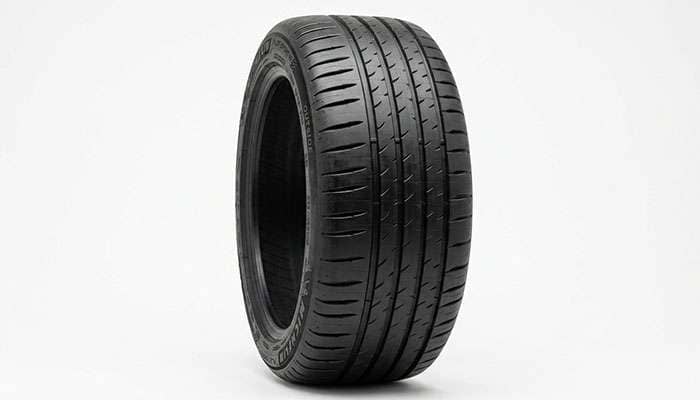
Mount one inside out and you've put the wet grooves on the outside shoulder and the cornering blocks on the inside. The tire still works, but it's giving away the very things it was designed around: grip when the car leans into a corner and water clearing where the tire needs it. It also tends to wear the shoulders unevenly.
Here's the catch: you can't fix an inside-out asymmetric tire by moving it to the other side of the car. The wheel's face always points out, so the same sidewall stays on the outside no matter which corner it's bolted to. It has to come off the wheel, get flipped, and go back on.
A symmetric tread is a mirror image across the centerline, with no arrow and no outside marking. It can go on any corner, spin either way, and face either direction. There's no wrong way to mount one. Most highway, all-terrain, and many touring tires use symmetric or near-symmetric patterns, which is part of why they're the easiest tires to own. For a deeper read on what each layout does, see how to decode tire tread patterns.
This is the part I wish more people knew, because it saves a trip and a bill. A directional set is really two left tires and two right tires once they're mounted. The arrow on a left-side wheel points one way, the arrow on a right-side wheel points the other. Moving a wheel to the opposite side of the car reverses its spin without touching the tire.
That gives you a clean rule. Count the backwards arrows and note which side they're on.
Backwards Arrows |
What Happened |
The Fix |
|---|---|---|
Two, one on each side |
Wheels got moved to the wrong side, usually a cross rotation |
Swap those two wheels side to side |
All four |
Every wheel is on the wrong side |
Swap left and right on both axles |
One or three |
At least one tire was mounted on its wheel the wrong way |
Remount that tire; then recheck all four |
Two on the same side |
Two tires were mounted on their wheels the wrong way |
Remount both |
Why does it work out that neatly? With two left-hand and two right-hand wheels, every left-hand wheel sitting on the right side forces a right-hand wheel onto the left side. So when wheels are simply on the wrong corners, the wrong arrows always come in matched pairs, one per side. An odd count, or a pair on the same side, means somebody mounted a tire on its wheel the wrong way, and no amount of shuffling wheels will fix that.
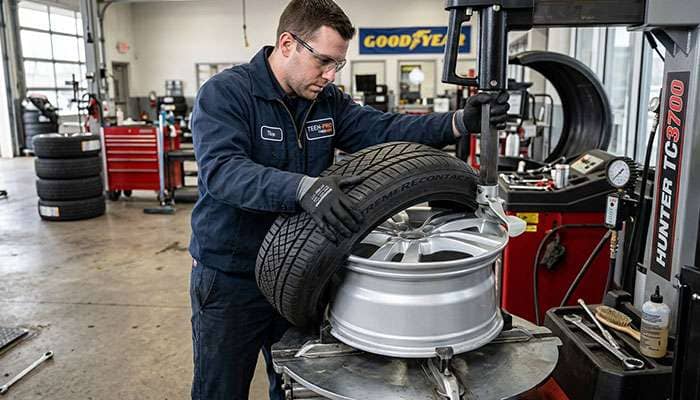
When a remount is the answer, it's a dismount, a flip, a remount, and a rebalance, with care around the TPMS sensor. Tire mounting and balancing costs breaks down what that service usually runs.
If you're shopping, the backwards question is worth thinking about before you buy. A directional tire is the best water-mover of the three when it's mounted right, but it limits how you rotate it. Here's how I'd match tread to setup.
Your Setup |
Best Tread Pattern |
Why |
|---|---|---|
Same size all around, lots of rain, highway miles |
Directional or asymmetric |
Best water clearing; directional tires rotate front to back on the same side |
Staggered, wider in the rear |
Asymmetric or symmetric |
Can still rotate side to side; directional plus staggered can't rotate without remounting |
Dedicated winter set |
Directional is common and works well |
Throws slush; mark each wheel by corner when you store it |
Truck or SUV, DIY rotations, full-size spare |
Symmetric |
Any rotation pattern, and the spare fits any corner |
Performance car with factory-specified tires |
Whatever the factory fitment calls for |
Often asymmetric or directional-asymmetric; follow the left, right, and outside markings exactly |
Across the market, directional tread shows up most in dedicated winter tires and high-performance summer tires. Asymmetric is the norm in ultra-high-performance and sport lines. All-terrain and highway truck tires are rarely directional. If you run a staggered car, read square vs. staggered setups before you pick a tread, because that choice decides whether you'll ever be able to rotate.
To the shop and back on a dry day, yes. As a way of life, no. Here's what it costs you the longer you drive on it, from least to most.
While you're down there reading arrows, take ten seconds to look over the sidewalls for cuts, bulges, or curb damage. If you find any, tire sidewall damage: is it safe to drive tells you which kinds can wait and which can't.
A directional tire mounted backwards isn't going to fall off the car. On a dry road you probably won't feel it. But the one job that tread was designed for, clearing water and slush out from under the tire, runs in reverse, and that's the job you need most on a wet freeway. An asymmetric tire mounted inside out gives away cornering grip and wet grip in the same way. A symmetric tire can't be wrong at all.
The fix depends on how it happened, and the arrows tell you. Wrong arrows split evenly across the car mean the wheels are on the wrong sides, and swapping them fixes it in a few minutes. An odd count, or a pair on one side, means a tire is mounted wrong on its wheel and needs to come off. Read the sidewalls, count, and fix it before the next rain.
It's not an emergency on dry pavement, but it shouldn't stay that way. Backwards directional tires clear water poorly, so they hydroplane sooner in standing water, and they can wear unevenly and run noisier over time. Get them corrected before your next drive in the rain.
Find the arrow on the sidewall, usually marked ROTATION or DIRECTION. When the arrow is on the top half of the tire, it should point toward the front of the car. Looking at the tread from the front of the car, the point of the V should aim down at the road.
Often, yes. If the backwards tires are split evenly between the left and right sides, the wheels are simply on the wrong sides, and swapping them fixes it. If only one or three are backwards, or two are on the same side, at least one tire is mounted on its wheel the wrong way and has to be remounted.
Yes, front to back on the same side of the car, as long as the front and rear tires are the same size. Moving them side to side requires dismounting and flipping each tire on its wheel. On a staggered car with different front and rear sizes, directional tires can't be rotated without dismounting.
With the INSIDE sidewall facing out, the stiff cornering blocks end up on the inner shoulder and the water-clearing grooves on the outer shoulder. You lose some cornering and wet grip and may see uneven shoulder wear. The only fix is to dismount the tire, flip it, and remount it.
Rules vary by country. New Zealand's vehicle inspection manual rejects a unidirectional tire fitted against its rotation, while the U.K.'s MOT manual treats a wrong-way asymmetric tire on a car as an advisory rather than a failure. Either way, the sidewall marking is the tire maker's instruction, and a shop should mount to it.