
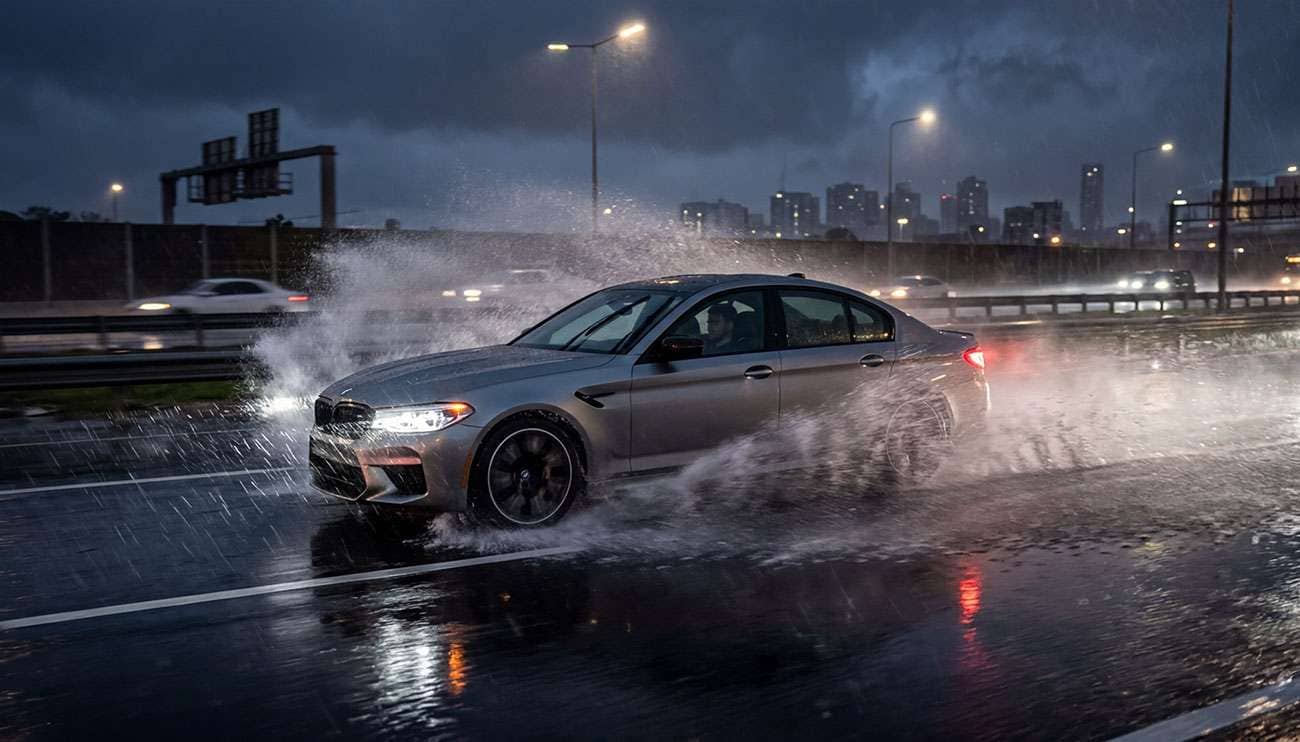
Your car can lose all contact with the road in 1/12 of an inch of water. Not a puddle. Not a flooded road. Just a thin film — the kind that forms within minutes of any rainstorm on any highway. At 55 mph, your tires each need to clear roughly two gallons of water per second to maintain traction. When they can't keep up, you're hydroplaning — and hydroplaning means you have no steering, no effective braking, and no control over where the car goes until the tires find asphalt again. It happens fast, it's terrifying, and most of the things drivers do by instinct when it happens make it worse. This guide covers the complete picture: what's happening to your tires when you hydroplane, when your risk is highest, exactly how to recover, and what you can do before it ever happens to dramatically reduce your odds of experiencing it.
Hydroplaning — also called aquaplaning — is the loss of traction that occurs when water builds up between your tire and the road surface faster than the tire can displace it. The water pressure in front of the rolling tire pushes water underneath, lifting the tire off the pavement onto a thin film. Once that film forms, the tire is no longer rolling on road — it's rolling on water, with a fraction of the friction it needs to steer, brake, or maintain direction.
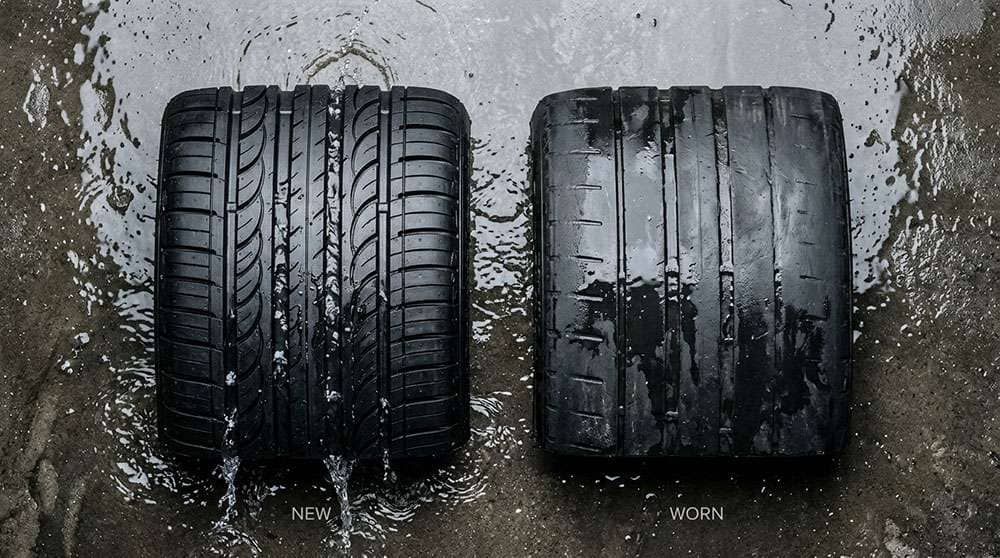
Every tire tread is an engineering solution to a specific problem: how do you maintain rubber-to-road contact when there's water between them? The grooves, channels, and sipes in your tire tread are not aesthetic — they're the tire's water management system. As the tire rolls, those grooves actively evacuate water from the contact patch, channeling it outward and rearward. A new tire with full tread depth can process an enormous volume of water — roughly 2 gallons per second per tire at highway speed. That's not a small ask. That's why tires work as well as they do in rain when they're in good condition.
The system breaks down when any of four things happen: the water volume exceeds what the tread can process, the speed of the tire increases the incoming water pressure beyond what the grooves can handle, the tread is worn too shallow to channel effectively, or the tire is improperly inflated and the contact patch shape changes. When any of these thresholds is crossed, water wins — and the tire starts to ride up on a water wedge instead of staying in contact with the road.
The reason hydroplaning is so disorienting is that it eliminates friction almost entirely — and friction is the only mechanism through which you control a car. Steering works because friction between the front tires and the road resists lateral movement, redirecting the vehicle as the wheels turn. Braking works because friction between the tire and road converts kinetic energy into heat, slowing the vehicle. Acceleration works because friction between the driven wheels and the road propels the car forward. Remove friction, remove all of that. Steering wheel inputs do nothing. Brake application does nothing — or makes it worse. The car goes where physics takes it until the tires find road again.
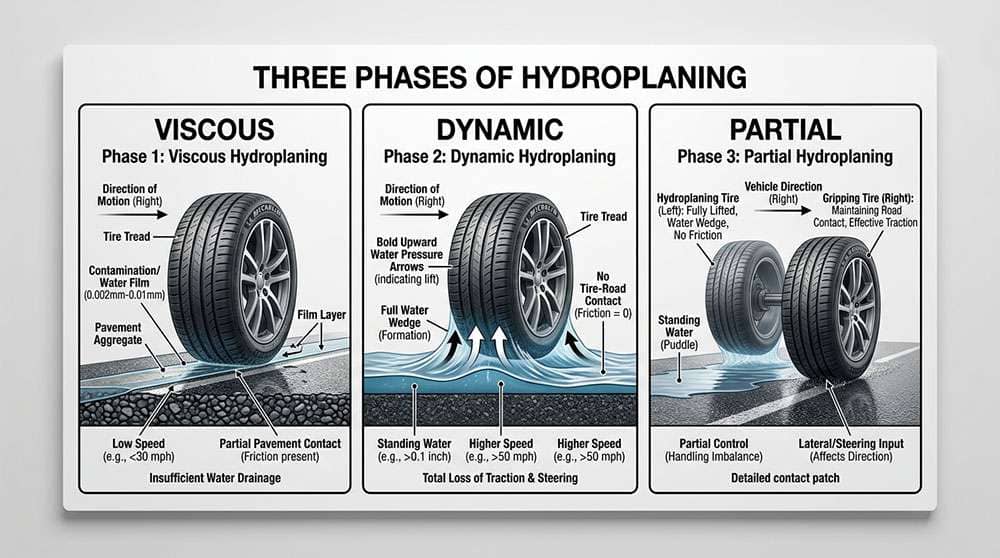
Hydroplaning isn't a binary switch — you're either in control or you're hydroplaning. It actually happens in three distinct phases, and understanding them explains why partial hydroplaning is in some ways more dangerous than full hydroplaning.
This is the lowest-speed, most common, and least recognized form. Viscous hydroplaning occurs when the very thin film of water mixed with road contaminants — oil residue, rubber dust, brake dust — becomes viscous enough under tire pressure to prevent the rubber from fully contacting the road. The tire isn't floating on a water wedge; it's separated from the road by a microscopically thin, slippery film. This is what makes roads so dangerous in the first few minutes of rain, when dry-accumulated oil and contaminants are activated by the initial water. You can experience viscous hydroplaning at speeds as low as 10–15 mph. Most drivers never recognize it because the loss of traction is subtle — a slight squirminess in the steering, reduced braking efficiency, a tire that doesn't quite bite the way it should.
This is the classic, full-force version that most people think of when they hear hydroplaning. Dynamic hydroplaning occurs when vehicle speed is high enough that water pressure in front of the tire exceeds the tire's ability to channel it, and a wedge of water physically lifts the tire off the pavement. The onset speed for dynamic hydroplaning depends heavily on tire tread depth, inflation pressure, and water depth on the road — but research consistently shows it can begin at speeds as low as 35 mph on standing water with worn tires, and typically occurs between 45–55 mph under more average conditions. The loss of traction in dynamic hydroplaning is sudden and total. The car floats — lighter vehicles more dramatically than heavier ones.
Partial hydroplaning is in some respects the most dangerous phase because it's the hardest to recognize and respond to correctly. It occurs when only one or two tires hydroplane while the others maintain traction. This creates an immediate and violent imbalance — the vehicle begins to yaw (rotate around its vertical axis), pulling strongly toward the hydroplaning tire while the gripping tires resist. Drivers often mistake this for a steering problem or a gust of wind, and their instinctive response is to grip the wheel harder and potentially steer or brake — both of which can cause a spin. Understanding that any sudden unexpected pull or rotation on a wet road may be partial hydroplaning is the key to responding correctly rather than reactively.
Every article about hydroplaning covers the same three causes: speed, water depth, and tread depth. Those matter — but there are three more factors that significantly influence your hydroplaning risk that almost never get discussed.
Speed is the dominant variable in hydroplaning risk, and it's the one you have the most direct control over. The physics are straightforward: at higher speeds, more water hits the tire per second, and the tire has less time to process it. The relationship isn't linear — it's more aggressive than that. Doubling your speed more than doubles your hydroplaning risk because the water pressure in front of the tire increases as a function of speed squared. At 35 mph, most tires in reasonable condition can manage typical road water. At 55 mph, the same tires are working much harder. At 70 mph in heavy rain, even good tires on a well-maintained vehicle are at meaningful hydroplaning risk. Slowing down by 10 mph in wet conditions provides a disproportionately large safety improvement relative to the time cost.
A vehicle can begin hydroplaning in as little as 1/12 of an inch of water — roughly 2mm. That's not a puddle. That's the film that forms on any road surface within minutes of rainfall starting. Deeper water is obviously more dangerous, but the threshold at which risk becomes serious is surprisingly low. Standing water — pooled water from poor drainage, road depression, or heavy downpour — is significantly more dangerous than a uniform film because the tire encounters a sudden high-volume water obstacle rather than a manageable continuous film. When you see visible pooling or spray from other vehicles, the water depth is well above the hydroplaning threshold.
Tread depth is the factor you can't change in the moment — you either have adequate tread when it rains or you don't. This is why tire condition is so critical to wet-weather safety. New tires with full tread depth (typically 10/32" to 12/32") have the full groove depth and volume available to channel water. As tires wear, that volume decreases, and so does the water management capacity. Research from Bridgestone and NHTSA consistently shows that wet braking distances increase significantly as tread wears from new to half-worn, and increase dramatically as tires approach the legal minimum of 2/32". Worn tires hydroplane sooner, at lower speeds, and in shallower water than new tires. The practical threshold for wet-weather safety — not the legal minimum — is 4/32" of tread. Below that, wet-weather performance is materially compromised even if the tire is still technically legal.
Check your tread depth regularly and replace tires before they approach the wet-weather threshold. Use the tire wear guide to understand wear patterns and when replacement is genuinely due — not just when the tire hits the legal minimum.
Tire pressure directly affects the shape of the tire's contact patch — the footprint it leaves on the road. A properly inflated tire has an optimal contact patch shape that maximizes the tread area in contact with the road and presents the grooves at the right geometry to channel water effectively. An underinflated tire deforms: the center of the contact patch lifts slightly and the outer edges bear more load, reducing effective water channeling and creating a tire that's more prone to hydroplaning. An overinflated tire has a smaller, narrower contact patch, reducing wet traction capacity. Both directions of pressure error increase hydroplaning risk — underinflation typically more severely than overinflation. Maintaining proper inflation is one of the lowest-effort, highest-impact hydroplaning prevention measures available. Use the inflation pressure calculator to confirm your target pressure for your vehicle's actual load.
Wider tires present more rubber width to the water on the road surface, which means more water that needs to be displaced laterally in the time available. All else being equal, a narrower tire hydroplanes less readily than a wider tire of the same tread pattern and depth, because the narrower tire can more easily cut through the water film and reach the road surface. This is a real engineering tradeoff: wider tires provide better dry-weather grip through a larger contact patch, but that same width increases wet-weather hydroplaning risk. Ultra-wide performance tires — 275mm, 295mm, and wider — require significantly deeper and more aggressive tread patterns to manage wet-weather hydroplaning risk at the same level as a narrower tire. When choosing tires, consider that going significantly wider than your OEM spec affects wet-weather performance, not just fitment.
Heavier vehicles resist hydroplaning more effectively than lighter ones, for a simple reason: greater mass pushes the tire into the road surface with more force, which must be overcome by the water pressure lifting the tire. A full-size pickup truck hydroplanes less readily than a compact car at the same speed with the same tires on the same road. This is not an invitation to drive heavy vehicles faster in the rain — the weight that provides hydroplaning resistance also increases stopping distances. But it does explain why lighter vehicles — including small SUVs and performance cars with wide, low-profile tires — need to take wet-weather conditions more seriously than drivers of heavier vehicles might.
Here's the most consistently underappreciated wet-weather risk: the first 10–15 minutes of rainfall on roads that have been dry for any significant period are the most dangerous time to drive. Not the middle of a heavy downpour. Not the aftermath. The beginning. And the reason is chemistry, not just physics.
Roads accumulate oil drippings from vehicles, rubber dust from tire wear, brake dust, and other contaminants during dry periods. When rainfall first begins, the water mixes with this accumulated contamination layer and creates a viscous, extremely slippery film on the road surface before rain volume is sufficient to wash it away. This is the viscous hydroplaning scenario described above — and it can happen at much lower speeds than dynamic hydroplaning because the slippery film is so effective at lubricating the tire-road interface.
After 10–15 minutes of consistent rain, the accumulated contamination washes away and the water on the road is relatively clean. The risk doesn't disappear — standing water and speed are still factors — but the viscous contamination layer is gone and tires grip the wet surface more effectively. This pattern is reflected in accident statistics: wet-road crashes spike disproportionately in the first phase of rainfall compared to sustained heavy rain.
Reduce speed more aggressively in the first minutes of rainfall than you would once rain has been falling for a while. Increase following distance to at least 4–5 seconds — double the dry-weather minimum. Be particularly smooth with all inputs: no hard braking, no sharp steering, no aggressive acceleration. The road is at its slipperiest right now, and your tires are dealing with the worst possible surface contamination. Once the rain has been falling consistently for 10–15 minutes, you can ease slightly back toward normal wet-weather precautions — though still not normal dry-weather driving.
The challenge with hydroplaning is that it can feel like several different things depending on which phase and which tires are involved. Knowing what to expect prevents the dangerous instinctive responses that make hydroplaning worse.
Full dynamic hydroplaning — all four tires off the road — produces a distinctive floating sensation. The steering wheel suddenly feels light and disconnected. Road vibrations disappear completely. The car seems to drift on a cushion. Engine RPMs may spike if the driven wheels lose all resistance. The car may begin to slow slightly as aerodynamic drag replaces road friction. This is the most dramatic form and the one most drivers recognize — if they've experienced it before. First-timers often don't process what's happening fast enough to respond correctly.
Partial hydroplaning — one or two tires losing traction while others grip — produces a sudden pull to one side, similar to a tire blowout but more transient. The car may yaw — begin rotating — if rear tires hydroplane while fronts grip, or if one side hydroplanes and the other doesn't. This is the form most likely to be misidentified as a mechanical problem, a wind gust, or a road irregularity. On any wet road, treat any unexpected lateral force or yaw as a potential hydroplane situation and respond accordingly.
One of the clearest indicators of hydroplaning is steering wheel input that produces no vehicle response. You turn the wheel and nothing happens — the car continues in its current direction. This is because the front tires are the primary steering mechanism and they're currently providing no lateral force. Don't increase steering input in response — the tires aren't responding to current inputs, more input won't help. Ease off the gas and wait for traction to return.
Most drivers, in the moment of hydroplaning, do the wrong thing. The wrong thing — braking hard, steering aggressively, accelerating — is what instinct provides. The right thing is counterintuitive and needs to be understood before the situation occurs, because there's no time to think it through when it's happening.
All three of these inputs are destabilizing when your tires have no road contact. Hard braking on hydroplaning tires — especially without ABS — can lock the tires and send the car into a spin when they regain traction. Hard acceleration increases wheel spin, throwing more water under the tires and potentially worsening the hydroplane. Sharp steering creates lateral loads the tires cannot respond to, and when traction suddenly returns, the stored steering input can snap the car into a violent oversteer condition. None of these inputs help. All of them can turn a recoverable situation into an accident.
The only productive immediate action is to ease off the accelerator — smoothly, not suddenly. Releasing the throttle reduces the water flow rate over the tires (because you're decelerating), allows the driven wheels to slow their rotation, and lets aerodynamic drag and remaining friction begin slowing the vehicle. The car will decelerate on its own. Let it.
Keep the wheel pointed in the direction you want to go and hold it firmly but without overcorrecting. If the car is beginning to yaw (rotate) from partial hydroplaning, use very small, gentle steering corrections — not aggressive counter-steering. The goal is to be positioned correctly when traction returns, not to fight the car while it has no grip.
In most cases, hydroplaning episodes last only a few seconds — the car decelerates enough for the tires to regain road contact. You'll feel the steering become responsive again and road vibration return through the wheel and seat. That's your signal that traction is restored. At that point — and only at that point — you can make any needed steering or braking corrections. Apply them gently: the car may still be on wet pavement and over-responding when traction returns is a common cause of post-hydroplane accidents.
If the yaw from partial hydroplaning progresses to a spin — the rear of the car beginning to overtake the front in a rotation — steer into the spin (in the direction the rear is moving) with smooth, measured inputs. This is the same countersteer technique used for any oversteer situation. Don't brake. Don't overcorrect. The goal is to keep the nose of the car pointing in the direction of travel as traction returns. This is a skill that benefits enormously from practice in a controlled environment — skid pad training or performance driving instruction provides exactly this experience in a safe setting.
Your tires are the only physical interface between your vehicle and the road. All the technology in your car — ABS, ESC, AWD, active suspension — operates through the tires. If the tires have lost contact with the road, none of that technology functions. Tire selection and maintenance is the most powerful hydroplaning prevention tool available, and it's entirely within your control.
The single most impactful factor you control is tread depth. New tires provide dramatically better wet traction than half-worn tires, and dramatically better than tires approaching the legal 2/32" minimum. The wet-weather performance cliff isn't at 2/32" — it's at 4/32". Below 4/32", stopping distances in rain increase significantly, hydroplaning onset speed drops, and overall wet-weather confidence degrades substantially. Replace tires before they hit 4/32" if you drive regularly in wet conditions. Don't wait for the legal minimum — that threshold exists for liability purposes, not optimal safety.
Not all tread patterns are equally effective at water evacuation. Tires designed for wet-weather performance incorporate several specific design elements: circumferential grooves (the channels that run around the full circumference of the tire) are the primary water evacuation channels — more and deeper circumferential grooves generally mean better wet traction. Lateral grooves (running perpendicular to the direction of travel) help evacuate water swept in from the circumferential channels. Sipes — small cuts within individual tread blocks — create additional biting edges for wet grip and help break up the water film. Directional tread patterns, which point in a V-shape toward the front of the tire, are specifically optimized for water evacuation in one direction of travel and provide excellent hydroplaning resistance.
All-season tires include these features in varying degrees of optimization. Dedicated summer performance tires are often optimized for dry grip with reduced wet weather capability — their tread patterns are less aggressively grooved than all-season designs. If you live in a region with regular significant rainfall, prioritize wet traction ratings when selecting tires. Browse tires at Performance Plus Tire and compare UTQG traction grades — AA-rated tires provide the best wet braking performance on the standardized test.
Proper inflation is the lowest-effort, highest-impact tire maintenance task, and most drivers don't do it monthly. Check all four tires cold — before driving — at least once a month. Your target pressure is on the door jamb sticker, not the maximum pressure molded into the sidewall. The door jamb pressure is what your vehicle manufacturer determined provides the optimal contact patch shape for all conditions including wet weather. Deviating significantly in either direction compromises that geometry and your wet-weather safety with it.
Tire rubber compounds degrade over time regardless of tread depth remaining. Older rubber becomes harder and less pliable — it doesn't conform to the road microstructure as effectively, reducing grip on any surface including wet pavement. Tires older than 6 years from manufacture date show measurably reduced wet traction even with adequate tread remaining. Use the tire age DOT date checker to verify your tires' manufacture date. If they're approaching 6 years, their wet-weather performance is declining even if they look fine and have tread left.
Tires get you to the starting line. Driving habits determine the outcome. Here's what the research and physics actually support — beyond the generic "slow down and be careful" advice every article gives.
Most drivers reduce speed by 5–10 mph in rain. The physics suggest more is warranted. The relationship between speed and hydroplaning risk is non-linear — small speed reductions provide large safety improvements. Driving at 45 mph instead of 55 mph in rain isn't a 18% safety improvement; the reduction in hydroplaning risk is significantly larger because water displacement pressure decreases as speed squared. If road conditions are visibly wet with standing water, a 15–20 mph reduction from your normal highway speed is not excessive — it's appropriately calibrated to the actual physics of your tires' water management capacity.
The vehicle ahead of you has already disturbed the water film in its tire tracks, partially displacing water in the path where your tires will roll. Driving in the tire tracks of the vehicle ahead — without following too closely — puts your tires on drier pavement than the center of the lane where water accumulates. This is particularly effective on highways with good lane discipline. Maintain at least 4–5 seconds of following distance to give you reaction time, and position your tires in the previous vehicle's tracks.
Highway lanes accumulate different amounts of water depending on the road's crown and drainage design. Outer lanes — the rightmost travel lane — typically collect more water than center or left lanes because the road is crowned (higher in the center, draining toward the edges) and because outer lanes experience more heavy truck traffic that creates ruts where water pools. In sustained rain on a multi-lane highway, moving to a center lane meaningfully reduces your exposure to standing water.
On wet roads, sharp lane changes, aggressive cornering, and sudden swerves all push your tires toward their traction limits — which are significantly lower on wet pavement than dry. The physics of cornering mean the tires are already managing lateral loads; combine that with water on the road and any sudden directional input can push beyond what the wet traction allows. Plan ahead, signal early, change lanes gradually, and take corners at speeds that feel slower than necessary — they're probably calibrated correctly.
A puddle of unknown depth isn't just a hydroplaning risk — it can hide a pothole that damages your rim or suspension, or water deep enough to damage your engine's intake if the car's air intake is near road level (particularly relevant for lowered vehicles). When standing water is unavoidable, approach it at reduced speed, hold your line through it, and resist the urge to brake inside the water — brake before, modulate gently through, and accelerate gradually after you've cleared it.
Modern vehicles have impressive safety technology. None of it overcomes the fundamental physics of a tire with no road contact. Understanding what these systems can and can't do in hydroplaning scenarios prevents overconfidence.
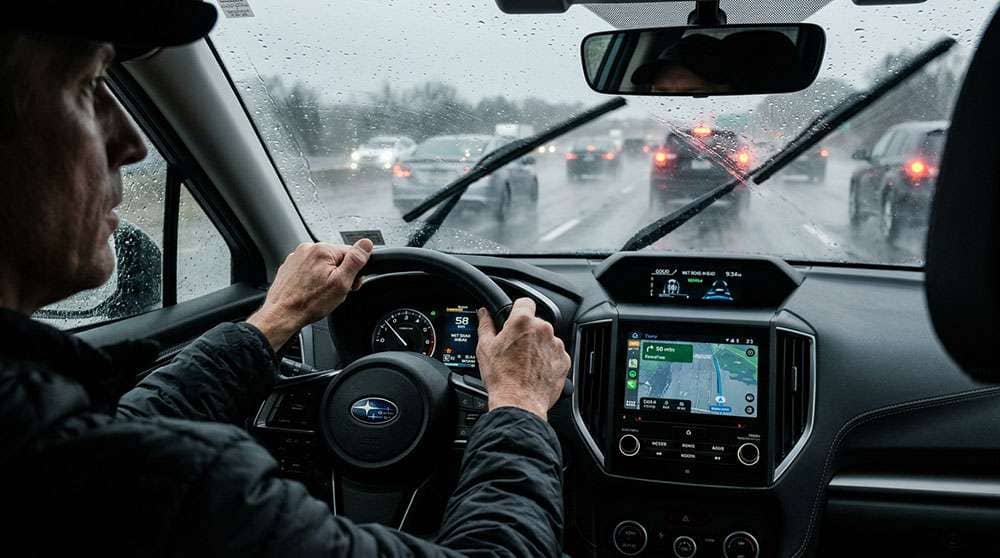
Cruise control is engineered to maintain a target speed by modulating throttle. When a tire hydroplanes, the wheel may spin faster (because it's lost road resistance), and the cruise control system can interpret this as deceleration and apply more throttle — exactly the wrong response. It's adding power to driven wheels that are already hydroplaning, potentially worsening the situation. Turn cruise control off whenever roads are wet. This is advice from every major tire manufacturer and the NHTSA, and it's consistently ignored. The habit of reaching for the cruise control switch as soon as pavement gets wet should become as automatic as putting on a seatbelt.
ABS — Anti-lock Braking System — prevents tire lockup during braking by modulating brake pressure many times per second, maintaining traction between tire and road. The critical word is "traction." ABS requires some contact between tire and road to function. On a hydroplaning tire with no road contact, ABS has nothing to work with — it cannot prevent a locked tire when the tire isn't gripping anything. ABS is enormously helpful as tires regain contact after hydroplaning, preventing lockup as traction suddenly returns. It's not helpful during the hydroplane itself. Understanding this distinction helps you avoid false confidence in ABS as a hydroplaning safety net.
AWD and 4WD systems distribute power between axles and wheels to maintain traction during acceleration. They help prevent wheelspin during acceleration on slippery surfaces. They provide zero benefit against hydroplaning — in fact, all four driven wheels can hydroplane simultaneously on an AWD vehicle, creating the same total loss of control as a two-wheel drive vehicle. AWD confidence in the rain is a documented contributor to wet-weather accidents: AWD drivers underestimate their risk and drive faster than conditions warrant, and then discover that their advanced drivetrain provides no help when all four tires leave the road. Tread depth, inflation pressure, speed management, and appropriate all-weather or all-season tires matter identically on AWD vehicles. Adjust your speed just as aggressively in wet conditions regardless of drivetrain.
ESC — Electronic Stability Control — monitors vehicle yaw and applies individual brakes to counteract oversteer or understeer. It works through the tires, so like ABS it cannot function when tires have no road contact. But ESC is the most useful wet-weather safety technology because it operates at the margins of traction loss — the partial hydroplaning scenarios where some tires are gripping and others aren't. When one or two tires hydroplane and the vehicle begins to yaw, ESC can apply targeted braking to the gripping tires to counteract rotation and help maintain directional control. Keep ESC enabled at all times in wet conditions — never switch it off on public wet roads.
Hydroplaning is one of those hazards that feels random and unavoidable until you understand the physics behind it — and then it becomes one of the most preventable dangerous situations on the road. The water has to exceed your tires' evacuation capacity. The speed has to exceed the threshold. The tread has to be insufficient. The pressure has to be wrong. Each of those factors is something you either control directly or can influence through your choices. Proper tires in good condition, maintained at correct pressure, on a vehicle driven at appropriate wet-weather speeds with cruise control off — that combination dramatically reduces your hydroplaning risk without eliminating it entirely. Nothing eliminates it entirely. But the drivers who hydroplane most often are the ones who haven't thought about it until it's happening.
Tread depth is the factor you set before the rain starts. If your tires are approaching 4/32" or below, they're already compromised for wet-weather use. Performance Plus Tire carries tires in every size and category — from all-season touring tires to high-performance summer applications — with full wet-weather performance specs available for every option. If your tires are already in replacement territory, don't wait for the next rain to discover it.
The complete hydroplaning picture condensed to what you need to know.
• Hydroplaning can happen at 35 mph in 1/12 inch of water: It's not a flooding-only risk. Normal rain on any road can create hydroplaning conditions, and the onset speed is much lower than most drivers assume — especially with worn tires or underinflation.
• The first 10–15 minutes of rain on dry roads are the most dangerous: Accumulated oil, rubber dust, and road contaminants mix with initial rainfall to create a viscous, extremely slippery film before rain volume washes it away. Reduce speed more aggressively in the opening minutes of any rainstorm than you would in sustained rain.
• When hydroplaning, ease off the gas — don't brake, don't steer hard: Hard braking and sharp steering inputs during hydroplaning can trigger a spin when traction returns. The correct response is smooth throttle release, a firm and steady steering hold, and patience until the tires find road again.
• Tread depth is your most powerful prevention tool and the one you set in advance: The wet-weather performance threshold is 4/32" — not the legal 2/32" minimum. Below 4/32", wet braking distances increase substantially and hydroplaning onset speed drops significantly. Replace tires before reaching this threshold.
• Turn cruise control off in rain — every time: Cruise control can apply throttle when it detects speed drop from hydroplaning, worsening the situation. AWD provides zero hydroplaning protection. ESC helps with partial hydroplaning but requires some traction to function. Your tires and your right foot are the only real defenses.
Hydroplaning occurs when water on the road builds up between your tires and the road surface faster than the tires can displace it. The primary causes are vehicle speed (higher speed means more water hitting the tire per second), water depth on the road (as little as 1/12 inch is sufficient under the right conditions), worn tire tread (shallow grooves can't channel water effectively), underinflated tires (altered contact patch shape reduces water evacuation efficiency), wider tires (more surface area means more water to displace), and lighter vehicle weight (less force pressing the tire into the road). Speed and tread depth are the two factors that most directly determine when hydroplaning begins.
Ease off the accelerator smoothly — do not brake hard or steer sharply. Hold the steering wheel straight and firm in the direction you want to go. Wait for traction to return as the vehicle decelerates and the tires regain contact with the road. Once you feel traction return through the steering wheel and seat, make any needed corrections gently. The most common mistakes — hard braking, aggressive steering, or punching the throttle — all risk causing a spin when traction returns. The correct response is deliberately minimal: reduce throttle, hold the wheel, wait.
Hydroplaning can begin at speeds as low as 35 mph under the right conditions — worn tires, deeper standing water, and lighter vehicles increase risk at lower speeds. With new tires at proper inflation on a light rain film, dynamic hydroplaning typically requires 45–55 mph or more. Viscous hydroplaning from road contamination in the first minutes of rain can occur at speeds as low as 15–20 mph. There is no "safe" speed on a wet road — appropriate speed depends on tire condition, water depth, and road surface. The general guideline of reducing highway speed by 10–20 mph in wet conditions is a reasonable baseline, not a guarantee against hydroplaning.
The most effective prevention measures, in order of impact: maintain tire tread above 4/32" (replace before the legal 2/32" minimum), keep tires inflated to the manufacturer's recommended pressure, reduce speed in wet conditions particularly in the first 10–15 minutes of rain when road contamination is worst, turn off cruise control on wet roads, drive in the tire tracks of the vehicle ahead where water is already displaced, avoid outer highway lanes where water accumulates, and steer around puddles and standing water where possible. Tread depth and speed management are the two highest-impact factors and the ones most within your direct control.
No. AWD distributes power between axles and wheels to maintain traction during acceleration, but it provides no protection against hydroplaning. All four tires on an AWD vehicle can hydroplane simultaneously, producing the same total loss of control as a two-wheel drive vehicle. AWD confidence in wet conditions is a documented cause of wet-weather accidents — AWD drivers tend to drive faster than conditions warrant and then discover their drivetrain provides no help when tires lose road contact. Tread depth, inflation pressure, and appropriate speed reduction matter identically on AWD vehicles as on any other drivetrain configuration.



