A car that shakes after new tires usually has an installation problem, not a bad tire, and two clues tell you which one: when the shake started and the speed where you feel it. A shake that shows up at highway speed right out of the shop is balance. One you can feel at 20 to 40 mph points to a bead that didn't seat or a wheel that isn't centered on the hub. A shake that appears days later points to lug nuts, and one that shows up only under braking, weeks later, points to how they were tightened. Most guides list the causes and stop. Here is how to sort them.
I'm Dennis Feldman, and vibration-after-install calls are some of the most fixable problems our Fitment Team hears. Write down two things before you call the shop back: the day the shake started and the speed range where it shows up. Then match them here.
When It Started |
Speed and Feel |
Most Likely Cause |
What to Ask For |
|---|---|---|---|
Right out of the shop |
Builds around 50 to 70 mph, may ease above that |
Imbalance |
Rebalance; road force balance if it comes back |
Right out of the shop |
A hop or wobble you feel at 20 to 40 mph that grows with speed |
Bead not fully seated, or tire-to-wheel runout |
Aligning ring check; remount, relube, reseat |
Right out of the shop, on aftermarket wheels |
Highway shake that survives rebalancing |
Wheel not centered on the hub (center bore gap) |
Hub-centric rings; remount centered |
Smooth at first, then a highway shake within a few hundred miles |
Same speed band as imbalance |
A weight came off, or the tire slipped on the wheel |
Rebalance; check the index mark |
A few days or 50 to 100 miles later |
Wobble or clunk at low speed that keeps getting worse |
Loose lug nuts |
Stop driving; torque check now |
Weeks or a few thousand miles later |
Only when braking; pedal or wheel pulses |
Uneven lug torque distorted the rotor mounting |
Rotor runout check, hub cleaning, torque wrench install |
Every morning, gone after a few miles |
Any speed, fades as the tires warm |
Flat spots from sitting overnight |
Usually nothing; recheck if it lasts |
Two more clues sharpen the table. A shake you feel in the steering wheel usually lives at the front axle. A shake you feel in the seat and floor usually lives at the rear.
No. New tires feel different for the first few hundred miles, but a correctly mounted and balanced set should not shake. A vibration that builds in the 50 to 70 mph range and sometimes eases above it is the classic signature of imbalance. That speed band is where the rotating heavy spot lines up with the natural frequency of the suspension, so the shake peaks there instead of growing steadily with speed.
No tire and wheel come out of the factory with perfectly even weight. The balancer spins the assembly, finds the heavy spot, and tells the technician where to place weights to cancel it. A modern dynamic balance corrects side-to-side wobble as well as up-and-down hop, which is why weights go on both the inner and outer rim. When a balance job goes wrong, it is usually for one of a few reasons:
A quick rebalance at the installing shop fixes most of these. If the shake comes right back after a careful rebalance, the cause isn't balance, and the next three sections are where to look.
If the car was smooth for the first drive and the highway shake arrived within a few hundred miles, the balance changed. Either a weight fell off, or the tire rotated on the wheel. Tire lubricant makes mounting easy, and under hard acceleration or braking before it dries, a tire can slip a few degrees on the rim and carry its balance point with it. Nissan's tire mounting bulletin on file with NHTSA notes that if slippage occurs, the assembly has to be rebalanced, and recommends an index mark across tire and wheel so you can tell. If your shop marked one and the marks no longer line up, you have your answer.
Imbalance rarely makes itself known at 25 mph. A hop or wobble you can feel at neighborhood speeds, one that grows steadily as you speed up, points to the tire not running round on the wheel. The most common reason is a bead that never fully seated.
When a tire is inflated on the wheel, each bead has to slide outward over the safety hump and seat tight against the rim flange all the way around. If a section of bead hangs up, that part of the tire sits slightly lower or farther in than the rest. The tire now has a high spot built into its mounting, and no amount of balancing weight fixes it, because the problem is shape, not weight. Nissan's bulletin says it plainly: a tire bead that is not seated correctly may cause a vehicle vibration. Michelin's guidance says the same, and adds that improper mounting can cause vibration that gets mistaken for an alignment problem.
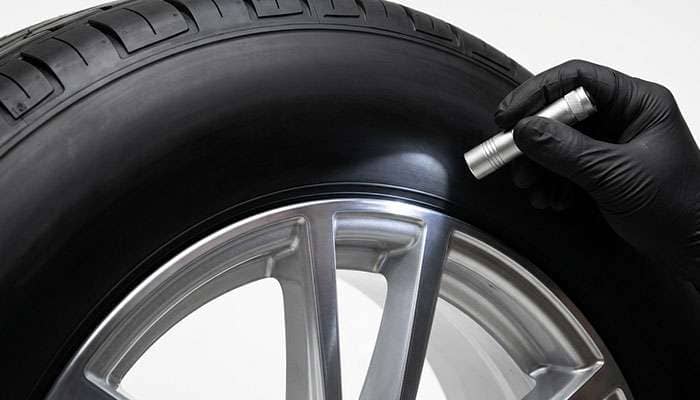
Most tires have a thin molded line on the lower sidewall just above the rim, called the aligning ring or rim line. On a seated bead, that line sits the same distance from the rim flange all the way around. Bridgestone's mounting guidance tells technicians to check it at four points, 90 degrees apart, on both sides of the tire, and to treat any visible difference as a non-concentric mount. You can do the same check in your driveway with a flashlight. If the line dips toward the rim in one spot and stands off in another, the bead isn't seated.
The fix belongs to the shop: deflate, break the bead, relubricate the bead and the rim's bead seat, and reinflate. The U.S. Tire Manufacturers Association is firm about one limit here. Never inflate beyond 40 psi to seat a bead. If both beads aren't seated at 40 psi, the procedure is to deflate completely, reposition, relubricate, and try again, not to add more air. USTMA also warns not to assume a bead is seated just because it made a popping sound. The bead has to clear a raised ridge on the rim to seat, and our explainer on the tire bead seat and the safety hump shows where a bead can hang up.
Because a standard balancer only measures weight, and some vibrations are not about weight. A tire can be perfectly balanced and still have a stiff spot in its construction or a slight high spot in its shape. A spin balancer can't feel that, because nothing presses on the tread while it spins.
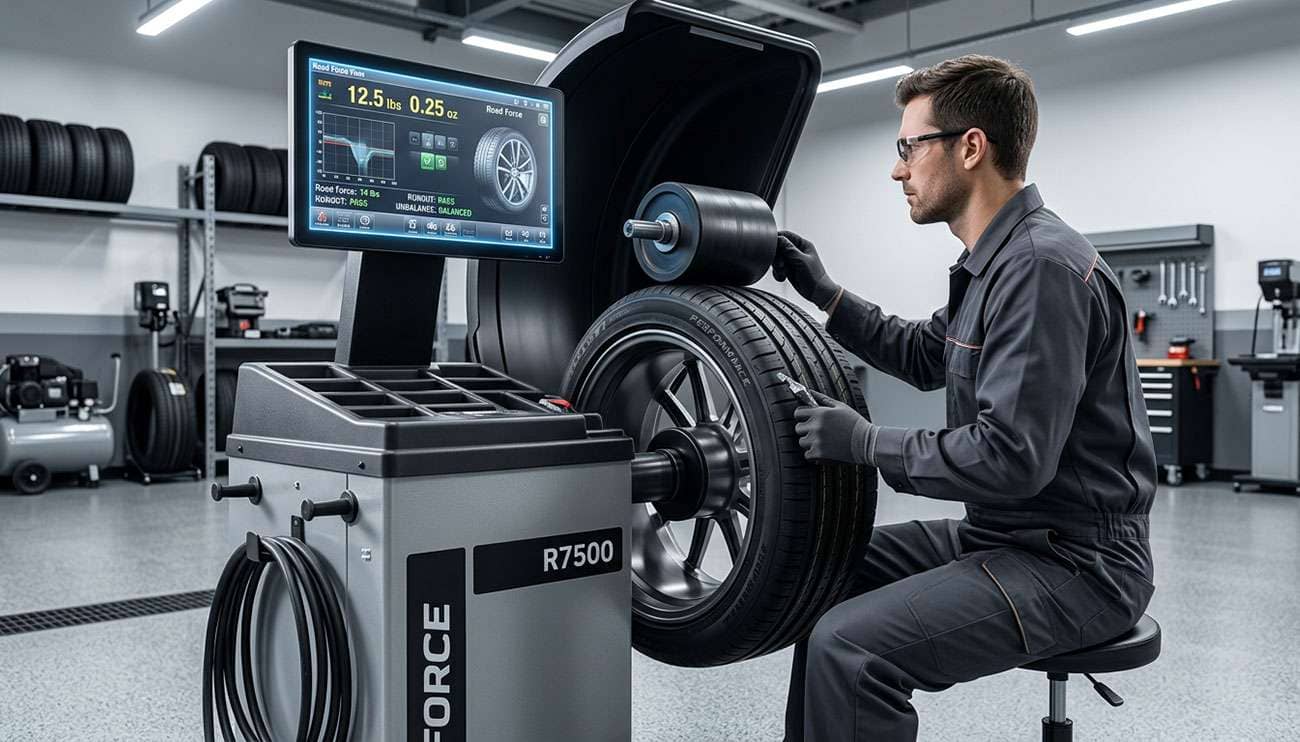
A road force balancer can. It presses a roller against the spinning tire with a load in the range of what the car puts on it, typically well over 1,000 pounds, and measures how much the push-back varies around the tire. That number, in pounds, is road force variation. It catches tire uniformity problems, bent or out-of-round wheels, and bead seating problems that a spin balancer misses. It also shows whether the tire or the wheel is the bigger contributor.
The fix is often free of new parts. The machine can call for match mounting: rotating the tire on the wheel so the tire's high point sits on the wheel's low point, which cancels much of the variation. USTMA recommends match mounting tire and rim because it can give a better-balanced assembly. If a tire still reads high after match mounting, that tire is the problem. Our guide to what road force balancing is and when you need it walks through the process.
If the wheel's center bore is larger than your vehicle's hub, yes, in most cases. This is behind a lot of "balanced three times and it still shakes" calls, and it only applies when new tires went on new wheels, or on wheels that have been off the car before.
Factory wheels are hub-centric: the center bore is machined to the exact diameter of the hub, so the hub centers the wheel. Most aftermarket wheels are made with an oversized bore so one wheel fits many vehicles. Without a ring filling the gap, the wheel is lug-centric, centered only by the lug nut seats.
Here is the part nobody puts in front of you. The balancer centers the wheel by its center bore, on a cone. The car centers that same wheel by its lugs. If the lug nuts are snugged with the wheel hanging low on the studs, or run down with an impact gun in a non-star order, the wheel can lock in a fraction of a millimeter off center. That much off-center works just like an imbalance at highway speed. The assembly balanced perfectly on the machine because the machine centered it right. On the car, it is off center, and no rebalance will find it.
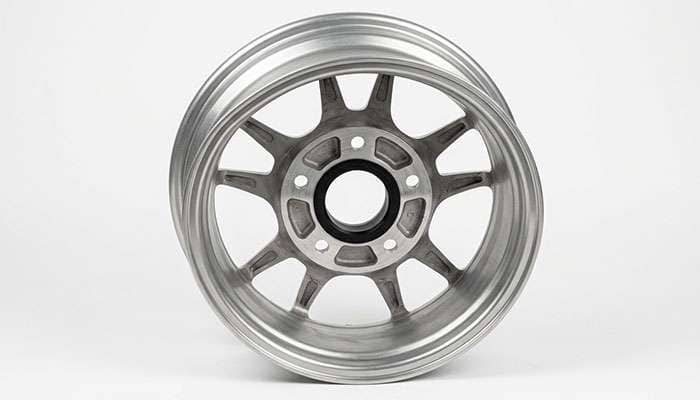
A hub-centric ring is a sleeve that fills the gap between the wheel's bore and the hub, so the hub centers the wheel again. Ring sizes are written as two numbers, the wheel's bore and the hub's diameter, both in millimeters. Our breakdown of hub-centric vs. lug-centric wheels covers how to measure both. Without rings, careful mounting still matters: snug the nuts in a star pattern with the wheel off the ground and pushed up against the hub, then lower the car and torque to spec.
One related trap: aftermarket wheels can need different lug nuts than the factory wheels. A lug nut with the wrong seat shape, conical where the wheel wants a ball seat or the reverse, touches the wheel on a thin ring instead of a full face. It won't center the wheel and won't hold torque.
Yes, and it is the one cause on this list that is an emergency. Loose lugs feel different from imbalance: a wobble or shimmy that is often worst at low speed, sometimes with a clunk when you start or stop, and it gets worse each day. If that describes your car, stop driving it and check the lug nuts now, before anything else.
Lug nuts lose clamp load after installation for a few reasons. The wheel, the hub face, and any paint, rust, or debris between them settle and compress in the first miles, especially on new alloy wheels. A nut that was run down with an impact gun can feel tight and still be under spec, or be over spec and stretch the stud. The Canadian Automobile Association has stated that most unintended wheel separations are caused by fasteners failing or lug nuts coming loose.
That is why the industry asks for a re-torque. Tire dealer associations, working from Tire Industry Association guidance, recommend a torque check shortly after installation, and most shops and owner's manuals put it within the first 50 to 100 miles. Ford's owner's manuals, for example, say to retighten lug nuts to spec within 100 miles after any wheel disturbance. If the shop told you to come back for a re-torque and you didn't, go now.
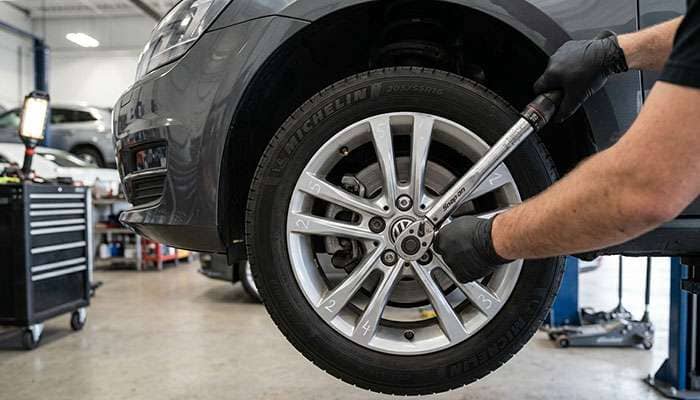
Torque spec gets the attention, but sequence is what keeps the wheel flat and centered against the hub. The right procedure is a calibrated torque wrench, a star or crisscross pattern, and at least two passes: a partial-torque pass to seat the wheel evenly, then a full-torque pass. Running nuts down in a circle pulls one side of the wheel tight before the other side touches. Our step-by-step on how to tighten lug nuts properly walks through the star pattern step by step.
If the car is smooth at a steady speed but the steering wheel shakes or the brake pedal pulses when you stop, and it started weeks after the tire job, look at how the lug nuts were tightened. New tires don't touch the brakes, but the wheel install does.
On most cars, the brake rotor is clamped between the hub and the wheel by the same lug nuts. Uneven lug torque, especially from an impact gun, clamps the rotor unevenly and can pull it slightly out of true. Trade guidance for brake technicians is blunt: never use an impact wrench to tighten wheel fasteners, because unequal tightening can distort the rotor and lead to a shuddering brake pedal. Shop manuals allow only a few thousandths of an inch of rotor wobble, called lateral runout.
Here is why the timing fools people. A rotor with a little runout doesn't pulse right away. As it wobbles, it brushes one pad harder than the other on every turn, and over a few thousand miles that wears or deposits friction material unevenly until the rotor is thicker in some spots than others. That thickness variation is what you feel. By then, nobody connects it to a tire job from a month ago, and the rotors get blamed as "warped." Resurfacing or replacing them helps only if the next install uses a clean hub face and a torque wrench. Otherwise the pulsation comes back.
Rarely. Alignment problems make a car pull, wander, or put the steering wheel off center, and they wear tires unevenly over thousands of miles. They don't usually make a car shake. Michelin's guidance notes that mounting tires doesn't change alignment angles, and that a mounting problem can cause vibration that gets mistaken for an alignment problem.
An alignment is still worth doing with new tires if the old ones showed uneven wear, because worn alignment will chew up the new set too. Our guide on whether you need an alignment with new tires covers when it pays. Just don't let an alignment be the answer to a shake. If the car shakes, you need a balance, bead, centering, or torque fix first.
One exception. Worn tie rod ends, ball joints, or wheel bearings can be masked by old tires with soft, worn tread. A new set with stiffer construction and full tread can transmit what the old ones absorbed. If every tire-and-wheel check comes back clean, have the front end inspected for play.
Yes, though it is less common than an install problem. Every tire has some variation in stiffness and roundness, and match mounting handles most of it. A small share of tires have more variation than mounting can cancel, and occasionally a tire has an internal problem such as a shifted belt.
Two quick tests separate a tire problem from a car problem. First, swap the suspect front assemblies to the rear. If the steering wheel shake moves to the seat, the problem traveled with the tire and wheel. Second, have a road force balancer measure each assembly. A tire that still reads high after match mounting on a wheel that measures true is a candidate for replacement through the manufacturer's warranty process.
A tire with a shifted belt or an internal separation can also show a visible bulge or a wobble you can see when you watch it roll slowly. Treat that as a safety issue, not a ride complaint. Our guide to tire sidewall damage and whether it is safe to drive covers bulges and bubbles, and the answer for them is the same: replace the tire.
A shake is cheap to fix the week it appears. It gets more expensive the longer you drive on it.
First, the tires. A wheel that hops on every revolution scuffs the tread unevenly, leaving cupped or scalloped wear you can feel with your hand. Rebalancing stops new damage, but it doesn't erase cupping, and a cupped tire stays noisy for the rest of its life. Our guide on whether unbalanced tires are safe to drive on covers how quickly that happens.
Then the chassis. Thousands of small impacts a minute go into wheel bearings, tie rod ends, ball joints, and shocks. None of them fail overnight from it, but all of them wear faster.
Then the brakes. If uneven torque started rotor runout, waiting turns a hub cleaning and a proper torque job into a set of rotors.
Then the wheel itself. Lug nuts that work loose let the wheel shift on the studs. That elongates the stud holes in an alloy wheel and stretches or breaks studs, and the end point is a wheel coming off. A wheel with wallowed-out lug holes has to be replaced.
Here is where each cause lands, and when you'd actually be buying something:
Cause |
The Fix |
Who Should Handle It |
When You'd Buy Parts |
|---|---|---|---|
Imbalance or lost weight |
Rebalance |
The installing shop |
Only if cupping has already set in |
Bead not seated or high runout |
Remount, reseat, match mount |
The installing shop, ideally with a road force balancer |
Rarely |
Oversized center bore |
Hub-centric rings and a centered remount |
You or the shop |
A set of rings sized to wheel bore and hub |
Wrong lug seat type |
Lug nuts that match the wheel's seat |
You or the shop |
A full set of correct lug nuts |
Loose lugs caught early |
Torque to spec in a star pattern |
Immediately, whoever is closest |
Studs or the wheel, if they're damaged |
Brake pulsation from uneven torque |
Clean hub, measure runout, correct rotors, torque wrench install |
A brake shop |
Rotors, if resurfacing can't correct them |
Tire out of tolerance after match mounting |
Replace the tire |
The seller, through the manufacturer's warranty process |
Usually not you |
If you're putting wheels and tires on yourself, or want to know exactly what to check behind a shop, our wheel and tire installation instructions cover the torque sequence, when hub-centric rings are required, and the re-torque interval.
A car that shakes after new tires is telling you what went wrong, and the timing is the translation. Shake at highway speed straight out of the shop is balance, or a wheel that isn't centered the way the balancer centered it. Shake you feel at low speed is a bead that didn't seat. Shake that shows up days later is lug nuts, and shake that shows up weeks later only when braking is how those lug nuts were tightened. Go back to the installer with the day it started and the speed where you feel it, ask for road force balancing if a rebalance doesn't hold, and never drive on a wobble that keeps getting worse. Almost every one of these is fixable for little or nothing if you catch it early.
No. New tires can feel slightly different during the first few hundred miles, but a correctly mounted and balanced set should not shake. A shake after new tires almost always traces to imbalance, a bead that didn't seat, a wheel that isn't centered on the hub, or lug nuts that weren't torqued correctly, and the installing shop should correct it.
A steering wheel shake that peaks around 50 to 70 mph usually means a front tire and wheel assembly is out of balance. If a rebalance doesn't fix it, ask for road force balancing and match mounting, and on aftermarket wheels make sure hub-centric rings are installed so the wheel is centered on the hub the same way it was centered on the balancer.
A vibration from new tires should not be waited out. The only shake that fades on its own is flat-spotting after the car sits overnight, which goes away within the first few miles of driving. A shake that is there every time you reach the same speed needs a rebalance or another fix at the shop.
Yes. A standard balancer measures weight only. A tire with a stiff spot, a bead that isn't fully seated, or a wheel with runout can balance perfectly and still vibrate. A road force balancer presses a roller against the tire to measure those variations, and match mounting the tire on the wheel often corrects them.
Yes. Most shops and many owner's manuals call for a re-torque within the first 50 to 100 miles after the wheels are installed, because the wheel and hub settle and lug nuts can lose clamp load. Use a calibrated torque wrench and a star pattern, not an impact gun.
The tires themselves don't, but the installation can. Uneven lug nut torque can clamp the brake rotor out of true, and over a few thousand miles that creates thickness variation you feel as a pulsing pedal or a shaking steering wheel when you brake. The fix is to correct the rotors, clean the hub face, and torque the wheels properly.
Reviewed by Dennis Feldman, Vice President, Performance Plus Tire