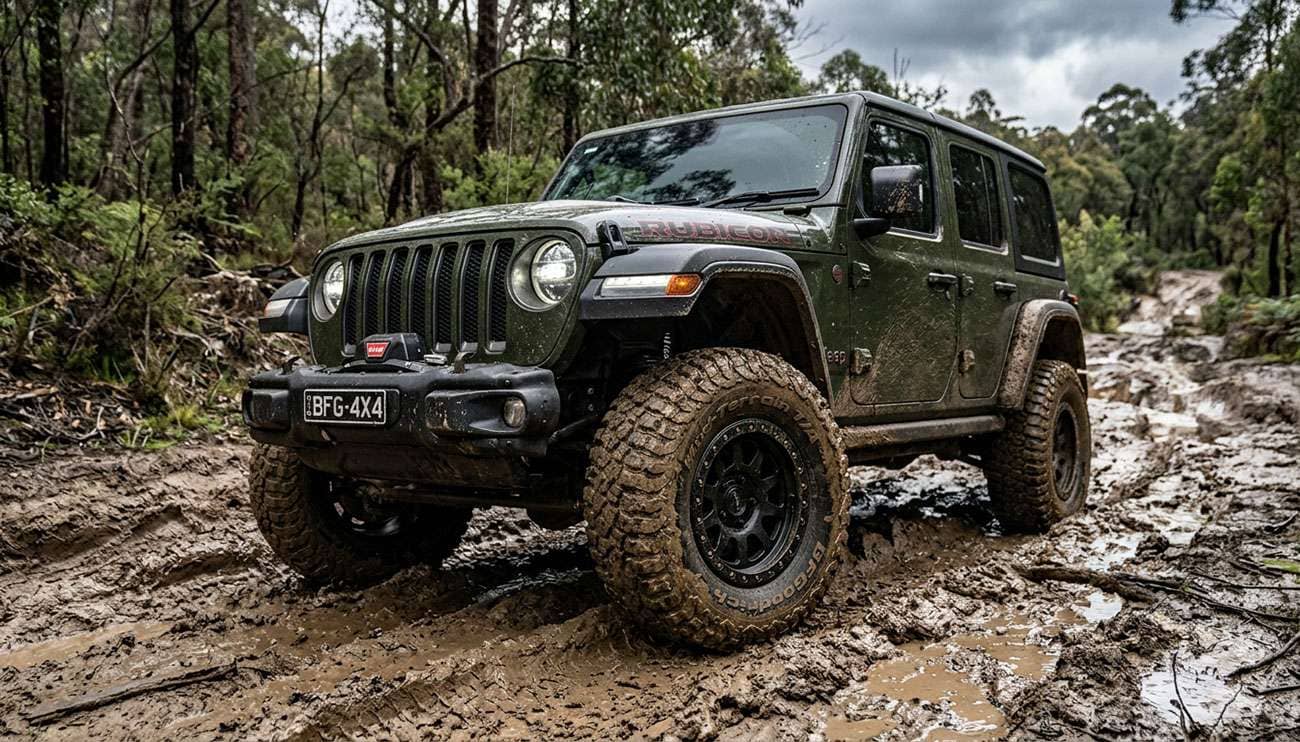
Yes, it is a very good tire, and the fastest way to understand it is to notice what BFGoodrich refuses to promise about it. The KM3 comes with no treadwear warranty. None. Every other tire in this article carries a mileage number on paper, and the KM3 carries a blank. That is not a company hiding a weak product. That is a company declining to guarantee mileage on a tire whose life depends almost entirely on how the owner treats it. Understand that one thing and the rest of the tire makes sense.
I have been putting mud tires on trucks since long before anybody called it overlanding, and I will tell you the same thing I tell people standing at the counter: a mud tire is a tool, and the KM3 is a very good tool being asked to do the wrong job about half the time it gets sold. Below is everything people ask me about it, answered straight.
BFGoodrich publishes which of its tires carry mileage coverage. The list names the g-Force, the COMP-2, the A/S Plus, the Trail-Terrain T/A and the All-Terrain T/A KO2. The KM3 is not on it. What you get instead is the standard limited warranty covering defects in workmanship and materials for the life of the usable tread or six years from purchase, whichever comes first.
Look at our own catalog and the same story shows up in the data. Across all 79 KM3 fitments we stock, the treadwear warranty field is empty. Pull up a KO2 in the same size and it reads 50,000.
Feature |
Mud-Terrain T/A KM3 |
All-Terrain T/A KO2 |
|---|---|---|
Treadwear warranty |
None |
50,000 miles |
Workmanship warranty |
6 years or life of usable tread |
6 years or life of usable tread |
Tread depth |
18/32 |
15/32 |
Severe snow rating |
No, M+S only |
Yes, 3PMSF branded |
Speed rating |
Q, 99 mph |
Q, R or S depending on size |
Weight, LT285/70R17 |
65 to 66 lb |
50 to 58 lb |
Here is the part that matters. A mileage warranty is a bet the manufacturer makes about average customer behavior. BFG can make that bet on an all-terrain because all-terrain buyers mostly drive on pavement at consistent pressure. They cannot make it on a mud tire, because mud tire owners air down to eight pounds on a Saturday, forget to air back up, run gravel roads at highway speed, and skip rotations for a year. That is not a criticism of the customer. It is just the reality of the product, and BFG priced the warranty accordingly by not offering one.
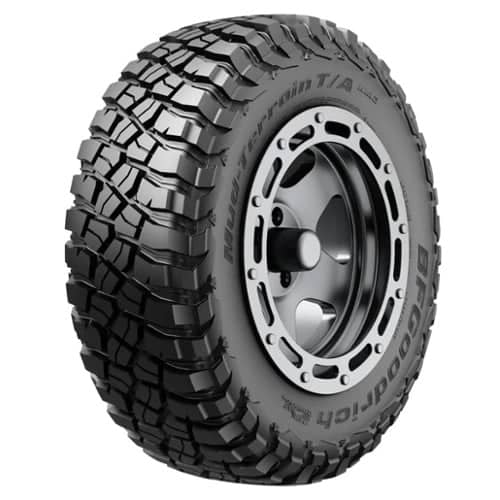
Realistic range is 25,000 to 50,000 miles, and the spread between the bottom and the top is almost double on identical tires. That gap is the whole story.
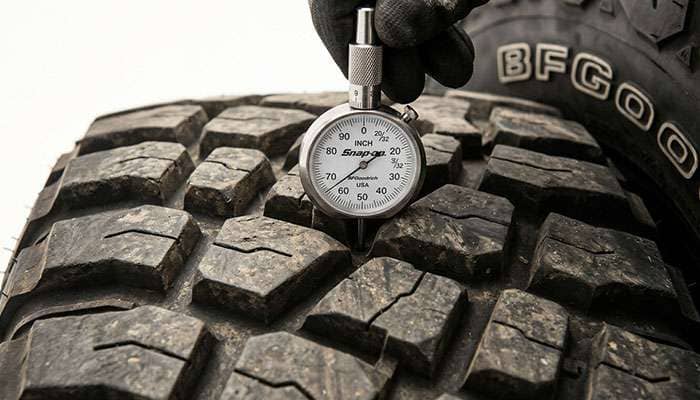
Start with the arithmetic. The KM3 comes out of the mold at 18/32. Legal minimum is 2/32. So you have 16/32 of usable rubber to spend, which is three more than a KO2 gives you.
An instrumented long-term test measured 2/32 of wear across 5,500 miles of mixed-surface driving. Hold that rate and you land right around 44,000 miles. BFGoodrich's own customer review summaries tell a rougher story, with a lot of owners reporting the end of the road between 30,000 and 40,000, and a meaningful group losing half their tread by 20,000.
Now the other end. One owner posted just under 40,000 miles with 10/32 of the original 18/32 still on the tire. That is 8/32 consumed across 40,000 miles, a rate that would carry him well past 70,000 if it held. His routine, in his own words, was monthly pressure checks and a rotate and balance every 5,000 miles. Another long-term reviewer sat at 31,000 miles with a little under half his tread left.
Same tire. Same compound. Wildly different outcomes. Four things separate them.
Rotation interval. BFGoodrich specifies rotation every 6,000 to 8,000 miles on the tires that do carry mileage coverage, and skipping it voids that coverage. On a heavy tire with big independent lugs and nothing backing it, rotation is not maintenance advice, it is the single biggest lever you have. Our guide on how often to rotate tires covers the intervals worth holding to.
Inflation. A 65-pound tire riding on a soft sidewall eats its shoulders. You will see it as a wear band on the outer lugs long before you feel it.
Aired-down miles you forgot to reverse. The Linear Flex Zone is what lets this tire wrap itself around a rock at low pressure. Drive home on the freeway still aired down and that same flexibility becomes heat, and heat is what kills tread.
Cupping. Plenty of owners replace KM3s with tread left because the tire got loud and rough enough to be miserable. Cupping on a lugged mud tire is loud in a way an all-terrain never is. That is a rotation and balance problem showing up as a noise problem.
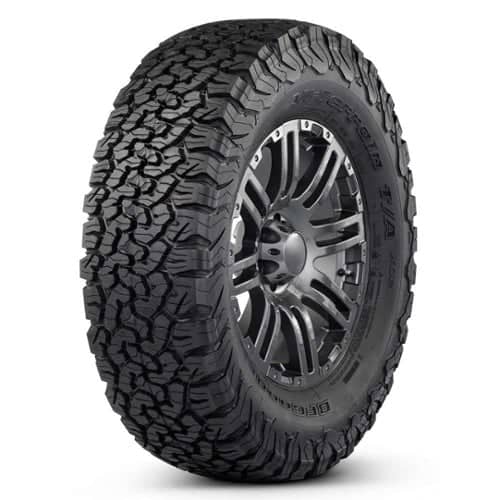
Wrong question, and I mean that kindly. These are different tools. Asking which is better is like asking whether a framing hammer beats a socket set.
That said, there are real, checkable differences, and two of them decide the answer for most people.
Feature |
KM3 |
KO2 |
KO3 |
|---|---|---|---|
Category |
Mud-terrain |
All-terrain |
All-terrain |
Tread depth |
18/32 |
15/32 |
15/32 to 16/32 |
Mileage warranty |
None |
50,000 miles |
50,000 miles |
3PMSF severe snow |
No |
Yes |
Yes |
Weight, LT285/70R17 |
65 to 66 lb |
50 to 58 lb |
51 to 57 lb |
Price, LT285/70R17 |
339.52 to 357.36 USD |
261.11 to 334.00 USD |
320.99 to 330.99 USD |
Buy it for |
Mud, rock, sand, deep ruts |
Mixed use with real winter |
Mostly pavement, wet grip |
The two dividers that settle it:
Winter. The KO2 carries the three-peak mountain snowflake. The KM3 does not. It is an M+S tire, which is a self-certified marking, not a tested severe snow rating. If you live where traction laws get enforced in winter, that difference is not a preference, it is a compliance issue. Our explainer on what the snowflake tire symbol means covers what the branding actually certifies.
Warranty. The KO2 gives you 50,000 miles on paper. The KM3 gives you nothing on paper and more rubber in your hand. Which is worth more depends on whether you are the kind of owner who rotates.
What the KM3 wins outright is everything past the pavement. Krawl-TEK compound is rated at eight percent better rock traction than the KM2, the Mud-Phobic shoulder bars eject packed mud instead of holding it, and Terrain-Attack tread blocks bite from whatever angle they hit. CoreGard Max toughens the sidewall by a claimed twenty-seven percent over the KM2. If you have ever torn a sidewall on a rock ledge, you know why that number matters more than a mileage figure. When you do take a hit, our guide on tire sidewall damage and whether it is safe to drive tells you which gouges send you home and which send you to the shop.
If the KO2 is what you are really weighing, we broke down its current standing in whether the BFG KO2 is still worth buying. And if you have not settled the category question yet, all-terrain versus mud tires is the place to start before you spend a dollar.
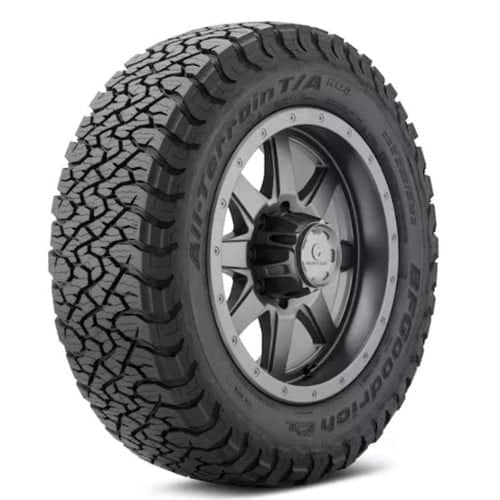
This is my favorite question in the pile, because the honest answer is that even BFGoodrich has never fully settled it in public.
The widely accepted reading is Traction Advantage. Ask any tire man who came up in the seventies and eighties and that is what he will tell you, and BFG-adjacent sources have used the phrase for decades. There is a competing story that it originally stood for Trans Am, pointing at the racing series where BFGoodrich supplied spec radials. Both explanations have been repeated so long that they have become part of the furniture. What is not in dispute is that T/A is a family name, not a technical spec, and it has been the badge on the sidewall of BFGoodrich's most important tires for fifty years.
The rest of the alphabet is cleaner:
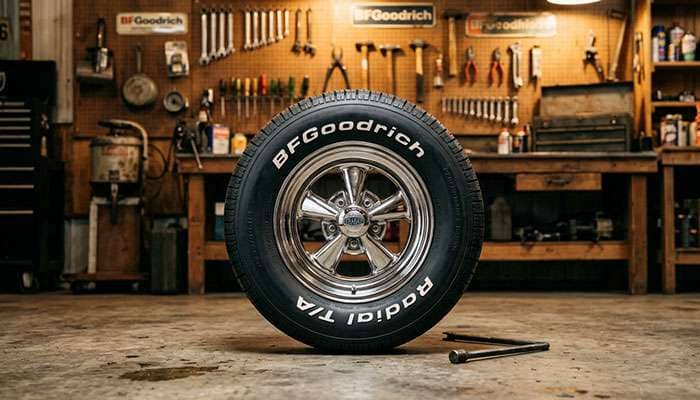
Now, the history is worth two minutes, because it explains why this badge still sells tires. BFGoodrich built the first American performance radial and put the Radial T/A on muscle cars and street rods in the early seventies. Raised white letters, wide profile, and it became the tire you wanted on a Camaro whether you needed it or not. I sold plenty of them.
Then in 1975 BFG took a concept tire down to Baja on the theory that if it survived that, it would survive anything. The Radial All-Terrain T/A launched in 1976 and ran the SCORE Baja 1000 that same year. It did not win. The following year it took eight wins at the Baja 500 and Baja 1000, and over the next four decades BFGoodrich piled up 86 overall SCORE Baja wins, more than every other tire manufacturer combined.
So when you look at KM3 on a sidewall, you are reading a supply chain of names going back to a tire company that decided the way to prove a product was to break it in the desert. The KM3 landed in 2018, following the KM2 from 2007. If you want the wider view on the brand, we covered it in whether BFGoodrich tires are any good.
Yes, and I can show you exactly why using nothing but our own catalog weight column.
Feature |
Weight Per Tire |
Added Weight Per Set Of Four |
|---|---|---|
KM3 in LT285/70R17 |
65 to 66 lb |
Baseline |
KO3 in LT285/70R17 |
51 to 57 lb |
KM3 adds 32 to 60 lb |
KO2 in LT285/70R17 |
50 to 58 lb |
KM3 adds 28 to 64 lb |
Roughly eight to fifteen pounds per corner. That does not sound like much until you remember where it sits. This is unsprung rotating mass, which is the most expensive weight on the vehicle. Every time you accelerate you are not just moving that weight forward, you are spinning it up. Every time you brake you are spinning it back down and throwing that energy away as heat.
Then stack the other two losses on top. Those big open tread blocks deform more per revolution than a tight all-terrain pattern does, and deformation is energy you paid for at the pump. And the voids between the lugs pump air, which is where a good part of the noise comes from and a small part of the drag.
Add it up and most owners moving from an all-terrain to a KM3 in the same size give up somewhere in the neighborhood of one to three miles per gallon. Go up in size at the same time and it gets worse, which we broke down in whether larger tires get better gas mileage.
Two things soften the hit and both are free. Keep them at the pressure your load actually calls for, and rotate on schedule so the tread stays flat instead of stepping and cupping. A cupped mud tire is dragging a serrated edge down the road.
Yes. The Mud-Terrain T/A KM3 is DOT approved and street legal in every size we stock for highway use. It carries the DOT code on the sidewall, it is speed rated at Q for 99 miles per hour, and it is sold in load ranges C, D and E just like any highway light truck tire.
Two footnotes, and they catch people.
Street legal is not the same as winter legal. The KM3 is an M+S tire without the three-peak mountain snowflake. Plenty of jurisdictions that enforce winter traction requirements ask for the snowflake specifically. Your KM3 is perfectly legal to drive year round, and it may still not satisfy a posted traction requirement on a mountain pass. That surprises people at the checkpoint, not in the driveway.
There is a separate KM3 UTV. We stock the Mud Terrain T/A KM3 UTV in 14-inch and 15-inch sizes, and it is a different tire built for side-by-sides, not a small version of the truck tire. If you are shopping for a Jeep or a pickup, you want the standard KM3 line. If you are shopping for a UTV, that is the one you want and the fitment rules are different.
Across our catalog the KM3 runs from 198.38 USD to 756.99 USD per tire, spanning 14-inch UTV fitments through 22-inch flotation sizes. Here is the ladder.
Feature |
Price Range Per Tire |
Notes |
|---|---|---|
14 inch |
218.99 to 264.99 USD |
Mostly UTV fitments |
15 inch |
198.38 to 362.99 USD |
Classic 33 and 35 inch flotation sizes |
16 inch |
245.15 to 371.99 USD |
Strong 3/4-ton coverage |
17 inch |
257.47 to 756.99 USD |
Deepest selection, 19 sizes, up to 39 inch |
18 inch |
229.46 to 557.99 USD |
Common modern truck fitment |
20 inch |
255.38 to 599.99 USD |
Half-ton and heavy-duty |
22 inch |
678.99 USD |
Single fitment |
Popular sizes for the people who already know what they want: LT265/70R17 is 317.99 USD, LT285/70R17 runs 339.52 to 357.36 USD, LT285/75R16 runs 327.99 to 338.48 USD, LT33x12.50R17 is 404.99 USD and LT35x12.50R17 is 429.99 USD.
Put next to the KO2 in the same fitment, the KM3 asks roughly 25 to 80 USD more per tire depending on size. What that buys you is three extra thirty-seconds of tread and a substantially tougher casing. What it costs you is the mileage warranty and the snowflake.
Nobody wrecks a set of KM3s in a week. It happens quietly, and I have watched it happen the same way for thirty years.
The first month. The truck feels planted and looks terrific and the noise is a fair trade. You air down for a trail on a Saturday and air back up on Sunday, mostly.
Months two through six. The rotation you meant to do at 6,000 slides to 9,000 and then to 12,000. Fuel economy is down a couple of miles per gallon and you have stopped noticing because it happened gradually.
Months six through twelve. The leading edges of the lugs are stepping. You can feel it with a bare hand more easily than you can see it. The hum at 65 has a new note in it. The shoulders on the fronts are rounding faster than the rears.
Year one to two. Now it is cupping, and cupping on a lugged mud tire is a genuinely unpleasant way to travel. You replace at 28,000 miles with 7/32 still on the tire, because you cannot stand another highway trip. There is no mileage warranty to claim against, because there never was one.
What it cost. On a set of LT285/70R17 at 357.36 USD each, that is about 1,429 USD for maybe 55 percent of the life the tread depth was capable of delivering. The rotations you skipped would have cost you a few hours of Saturdays.
That is the whole argument for taking the maintenance seriously on this particular tire. On a warrantied all-terrain, neglect costs you a warranty claim. On a KM3, neglect costs you the tire, and there is nobody to send the bill to.
Ready to spec a set? Have a look at the full size and load range lineup on our BFGoodrich Mud-Terrain T/A KM3 page, or browse the wider BFGoodrich tires range if you are still deciding between the mud-terrain and an all-terrain. Call us and we will talk through your truck before you order.
Feature |
Verdict |
Why |
|---|---|---|
Rock crawling and ledges |
Buy it |
Krawl-TEK and CoreGard Max sidewall are exactly this job |
Deep mud and soft soil |
Buy it |
Mud-Phobic bars clear packed mud that stops lesser tires |
Sand and deep ruts |
Buy it |
Linear Flex Zone works properly when aired down |
Enforced winter traction laws |
Look at the KO2 or KO3 |
The KM3 has no 3PMSF branding |
Long highway commute |
Look elsewhere |
You pay in fuel and noise for capability you never use |
You do not rotate on schedule |
Look elsewhere |
No mileage warranty means neglect comes straight out of your pocket |
The KM3 is a good tire and an honest one. BFGoodrich built something with three extra thirty-seconds of rubber, a sidewall that takes a beating, and a compound that grabs rock, then declined to promise you a mileage figure they could not control. I respect that more than a warranty number written to survive a marketing meeting.
Buy it if you actually go where it is designed to go. Rotate it every 6,000 to 8,000 miles, keep the pressure honest, and air back up before you get on the freeway. Do that and you will land at the top of the range instead of the bottom, and you will get every mile that tread depth is capable of giving. Skip it and you will replace a good tire early and blame the tire.
Yes, for the job it was built to do. The KM3 offers 18/32 of tread, Krawl-TEK compound rated at eight percent better rock traction than the KM2, Mud-Phobic shoulder bars that eject packed mud, and a CoreGard Max sidewall roughly twenty-seven percent tougher than its predecessor. The trade-offs are real: no treadwear warranty, no severe snow rating, extra weight and a fuel economy penalty. It is an excellent mud-terrain tire and a poor commuter tire.
Realistically 25,000 to 50,000 miles, and BFGoodrich offers no mileage warranty on the tire at all. It starts at 18/32 with 16/32 of usable tread before the 2/32 legal limit. Instrumented testing measured 2/32 of wear over 5,500 mixed-surface miles, which extrapolates to roughly 44,000. Owners who rotate every 5,000 to 6,000 miles and check pressure monthly routinely beat that, while owners who skip rotations commonly replace between 25,000 and 30,000 due to cupping.
They are built for different jobs. The KM3 wins decisively in mud, rock and sand, with 18/32 of tread against the KO2's 15/32 and a much tougher sidewall. The KO2 wins on pavement, carries a 50,000-mile treadwear warranty the KM3 lacks, holds the three-peak mountain snowflake severe snow rating, and weighs eight to fifteen pounds less per tire. If winter traction laws apply where you drive, the KO2 is the answer regardless of preference.
T/A is a family name BFGoodrich has used across car and truck tires for about fifty years, most commonly explained as Traction Advantage, though a competing account traces it to the Trans-Am racing series. BFGoodrich has never definitively settled it publicly. The suffixes are clearer: KO means key benefit on and off-road, KM means key benefit mud, KX is the Krawler rock tire and KT is the HD-Terrain.
Yes, typically one to three miles per gallon versus an all-terrain in the same size. Three things cause it. The tire is heavier, with the KM3 at 65 to 66 pounds in LT285/70R17 against 50 to 58 for a KO2, and that is unsprung rotating mass you spin up and brake down constantly. The large open tread blocks deform more per revolution. And the voids between lugs pump air. Correct inflation and regular rotation reduce the penalty.
Yes. The Mud-Terrain T/A KM3 carries the DOT code, is Q speed rated to 99 mph, and is street legal in load ranges C, D and E. Be aware that street legal is not the same as winter legal: the KM3 is M+S marked but has no three-peak mountain snowflake, so it may not satisfy posted winter traction requirements. Note also that the KM3 UTV is a separate tire built for side-by-sides rather than highway trucks.