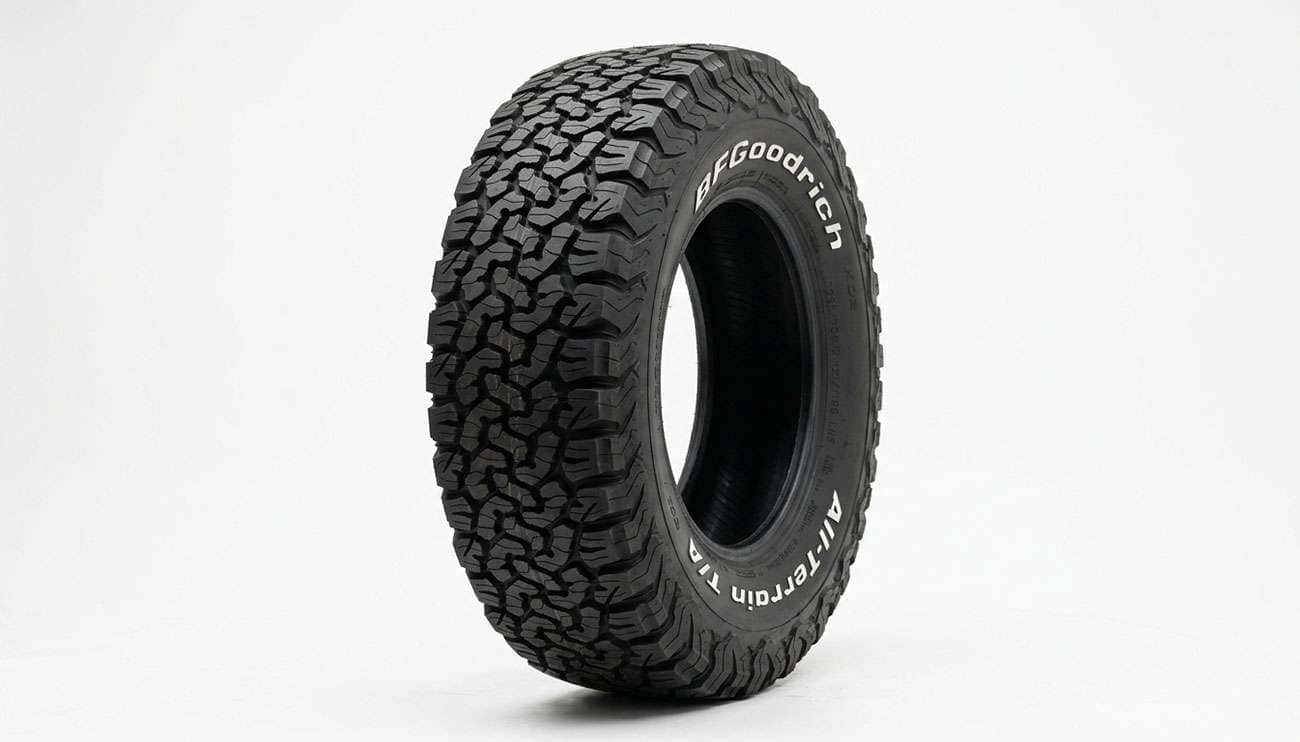
Yes, the BFGoodrich KO2 is still worth buying in 2026, but only in one of two situations: your size has no KO3 replacement on shelves yet, or you found KO2s discounted at least 15 percent below KO3 pricing. The variable that decides it is size availability, not tire quality. BFGoodrich is retiring the KO2 size by size as KO3 production ramps through 2026, which means the tire you buy today may have no exact match available when you need one in two years.
Here is what should bother you about every other answer to this question. The top-ranking reviews score the KO2 an 8.5 out of 10, tell you it depends on your driving, and never once mention that the tire is mid-discontinuation. That is the single most decision-relevant fact about the KO2 right now, and the articles ranking on page one were written as if it were still 2022. The KO2 did not get worse. Its supply chain did. Those are different problems, and they have different answers depending on which situation you are in.
Your Situation |
Verdict |
What You End Up Buying |
|---|---|---|
KO3 is available in your size right now |
Skip the KO2 unless it is discounted 15%+ below the KO3 |
A set of KO3s at full price, or KO2s only at a real closeout discount |
KO3 has not launched in your size yet |
Buy the KO2 with confidence; it is still the benchmark in that size |
A full set of KO2s, with a plan to replace all four together |
You need to replace 1-2 damaged KO2s on a newer set |
Buy matching KO2s now, while remaining stock exists |
One or two KO2s today instead of a forced four-tire set later |
Dry climate, budget is the priority |
The discounted KO2 is the value play |
Closeout KO2s; verify the DOT date code is under 18 months old |
Snow country, keeping the truck 5+ years |
Go KO3: newer compound, fresh stock, guaranteed future availability |
A set of KO3s sized to your placard load requirement |
That table is the whole decision. The rest of this article is the engineering behind each row, because if you understand why the rows break the way they do, you can adjust when your situation does not fit neatly into one of them. I am Dennis Feldman, VP at Performance Plus Tire, and we stock both the KO2 and the KO3, so I have no incentive to push you toward either one. I have an incentive to route you to the right one.
The KO2 launched in 2015 as the second-generation version of the All-Terrain T/A, a lineage that effectively created the all-terrain category back in 1976. BFGoodrich has sold more than five million KO2s since launch, which almost certainly makes it the best-selling specialty light-truck tire of its era. Nothing about its retirement is a quality recall or a design failure. It is a standard generational handoff, the same one BFGoodrich executed when the KO2 replaced the original KO.
The KO3 entered production in 2024, and BFGoodrich chose a rolling launch: sizes released in batches, with the full lineup of more than 100 sizes not complete until late 2026. As each KO3 size comes online, the matching KO2 size stops production and remaining inventory sells down. Dealers started reporting manufacturer discontinuation notices on KO2 sizes as early as mid-2024. In July 2026, we are deep into that transition. Some sizes are KO3-only already. Some are still KO2-only. Many are both, briefly.
This is why the question "is the KO2 good" is the wrong question. The KO2 is the same tire it was when it dominated the category. The right question is whether buying into a shrinking size matrix makes sense for your specific replacement timeline, and that depends entirely on which size your truck runs and how long you plan to keep it.
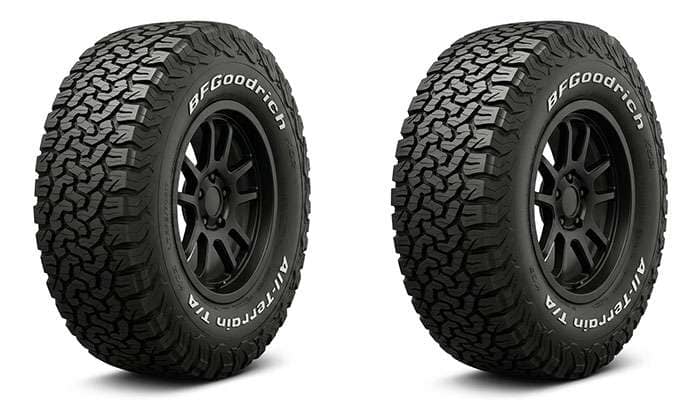
From ten feet away, the KO3 looks nearly identical to the KO2. That was deliberate. The KO2's interlocking tread pattern and raised-letter sidewall are the most recognizable design in the truck world, and BFGoodrich was not going to abandon the look. The changes are in the compound, the sipe architecture, and the sidewall package.
Feature |
KO2 (2015-2026) |
KO3 (2024-present) |
|---|---|---|
Sidewall construction |
CoreGard, derived from the Baja T/A KR2 race tire |
CoreGard with thicker upper-shoulder rubber and revised deflection profile |
Tread life claim |
50,000-mile warranty; 40,000-60,000 miles typical real-world |
50,000-mile warranty; BFGoodrich claims up to double the KO2's wear life on gravel |
Winter certification |
3PMSF certified |
3PMSF certified, with denser siping for improved ice bite |
Road noise |
Moderate hum, grows noticeably as tread wears |
Quieter at equivalent wear; revised pitch sequencing |
Size availability (July 2026) |
Shrinking; sell-down stock only in many sizes |
Expanding; 100+ sizes by end of 2026 |
OE fitments |
Ford Raptor (previous generations), various trims |
Ford Ranger Raptor and newer HD truck trims |
Price position |
Increasingly discounted as stock clears |
Full premium pricing |
The tread-life claim deserves scrutiny, because "up to twice as long on gravel" is a manufacturer figure measured in the KO2's weakest wear scenario. On pavement, the gap between the two tires is far smaller. What is not marketing is the sipe count: the KO3 carries measurably more biting edges per tread block, which shows up in packed-snow and wet-pavement traction, the two areas where the KO2 always trailed the best of its rivals. If you want the full head-to-head against the KO3's biggest hybrid-terrain competitor, our KO3 vs Nitto Ridge Grappler comparison covers it in depth.
All-terrain tires live on a spectrum between highway-terrain comfort and mud-terrain aggression, and the KO2 sits closer to the aggressive end than most drivers expect. If you have not compared the categories directly, our guide to H/T vs A/T vs M/T tires maps exactly where each type trades comfort for capability.
On pavement, the KO2 is stable and predictable. Braking on dry asphalt is strong for the category. The compromises are the ones physics demands from a tire built with thick tread blocks and reinforced casings. Expect three of them.
First, noise. A new set produces a moderate hum that most cabins absorb without complaint. By 30,000 miles, tread blocks round off, the pitch changes, and the hum becomes a presence on coarse concrete. Skipped rotations accelerate this dramatically, because heel-toe wear on an unrotated KO2 turns the tread into a series of tiny ramps that slap the pavement.
Second, ride stiffness. This is a load-range problem more than a tire problem. A Load Range E KO2 carries a stiff casing designed for three-quarter-ton payloads, and mounted on a half-ton truck at maximum sidewall pressure it will ride like a lumber cart. Set cold pressure from the door placard, not the sidewall maximum, and choose Load Range C or SL sizes when your truck's placard permits it.
Third, fuel economy. The aggressive tread and extra casing mass cost most drivers a real but modest penalty at highway speed versus a highway-terrain tire, typically in the range of one to two miles per gallon depending on the vehicle and the tire it replaced. Rolling resistance rises with void ratio; there is no engineering way around it.
Off-road is where the KO2 built its five-million-tire reputation, and nothing about the discontinuation changes the performance. The tread uses large interlocking blocks with a high void ratio to bite into loose surfaces, stone ejectors in the grooves to throw gravel before it drills into the casing, and serrated shoulder blocks that keep pulling when you air down and the sidewall becomes part of the contact patch.
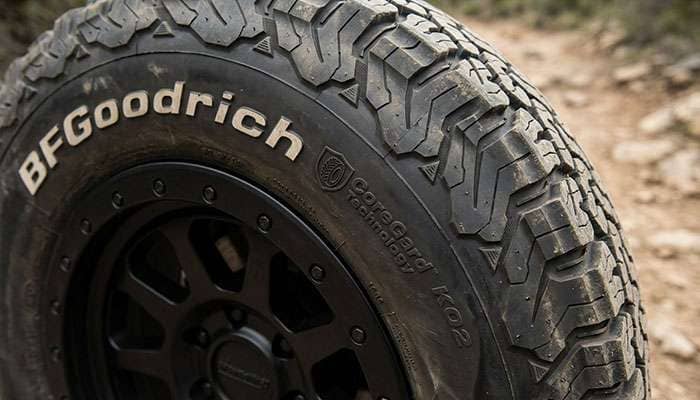
The CoreGard sidewall is the real differentiator. It was developed from the Baja T/A KR2 race tire, and it adds rubber thickness precisely in the upper shoulder zone where trail rocks and sharp ledges concentrate cuts. Sidewall failure is the number-one killer of off-road tires because unlike tread punctures, sidewall damage is almost never repairable; the Tire Industry Association limits proper repairs to the crown area of the tread, which is why we wrote an entire guide on tire sidewall damage and when it is safe to drive. A tire that resists the cut in the first place saves you the whole conversation.
Know the KO2's ceiling, though. It is an all-terrain, not a mud-terrain. Deep clay and soupy bottomland pack the tread and turn it into a slick; the void ratio that clears gravel cannot clear saturated mud the way a dedicated M/T pattern does. Rock crawling at low pressures is well within its envelope. Competition-grade mud is not.
The KO2 carries the Three-Peak Mountain Snowflake symbol, which is not a marketing badge. 3PMSF certification requires the tire to pass the ASTM F1805 traction test, demonstrating at least 110 percent of a reference tire's acceleration traction on medium-packed snow. The KO2 passes it, and real-world experience backs the certification: confident starts and controlled stops in light-to-moderate snow, well beyond what a standard all-season delivers.
Two honest caveats. The ASTM F1805 test measures acceleration traction on packed snow; it does not test ice braking, and on hard ice the KO2's relatively firm all-terrain compound trails a dedicated winter tire by a wide margin. If your winters are ice-storm winters rather than snowpack winters, run a winter set. Second, wet-pavement braking is the KO2's weakest measured discipline. The wide grooves evacuate standing water well and resist hydroplaning, but the compound's outright wet grip lags the best in the category, and the gap widens as the tread wears past half depth. Leave following distance in the rain, especially on a worn set.
The KO3's denser siping was aimed directly at both of these gaps, which is one of the quiet reasons the snow-country row in the decision table points to the newer tire.
BFGoodrich backs most KO2 sizes with a 50,000-mile treadwear warranty, and the real-world range clusters between 40,000 and 60,000 miles. Where you land in that range is mostly under your control, and the mechanism is worth understanding because it is the same mechanism that decides whether your set wears evenly enough to avoid the orphan-tire trap in the next section.
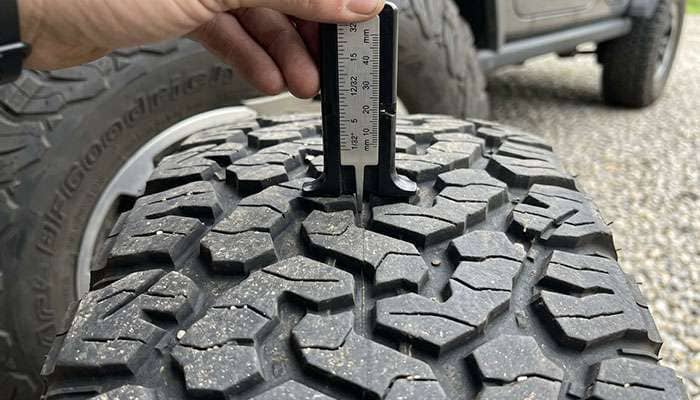
Three factors dominate. Rotation interval: every 5,000 miles, front to rear, because steer-axle scrub wears shoulders and drive-axle torque wears centers, and only rotation averages them out. Inflation: underinflation flexes the casing, builds heat, and wears shoulders fast; check cold pressure monthly, because permeation alone bleeds roughly one PSI per month before temperature swings add more. Alignment: a quarter degree of excess toe drags every tread block sideways a few feet per mile, and on a blocky all-terrain pattern that shows up as feathering you can feel with your palm long before you can see it. After any new install, re-torque the lug nuts at 50 to 100 miles per Tire Industry Association guidance; a loose wheel destroys more than tires.
Heavy towing, sustained high-speed summer runs, and gravel commutes pull mileage toward the bottom of the range. A rotated, aligned, placard-inflated KO2 on mixed pavement duty routinely clears the warranty number. Comparable rivals like the Toyo Open Country A/T III post similar real-world figures, which is exactly why the deciding factor between them in 2026 is availability, not longevity.
Here is the section nobody else writes, and it is the one that actually costs you money. When you buy a discontinued tire, you are not just buying four tires. You are betting that you will never need a fifth.
Play the scenario forward. You buy a set of KO2s today. Eighteen months from now, at 20,000 miles, you catch an unrepairable sidewall cut on a trail. The tread is at roughly 60 percent. In 2024, the fix was one phone call: a single matching KO2, mounted, shaved if needed, done. In 2028, that size may simply not exist new. Now you have a decision ladder, and every rung is more expensive than the last.
Rung one: run a mismatched tire. On a two-wheel-drive truck you can sometimes get away with a different model on the same axle in a matching size, at the cost of uneven grip and handling balance. Rung two: your vehicle is four-wheel or all-wheel drive, and most manufacturers require all four tires to match within a tight tread-depth window, commonly specified around 2/32 of an inch or a fraction of an inch of rolling circumference, because a persistent circumference mismatch forces the center differential or clutch pack to absorb the difference continuously, and that is a driveline repair measured in thousands of dollars. Rung three, where most AWD owners land: replace all four tires at 60 percent tread because one of them died. You just paid for 2.4 tires' worth of rubber you already owned.
This is why the decision table tells damaged-set owners to buy matching KO2s now while stock exists, and why anyone buying a fresh KO2 set today should mentally price the set as a single unit with a shared fate. It is also worth getting your size strategy right the first time; if you are between diameters, our 31s vs 33s vs 35s guide covers the fitment math, because upsizing into a rarer size during a discontinuation compounds the availability problem.
One more cost lever in your favor: closeout pricing. As KO2 sizes sell down, discounts of 15 to 25 percent below KO3 pricing are appearing size by size. On a dry-climate truck you plan to keep for one more tire cycle, that discount is real money for a tire that was the category benchmark two years ago. Check the DOT date code before you buy closeout stock; a tire that has sat in a warehouse for three years has spent a third of its practical service life on a shelf.
Step 1: Pull your exact tire size off the sidewall or door placard, including the load range letter. The decision lives or dies on the exact size, not the diameter.
Step 2: Check whether the KO3 has launched in that exact size and load range. If it has not, the KO2 is still the best version of this tire you can buy, and the availability clock is the only thing to plan around.
Step 3: If both are available, price them side by side. KO2 within 15 percent of the KO3: buy the KO3 and take the newer compound, the quieter wear pattern, and the guaranteed future match. KO2 discounted deeper than that: the closeout is a legitimate value if you are comfortable with the set-replacement math above.
Step 4: If you are patching a partial set of KO2s, buy your match now. Do not wait for the price to drop further; the size will disappear before it gets meaningfully cheaper.
Step 5: Whatever you mount, set cold pressures from the door placard, re-torque at 50 to 100 miles, and put a rotation on the calendar every 5,000. The gap between a 40,000-mile KO2 and a 60,000-mile KO2 is maintenance, not luck. For a broader look at how the KO2 stacks against premium rivals, our Michelin LTX A/T2 vs BFG KO2 comparison is the deep dive.
The KO2 is not suddenly a bad tire. It is a great tire on a countdown clock, and the smart money treats it that way. If your size has no KO3 yet, buy the KO2 without hesitation. If both exist, the KO3 wins at even money and the KO2 wins at a real discount. If you are matching a partial set, move now. The only genuinely wrong answer in 2026 is paying full KO3-equivalent pricing for the outgoing tire and inheriting its shrinking size matrix for free.
We stock both generations, and inventory on discontinued KO2 sizes moves fast and does not come back. Browse the full BFGoodrich tire lineup at Performance Plus Tire to check what is still available in your size, and if you are not sure which row of the decision table you are sitting in, call us and we will walk the size matrix with you.
The short version, if you only remember five things.
• The deciding variable is size availability, not quality: The KO2 is being retired size by size as KO3 production ramps through 2026, and your exact size determines the answer.
• KO2 wins at a discount, KO3 wins at even money: Pay full price for the newer tire; buy the outgoing one only 15 percent or more below it.
• Partial-set owners should buy matches immediately: AWD tread-matching requirements can turn one dead tire into a forced four-tire purchase once the size disappears.
• The performance profile is unchanged: Benchmark off-road durability and 3PMSF snow certification, with wet braking and worn-tread noise as the honest weak spots.
• Maintenance decides your mileage: Placard pressure, 5,000-mile rotations, and alignment are the difference between 40,000 and 60,000 miles on the same tire.
Yes, progressively. As each KO3 size enters production, the matching KO2 size stops production and remaining stock sells down. The transition began in 2024 and continues through 2026, so availability today depends entirely on your specific size.
If the KO3 exists in your size, buy it unless the KO2 is discounted at least 15 percent below it. If your size has no KO3 yet, buy the KO2 now rather than waiting, especially if you need tires this season; the KO2 remains the benchmark in sizes the KO3 has not reached.
Most sizes carry a 50,000-mile treadwear warranty, and real-world life clusters between 40,000 and 60,000 miles. Regular 5,000-mile rotations, placard-correct cold pressure, and good alignment push you toward the top of that range; towing, heat, and skipped rotations pull you toward the bottom.
Yes. The KO2 carries the Three-Peak Mountain Snowflake symbol, meaning it passed the ASTM F1805 packed-snow traction test, and it performs well in light-to-moderate snow. On hard ice, a dedicated winter tire still stops meaningfully shorter, so ice-heavy regions should run a winter set.
Avoid it on four-wheel and all-wheel drive vehicles. The two generations have different tread designs and wear rates, and most AWD manufacturers require all four tires to match closely in tread depth to protect the driveline. On a two-wheel-drive vehicle, mixing across axles in the same size is workable but still compromises handling balance.
Not when new; a fresh set produces a moderate hum most drivers tune out. Noise grows as the tread wears, and skipped rotations accelerate it sharply. If cabin silence is a top priority, a highway-terrain tire or the quieter KO3 is the better fit.