
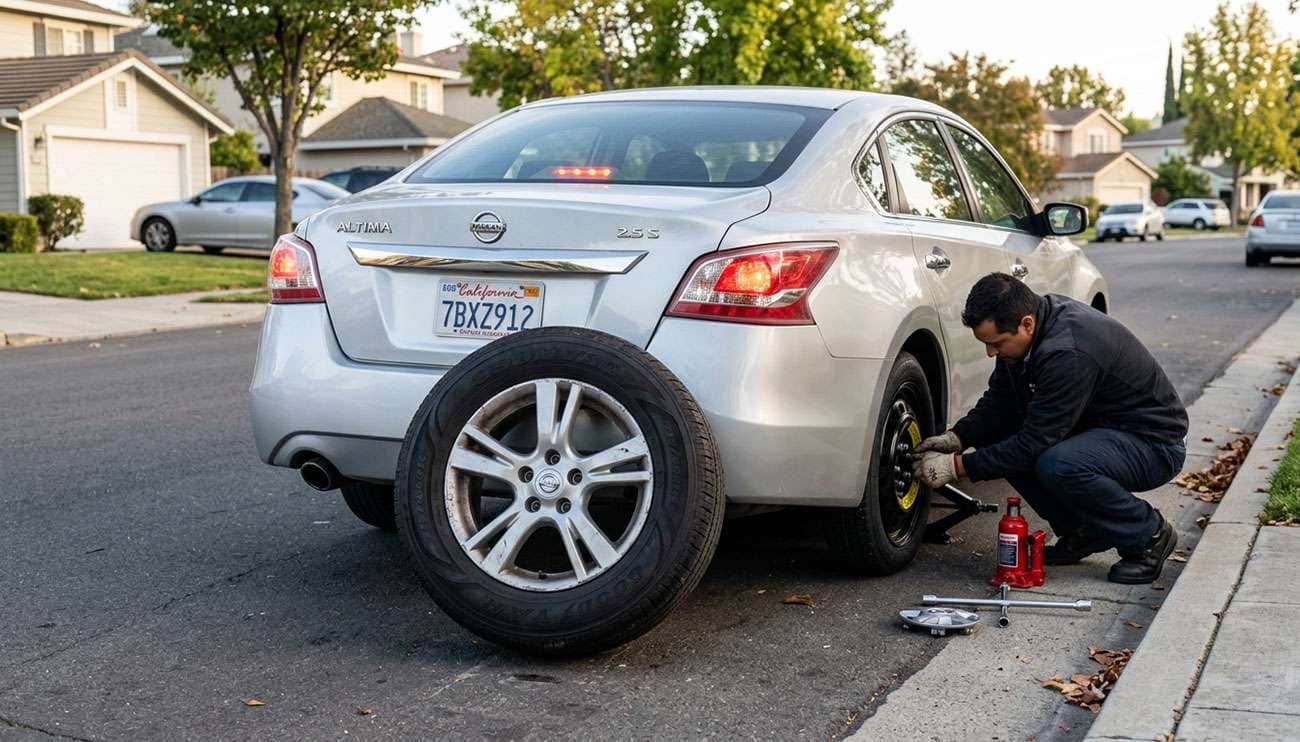
Your tire just went flat. Maybe you heard the pop. Maybe the steering wheel pulled hard to one side. Maybe you're already on the shoulder with hazard lights flashing, staring at a completely deflated tire and wondering how far you can limp to safety. This is one of the most urgent questions a driver ever faces — and the answer is different depending on whether you're on a true flat, a donut spare, a full-size spare, a run-flat, or a sealant kit. Get it wrong and you're looking at a destroyed rim, damaged suspension, or a second blowout. This guide covers every scenario with actual numbers, not vague advice.
First things first: a flat tire and a spare tire are two completely different situations. A flat tire — one that has lost air pressure — is not the same as driving on a spare. Knowing what happens when you drive on an actual flat helps you understand exactly how much risk you're taking and why the advice is always to stop immediately.
When a tire loses air pressure, the air that normally carries the vehicle's weight disappears. The tire's sidewall suddenly has to bear loads it was never designed to handle. At full pressure, your tire's sidewall flexes through a small, controlled range with each rotation. Deflated, that same sidewall folds and unfolds violently with every revolution, generating enormous heat through friction. The internal cords that give the tire its structure begin to delaminate. The rubber compound separates from the fabric. Within a few hundred yards at driving speed, an unprepared standard tire can shred completely.
At the same time, your bare or nearly bare rim is contacting the pavement through whatever remains of the tire. Aluminum and steel rims are not designed to absorb road impacts — that's the tire's job. A rim that contacts the road, even through a thin layer of degraded rubber, can bend, crack, or shatter on any road irregularity. A bent rim costs $200–$500 to replace. A cracked alloy rim may be irreparable. And while you're dealing with rim destruction, the vehicle's handling is severely compromised — steering response is unpredictable and braking is dangerously diminished.
Here's what actually happens at specific distances on a flat, standard (non-run-flat) tire at low speed (under 20 mph):
Under 100 yards: Sidewall damage begins immediately. The tire is likely already unrepairable due to sidewall deformation from the first moments of flat driving — even if it started as a patchable tread puncture.
Under 1/4 mile: The tire is almost certainly destroyed beyond repair. The rim may still be intact if the road surface is smooth and speed was very low, but you've already paid for a new tire.
1/4 to 1 mile: At this distance, rim damage becomes likely — bending, scoring, and cracking on anything but perfect pavement. Suspension components are taking abnormal impacts. Wheel bearing damage is possible. The total repair bill starts exceeding the cost of a new tire by a significant margin.
Over 1 mile: Probable rim destruction, potential suspension damage, possible brake line contact if the tire delaminates completely. At highway speeds these distances are compressed dramatically — at 60 mph, you can destroy a rim in seconds.
The only time driving on a flat is acceptable is to reach a safe stopping location when pulling over immediately would put you in a more dangerous position — crossing an active traffic lane, stopping on a narrow bridge, or other acute hazards. In that case, drive at the absolute minimum speed, turn on hazard lights, and stop at the first safe opportunity. Even then, keep it under a few hundred yards if at all possible.
Pull over at the first safe opportunity. If you have a spare, change it. If you don't, call roadside assistance. If you're on a highway, get as far onto the shoulder as possible, exit the vehicle away from traffic, and call for help. A tow is always cheaper than rim replacement plus suspension repair plus whatever the secondary damage costs. Never drive a flat at highway speed — a tire that has partially delaminated can shred suddenly, causing a full loss of control at the worst possible moment.
The compact spare — the narrow, undersized tire most drivers call a "donut" — is the most common spare type on modern passenger vehicles. It's lighter and smaller than a full-size tire, which is why manufacturers use it: it takes up less trunk space and costs less. But those advantages come with strict operating limits that most drivers ignore or don't know.
The industry standard for donut spare operation is 50 miles maximum distance and 50 mph maximum speed. These aren't arbitrary figures — they reflect the actual engineering limits of what a compact spare can sustain. Here's what's physically happening when you exceed them:
A donut spare has significantly less tread than a full-size tire — typically 4/32" or less compared to 10/32" on a new standard tire. It has a much smaller contact patch. Its narrower width means it generates more heat per square inch of rubber under load. At speeds above 50 mph, that heat generation accelerates to the point where the donut's structural integrity begins to degrade. The rubber compound isn't formulated for sustained high-speed operation, and the thinner sidewall can't manage the heat as effectively as a full-size tire. Above 50 mph, blowout risk climbs sharply.
The 50-mile distance limit exists for similar reasons — cumulative heat and mechanical fatigue. It's also a practical target: 50 miles should be enough to reach a tire shop from almost anywhere. If you're genuinely farther than 50 miles from tire service, push to 70 miles at the absolute maximum — but understand you're operating outside the engineering design envelope of the tire.
Driving on a donut spare isn't just about distance and speed. The smaller diameter of a compact spare — typically 3–4 inches smaller in overall diameter than the tire it's replacing — has downstream effects on your vehicle that most drivers never consider.
Your speedometer reads higher than your actual speed. A smaller circumference tire completes more rotations per mile, which tricks the speedometer into reading 3–5 mph faster than you're actually going. At an indicated 50 mph, you may actually be doing 45–47 mph — a fortunate error in this case, since it means the actual speed limit on the donut is higher than it appears on the gauge. But it's worth knowing the speedometer is inaccurate when the donut is on.
Your ABS and stability control may behave differently. These systems monitor individual wheel speeds to detect loss of traction. A wheel rotating at a different speed due to the smaller tire diameter can confuse these systems, causing unexpected interventions or reduced effectiveness. Don't rely on ABS performance being normal when a donut is on the car.
If the donut is on a driven axle, your differential is working harder than normal. The size difference between the donut and the matching tire on the other side of the axle forces the differential to continuously compensate for the different rolling circumferences — something it was not designed to do at highway speeds for extended periods.
Rain, snow, and wet roads are significantly more dangerous on a donut. The limited tread and smaller contact patch mean far less wet traction than your regular tire. Treat rain-driving on a donut as you would treat driving on bald tires — with maximum caution, reduced speed, and greatly increased following distance.
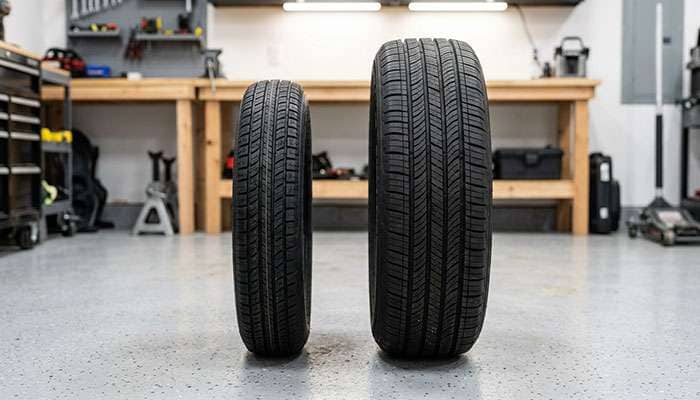
If your vehicle came with a full-size spare — common on trucks, SUVs, and older vehicles — you have significantly more flexibility than a donut user. A full-size spare that matches the vehicle's other tires in brand, size, and tread pattern can technically be used indefinitely, because it is, for all practical purposes, a fifth regular tire. But "can be" and "should be" are different things.
The key distinction with full-size spares is whether the spare matches the other tires on the vehicle. A matching spare — same brand, same model, same size — can be driven as a normal tire with no speed or distance restriction, and in fact should be included in your regular tire rotation schedule to keep its tread depth consistent with the others. Many truck owners do exactly this, rotating all five tires on a schedule that keeps wear even across the entire set.
A non-matching full-size spare — different brand, different tread pattern, or significantly different tread depth — introduces the same handling asymmetries that come with any mixed-tire setup. It should be treated as a temporary solution even though it's full-size: drive more carefully, have it professionally assessed, and replace with a properly matched tire as soon as possible. On AWD vehicles especially (covered in detail below), a non-matching full-size spare creates drivetrain stress through the diameter difference.
For a matching full-size spare: no specific speed or distance restriction beyond normal driving limits. Drive normally, drive highway speeds, drive as long as needed. Just include it in your next rotation schedule.
For a non-matching full-size spare on a standard FWD or RWD vehicle: no firm limit, but treat it as a temporary tire. Drive more conservatively, get it replaced within a few hundred miles, and don't push highway speeds unnecessarily.
For a non-matching full-size spare on an AWD or 4WD vehicle: treat it like an extended donut — minimize distance, avoid highway, and get a proper replacement as quickly as possible. More on this in the AWD section.
Run-flat tires are equipped on many BMW, Mercedes, Lexus, Mini, and other premium vehicles as standard fitment — often without any spare tire at all. The ability to keep driving after a puncture is the core feature, but the limits are more nuanced than most drivers realize.
Run-flat tires have reinforced sidewalls — typically a thick, rigid insert of heat-resistant rubber — that allows the tire to support the vehicle's weight even when completely deflated. The sidewall effectively becomes a structural support rather than a pressurized air column. This is why you can lose all tire pressure from a run-flat and still drive — the tire physically holds its shape through sidewall rigidity rather than air pressure.
The 50/50 standard — 50 miles at up to 50 mph — is the industry-wide baseline for run-flat capability after pressure loss. Some manufacturers specify slightly different limits: BMW and Continental specify 50 miles at 50 mph for most applications. Bridgestone's DriveGuard run-flats are rated for 50 miles at 55 mph. Always check your specific tire's sidewall marking and your vehicle's owner's manual for the exact specifications, as they vary by brand, tire model, and vehicle application.
The 50-mile figure assumes favorable conditions. Several factors can significantly reduce the actual distance a run-flat can safely sustain after deflation:
Vehicle load: A fully loaded vehicle — all seats occupied, cargo in the trunk, hitch weight if towing — puts dramatically more stress on the reinforced sidewall than the same vehicle with just the driver. Manufacturers' 50-mile specifications are typically for lightly loaded vehicles. Heavy loads can reduce safe range to 20–30 miles.
Temperature: Heat is the enemy of run-flat operation. Driving a deflated run-flat in high ambient temperatures — summer highway driving, for instance — generates more heat in the reinforced sidewall than the same tire in cool conditions. Range drops in hot weather.
Road surface: Rough roads, potholes, and uneven surfaces all increase the stress on a deflated run-flat sidewall. Smooth highway is the best-case scenario; urban roads with rough pavement and frequent stops and starts are harder on a deflated run-flat.
Speed: Higher speeds generate more heat faster. Staying well below 50 mph when operating a deflated run-flat preserves range — driving at 35 mph may allow you to travel significantly farther than 50 miles safely.
Run-flat tires require a functioning TPMS (Tire Pressure Monitoring System) to be used safely. Because the tire maintains its shape and drivability even when flat, you may not feel the pressure loss or notice any handling change — particularly with a slow leak. Without TPMS, you could be driving on a deflated run-flat without knowing it, accumulating distance and heat beyond safe limits. If your TPMS warning light illuminates, check all four tires immediately. If you're on a run-flat vehicle and can't identify which tire is low, get to a shop — don't guess and drive.
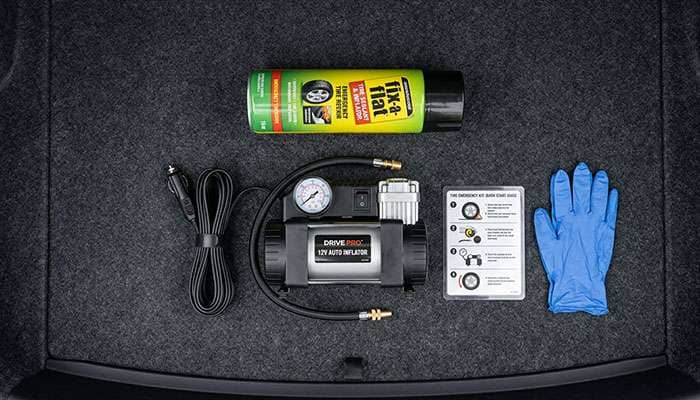
Many new vehicles — particularly smaller cars and some EVs where trunk space is prioritized — come without any spare tire at all, just a can of sealant and a portable compressor. These kits are widely misunderstood, and knowing their actual capabilities and limitations is essential before you end up needing one on the highway.
Tire sealant kits (Fix-a-Flat, Slime, OEM-branded equivalents) work on one specific type of damage: small punctures in the tread area, typically no larger than 3/16" in diameter. The sealant is injected through the valve stem, coats the interior of the tire as it rotates, and plugs the puncture from the inside while the compressor re-inflates the tire. Under ideal conditions — clean tread puncture, small diameter, no sidewall involvement — this can get you to a shop.
What sealant kits cannot handle: sidewall damage of any kind, large tread punctures, multiple punctures, blowouts, structural damage, or any situation where the tire has been driven flat long enough to separate from the bead. If your flat doesn't fit the narrow window of "small tread puncture," the kit won't work and you'll know immediately because the tire won't hold pressure after treatment.
Fix-a-Flat specifies a maximum of 100 miles or 3 days in the tire before professional repair or replacement. Slime specifies similar limits for automotive use. These aren't conservative suggestions — they're the window within which the sealant remains effective and before it starts causing secondary problems: imbalance from uneven sealant distribution, TPMS sensor damage from sealant coating the sensor element, and potential difficulty removing the sealant during professional repair.
After applying sealant: drive at low speed (under 50 mph) immediately to distribute it around the interior. Check pressure after a few miles. Drive directly to a tire shop — don't treat it as a complete repair and resume normal driving. Always tell the technician you used sealant when you arrive, so they can account for it during repair assessment. Some shops charge a cleaning fee to remove sealant residue before they can properly patch the tire.
One significant downside of aerosol tire sealants is their tendency to damage TPMS sensors. The sealant coats everything inside the tire, including the TPMS sensor mounted inside the rim. Some sealants can clog the sensor's pressure port or damage the sensor element, requiring TPMS sensor replacement at $75–$150 per sensor. OEM sealant kits (the ones that came with your car) are typically formulated to be TPMS-safe. Aftermarket cans vary — check compatibility before keeping one in your vehicle.
If you drive an AWD or 4WD vehicle, spare tire rules are stricter than for standard front- or rear-wheel drive vehicles. This is one of the most commonly missed pieces of tire knowledge, and ignoring it can lead to expensive drivetrain repairs.
AWD systems continuously monitor wheel speed at all four corners and distribute torque to compensate for any differences. They were designed and calibrated for four tires of identical rolling circumference — meaning the same effective diameter, including tread depth. When you install a donut spare or a non-matching full-size spare, one wheel is rotating at a different speed from the others, because its circumference is different. The AWD system interprets this as continuous wheelspin and constantly tries to correct for it by transferring torque and applying differential braking.
The result is continuous stress on the center differential, rear differential, and transfer case — components that can cost $1,000–$3,000 to rebuild or replace. The damage happens slowly and invisibly — there are no warning lights, no noise, no handling change. By the time the problem manifests as a drivability issue, significant internal wear has already occurred. This is why many AWD manufacturers specify that if one tire is replaced, all four should be replaced simultaneously, and why driving on a donut spare in an AWD vehicle must be treated as a true emergency measure with immediate replacement as the only acceptable resolution.
For AWD and 4WD vehicles with a donut spare: treat 50 miles as the absolute maximum, not a comfortable guideline. Reduce highway speed to 40–45 mph if possible. Avoid the AWD system working hard — no aggressive acceleration, no off-road use, no towing. Get to a tire shop and replace the damaged tire before the next drive if at all possible. If the damaged tire is repairable, great — have it repaired and reinstalled. If it needs replacement, the shop should assess whether the other tires have similar tread depth or whether multiple tires should be replaced simultaneously to restore matched rolling circumferences.
Even a full-size spare that differs in tread depth from the other tires by more than 4/32" creates the same differential stress problem on an AWD system — just to a smaller degree. A spare that's been sitting unused has its full original tread depth while the other tires are worn. That depth difference means different rolling circumferences, which means differential stress. Some AWD manufacturers have historically recommended shaving a new spare to match the remaining tread depth of the other tires for exactly this reason. Consult your vehicle's owner's manual for manufacturer-specific guidance on spare tire use in AWD applications — many now include explicit warnings.
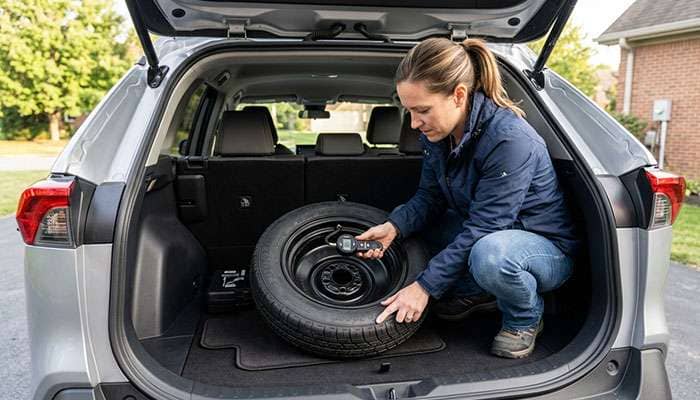
A significant percentage of vehicles manufactured in the past decade don't include any spare tire — not even a donut. This is particularly common on smaller sedans, crossovers, and EVs, where manufacturers prioritize cargo space and weight reduction over traditional emergency equipment. If you drive one of these vehicles and haven't thought about what to do in a flat-tire situation, now is the time.
Most no-spare vehicles come with one of three alternatives: a tire inflation kit (sealant + compressor), run-flat tires, or neither — relying solely on roadside assistance. Know which applies to your vehicle before you need it. Check your trunk, under-cargo area, and owner's manual to confirm what you have. If your vehicle came with run-flat tires but they've been replaced with standard tires (a common cost-saving move by used car buyers), you may believe you have run-flat capability when you don't.
If your vehicle has no spare and no run-flat capability, roadside assistance is your primary flat-tire solution. Many automakers include roadside assistance with new vehicle purchase for a limited period. Beyond that, AAA membership, credit card roadside programs, and insurance add-ons all provide this coverage. Know which option applies to you and have the relevant phone number saved before you need it — not after you're sitting on the shoulder of a highway with a flat tire trying to figure it out.
It's often possible to add a spare to a vehicle that didn't come with one, particularly if the vehicle has an under-cargo or under-floor storage area. Some vehicles have a spare tire well that the manufacturer simply left unoccupied to save cost. A compact spare in the correct size for your vehicle, a jack, and a lug wrench can be stored in many of these spaces, giving you the same emergency capability as vehicles that include a spare from the factory. Performance Plus Tire carries spare tires across a wide range of sizes — finding the correct compact spare for your vehicle's bolt pattern and hub bore is part of the fitment process. Browse tires at Performance Plus Tire to find the right size and confirm fitment for your vehicle.
Here's a situation nobody thinks about until it's too late: you get a flat, you open the trunk, you pull out the spare — and it's flat too. Or it's cracked and unsafe. Or it's so old the rubber has gone brittle. A spare tire that can't do its job when you need it is worse than useless, because it creates false confidence.
Tires lose air naturally over time — approximately 1 PSI per month is normal. A spare that was properly inflated when the car was new may have lost 10–15 PSI over a year without anyone noticing. Most donut spares require 60 PSI — significantly higher than regular tires — and this higher pressure drops faster. Include the spare in your monthly tire pressure check. The correct inflation pressure is printed on the spare's sidewall. A quick check with a gauge takes 30 seconds and could be the difference between having a functional spare when you need it and discovering a flat spare in a difficult situation.
Spare tires age even when they've never been used. The rubber compound oxidizes, hardens, and becomes brittle over time regardless of whether the tire has ever rolled on pavement. Unused spare tires should be replaced at 6–10 years from manufacture date. Use the tire age DOT date checker to read the 4-digit date code on your spare's sidewall — the first two digits are the manufacturing week, the last two are the year. A spare showing 0819 was made in the 8th week of 2019, making it 7 years old — approaching the end of safe service life even though it's never been driven on.
Pull the spare out of its storage location every six months and give it a real look. Check for sidewall cracking, any deformation or flat spots from improper storage, and tread condition. If you've had the spare sitting in a sunny location (under the vehicle bed on a truck, for example), UV degradation can accelerate significantly. If you find cracking that looks significant or the rubber feels hard and brittle, replace the spare before you need to depend on it.
Tire Situation | Max Distance | Max Speed | Key Warnings |
|---|---|---|---|
Driving on a true flat (standard tire) |
100 yards or less |
Walking pace |
Rim and tire destroyed almost immediately; stop as soon as safely possible |
Compact donut spare |
50 miles (70 absolute max) |
50 mph |
Reduced traction, speedometer inaccurate, ABS affected; avoid rain and highway |
Full-size matching spare |
No firm limit |
Normal |
Include in regular rotation; replace damaged tire promptly |
Full-size non-matching spare (FWD/RWD) |
No firm limit, treat as temporary |
Normal but cautious |
Replace with matched tire soon; handling may be affected |
Any spare on AWD/4WD vehicle |
50 miles max if donut |
50 mph max if donut |
Drivetrain damage risk; replace damaged tire immediately |
Run-flat tire after pressure loss |
50 miles (less if loaded or hot) |
50 mph |
Requires TPMS; heat and load reduce range; cannot be repaired after run-flat use in many cases |
Tire sealant kit used |
50–100 miles |
50 mph |
Tread punctures only; TPMS damage risk; tell technician when you arrive at shop |
The answer to "how long can I drive?" depends entirely on what you're driving on. A true flat tire — almost zero, get off the road immediately. A donut spare — 50 miles at 50 mph, and that's the engineering limit, not a comfortable cushion. A full-size matching spare — drive normally, but get the damaged tire addressed. A run-flat — 50 miles at 50 mph, less if you're loaded or it's hot. A sealant kit — enough to reach a shop, with the clock ticking on TPMS health.
The one thing that applies to every scenario: whatever temporary solution you're on is not a permanent fix. The spare exists to get you to a tire shop. The sealant exists to get you to a tire shop. The run-flat capability exists to get you to a tire shop. All of them have limits, and all of them are bridges to a proper replacement. When you get there, Performance Plus Tire has the full selection in your vehicle's size and application — browse replacement tires by vehicle to find the right match and get back on four properly rated, properly sized tires as quickly as possible. If the timing or budget is difficult, tires now pay later options let you get the right tires immediately without waiting.
Every spare tire situation condensed to what you need to remember.
• A true flat tire means stop now: Driving on a completely flat standard tire destroys the tire and risks the rim within a few hundred yards. The only acceptable reason to drive on a flat is to reach the nearest safe stopping point — at walking pace, hazard lights on, as short a distance as possible.
• Donut spares are 50 miles and 50 mph — hard limits: These aren't conservative suggestions. They reflect actual engineering limits of compact spare construction. Avoid highway speed, avoid rain, watch the speedometer (it reads high), and get to a shop the same day you use one.
• AWD vehicles have stricter rules than other vehicles: Any size mismatch between the spare and the other tires forces the AWD differential to compensate continuously, generating heat and wear in components that are expensive to repair. Treat any spare on an AWD vehicle as a true emergency — minimize distance and replace the damaged tire the same day.
• Check your spare before you need it: A flat spare in an emergency is worse than no spare. Check pressure monthly, check DOT age every six months, and replace any spare that's older than 6–10 years regardless of whether it's ever been driven on.
• No spare means you need a plan before you need it: If your vehicle has no spare, know whether it has run-flat capability, what sealant kit it carries, and what roadside assistance is available to you. Discovering you have no options after a flat is the worst time to figure this out.
A compact donut spare should not be driven more than 50 miles or faster than 50 mph. These are engineering limits, not conservative suggestions — the donut's thin tread, narrow profile, and lighter construction are not designed for sustained operation beyond these thresholds. If you absolutely must travel farther, 70 miles is the absolute maximum before blowout risk becomes serious. Get to a tire shop the same day you use a donut spare.
Only if the gas station is very close — ideally within a few hundred yards — and you drive at walking pace with hazard lights on. Driving on a flat at any meaningful speed or distance destroys the tire and risks bending or cracking the rim. If the gas station is more than a block or two away, call roadside assistance rather than driving on a flat. A tow is always cheaper than rim replacement, and rim replacement is always cheaper than the suspension and brake damage that can result from driving a flat over distance.
Most run-flat tires allow approximately 50 miles at up to 50 mph after complete pressure loss. However, this figure assumes a lightly loaded vehicle at moderate temperatures on smooth roads. A fully loaded vehicle in hot weather on rough roads may have significantly less range. Always check the TPMS warning immediately when it illuminates, drive directly to a shop once pressure is lost, and never exceed the 50 mph limit on a deflated run-flat. Note that many run-flat tires cannot be repaired after being driven flat — they typically require replacement regardless of the original puncture size.
On standard front-wheel or rear-wheel drive vehicles, driving on a compact spare for reasonable distances does not typically damage the transmission. On AWD and 4WD vehicles, the size difference between the donut spare and the other tires forces the center differential and transfer case to work continuously to compensate for the different rolling circumferences — which can cause real wear and heat damage to those components over extended use. This is why AWD vehicles have stricter spare tire guidelines and why replacement of the damaged tire should be treated as urgent on any AWD platform.
Check spare tire pressure at least once a month — tires lose approximately 1 PSI per month naturally, and donut spares typically require 60 PSI, which means they can drop significantly without appearing visibly low. Inspect the spare visually every six months for cracking, sidewall condition, and tread wear. Check the DOT date code and replace any spare that's 6–10 years old from manufacture date regardless of whether it's ever been driven on — rubber degrades with age even in storage.



