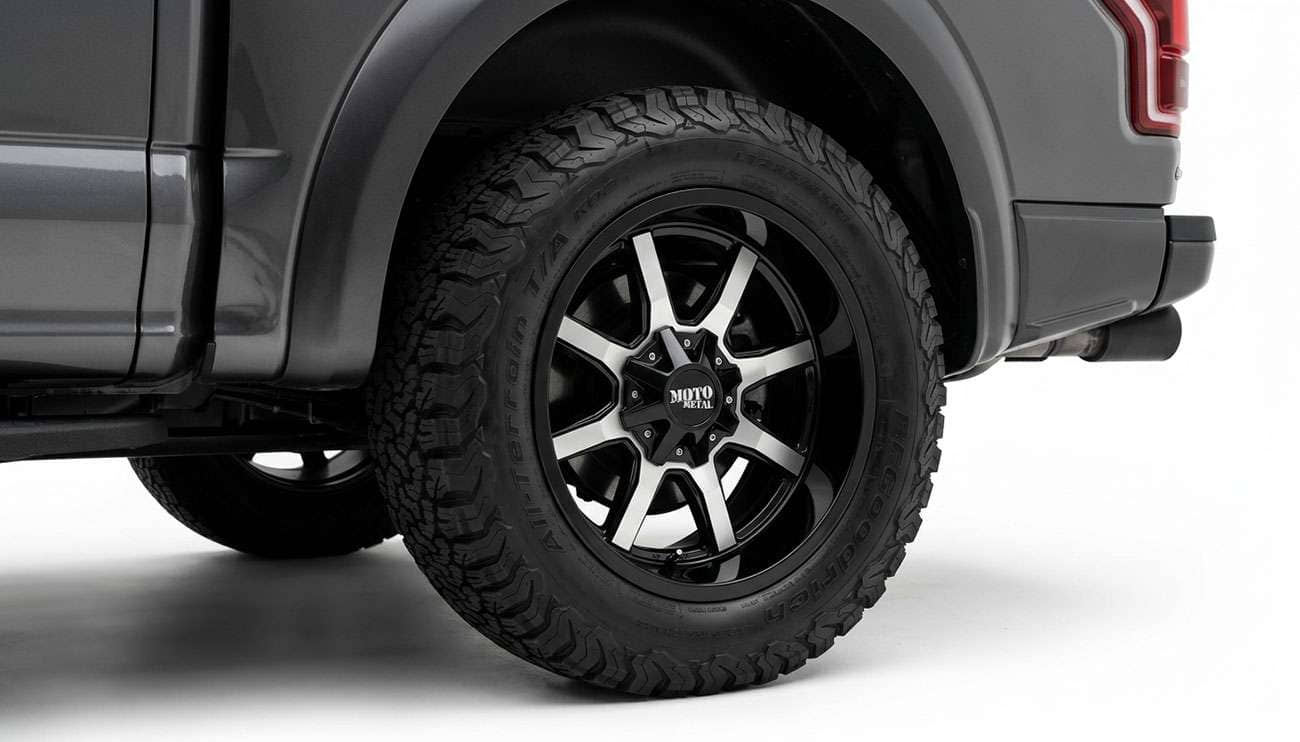
Yes, and I will tell you exactly why, because most of what you will read about this wheel is guesswork. The MO970 is a one-piece cast aluminum wheel that weighs 22 to 51 pounds depending on the size, holds 2,500 to 3,700 pounds per corner depending on the lug pattern, and lands under 200 dollars a wheel in most common truck sizes. For that money, it is one of the honest values in the aftermarket. What it is not is a wheel you should order without checking three numbers first.
I have been putting these on trucks for a long time now, and here is what bothers me about the rest of the internet on this subject. Every site quotes the MO970 at "25 to 35 pounds" or "25 to 40 pounds," and every one of them is wrong at both ends. Pull the actual spec sheet and a 16x7 comes in at 22 pounds while a 24x14 is 51. That is not a rounding error, that is a 29-pound spread, and it is the difference between a wheel that helps your truck and one that fights it. Nobody publishes the real numbers because nobody bothers to look them up. We did.
What You Drive |
Is the MO970 a Good Call? |
What to Watch |
|---|---|---|
Half-ton truck, daily driver |
Strong yes |
Stay at 18 or 20 inch for the best weight tradeoff |
3/4 or 1-ton, towing and hauling |
Yes, order the 8-lug |
3,640 to 3,700 lb rating, verify against your axle load |
SUV or Jeep, appearance build |
Yes |
Deep dish sizes need offset checked against your fenders |
Show truck on 24s |
Yes, with eyes open |
51 lb per wheel and a -76 offset changes how it drives |
Hard trail rig, repeated rock impacts |
Not the best pick |
Cast construction cracks where forged bends |
Coastal or road-salt driver |
Conditional |
Skip machined faces, buy solid gloss black |
Moto Metal is a Wheel Pros brand, and the MO970 has been in the lineup long enough to be a known quantity. That matters more than people give it credit for. A wheel design that has been in continuous production for years has had its problems found already, which is not something you can say about whatever came out last spring.
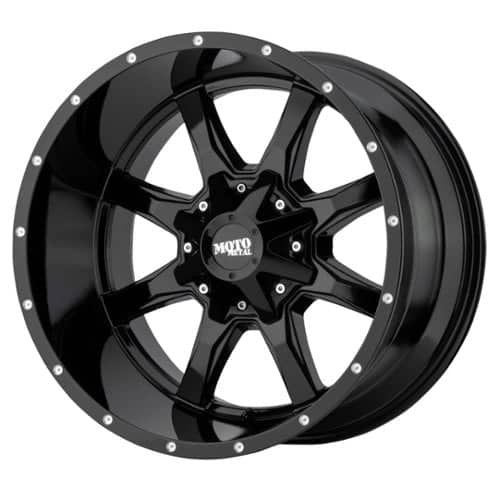
The build is straightforward: one-piece cast aluminum, no welds, no bolted rings, nothing to loosen. The look is a deep dish with angular split spokes running out to a fairly pronounced lip, and depending on the size you pick, that dish gets dramatic. It hides lug hardware behind a bolt-on center cap, which is included with most SKUs but not every one, so check that line on the specific size you are ordering.
Wheel Pros covers the structure with a limited lifetime warranty to the original retail purchaser under normal street use. Finish coverage is one year on painted and chrome and two years on PVD. Polished aluminum that has not been clear coated is not covered at all, which is standard across the industry and honest of them to state plainly.
Here is the specification range in one place, pulled from our current stock rather than from a brochure:
That is an unusually wide net for one design. It is also the source of nearly every complaint I have ever heard about this wheel, because a range that broad gives you a lot of room to order the wrong one.
For what they cost, yes. Let me be more useful than that, though, because "good quality" is a phrase that means nothing without a price attached to it.
There are roughly three tiers in the aftermarket wheel business. At the top you have forged wheels running 700 to 1,200 dollars apiece, where a billet of aluminum gets pressed under enormous force and the grain structure follows the shape of the part. In the middle sits flow-formed, where a cast center gets spun and stretched into a thinner, denser barrel. At the bottom sits one-piece cast, where molten aluminum fills a mold and cools, and that is where the MO970 lives at a street price under 200 dollars in most truck sizes.
Judged as a cast wheel against other cast wheels, the MO970 is solidly built and finished better than its price suggests. Judged against a forged wheel, it is heavier and it fails differently. Both statements are true and neither is a criticism. You do not fault a good work truck for not being a sports car.
The knock I hear most on Moto Metal generally is finish related, not structural. Center cap hardware developing surface rust over a few years is the recurring one, and it is a cheap fix. I have not seen these come back cracked from normal road use, and I see a lot of wheels come back. If you want the wider view across the whole Moto Metal catalog rather than this one model, we went through it in Are Moto Metal Wheels Any Good? Real Testing vs Popular Brands.
There is no single number, which is exactly why every other page gives you a vague range and moves on. The MO970 runs from 22 pounds to 51 pounds, and the driver is diameter and width. Not lug count, not finish. Here is the actual size-by-size breakdown:
Size |
Weight |
Load Rating |
Available Offsets |
|---|---|---|---|
16x7 |
22 lb |
3,000 lb |
+42 |
16x8 |
22 to 23 lb |
2,500 to 3,640 lb |
0 |
17x8 |
24 to 26 lb |
2,500 to 3,640 lb |
0, +40, +42, +50 |
17x9 |
27 to 28.5 lb |
2,500 to 3,640 lb |
-12, +12 |
18x9 |
27 to 30 lb |
2,500 to 3,640 lb |
+12, +18 |
18x10 |
28 to 30 lb |
2,500 to 3,640 lb |
-24 |
20x9 |
31 to 33 lb |
2,500 to 3,640 lb |
0, +12, +18, +45 |
20x10 |
33 to 35 lb |
2,500 to 3,700 lb |
-24, -18, +12 |
20x12 |
36 lb |
2,500 to 3,640 lb |
-44 |
22x10 |
39 to 42 lb |
2,500 to 3,640 lb |
-18 |
22x12 |
42 to 44 lb |
2,500 to 3,640 lb |
-44 |
24x14 |
50 to 51 lb |
2,500 to 3,640 lb |
-76 |
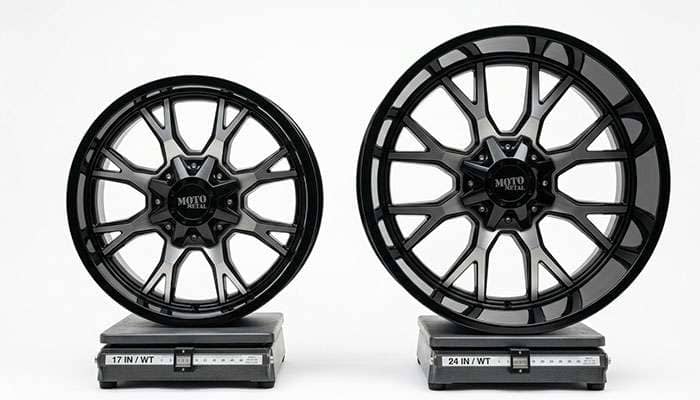
Look at where the curve steepens. From 16 inch to 20 inch you gain about 11 pounds. From 20x10 to 24x14 you gain another 17. The last two sizes cost you more weight than the first four combined, and that is before you account for the bigger, heavier tire that has to go on them.
Why should you care? Because wheel weight is unsprung and rotating, and both of those multiply its effect. Unsprung weight is mass the suspension has to control rather than mass the suspension carries, so every pound of it works against your dampers over bumps. Rotating mass has to be accelerated and decelerated every time you touch the throttle or the brake pedal. A pound at the wheel is worth considerably more than a pound in the bed, which is the whole reason racers spend real money to shave ounces. We put actual test numbers to this in How Much Does Wheel Weight Affect Performance? Real Test Data Reveals Truth.
None of that means do not buy 24s. It means know what you are trading. On a half-ton daily driver I steer most folks to the 18 or 20 inch sizes, because 27 to 33 pounds is right in the neighborhood of a factory alloy and you get the look without the truck feeling different.
Durable enough for what most people do, and you should understand the failure mode before you decide whether that includes you.
Cast aluminum and forged aluminum break differently, and this is the part nobody explains. When you cast a wheel, molten metal fills a mold and cools with a more or less random grain structure and some porosity baked in. When you forge one, a solid billet is pressed and the grain flows to follow the part, which makes it roughly 20 to 25 percent stronger for the same weight.
The practical difference shows up at the moment of impact. Hit a forged wheel hard enough and it tends to bend. Hit a cast wheel that hard and it is more likely to crack. A bent wheel usually holds air long enough to limp home. A cracked one does not. That is the honest case for forged, and if you are stacking your truck into rocks every other weekend, it is the right argument. We laid out the whole comparison in Cast vs Forged vs Flow Formed Wheels.
For street driving, potholes, gravel roads, fire roads, sand, and towing, cast is fine. It has been fine for decades. The load ratings back it up: 2,500 pounds per corner on the 5 and 6-lug sizes and 3,640 to 3,700 pounds on the 8-lug heavy duty fitments. Four corners at 3,640 pounds is 14,560 pounds of wheel capacity, which covers a loaded one-ton with margin. If you run anywhere near your limits, put each corner on a scale instead of estimating.
The thing that actually kills wheels in my experience is not the casting. It is installation. Wheels come loose because somebody used the wrong lug nuts or an impact gun instead of a torque wrench, and then the stud holes elongate and the studs fatigue. Torque to your vehicle's spec in a star pattern with a torque wrench, then re-torque at 50 to 100 miles, every single time. The Tire Industry Association has been saying it for years and it is still the most ignored instruction in this business.
Almost anything with a truck-shaped silhouette, and I mean that literally. Sixteen bolt patterns is more coverage than most brands offer across their entire catalog, let alone in one design.
Bolt Pattern |
Typical Applications |
Load Class |
|---|---|---|
5x114.3 |
Jeep Wrangler TJ and YJ, older Ranger and Explorer, Nissan and Dodge midsize |
2,500 to 2,800 lb |
5x120 |
Various GM crossover and van applications |
2,500 lb |
5x127 |
Jeep Wrangler JK and JL, Gladiator, Grand Cherokee, older GM half-ton |
2,500 lb |
5x130 |
Mercedes Sprinter, VW Touareg and related vans |
2,500 to 3,000 lb |
5x139.7 |
Ram 1500 older generations, pre-2003 F-150 and Bronco, older GM half-ton |
2,500 lb |
5x150 |
Toyota Tundra 2007 and newer, Sequoia, Land Cruiser |
2,500 lb |
5x160 |
Ford Transit |
3,000 lb |
6x114.3 |
Nissan Frontier and Titan, Dodge Dakota |
2,500 lb |
6x120 |
Chevrolet Colorado and GMC Canyon 2015 and newer |
2,500 lb |
6x127 |
Chevrolet Trailblazer, GMC Envoy and related SUVs |
2,800 lb |
6x130 |
Mercedes Sprinter and comparable heavy vans |
2,800 to 3,000 lb |
6x135 |
Ford F-150 2004 and newer, Expedition, Navigator |
2,500 lb |
8x165.1 |
GM 2500 and 3500 older generations, Ram 2500 and 3500 older generations |
3,640 to 3,700 lb |
8x170 |
Ford F-250 and F-350 1999 and newer |
3,640 to 3,700 lb |
8x180 |
GM 2500 and 3500 2011 and newer |
3,640 to 3,700 lb |
Blank 5-lug |
Undrilled, for custom or oddball patterns drilled to order |
2,500 to 2,800 lb |
Two things worth knowing beyond the table. First, that blank 5-lug option is a genuinely useful thing that almost nobody offers anymore. If you are building something that does not share a pattern with a modern truck, an undrilled blank gets drilled to whatever you need. Second, bolt pattern alone does not confirm fitment. Hub bore has to match too, and the MO970 spans everything from 65.1mm up to 125.5mm. Get the pattern right and the bore wrong and the wheel mounts on the studs instead of the hub, and you will chase a vibration you cannot balance out. If that is new to you, start with Hub Centric vs Lug Centric Wheels. For the heavy duty crowd, What Are 8 Lug Wheels? Guide for Truck Owners covers the three eight-lug patterns and which trucks wear them.
Bolt patterns changed mid-generation on more trucks than you would believe, so verify against your specific year and trim rather than what your neighbor runs.
The MO970 spans +50 all the way to -76. That is 126 millimeters, right around five inches of lateral wheel position between the two extremes. You could buy two MO970s in the same diameter and end up with completely different trucks.
Offset is the distance from the wheel's mounting surface to its centerline. Positive pulls the wheel in under the truck, negative pushes it out past the fender. If you want the full walkthrough, we wrote Wheel Offset Explained: How to Get the Perfect Fit Every Time.
The short version for this wheel. The high positive numbers, +40 through +50, live on the narrower 16 and 17 inch sizes and on van and crossover patterns where the wheel needs to tuck well inside the arch. The 0 to +18 range is your factory-ish territory on half-ton trucks and gives a flush look with no drama. From -12 to -24 you start getting real stance, and you should expect to look at your fender liners. And -44 and -76 on the 20x12, 22x12, and 24x14 are lifted and wide-body territory, not something to bolt onto a stock truck and hope.
Understand there is a bill for the aggressive end. Push a wheel outboard and you increase scrub radius, which means the tire's contact patch now sits farther from the steering axis. Every bump and every brake application works through a longer lever back into the tie rods, the ball joints, and the wheel bearings. Bearings that would have run 150,000 miles start feeling loose at 60,000. That is not a reason to avoid it, it is a reason to budget for it.
Seven finishes are in production, and they do not age the same way.
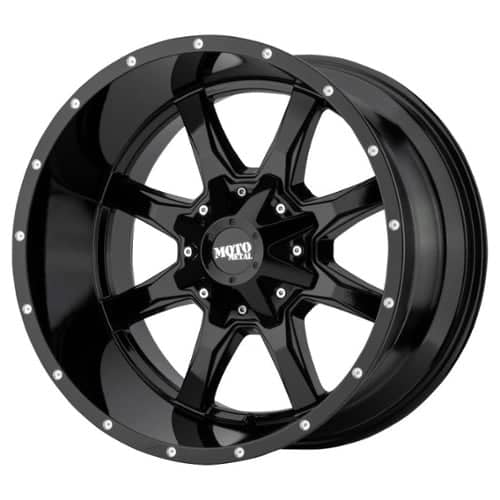
Gloss Black is the one I recommend to anyone who parks outside, drives in salt, or lives near the ocean. It is a single coating over the whole wheel with no transition edges, and edges are where moisture gets underneath a finish and starts lifting it. Nothing to fail, easy to touch up, hides brake dust.
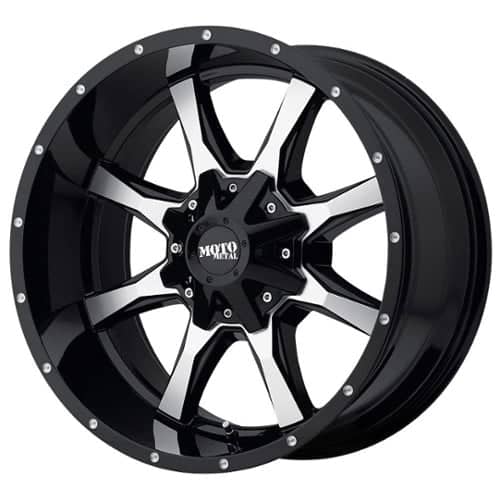
Gloss Black with Machined Face and Gloss Black with Milled Lip are the popular ones and I understand why, because the contrast makes the spoke geometry pop in a way solid black does not. The tradeoff is that a machined surface is bare aluminum under clear coat. Get a chip in that clear and the aluminum underneath starts to oxidize and cloud, and there is no fixing it short of a refinish.
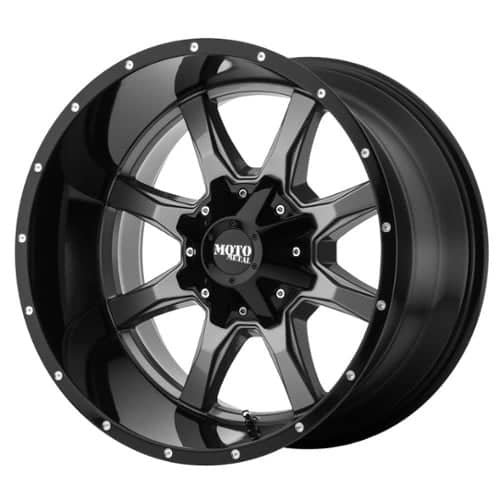
Gloss Gray Center with Gloss Black Lip is the sleeper of the group. Two-tone without any bare machined aluminum showing, so it gets you the depth and contrast of a milled finish with the durability closer to solid paint. If you like the look of the machined versions but you park outside in Chicago, this is your answer.
Gloss Black with Milled Spoke, Semi Gloss Black Milled, and Black Milled with Red Tint round out the range. The red tint version is the boldest of the bunch and looks sharp on the right truck, though tinted accents are the first thing to fade under hard UV, so a garage or a cover helps.
Whatever you pick, keep acid-based wheel cleaner away from all of them. The strong brake dust removers will etch clear coat and eat machined aluminum, and by the time you see it, the damage is permanent. pH-neutral cleaner, soft brush, rinse well, and do it more often in winter than you think you need to.
Individual wheels run from roughly 98 dollars up to about 503 dollars depending on size and finish, but that full spread is misleading because the extremes are unusual sizes. Most common half-ton and heavy duty truck fitments land between 130 and 260 dollars per wheel.
Line Item |
Typical Cost |
Notes |
|---|---|---|
Four wheels, common truck sizes |
520 to 1,040 dollars |
130 to 260 per wheel in 17 through 20 inch |
Four wheels, 22 or 24 inch |
Up to about 2,000 dollars |
Large diameter and wide fitments carry a premium |
Lug nuts |
40 to 50 dollars |
Our black sets run 39.95, Gorilla sets 49.00 |
TPMS sensors |
160 dollars |
39.99 each, skip if transferring your existing set |
Mount, balance, road force |
100 to 200 dollars |
Road force balancing earns its keep at 20 inch and up |
Hub-centric rings |
20 to 40 dollars |
Only if the bore does not match your hub |
Center caps are included on most SKUs, which is 80 to 120 dollars you are not spending compared to brands that sell them separately. Confirm it on your specific size, since a handful of fitments list no cap.
These two get cross-shopped constantly and they serve different tastes rather than different quality tiers.
The MO970 is the deep dish, angular split-spoke design with a pronounced lip. It reads aggressive and modern, it carries the widest fitment range in the Moto Metal catalog, and it goes as large as 24x14 with offsets down to -76. If you want stance and presence, this is the one.
The MO951 is a cleaner, more conventional face. It suits a truck you want to look sharp without shouting, and it is a better match for a work truck or a lease return you plan to put back to stock. We covered it on its own in Moto Metal Wheels MO951 Black and Machined Review.
Same brand, same construction philosophy, same warranty. Pick on looks and available fitment, not on some imagined durability gap between them, because there is not one.
Three situations, and I would rather tell you now than sell you the wrong thing.
You take repeated hard hits on sharp rock. Cast wheels crack where forged wheels bend. If your weekends involve loading a wheel hard enough to damage it, spend the money on forged and get a failure mode that lets you drive home.
You are chasing minimum unsprung weight. At 22 to 51 pounds the MO970 is competitive for a cast wheel, but a forged wheel in the same size will save you four to eight pounds a corner. If you are building for lap times or maximum efficiency, that is real. For everyone else, it is not worth four times the price.
You want a polished or chrome look. The MO970 is a painted and machined wheel. No chrome, no full polish. Nice to know before you fall in love with a rendering.
Are Moto Metal MO970 wheels good? For a cast wheel under 200 dollars in most truck sizes, they are one of the better buys on the market. The design has been proven over years of production, the load ratings are honest, the fitment range is wider than anything else in its class, and Wheel Pros stands behind the structure for as long as you own it.
The trouble people run into is never the wheel itself. It is a 126mm offset range and sixteen bolt patterns and six diameters, and somebody ordering off a photograph instead of a spec sheet. Get the three numbers right, bolt pattern, hub bore, and offset, and this wheel will still look good on your truck when you sell it.
Take a look at what we have in stock on our Moto Metal wheels page, and if you are running a 3/4 or 1-ton, our 8-lug wheels page will narrow it down fast. Call us with your year, make, model, and what is under the truck before you order. Sorting out fitment on the phone costs you nothing. Sorting it out after the boxes arrive costs you a restock fee and three weeks.
For their price tier, yes. Moto Metal wheels are one-piece cast aluminum from Wheel Pros, backed by a limited lifetime structural warranty to the original retail purchaser. They are finished better than the price suggests and structural failures are rare in normal road use. They are not forged wheels, so they weigh more and crack rather than bend under extreme impact, but for street driving, towing, and moderate off-road use they hold up well.
It depends on the size. A 16x7 weighs 22 pounds, a 17x9 is 27 to 28.5 pounds, a 20x9 is 31 to 33 pounds, a 20x10 is 33 to 35 pounds, a 22x12 is 42 to 44 pounds, and a 24x14 is 50 to 51 pounds. Weight tracks diameter and width rather than lug count or finish. The commonly quoted range of 25 to 35 pounds understates both ends of the actual lineup.
The MO970 is offered in sixteen bolt patterns covering most trucks, SUVs, Jeeps, and vans. Common ones include 5x127 for Jeep Wrangler JK and JL, 5x150 for the Toyota Tundra, 6x135 for the Ford F-150, 6x120 for the Colorado and Canyon, and 8x165.1, 8x170, and 8x180 for heavy duty pickups. An undrilled 5-lug blank is also available for custom patterns. Always verify hub bore alongside bolt pattern, and check against your specific year and trim.
Durable for street, towing, gravel, and moderate off-road duty. Load ratings run 2,500 pounds per corner on 5 and 6-lug fitments and 3,640 to 3,700 pounds on 8-lug heavy duty sizes, with a limited lifetime structural warranty behind them. Because they are cast rather than forged, a severe impact is more likely to crack the wheel than bend it, so a dedicated rock crawler is better served by forged. Most failures in the field trace to improper installation rather than the casting.
Most MO970 fitments include a bolt-on center cap that covers the lug hardware. A small number of SKUs list no cap, so confirm it on the specific size and finish you are ordering. Included caps are worth 80 to 120 dollars across a set of four compared with brands that sell them separately.
Solid Gloss Black. It is a single coating over the entire wheel with no transition edges for moisture to get under, and it is the easiest to touch up. Gloss Gray Center with Gloss Black Lip is the next best because it delivers two-tone contrast without exposing bare machined aluminum. Machined face and milled lip finishes look sharpest but leave bare aluminum under clear coat, which clouds permanently once the clear is chipped.