
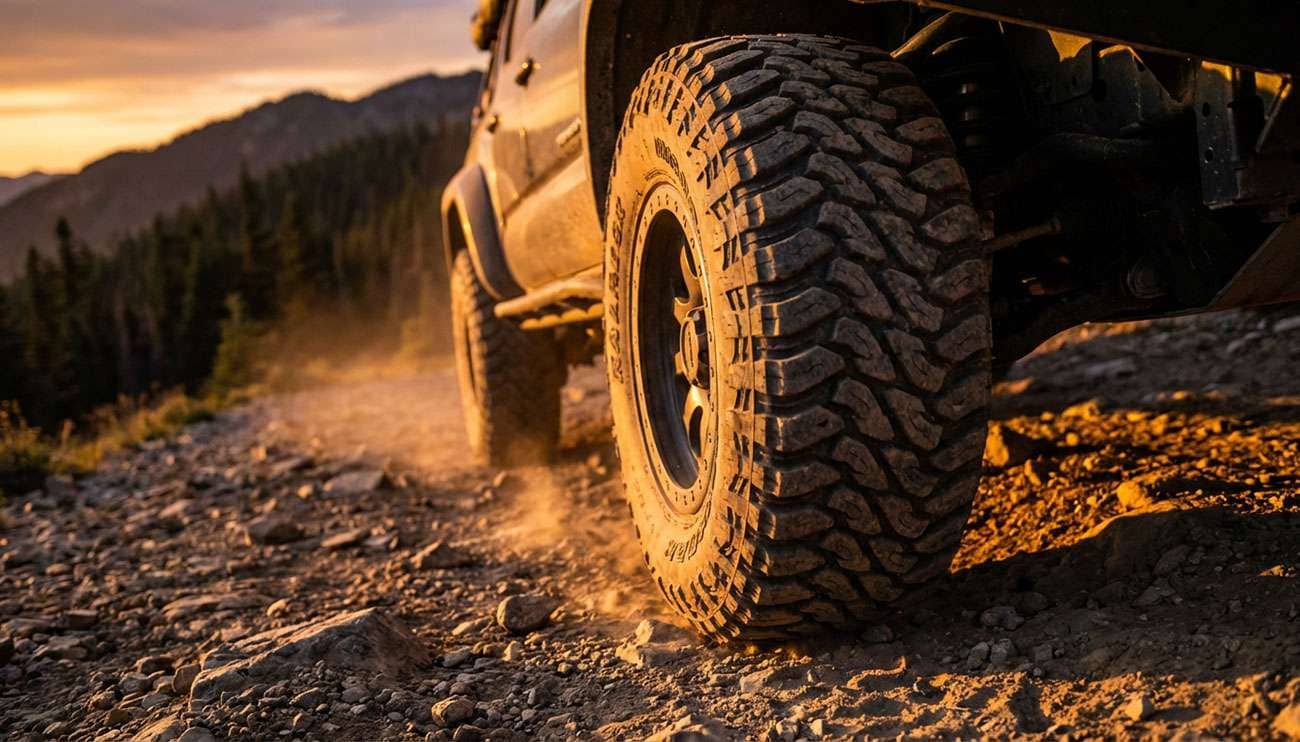
Off-road tires were originally developed by the U.S. military to handle terrain where standard tires simply fail. From deep mud to rocky trails, the right tire selection determines whether you conquer challenging terrain or find yourself stuck miles from help.
All-Terrain (AT) and Mud-Terrain (MT) tires serve different purposes despite sharing some design elements. MT tires dominate in extreme conditions, delivering superior grip on dirt, mud, gravel, and rock surfaces. AT tires provide a balanced approach between off-road capability and highway performance, making them ideal when your driving splits between pavement and trails. Understanding these fundamental differences helps answer what makes good off-road tires for beginners.
Traction stands as the most critical factor when selecting tires for your off-road vehicle. Each tire type features specific tread patterns engineered for particular terrain challenges, whether you're planning weekend adventures or serious off-road expeditions. We'll guide you through matching the right off-road tires to your vehicle and intended use, ensuring you can tackle any terrain with confidence.
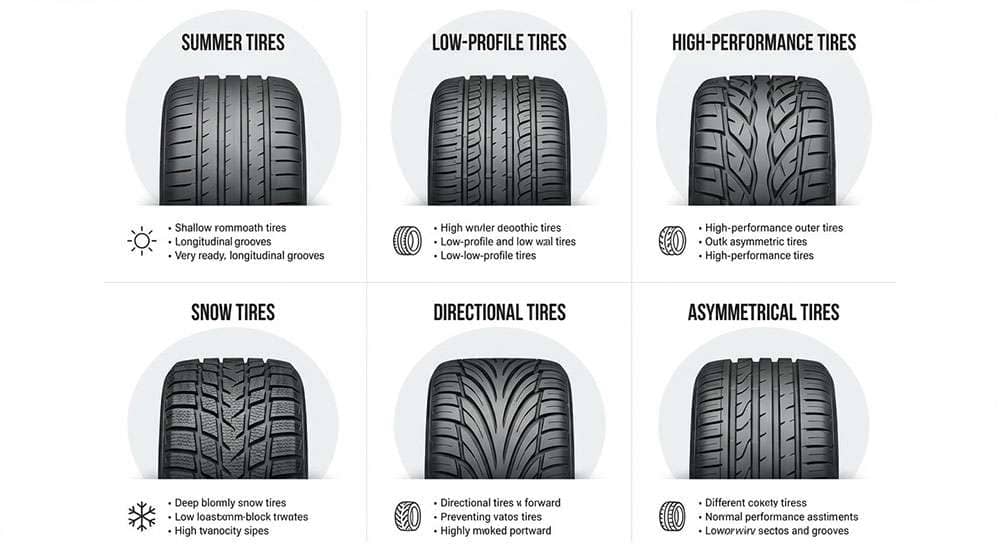
Selecting the right types of off road tires starts with understanding what's available in today's market. The industry offers distinct categories engineered for specific terrain challenges and driving conditions. We'll break down each type to help you make the best selection for your vehicle.
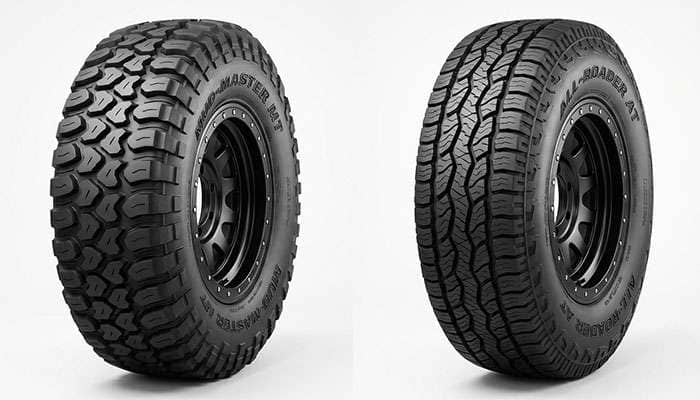
All-terrain tires deliver balanced performance between highway comfort and off-road capability. These practical options feature moderate tread patterns with smaller, tighter lugs compared to mud tires. Their design provides reliable traction across multiple surfaces including pavement, light mud, sand, gravel, and light snow conditions.
AT tires excel through their versatility. They incorporate siping (small slits in tread blocks) that enhances grip on wet pavement and snowy conditions. Many AT tires earn the M+S (mud and snow) rating, while premium options feature the three-peak mountain snowflake symbol for superior winter performance.
AT tires typically deliver better fuel economy than aggressive alternatives, making them ideal for drivers who balance city driving with weekend trail adventures. With treadwear ratings commonly between 50,000-65,000 miles, they offer practical value for daily drivers who occasionally venture off-road.
Mud-terrain tires represent the most aggressive option for serious off-road enthusiasts. They feature large, chunky tread blocks with wide, open voids that effectively channel mud away from the tire surface. This self-cleaning design proves essential when navigating sticky, challenging terrain.
MT tires include reinforced sidewalls for superior durability and puncture resistance during rock crawling or rough terrain navigation. Originally developed for military use, these tires dominate in extreme conditions including deep mud, loose rocks, and uneven surfaces.
MT tires do require trade-offs for their off-road superiority. They generate more road noise, reduce fuel efficiency by 1-2 MPG compared to AT options, and wear faster on pavement. Their large, smooth tread lugs also provide limited performance on ice and wet roads, despite siping features.
Rugged-terrain (RT) tires represent an emerging category that bridges AT and MT capabilities. Sometimes called "tweener" or hybrid-terrain tires, they provide an appealing middle ground for many drivers.
RT tires combine aggressive tread patterns similar to mud tires with design elements that enhance on-road comfort and performance. They typically feature large open voids and knobby sidewall treads for mud clearance, plus siped tread lugs that improve traction in wet and icy conditions.
RT tires deliver superior off-road traction compared to all-terrains without the on-road penalties of full mud-terrains. This makes them particularly suitable for drivers who split time equally between pavement and off-road adventures.
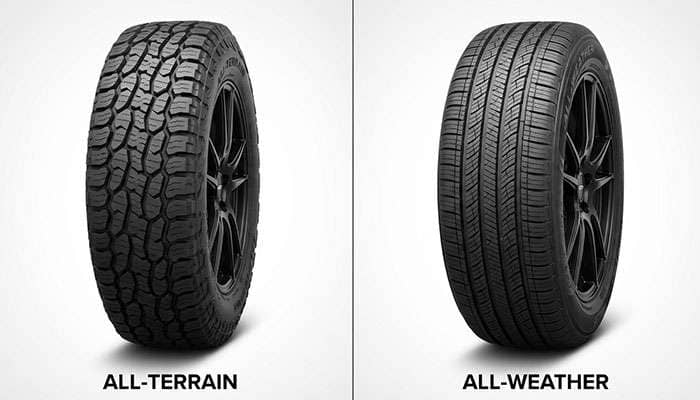
All-season and all-weather tires serve different purposes for off-road applications.
All-season tires perform well in moderate climates with minimal snowfall. They handle rain, warm roads, and daily driving with smooth, quiet operation and good fuel economy. However, cold weather causes the rubber to stiffen, reducing grip on ice and packed snow.
All-weather tires offer enhanced capability in wet, slushy, or lightly snowy conditions. They feature more aggressive tread patterns and advanced rubber compounds that maintain performance in challenging weather.
For serious off-roading, neither type matches the capability of purpose-built AT, MT, or RT tires. They can handle occasional light off-road use in favorable conditions but aren't designed for demanding terrain.
Explore our complete selection of off-road tires to find the perfect match for your vehicle and adventures, from beginner-friendly all-terrains to hardcore mud-terrains designed for the most demanding conditions.
Selecting the right tire for your specific terrain determines the difference between conquering challenging paths and getting stranded in remote locations. Understanding how tire designs perform on various surfaces ensures you choose the optimal option rather than purchasing based on appearance alone.
Mud-terrain tires dominate in wet, sticky conditions through their specialized construction. These tires feature deep, widely-spaced lugs that effectively clear mud from the tread surface, maintaining consistent grip in challenging situations. Premium mud tires incorporate "mud-phobic bars" and stone ejectors that excel when navigating thick mud and loose rock terrain.
Sand driving requires a different approach than you might expect. Overly aggressive tires can actually hurt performance in sandy conditions. All-terrain tires often outperform mud tires on sand because their tighter tread patterns prevent excessive digging. You need tires that float on sand rather than cutting into it.
When tackling sand dunes, consider these essential factors:
Reduce tire pressure to 10-20 PSI to increase your tire's footprint
Select tires with broad, flat tread blocks that distribute weight effectively
Choose wider tires that provide better flotation on loose surfaces
Rock crawling demands entirely different tire characteristics. Look for tires with reinforced sidewalls that resist punctures and "pinch flats" when navigating sharp edges. Tires designed for rock terrain feature tough, cut-resistant compounds and often utilize 3-ply sidewall construction for superior protection.
The BFGoodrich KO2 provides 19% greater traction in snow and demonstrates outstanding grip during both traction and braking evaluations. The Toyo Open Country R/T incorporates hook-shaped tread blocks with wide lateral grooves that bite into rock edges while self-cleaning in loose debris.
Hardpack trails benefit from tires with medium-spaced lugs that balance grip and surface contact. The BFGoodrich All-Terrain T/A KO3 finds grip and builds speed without feeling like it's sliding around or wasting energy on packed dirt surfaces.
Drivers who encounter varied surfaces in a single outing need versatility above all else. All-terrain tires offer the best compromise for mixed conditions, featuring medium-depth, multi-directional lugs that provide balanced performance across different surfaces.
The emerging "rugged-terrain" category bridges the gap between all-terrain and mud-terrain options. Tires like the Nitto Ridge Grappler represent this hybrid approach, though testing shows they perform better on some surfaces than others.
A comprehensive survey found that 85% of recreational riders are best served by quality all-terrain tires rather than specialized designs, particularly when their riding includes multiple terrain types.
Find the perfect off-road tires for your specific terrain at Performance Plus Tire, where experts can help you select the ideal balance between off-road capability and on-road performance based on your unique driving needs.
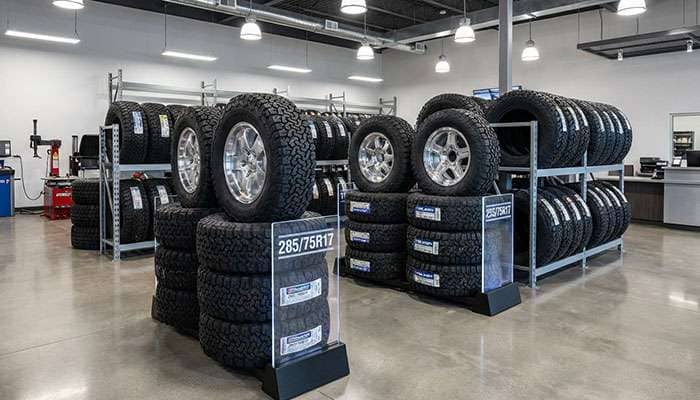
Tire size affects your off-road performance in ways that go far beyond appearance. The right dimensions require careful consideration of multiple factors that directly impact your vehicle's capabilities on challenging terrain.
Larger tires provide clear advantages for off-road driving. They increase ground clearance, helping you clear rocks, mud, and uneven surfaces more easily. Bigger tires also create a larger contact patch, which improves traction significantly on challenging surfaces like sand, snow, or loose gravel.
However, these benefits come with compromises. Acceleration suffers due to increased weight and rolling resistance, while highway driving becomes less responsive. For optimal off-road performance, keep wheel diameter no larger than half the tire height—15-16 inch wheels work best for 33-inch tires, while 17-inch wheels suit 35-inch tires.
Most tire upgrades require some modifications for proper clearance. Standard 33-inch tires represent a common starting point, with many stock trucks needing minimal changes, though smaller 4x4s typically require more substantial lift kits.
Moving to 35-inch tires increases the modification requirements. A suspension leveling kit combined with fender trimming usually provides adequate clearance. Massive 37-inch or 40-inch tires demand extensive suspension modifications, plus potential upgrades to steering and brake systems.
Larger, heavier off-road tires create noticeable changes in vehicle performance. Higher rolling resistance reduces fuel economy. Larger tires actually require lower air pressure to carry the same weight, meaning you'll need to adjust from manufacturer PSI recommendations.
Bigger tires also affect speedometer and odometer accuracy since they cover more distance per rotation. This impacts fuel efficiency calculations and daily driving measurements. To maximize performance while maintaining drivability:
Maintain proper inflation based on new tire size
Consider re-gearing differentials to match larger tires
Choose lighter aftermarket wheels to offset tire weight increases
Remove unnecessary cargo to reduce total vehicle weight
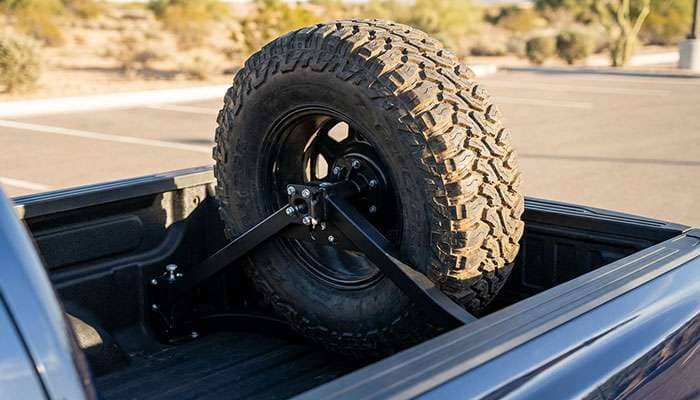
Your spare tire becomes critical survival equipment when you head off-road. Many enthusiasts spend considerable time selecting the perfect tires for their vehicle but overlook the fifth tire that could save their adventure from disaster.
Tire damage happens frequently on off-road trails. Rocks slice through sidewalls, sharp objects puncture treads, and rough terrain tests even the toughest rubber. A compact "donut" spare designed for emergency highway use won't help you when you're miles from civilization.
A full-size spare serves as your insurance policy against getting stranded in remote areas. When cell service doesn't exist and roadside assistance can't reach you, self-recovery becomes your only option. Carrying a spare that matches your other off-road tires transforms from convenience to necessity.
Your spare must match your main tires in several important ways. The tread pattern and design should be identical to your other tires. Mixing different tire types creates handling problems and reduces capability on challenging terrain.
Size consistency matters just as much. A smaller spare creates uneven axle heights that can damage your vehicle's differential during extended use. When you've decided on the right off-road tires for your needs, simply buy five instead of four.
Regular inspection keeps your spare ready when you need it. Even unused tires age, lose air pressure, and deteriorate from exposure to the elements. We recommend rotating your spare into regular service periodically. This practice ensures all five tires wear evenly and remain equally reliable when you need them most.
Selecting the right off-road tires comes down to matching your actual driving needs with tire capabilities. We've seen too many drivers choose tires based on appearance rather than performance requirements. Here's how to make the best choice for your specific situation.
Most 4x4 owners overestimate how much time they actually spend off-road. Be honest about your driving habits. If you're primarily on highways with occasional weekend trail runs, all-terrain tires deliver the ideal balance of comfort and capability.
For drivers who split time evenly between pavement and dirt, rugged-terrain (hybrid) tires provide excellent versatility. Those who spend most of their time in extreme off-road conditions should choose mud-terrain tires despite their highway compromises.
Your local climate plays a major role in tire selection. Areas with heavy snow require tires featuring the Three-Peak Mountain Snowflake rating, which surpasses standard M+S (mud and snow) certifications. All-weather tires maintain flexibility in cold temperatures while delivering solid performance in warmer conditions.
Drivers in predominantly muddy regions need tires with deep treads and self-cleaning capabilities to maintain traction in challenging conditions.
Don't let aggressive looks drive your tire selection. Performance should always outweigh aesthetics. That rugged-looking tire might perform poorly on the terrain you actually encounter. Instead, focus on tread design, rubber compounds, and construction quality that match your real-world driving needs.
All-terrain tires provide the best starting point for newcomers to off-roading. They deliver smooth highway performance while offering sufficient capability for light-to-moderate trail use. Vehicle manufacturers select these tires as original equipment for good reason.
Professional installation matters tremendously. Even premium tires perform poorly when incorrectly mounted or balanced. At Performance Plus Tire, our experienced technicians ensure proper fitment and performance.
Selecting the right off-road tires comes down to matching tire type to your actual driving needs and terrain conditions. All-terrain tires work best for drivers who spend most time on highways with weekend trail adventures, while mud-terrain options excel when extreme off-road conditions dominate your driving.
Tire size affects more than just appearance. Larger tires improve ground clearance and traction but may require lift kits and reduce fuel economy. A full-size spare matching your main tires becomes essential equipment for remote adventures where help isn't available.
Weather plays a major role in tire selection. Look for the Three-Peak Mountain Snowflake rating in snowy regions, while muddy areas demand deep treads with self-cleaning capabilities.
Performance should always come before looks when selecting tires. The best tire for your vehicle balances your on-road versus off-road driving ratio with terrain-specific requirements and practical considerations like fuel efficiency and road noise.
We recommend starting with quality all-terrain tires for newcomers to off-roading. These versatile options provide sufficient capability for moderate trail use while maintaining comfortable highway performance. Once you gain experience and better understand your specific needs, you can upgrade to more specialized options.
At Performance Plus Tire, our expert team can help you find the perfect off-road tires for your vehicle and intended use, ensuring you get the best selection at the lowest prices for whatever terrain you plan to conquer.
Selecting the right off-road tires requires matching tire type to your specific driving needs and terrain conditions. Here are the essential insights every trail warrior should know:
• Match tire type to your driving ratio: All-terrain tires work best for 80% highway/20% trail use, while mud-terrain tires excel when you spend majority time in extreme off-road conditions.
• Consider terrain-specific designs: Mud tires feature wide-spaced lugs for self-cleaning, while rock crawling demands reinforced sidewalls and cut-resistant compounds for puncture protection.
• Size impacts performance significantly: Larger tires improve ground clearance and traction but reduce fuel economy and may require lift kits for proper fitment.
• Don't forget the full-size spare: A matching spare tire is essential safety equipment for remote adventures where roadside assistance isn't available.
• Start with all-terrain for beginners: These versatile tires provide the best balance of on-road comfort and off-road capability while you learn your specific needs.
Remember that proper tire selection is about function over form—choose based on where you actually drive, not just what looks aggressive. The right tires will enhance your adventures while keeping you safe on both highways and trails.
The main types of off-road tires are all-terrain (AT), mud-terrain (MT), and rugged-terrain (RT) tires. AT tires offer a balance between on-road and off-road performance, MT tires excel in extreme off-road conditions, and RT tires bridge the gap between AT and MT options.
Choose off-road tires based on your driving habits, terrain types, and climate. Consider your on-road vs. off-road driving ratio, evaluate the specific terrains you'll encounter, and factor in weather conditions. For beginners, all-terrain tires are often a good starting point.
In many cases, yes. While some stock trucks can accommodate 33-inch tires with minimal modifications, larger sizes often require lift kits. For 35-inch tires, a suspension leveling kit and fender trimming may be necessary. Larger sizes typically demand more extensive suspension modifications.
Larger off-road tires can increase ground clearance and traction but may reduce fuel efficiency and affect handling. They can also impact speedometer accuracy and may require adjustments to tire pressure and differential gearing for optimal performance.
A full-size spare tire is crucial for off-roading because it provides a reliable replacement in case of tire damage in remote areas. It should match your main tires in size, tread pattern, and design to ensure consistent performance and prevent potential drivetrain issues.



